Results by title
69 books match the query 'Middle class' and 12 start with t
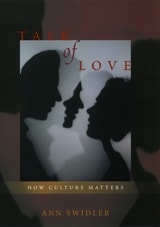
Talk of Love
How Culture MattersAnn Swidler
University of Chicago Press, 2001
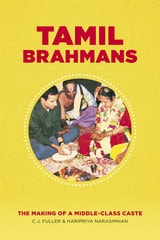
Tamil Brahmans
The Making of a Middle-Class CasteC. J. Fuller and Haripriya Narasimhan
University of Chicago Press, 2014
Fuller and Narasimhan offer one of the most comprehensive looks at Tamil Brahmans around the world to date. They examine Brahman migration from rural to urban areas, more recent transnational migration, and how the Brahman way of life has translated to both Indian cities and American suburbs. They look at modern education and the new employment opportunities afforded by engineering and IT. They examine how Sanskritic Hinduism and traditional music and dance have shaped Tamil Brahmans’ particular middle-class sensibilities and how middle-class status is related to the changing position of women. Above all, they explore the complex relationship between class and caste systems and the ways in which hierarchy has persisted in modernized India.
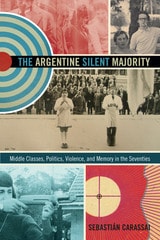
The Argentine Silent Majority
Middle Classes, Politics, Violence, and Memory in the SeventiesSebastián Carassai
Duke University Press, 2014
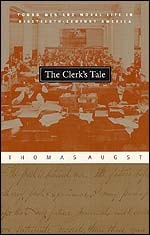
The Clerk's Tale
Young Men and Moral Life in Nineteenth-Century AmericaThomas Augst
University of Chicago Press, 2003
Thomas Augst follows clerks as they made their way through the boarding houses, parlors, and offices of the big city. Tracing the course of their everyday lives, Augst shows how these young men used acts of reading and writing to navigate the anonymous world of market culture and claim identities for themselves within it. Clerks, he reveals, calculated their prospects in diaries, composed detailed letters to friends and family, attended lectures by key thinkers of the day, joined libraries where they consumed fiction, all while wrestling with the boredom of their work. What results, then, is a poignant look at the literary practices of ordinary people and an affecting meditation on the moral lives of men in antebellum America.
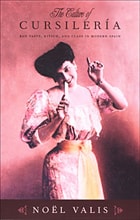
The Culture of Cursilería
Bad Taste, Kitsch, and Class in Modern SpainNoel Valis
Duke University Press, 2002
Valis finds evidence in literature, cultural objects, and popular customs to
argue that cursilería has its roots in a sense of cultural inadequacy felt by the lower middle classes in nineteenth- and early-twentieth-century Spain. The Spain of this era, popularly viewed as the European power most resistant to economic and social modernization, is characterized by Valis as suffering from nostalgia for a bygone, romanticized society that structured itself on strict class delineations. With the development of an economic middle class during the latter half of the nineteenth century, these designations began to break down, and individuals across all levels of the middle class exaggerated their own social status in an attempt to protect their cultural capital. While the resulting manifestations of cursilería were often provincial, indeed backward, the concept was—and still is—closely associated with a sense of home. Ultimately, Valis shows how cursilería embodied the disparity between old ways and new, and how in its awkward manners, airs of pretension, and graceless anxieties it represents Spain's uneasy surrender to the forces of modernity.
The Culture of Cursilería will interest students and scholars of Latin America, cultural studies, Spanish literature, and modernity.
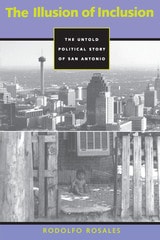
The Illusion of Inclusion
The Untold Political Story of San AntonioBy Rodolfo Rosales
University of Texas Press, 2000
To many observers, the 1981 election of Henry Cisneros as mayor of San Antonio, Texas, represented the culminating victory in the Chicano community's decades-long struggle for inclusion in the city's political life. Yet, nearly twenty years later, inclusion is still largely an illusion for many working-class and poor Chicanas and Chicanos, since business interests continue to set the city's political and economic priorities.
In this book, Rodolfo Rosales offers the first in-depth history of the Chicano community's struggle for inclusion in the political life of San Antonio during the years 1951 to 1991, drawn from interviews with key participants as well as archival research. He focuses on the political and organizational activities of the Chicano middle class in the context of post-World War II municipal reform and how it led ultimately to independent political representation for the Chicano community. Of special interest is his extended discussion of the role of Chicana middle-class women as they gained greater political visibility in the 1980s.
The Making of the Middle Class
Toward a Transnational HistoryA. Ricardo López and Barbara Weinstein, eds.
Duke University Press, 2012
Contributors. Susanne Eineigel, Michael A.Ervin, Iñigo García-Bryce, Enrique Garguin, Simon Gunn, Carol E. Harrison, Franca Iacovetta, Sanjay Joshi, Prashant Kidambi, A. Ricardo López, Gisela Mettele, Marina Moskowitz, Robyn Muncy, Brian Owensby, David S. Parker, Mrinalini Sinha, Mary Kay Vaughan, Daniel J. Walkowitz, Keith David Watenpaugh, Barbara Weinstein, Michael O. West
The Patchwork City
Class, Space, and Politics in Metro ManilaMarco Z. Garrido
University of Chicago Press, 2019
The Patchwork City illuminates how segregation, class relations, and democracy are all intensely connected. It makes clear, ultimately, that class as a social structure is as indispensable to the study of Manila—and of many other cities of the Global South—as race is to the study of American cities.
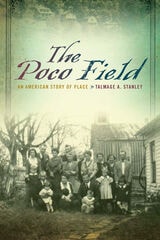
The Poco Field
An American Story of PlaceTalmage A. Stanley
University of Illinois Press, 2012
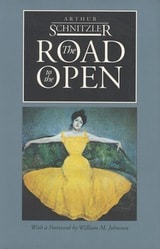
The Road to the Open
Arthur Schnitzler
Northwestern University Press, 1991
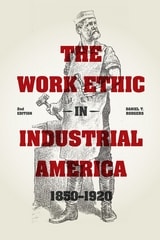
The Work Ethic in Industrial America 1850-1920
Second EditionDaniel T. Rodgers
University of Chicago Press, 2014
Daniel T. Rodgers masterfully explores the ways in which the eclipse of small-scale workshops by mechanized production and mass consumption triggered far-reaching shifts in perceptions of labor, leisure, and personal success. He also shows how the new work culture permeated society, including literature, politics, the emerging feminist movement, and the labor movement.
A staple of courses in the history of American labor and industrial society, Rodgers’s sharp analysis is sure to find a new audience, as twenty-first-century workers face another shift brought about by technology. The Work Ethic in Industrial America 1850–1920 is a classic with critical relevance in today’s volatile economic times.
The Work Ethic in Industrial America, 1850-1920
Daniel T. Rodgers
University of Chicago Press, 1978