Results by title
121 books match the query 'Motion picture industry' and 23 start with t
That Was the Wild East
Film Culture, Unification, and the "New" GermanyLeonie Naughton
University of Michigan Press, 2002
The Aesthetics of Shadow
Lighting and Japanese CinemaDaisuke Miyao
Duke University Press, 2013
The American Film Industry
Edited by Tino T. Balio
University of Wisconsin Press, 1985
Upon its original publication in 1976, The American Film Industry was welcomed by film students, scholars, and fans as the first systematic and unified history of the American movie industry. Now this indispensible anthology has been expanded and revised to include a fresh introductory overview by editor Tino Balio and ten new chapters that explore such topics as the growth of exhibition as big business, the mode of production for feature films, the star as market strategy, and the changing economics and structure of contemporary entertainment companies. The result is a unique collection of essays, more comprehensive and current than ever, that reveals how the American movie industry really worked in a century of constant change-from kinetoscopes and the coming of sound to the star system, 1950s blacklisting, and today's corporate empires.
The Battle for the Bs
1950s Hollywood and the Rebirth of Low-Budget CinemaDavis, Blair
Rutgers University Press, 2012
The emergence of the double-bill in the 1930s created a divide between A-pictures and B-pictures as theaters typically screened packages featuring one of each. With the former considered more prestigious because of their larger budgets and more popular actors, the lower-budgeted Bs served largely as a support mechanism to A-films of the major studios—most of which also owned the theater chains in which movies were shown. When a 1948 U.S. Supreme Court antitrust ruling severed ownership of theaters from the studios, the B-movie soon became a different entity in the wake of profound changes to the corporate organization and production methods of the major Hollywood studios.
In The Battle for the Bs, Blair Davis analyzes how B-films were produced, distributed, and exhibited in the 1950s and demonstrates the possibilities that existed for low-budget filmmaking at a time when many in Hollywood had abandoned the Bs. Made by newly formed independent companies, 1950s B-movies took advantage of changing demographic patterns to fashion innovative marketing approaches. They established such genre cycles as science fiction and teen-oriented films (think Destination Moon and I Was a Teenage Werewolf) well before the major studios and also contributed to the emergence of the movement now known as underground cinema. Although frequently proving to be multimillion-dollar box-office draws by the end of the decade, the Bs existed in opposition to the cinematic mainstream in the 1950s and created a legacy that was passed on to independent filmmakers in the decades to come.
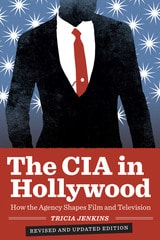
The CIA in Hollywood
How the Agency Shapes Film and TelevisionBy Tricia Jenkins
University of Texas Press, 2016
What’s your impression of the CIA? A bumbling agency that can’t protect its own spies? A rogue organization prone to covert operations and assassinations? Or a dedicated public service that advances the interests of the United States? Astute TV and movie viewers may have noticed that the CIA’s image in popular media has spanned this entire range, with a decided shift to more positive portrayals in recent years. But what very few people know is that the Central Intelligence Agency has been actively engaged in shaping the content of film and television, especially since it established an entertainment industry liaison program in the mid-1990s.
The CIA in Hollywood offers the first full-scale investigation of the relationship between the Agency and the film and television industries. Tricia Jenkins draws on numerous interviews with the CIA’s public affairs staff, operations officers, and historians, as well as with Hollywood technical consultants, producers, and screenwriters who have worked with the Agency, to uncover the nature of the CIA’s role in Hollywood. In particular, she delves into the Agency’s and its officers’ involvement in the production of The Agency, In the Company of Spies, Alias, The Recruit, The Sum of All Fears, Enemy of the State, Syriana, The Good Shepherd, and more. Her research reveals the significant influence that the CIA now wields in Hollywood and raises important and troubling questions about the ethics and legality of a government agency using popular media to manipulate its public image.
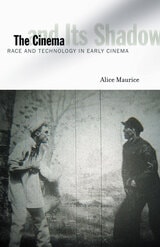
The Cinema and Its Shadow
Race and Technology in Early CinemaAlice Maurice
University of Minnesota Press, 2013
The Cinema and Its Shadow argues that race has defined the cinematic apparatus since the earliest motion pictures, especially at times of technological transition. In particular, this work explores how racial difference became central to the resolving of cinematic problems: the stationary camera, narrative form, realism, the synchronization of image and sound, and, perhaps most fundamentally, the immaterial image—the cinema’s “shadow,” which figures both the material reality of the screen image and its racist past.
Discussing early “race subjects,” Alice Maurice demonstrates that these films influenced cinematic narrative in lasting ways by helping to determine the relation between stillness and motion, spectacle and narrative drive. The book examines how motion picture technology related to race, embodiment, and authenticity at specific junctures in cinema’s development, including the advent of narratives, feature films, and sound. In close readings of such films as The Cheat, Shadows, and Hallelujah!, Maurice reveals how the rhetoric of race repeatedly embodies film technology, endowing it with a powerful mix of authenticity and magic. In this way, the racialized subject became the perfect medium for showing off, shoring up, and reintroducing the cinematic apparatus at various points in the history of American film.
Moving beyond analyzing race in purely thematic or ideological terms, Maurice traces how it shaped the formal and technological means of the cinema.
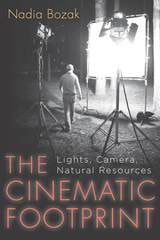
The Cinematic Footprint
Lights, Camera, Natural ResourcesBozak, Nadia
Rutgers University Press, 2011
Film is often used to represent the natural landscape and, increasingly, to communicate environmentalist messages. Yet behind even today’s “green” movies are ecologically unsustainable production, distribution, and consumption processes. Noting how seemingly immaterial moving images are supported by highly durable resource-dependent infrastructures, The Cinematic Footprint traces the history of how the “hydrocarbon imagination” has been central to the development of film as a medium.
Nadia Bozak’s innovative fusion of film studies and environmental studies makes provocative connections between the disappearance of material resources and the emergence of digital media—with examples ranging from early cinema to Dziga Vertov’s prescient eye, from Chris Marker’s analog experiments to the digital work of Agnès Varda, James Benning, and Zacharias Kunuk. Combining an analysis of cinema technology with a sensitive consideration of film aesthetics, The Cinematic Footprint offers a new perspective on moving images and the natural resources that sustain them.
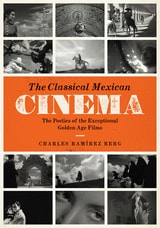
The Classical Mexican Cinema
The Poetics of the Exceptional Golden Age FilmsBy Charles Ramírez Berg
University of Texas Press, 2015
From the mid-1930s to the late 1950s, Mexican cinema became the most successful Latin American cinema and the leading Spanish-language film industry in the world. Many Cine de Oro (Golden Age cinema) films adhered to the dominant Hollywood model, but a small yet formidable filmmaking faction rejected Hollywood’s paradigm outright. Directors Fernando de Fuentes, Emilio Fernández, Luis Buñuel, Juan Bustillo Oro, Adolfo Best Maugard, and Julio Bracho sought to create a unique national cinema that, through the stories it told and the ways it told them, was wholly Mexican. The Classical Mexican Cinema traces the emergence and evolution of this Mexican cinematic aesthetic, a distinctive film form designed to express lo mexicano.
Charles Ramírez Berg begins by locating the classical style’s pre-cinematic roots in the work of popular Mexican artist José Guadalupe Posada at the turn of the twentieth century. He also looks at the dawning of Mexican classicism in the poetics of Enrique Rosas’ El Automóvil Gris, the crowning achievement of Mexico’s silent filmmaking era and the film that set the stage for the Golden Age films. Berg then analyzes mature examples of classical Mexican filmmaking by the predominant Golden Age auteurs of three successive decades. Drawing on neoformalism and neoauteurism within a cultural studies framework, he brilliantly reveals how the poetics of Classical Mexican Cinema deviated from the formal norms of the Golden Age to express a uniquely Mexican sensibility thematically, stylistically, and ideologically.
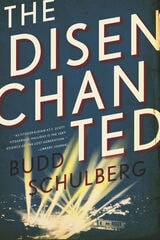
The Disenchanted
Budd Schulberg
University of Minnesota Press, 2012
Considered by some to be Budd Schulberg’s masterpiece, The Disenchanted tells the tragic story of Manley Halliday, a fabulously successful writer during the 1920s—a golden figure in a golden age—who by the late 1930s is forgotten by the literary establishment, living in Hollywood and writing for the film industry. Halliday is hired to work on a screenplay with a young writer in his twenties named Shep, who is desperate for success and idolizes Halliday. The two are sent to New York City, where a few drinks on the plane begin an epic disintegration on the part of Halliday due to the forces of alcoholism he is heroically fighting against and the powerful draw of memory and happier times. Based in part on a real-life and ill-fated writing assignment between the author and F. Scott Fitzgerald in 1939, Schulberg’s novel is at its heart a masterful depiction of Manley Halliday—at times bitter, at others sympathetic and utterly sorrowful—and The Disenchanted stands as one of the most compelling and emotional evocations of generational disillusionment and fallen American stardom.
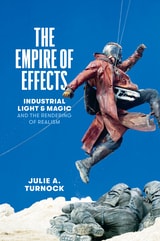
The Empire of Effects
Industrial Light and Magic and the Rendering of RealismJulie A. Turnock
University of Texas Press, 2022
2024 Finalist, Marshall McLuhan Outstanding Book Award, Media Ecology Association
How one company created the dominant aesthetic of digital realism.
Just about every major film now comes to us with an assist from digital effects. The results are obvious in superhero fantasies, yet dramas like Roma also rely on computer-generated imagery to enhance the verisimilitude of scenes. But the realism of digital effects is not actually true to life. It is a realism invented by Hollywood—by one company specifically: Industrial Light & Magic.
The Empire of Effects shows how the effects company known for the puppets and space battles of the original Star Wars went on to develop the dominant aesthetic of digital realism. Julie A. Turnock finds that ILM borrowed its technique from the New Hollywood of the 1970s, incorporating lens flares, wobbly camerawork, haphazard framing, and other cinematography that called attention to the person behind the camera. In the context of digital imagery, however, these aesthetic strategies had the opposite effect, heightening the sense of realism by calling on tropes suggesting the authenticity to which viewers were accustomed. ILM’s style, on display in the most successful films of the 1980s and beyond, was so convincing that other studios were forced to follow suit, and today, ILM is a victim of its own success, having fostered a cinematic monoculture in which it is but one player among many.
The Feature Film Distribution Deal
A Critical Analysis of the Single Most Important Film Industry AgreementJohn W. Cones
Southern Illinois University Press, 1997
John W. Cones, whose real goal is to stimulate a long-term film industry reform movement, shows how the financial control of the film industry in the hands of the major studios and distributors actually translates into creative control of the industry.
Cones discusses the pros and cons of the debate relating to the industry’s so-called net profit problem and the way in which the distribution deal plays an integral part in that problem. He then breaks down five major film finance/distribution scenarios, explaining various distribution deals and suggesting ways of negotiating distribution.
Critically examining the specific terms of the distribution deal itself, Cones covers gross receipts exclusions, distributor fees, and distribution expenses. He also investigates the various forms of interest, issues of production costs, matters of creative control, and general contractual provisions.
For handy reference, Cones includes an extensive checklist for negotiating any feature film distribution deal. The list deals with distribution fees, distribution expenses, interest, production costs, creative control issues, general contractual provisions, distributor commitments, and the limits of negotiating. His nine appendixes present a "Motion Picture Industry Overview," "Profit Participation Audit Firms," "ADI (Top 50) Market Rankings," an "AFMA Member List, 1992–1993," a "Production-Financing/Distribution Agreement," a "Negative Pickup Distribution Agreement," a "Distribution Rights Acquisition Agreement," a "Distribution Agreement (Rent-a-Distributor Deal)," and a "Foreign Distribution Agreement."
Cones wrote this book for independent producers, executive and associate producers and their representatives, directors, actors, screenwriters, members of talent guilds, distributors, and entertainment, antitrust, and securities attorneys. Securities issuers and dealers, investment bankers, and money finders, investors, and financiers of every sort also will be interested. In addition, Cones suggests and hopes that the book will interest "Congress, their research staff, government regulators at the Internal Revenue Service, the Securities and Exchange Commission, the Federal Trade Commission, and law enforcement officials such as the Los Angeles District Attorney and the U.S. Justice Department."
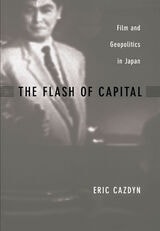
The Flash of Capital
Film and Geopolitics in JapanEric Cazdyn
Duke University Press, 2002
Cazdyn focuses on three key moments of historical contradiction: colonialism, post-war reconstruction, and globalization. Considering great classics of Japanese film, documentaries, works of science fiction, animation, and pornography, he brings to light cinematic attempts to come to terms with the tensions inherent in each historical moment—tensions between the colonizer and the colonized, between the individual and the collective, and between the national and the transnational. Paying close attention to political context, Cazdyn shows how formal inventions in the realms of acting, film history and theory, thematics, documentary filmmaking, and adaptation articulate a struggle to solve implacable historical problems. This innovative work of cultural history and criticism offers explanations of historical change that challenge conventional distinctions between the aesthetic and the geopolitical.

The Gordon File
A Screenwriter Recalls Twenty Years of FBI SurveillanceBy Bernard Gordon
University of Texas Press, 2004
For twenty-six years, the FBI devoted countless hours of staff time and thousands of U.S. taxpayer dollars to the surveillance of an American citizen named Bernard Gordon. Given the lavish use of resources, one might assume this man was a threat to national security or perhaps a kingpin of organized crime—not a Hollywood screenwriter whose most subversive act was joining the Communist Party during the 1940s when we were allied with the USSR in a war against Germany. For this honest act of political dissent, Gordon came to be investigated by the House Committee on Un-American Activities in 1952, blacklisted by the Hollywood film industry, and tailed by the FBI for over two decades.
In The Gordon File, Bernard Gordon tells the compelling, cautionary story of his life under Bureau surveillance. Drawing on his FBI file of over 300 pages, which he obtained under the Freedom of Information Act, he traces how the Bureau followed him from Hollywood to Mexico, Paris, London, Rome, and even aboard a Dutch freighter as he created an unusually successful, albeit uncredited, career as a screenwriter and producer during the blacklist years. Comparing his actual activities during that time to records in the file, he pointedly and often humorously underscores how often the FBI got it wrong, from the smallest details of his life to the main fact of his not being a threat to national security.
Most important, Gordon links his personal experience to the headlines of today, when the FBI is again assuming broad powers to monitor political dissidents it deems a threat to the nation. "Is it possible," he asks, "that books like this will help to move our investigative agencies from the job of blackmailing those who are critical of our imperfect democracy to arresting those who are truly out to destroy us?"
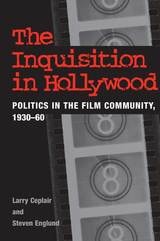
The Inquisition in Hollywood
Politics in the Film Community, 1930-60Larry Ceplair and Steven Englund
University of Illinois Press, 1979
The definitive work on the Hollywood blacklist era
The Inquisition in Hollywood examines the suppression of radical political activity in the film industry from the days of the Great Depression through the tumultuous House Un-American Activities Commission era to the waning days of the infamous blacklist.
Although this thirty-year period of American history is marked by widespread targeting of leftists in all areas of life, those in the film industry–-predominately screenwriters–-were considered to be in positions of great potential indoctrinating power, and found themselves under intense scrutiny as the Cold War hysteria mounted.
Ceplair and Englund trace the history of political struggle in Hollywood back to the formation of the Screen Writers Guild in 1933. Many of the blacklisted filmmakers were members of the Communist Party and all of the graylisted filmmakers had expressed their sympathy with progressive (mainly anti-fascist) causes.
Although no Hollywood Communist has ever been linked to espionage or sabotage, and charges of subversive indoctrination have no basis in documented fact, this book powerfully shows how devastating a mere suspicion or insinuation of guilt could be during the era of the Red Menace.
Twenty-two years after its initial publication, The Inquisition in Hollywood remains the definitive work on the blacklist era, and this new edition features a new introduction by the authors.

The International Movie Industry
Edited by Gorham Kindem
Southern Illinois University Press, 2000
Movies are both art and commerce, creative expressions of national/cultural interests and preoccupations and part of a global entertainment market. The past century has witnessed a transformation of the movies from popular novelties into highly valued cultural icons and commodities that have promoted national identity and specific political agendas, while also affecting international trade.
This comprehensive history of the international movie industry from its inception in 1895 to the present features nineteen original essays by international scholars who examine the film industries of nineteen countries and six continents. Each chapter in The International Movie Industry focuses on a specific national movie industry’s economic and related social, aesthetic, technological, and political/ideological development within an international context during the last century. The result is a global history of the movie industry over the last one hundred years.
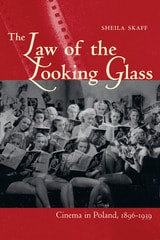
The Law of the Looking Glass
Cinema in Poland, 1896–1939Sheila Skaff
Ohio University Press, 2008
The Law of the Looking Glass: Cinema in Poland, 1896–1939 reveals the complex relationship between nationhood, national language, and national cinema in Europe before World War II. Author Sheila Skaff describes how the major issues facing the region before World War I, from the relatively slow pace of modernization to the desire for national sovereignty, shaped local practices in film production, exhibition, and criticism. She goes on to analyze local film production, practices of spectatorship in large cities and small towns, clashes over language choice in intertitles, and controversy surrounding the first synchronized sound experiments before World War I. Skaff depicts the creation of a national film industry in the newly independent country, the golden years of the silent cinema, the transition from silent to sound film—and debates in the press over this transition—as well as the first Polish and Yiddish “talkies.” She places particular importance on conflicts in majority-minority relations in the region and the types of collaboration that led to important films such as The Dybbuk and The Ghosts.
The Law of the Looking Glass: Cinema in Poland, 1896–1939 is the first comprehensive history of the country’s film industry before World War II. This history is characterized by alternating periods of multilingual, multiethnic production, on the one hand, and rejection of such inclusiveness, on the other. Through it all, however, runs a single unifying thread: an appreciation for visual imagery.
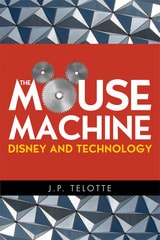
The Mouse Machine
Disney and TechnologyJ. P. Telotte
University of Illinois Press, 2007

The New American Cinema
Jon Lewis, ed.
Duke University Press, 1998
The essays are divided into three sections: "Movies and Money," "Cinema and Culture," and "Independents and Independence." The first section focuses on the economics of the industry and analyzes the connection between the film business and the finished product. Topics include a look at the economic conditions that made the seventies’ auteur renaissance possible, the distribution of studio and independent films, and the recent spate of mergers and acquisitions that have come to characterize the new Hollywood. The second part of The New American Cinema deals with the political and cultural significance of war and Vietnam films (Platoon, Apocalypse Now, Born on the Fourth of July); "male rampage" films (Rambo, Lethal Weapon, Die Hard); women’s psychothrillers (The Silence of the Lambs); special effects pictures (2001: A Space Odyssey, Star Wars); and historical re-presentations (Oliver Stone’s JFK). The final section casts a keen eye on films produced and exhibited outside the commercial mainstream, examining the financial realities of "indie" films; the influence of independent filmmaker John Cassavetes on Coppola, Altman, and Scorsese; the stereotyping of African Americans in mainstream cinema; and the films of independent women filmmakers.
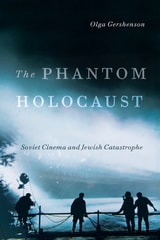
The Phantom Holocaust
Soviet Cinema and Jewish CatastropheGershenson, Olga
Rutgers University Press, 2013
Focusing on work by both celebrated and unknown Soviet directors and screenwriters, Olga Gershenson has written the first book about all Soviet narrative films dealing with the Holocaust from 1938 to 1991. In addition to studying the completed films, Gershenson analyzes the projects that were banned at various stages of production.
The book draws on archival research and in-depth interviews to tell the sometimes tragic and sometimes triumphant stories of filmmakers who found authentic ways to represent the Holocaust in the face of official silencing. By uncovering little known works, Gershenson makes a significant contribution to the international Holocaust filmography.
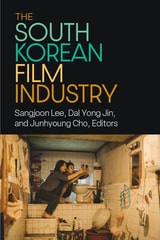
The South Korean Film Industry
Sangjoon Lee, Dal Yong Jin, And Junhyoung Cho, Editors
University of Michigan Press, 2024
The South Korean Film Industry is the first detailed scholarly overview of the South Korean film industry. The thirteen chapters discuss topics from short films to popular television series that have engaged global audiences. Contributors explore the major changes in South Korean film making, marketing, and in the international growth and popularity of South Korean films. By bringing together a wide range of academic specialists, The South Korean Film Industry situates the current scholarship on South Korean cinema within the ongoing theoretical debates in contemporary global film studies. This volume will be widely read in undergraduate and graduate classes related to Korean and East Asian studies, cinema and media studies, cultural studies, and communication studies. Moreover, many institutions offer dedicated modules on South Korean cinema, media, and popular culture, for which The South Korean Film Industry will be ideal.
The Value Gap
Female-Driven Films from Pitch to PremiereCourtney Brannon Donoghue
University of Texas Press, 2023
How female directors, producers, and writers navigate the challenges and barriers facing female-driven projects at each stage of filmmaking in contemporary Hollywood.
Conversations about gender equity in the workplace accelerated in the 2010s, with debates inside Hollywood specifically pointing to broader systemic problems of employment disparities and exploitative labor practices. Compounded by the devastating #MeToo revelations, these problems led to a wide-scale call for change. The Value Gap traces female-driven filmmaking across development, financing, production, film festivals, marketing, and distribution, examining the realities facing women working in the industry during this transformative moment. Drawing from five years of extensive interviews with female producers, writers, and directors at different stages of their careers, Courtney Brannon Donoghue examines how Hollywood business cultures “value” female-driven projects as risky or not bankable. Industry claims that “movies targeting female audiences don’t make money” or “women can’t direct big-budget blockbusters” have long circulated to rationalize systemic gender inequities and have served to normalize studios prioritizing the white male–driven status quo. Through a critical media industry studies lens, The Value Gap challenges this pervasive logic with firsthand accounts of women actively navigating the male-dominated and conglomerate-owned industrial landscape.
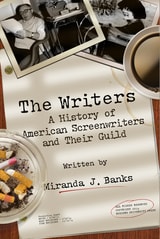
The Writers
A History of American Screenwriters and Their GuildBanks, Miranda J
Rutgers University Press, 2016

Touring the Screen
Tourism and New Zealand Film GeographiesAlfio Leotta
Intellect Books, 2011
Following the success of prominent feature films shot on location, including Tolkien’s wildly popular The Lord of the Rings, New Zealand boasts an impressive film tourism industry. This book examines the relationship between New Zealand’s cinematic representation—as both a vast expanse of natural beauty and a magical world of fantasy on screen—and its tourism imagery, including the ways in which savvy local tourism boards have in recent decades used the country’s film representations to sell New Zealand as a premiere travel destination. Focusing on the films that have had a strong impact on marketing strategies by local tourist boards, Touring the Screen will be of interest to all those working and studying in the fields of cinema, postcolonial history, and tourism studies.