Results by title
99 books match the query 'Motion picture producers and directors' and 12 start with t
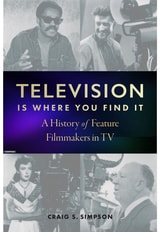
Television Is Where You Find It
A History of Feature Filmmakers in TVCraig S. Simpson
Rutgers University Press, 0
Television Is Where You Find It is a revelatory journey into the overlooked world of feature filmmakers who brought their cinematic vision to the small screen between 1955 and 1990—long before directing for television became trendy in the age of “Prestige TV.” With ten compelling case studies—from legends like Alfred Hitchcock, David Lynch, and Orson Welles to trailblazers like Ida Lupino, Melvin Van Peebles, and Martin Scorsese—author Craig S. Simpson uncovers how these directors reshaped the language of television with style and imagination.
Far from simply dabbling in a “lesser” medium, these filmmakers pushed the boundaries of what TV could do, crafting bold, innovative work that challenges the old notion that television belongs solely to writers and producers. In this fresh, critical study, Television Is Where You Find It makes a case for rediscovering and reevaluating a rich chapter of television history—one in which cinematic artistry quietly flourished, often hidden in plain sight.
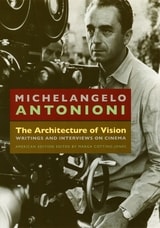
The Architecture of Vision
Writings and Interviews on CinemaMichelangelo Antonioni
University of Chicago Press, 2007
Through autobiographical sketches, theoretical essays, interviews, and conversations with such luminaries as Jean-Luc Godard and Alberto Moravia, this compelling volume explores the director’s unique brand of narrative-defying cinema as well as the motivations and anxieties of the man behind the camera.
“The Architecture of Vision provides a filmmaker’s absorbing reflections and insights on his career. . . . Antonioni’s comments . . . deepen and humanize a sometimes cerebral book.”—Publishers Weekly
“[Antonioni’s] erudition is astonishing . . . few of his peers can match his verbal articulateness.”—Film Quarterly
“This valuable resource offers entrée to material difficult to gain access to under other circumstances.”—Library Journal

The Cinema of Mika Kaurismäki
Transvergent Cinescapes, Emergent IdentitiesPietari Kääpä
Intellect Books, 2011
A PDF version of this book is available for free in open access via the OAPEN Library platform, www.oapen.org It has been made available under a Creative Commons Attribution 4.0 International Public License and is part of Knowledge Unlatched.
The Cinema of Yakov Protazanov
F. Booth Wilson
Rutgers University Press, 2024
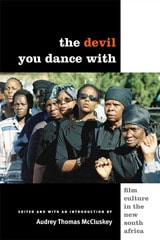
The Devil You Dance With
Film Culture in the New South AfricaEdited and with an Introduction by Audrey McCluskey
University of Illinois Press, 2008
This extraordinary volume presents twenty-five in-depth interviews with established and emerging South African filmmakers, collected and edited by Audrey Thomas McCluskey. The interviews capture the filmmakers’ spirit, energy, and ambition as they attempt to give birth to a film culture that reflects the heart and aspirations of their diverse and emergent nation. The collection includes a biographical profile of each filmmaker, as well an introductory essay by McCluskey, pointing to the themes, as well as creative differences and similarities, among the filmmakers.

The Films of Bong Joon Ho
Nam Lee
Rutgers University Press, 2020
Bong Joon Ho won the Oscar® for Best Director for Parasite (2019), which also won Best Picture, the first foreign film to do so, and two other Academy Awards. Parasite was the first Korean film to win the Palme d’Or at Cannes. These achievements mark a new career peak for the director, who first achieved wide international acclaim with 2006’s monster movie The Host and whose forays into English-language film with Snowpiercer (2013) and Okja (2017) brought him further recognition.
As this timely book reveals, even as Bong Joon Ho has emerged as an internationally known director, his films still engage with distinctly Korean social and political contexts that may elude many Western viewers. The Films of Bong Joon Ho demonstrates how he hybridizes Hollywood conventions with local realities in order to create a cinema that foregrounds the absurd cultural anomie Koreans have experienced in tandem with their rapid economic development. Film critic and scholar Nam Lee explores how Bong subverts the structures of the genres he works within, from the crime thriller to the sci-fi film, in order to be truthful to Korean realities that often deny the reassurances of the happy Hollywood ending. With detailed readings of Bong’s films from Barking Dogs Never Bite (2000) through Parasite (2019), the book will give readers a new appreciation of this world-class cinematic talent.
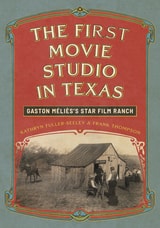
The First Movie Studio in Texas
Gaston Méliès's Star Film RanchKathryn Fuller-Seeley and Frank Thompson
University of Texas Press, 2026
The story of the Star Film Ranch and its pioneering crew, who created the first “authentic” Westerns filmed in Texas.
In 1910, the Méliès Star Film Company of Manhattan set up a moving-picture studio outside San Antonio, the first in Texas. Determined to make the most authentic Westerns possible, the company filmed there for a little over a year. In that brief time, it created more than seventy single-reel films, leaving a lasting mark on moviemaking.
Film historians Kathryn Fuller-Seeley and Frank Thompson return to a moment when on-location filmmaking was emerging as an artform. We meet producer Gaston Méliès, older brother of early-cinema legend Georges Méliès, and his cast and crew of young innovators, old hands, and genuine cowboys—like seventeen-year-old Edith Storey, the tomboy star who helped to ignite modern celebrity culture, and Francis Ford, who learned the art of film directing on the job and mentored his younger brother, Hollywood legend John Ford. The First Movie Studio in Texas traces the company’s trials and accomplishments, its influence on the depiction of race and gender in Western filmmaking, its surviving works, and its crowning achievement: The Immortal Alamo (1911), the earliest cinematic depiction of that famous battle.
Finally recovered from the shadows, the forgotten Méliès brother proves to be one of the key founders of the Western myth on screen.
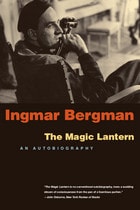
The Magic Lantern
An AutobiographyIngmar Bergman
University of Chicago Press, 1988
“When a film is not a document, it is a dream. . . . At the editing table, when I run the strip of film through, frame by frame, I still feel that dizzy sense of magic of my childhood.” Bergman, who has conveyed this heady sense of wonder and vision to moviegoers for decades, traces his lifelong love affair with film in his breathtakingly visual autobiography, The Magic Lantern.
More grand mosaic than linear account, Bergman’s vignettes trace his life from a rural Swedish childhood through his work in theater to Hollywood’s golden age, and a tumultuous romantic history that includes five wives and more than a few mistresses. Throughout, Bergman recounts his life in a series of deeply personal flashbacks that document some of the most important moments in twentieth-century filmmaking as well as the private obsessions of the man behind them. Ambitious in scope yet sensitively wrought, The Magic Lantern is a window to the mind of one of our era’s great geniuses.
“[Bergman] has found a way to show the soul’s landscape . . . . Many gripping revelations.”—New York Times Book Review
“Joan Tate’s translation of this book has delicacy and true pitch . . . The Magic Lantern is as personal and penetrating as a Bergman film, wry, shadowy, austere.”—New Republic
“[Bergman] keeps returning to his past, reassessing it, distilling its meaning, offering it to his audiences in dazzling new shapes.”—New York Times
“What Bergman does relate, particularly his tangled relationships with his parents, is not only illuminating but quite moving. No ‘tell-all’ book this one, but revealing in ways that much longer and allegedly ‘franker’ books are not.”—Library Journal
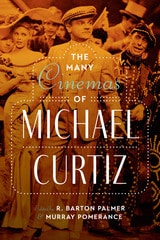
The Many Cinemas of Michael Curtiz
Edited by R. Barton Palmer and Murray Pomerance
University of Texas Press, 2018
Director Michael Curtiz was the mastermind behind some of the most iconic films of classical Hollywood—Casablanca, Yankee Doodle Dandy, The Sea Hawk, White Christmas, and Mildred Pierce, to name only a few. The most prolific and consistently successful Hollywood generalist with an all-embracing interest in different forms of narrative and spectacle, Curtiz made around a hundred films in an astonishing range of genres: action, biopics, melodramas/film noir, musicals, and westerns. But his important contributions to the history of American film have been overlooked because his broadly varied oeuvre does not present the unified vision of filmmaking that canonical criticism demands for the category of “auteur.”
Exploring his films and artistic practice from a variety of angles, including politics, gender, and genre, The Many Cinemas of Michael Curtiz sheds new light on this underappreciated cinematic genius. Leading film studies scholars offer fresh appraisals of many of Curtiz’s most popular films, while also paying attention to neglected releases of substantial historical interest, such as Noah’s Ark , Night and Day, Virginia City, Black Fury, Mystery of the Wax Museum, and Female. Because Curtiz worked for so long and in so many genres, this analysis of his work becomes more than an author study of a notable director. Instead, The Many Cinemas of Michael Curtiz effectively adds a major chapter to the history of Hollywood’s studio era, including its internationalism and the significant contributions of European émigrés.
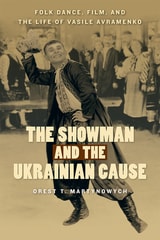
The Showman and the Ukrainian Cause
Folk Dance, Film, and the Life of Vasile AvramenkoOrest T. Martynowych
University of Manitoba Press, 2014
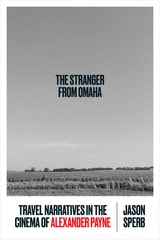
The Stranger from Omaha
Travel Narratives in the Cinema of Alexander PayneJason Sperb
University of Texas Press, 2025
The first in-depth analysis of the films of Alexander Payne through the lenses of authorship, tourism, and leisure.
With the films Election, About Schmidt, Sideways, Nebraska, and The Holdovers, Alexander Payne has carved out an unusual role in American cinema as a bankable auteur. There is something about Payne’s neurotics and searchers, his working stiffs and disillusioned idealists—something funny, moving, and filled with insight.
Jason Sperb dissects Payne’s oeuvre, focusing on the director’s penchant for travel narratives. Payne’s films usually center on male protagonists discontent with the emotional and material realities of the day-to-day and seeking satisfaction in some literal or metaphorical elsewhere. But their attempts to escape wind up perpetuating, rather than alleviating, the imbalance between labor and leisure that structures modern life. In this sense, Sperb argues, Payne’s characters are akin to tourists, searching for fleeting glimpses of the fulfillment they dream about. Examining themes of masculinity, nostalgia, whiteness, and class, The Stranger from Omaha is the first auteur study devoted to Payne’s delicately balanced cinematic world. An outsider even in his own heartland, Payne proves to be an artist working at a clarifying remove—a witness to the American condition, observing from just enough distance.
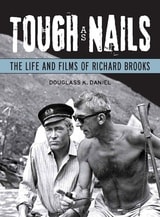
Tough as Nails
The Life and Films of Richard BrooksDouglass K. Daniel
University of Wisconsin Press, 2011