Results by title
111 books match the query 'Museum Studies' and 12 start with t
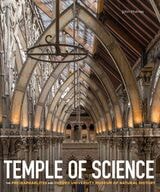
Temple of Science
The Pre-Raphaelites and Oxford University Museum of Natural HistoryJohn Holmes
Bodleian Library Publishing, 2020
The Absent Stone
Mexican Patrimony and the Aftershocks of State TheftSandra Rozental
Duke University Press, 2026
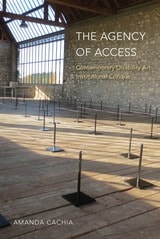
The Agency of Access
Contemporary Disability Art & Institutional CritiqueAmanda Cachia
Temple University Press, 2025
Showcasing artwork by contemporary disabled artists Corban Walker, Christine Sun Kim, and Carmen Papalia, among others, The Agency of Access inscribes contemporary disability art in the broad canon of contemporary art, where the artistic past is regarded differently.
Cachia is an outspoken advocate for artists living with sensory disabilities. She understands disabled artists’ experiences in both the world and the gallery. The artists she has curated make bold, astonishing, and compelling statements about interdependency, care, and the ways in which our environment affects disabled, ill, and immunocompromised bodies.
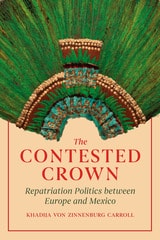
The Contested Crown
Repatriation Politics between Europe and MexicoKhadija von Zinnenburg Carroll
University of Chicago Press, 2022
In The Contested Crown, Khadija von Zinnenburg Carroll meditates on the case of a spectacular feather headdress believed to have belonged to Montezuma, emperor of the Aztecs. This crown has long been the center of political and cultural power struggles, and it is one of the most contested museum claims between Europe and the Americas. Taken to Europe during the conquest of Mexico, it was placed at Ambras Castle, the Habsburg residence of the author’s ancestors, and is now in Vienna’s Welt Museum. Mexico has long requested to have it back, but the Welt Museum uses science to insist it is too fragile to travel.
Both the biography of a cultural object and a history of collecting and colonizing, this book offers an artist’s perspective on the creative potentials of repatriation. Carroll compares Holocaust and colonial ethical claims, and she considers relationships between indigenous people, international law and the museums that amass global treasures, the significance of copies, and how conservation science shapes collections. Illustrated with diagrams and rare archival material, this book brings together global history, European history, and material culture around this fascinating object and the debates about repatriation.
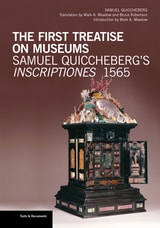
The First Treatise on Museums
Samuel Quiccheberg’s Inscriptiones, 1565Samuel Quiccheberg
J. Paul Getty Trust, The, 2014
Samuel Quiccheberg’s Inscriptiones, first published in Latin in 1565, is an ambitious effort to demonstrate the pragmatic value of curiosity cabinets, or Wunderkammern, to princely collectors in sixteenth-century Europe and, by so doing, inspire them to develop their own such collections. Quiccheberg shows how the assembly and display of physical objects offered nobles a powerful means to expand visual knowledge, allowing them to incorporate empirical and artisanal expertise into the realm of the written word. But in mapping out the collectability of the material world, Quiccheberg did far more than create a taxonomy. Rather, he demonstrated how organizing objects made their knowledge more accessible; how objects, when juxtaposed or grouped, could tell a story; and how such strategies could enhance the value of any single object.
Quiccheberg’s descriptions of early modern collections provide both a point of origin for today’s museums and an implicit critique of their aims, asserting the fundamental research and scholarly value of collections: collections are to be used, not merely viewed. The First Treatise on Museums makes Quiccheberg’s now rare publication available in an English translation. Complementing the translation are a critical introduction by Mark A. Meadow and a preface by Bruce Robertson.

The India Museum Revisited
Arthur MacGregor
University College London, 2023
The museum of the East India Company formed, for a large part of the nineteenth century, one of the sights of London. In recent years, little has been remembered of it beyond its mere existence, while an assumed negative role has been widely attributed to it on the basis of its position at the heart of one of Britain’s arch-colonialist enterprises.
Extensively illustrated, The India Museum Revisited surveys the contents of its multi-faceted collections—with respect to materials, their manufacture, and original functions on the Indian sub-continent—as well as the collectors who gathered them and the manner in which they were mobilized to various ends within the museum.
From this integrated treatment of documentary and material sources, a more accurate, rounded, and nuanced picture emerges of an institution that contributed in major ways, over a period of eighty years, to the representation of India for a European audience, not only in Britain but through the museum’s involvement in the international exposition movement to audiences on the continent and beyond.
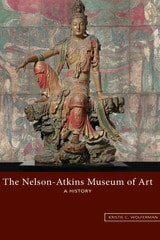
The Nelson-Atkins Museum of Art
A HistoryKristie C. Wolferman
University of Missouri Press, 2020
Wolferman begins by relaying how the trustees of the estates of the reclusive widow Mary Atkins and the family of Kansas City Star newspaper editor William Rockhill Nelson joined forces to establish a museum from scratch, then goes on to consider all of the highly talented people who directed and staffed the Nelson-Atkins along the way, their efforts resulting in many bold innovations, among them new collections, grounds, and educational programs and offerings.
With 100 color and black and white photographs, this book will be treasured by all who love and admire this remarkable institution, one that attracts half a million visitors—from across the city, state, nation, and world—each year.
This is a co-publication of the University of Missouri Press and the Nelson-Atkins Museum of Art.
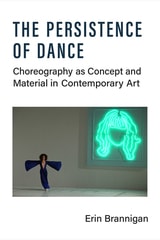
The Persistence of Dance
Choreography as Concept and Material in Contemporary ArtErin Brannigan
University of Michigan Press, 2023
The Persistence of Dance: Choreography as Concept and Material in Contemporary Art clarifies the continuities and differences between the second-wave dance avant-garde in the 1950s‒1970s and the third-wave starting in the 1990s. Through close readings of key artists such as Maria Hassabi, Sarah Michelson, Boris Charmatz, Meg Stuart, Philipp Gehmacher, Adam Linder, Agatha Gothe-Snape, Shelley Lasica and Latai Taumoepeau, The Persistence of Dance traces the relationship between the third-wave and gallery-based work. Looking at these artists highlights how the discussions and practices associated with “conceptual dance” resonate with the categories of conceptual and post-conceptual art as well as with the critical work on the function of visual art categories. Brannigan concludes that within the current post-disciplinary context, there is a persistence of dance and that a model of post-dance exists that encompasses dance as a contemporary art medium.
The Politics of Collecting
Race and the Aestheticization of PropertyEunsong Kim
Duke University Press, 2024
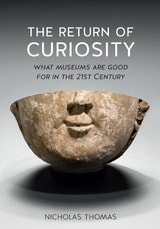
The Return of Curiosity
What Museums are Good For in the 21st CenturyNicholas Thomas
Reaktion Books, 2016
Reflecting on art galleries, science and history institutions, and collections all around the world, Nicholas Thomas argues that, in times marked by incredible insecurity and turbulence, museums help us sustain and enrich society. Moreover, they stimulate us to think in new ways about our world, compelling our curiosity and showing us the importance of understanding one another. Thomas looks at museums not simply as storehouses of old things but as the products of meaningful relationships between curators, the public, history, and culture. These relationships, he shows, don’t always go smoothly, but they do always offer new insights into the many ways we value—and try to preserve—the world we live in.
The result is a refreshing and hopeful look at museums as a cultural force, one that, by gathering together paintings, tropical birds, antiques, or even our own bodies, offers an illuminating reflection of who we are.
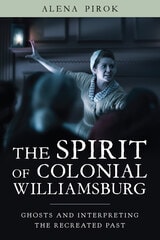
The Spirit of Colonial Williamsburg
Ghosts and Interpreting the Recreated PastAlena Pirok
University of Massachusetts Press, 2022
On any given night, hundreds of guests walk the darkened streets of Colonial Williamsburg looking for ghosts. Since the early 2000s, both the museum and private companies have facilitated these hunts, offering year-round ghost tours. Critics have called these excursions a cash grab, but in truth, ghosts and hauntings have long been at the center of the Colonial Williamsburg project.
The Spirit of Colonial Williamsburg examines how the long-dead past comes alive at this living-history museum. In the early twentieth century, local stories about the ghosts of former residents—among them Revolutionary War soldiers and nurses, tavern owners and prominent attorneys, and enslaved African Americans—helped to turn Williamsburg into a desirable site for historical restoration. But, for much of the twentieth century, the museum tried diligently to avoid any discussion of ghosts, considering them frivolous and lowbrow. Alena Pirok explores why historic sites have begun to embrace their spectral residents in recent decades, arguing that through them, patrons experience an emotional connection to place and a palpable understanding of the past through its people.
Treasured Possessions
Indigenous Interventions into Cultural and Intellectual PropertyHaidy Geismar
Duke University Press, 2013