Results by title
62 books match the query 'Musicians' and 11 start with t
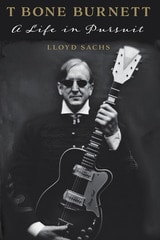
T Bone Burnett
A Life in PursuitBy Lloyd Sachs
University of Texas Press, 2016
This first critical appreciation of T Bone Burnett reveals how the proponent of Americana music and producer of artists ranging from Robert Plant and Alison Krauss to B. B. King and Elvis Costello has profoundly influenced American music and culture.
T Bone Burnett is a unique, astonishingly prolific music producer, singer-songwriter, guitarist, and soundtrack visionary. Renowned as a studio maven with a Midas touch, Burnett is known for lifting artists to their greatest heights, as he did with Raising Sand, the multiple Grammy Award–winning album by Robert Plant and Alison Krauss, as well as acclaimed albums by Los Lobos, the Wallflowers, B. B. King, and Elvis Costello. Burnett virtually invented “Americana” with his hugely successful roots-based soundtrack for the Coen Brothers film, O Brother, Where Art Thou? Outspoken in his contempt for the entertainment industry, Burnett has nevertheless received many of its highest honors, including Grammy Awards and an Academy Award.
T Bone Burnett offers the first critical appreciation of Burnett’s wide-ranging contributions to American music, his passionate advocacy for analog sound, and the striking contradictions that define his maverick artistry. Lloyd Sachs highlights all the important aspects of Burnett’s musical pursuits, from his early days as a member of Bob Dylan’s Rolling Thunder Revue and his collaboration with the playwright Sam Shepard to the music he recently composed for the TV shows Nashville and True Detective and his production of the all-star album Lost on the River: The New Basement Tapes. Sachs also underscores Burnett’s brilliance as a singer-songwriter in his own right. Going well beyond the labels “legendary” or “visionary” that usually accompany his name, T Bone Burnett reveals how this consummate music maker has exerted a powerful influence on American music and culture across four decades.
Tell Tchaikovsky the News
Rock 'n' Roll, the Labor Question, and the Musicians' Union, 1942-1968Michael James Roberts
Duke University Press, 2014
The Black Musician and the White City
Race and Music in Chicago, 1900-1967Amy Absher
University of Michigan Press, 2014
Absher’s work diverges from existing studies in three ways: First, she takes the history beyond the study of jazz and blues by examining the significant role that classically trained black musicians played in building the Chicago South Side community. By acknowledging the presence and importance of classical musicians, Absher argues that black migrants in Chicago had diverse education and economic backgrounds but found common cause in the city’s music community. Second, Absher brings numerous maps to the history, illustrating the relationship between Chicago’s physical lines of segregation and the geography of black music in the city over the years. Third, Absher’s use of archival sources is both extensive and original, drawing on manuscript and oral history collections at the Center for Black Music Research in Chicago, Columbia University, Rutgers’s Institute of Jazz Studies, and Tulane’s Hogan Jazz Archive. By approaching the Chicago black musical community from these previously untapped angles, Absher offers a history that goes beyond the retelling of the achievements of the famous musicians by discussing musicians as a group. In The Black Musician and the White City, black musicians are the leading actors, thinkers, organizers, and critics of their own story.
The Civic Muse
Music and Musicians in Siena during the Middle Ages and the RenaissanceFrank A. D'Accone
University of Chicago Press, 1997
Based on decades of research in the town's archives, D'Accone's The Civic Muse brilliantly illuminates both the sacred and the secular aspects of more than three centuries of music and music-making in Siena. After detailing the history of music and liturgy at Siena's famous cathedral and of civic music at the Palazzo Pubblico, D'Accone describes the crucial role that music played in the daily life of the town, from public festivities for foreign dignitaries to private musical instruction. Putting Siena squarely on the Renaissance musical map, D'Accone's monumental study will interest both musicologists and historians of the Italian Renaissance.

The Come Apart
A NovelSusannah Felts
Northwestern University Press, 2026
An authentic rock band story from Chicago to Nashville and, just maybe, back again
On the cusp of turning thirty, Chicago indie musician Maggie Corbin has hustled for a decade, set on making her rock and roll dreams come true. Her band, Spinning Birds, fronted by Maggie and her romantic partner Matt Turkish, releases a debut record to critical acclaim, hits the road, and begins working on a follow-up. From the outside, her path looks like success—but as streaming deconstructs the industry and Maggie’s relationships shift and slip, the question remains: Can you live for art alone?
When a sudden move back to the South forces Maggie to reframe her dreams and reckon with familial rifts and her past—while still fighting to reimagine what her future could be—a natural disaster in Nashville and a surprise encounter with a character from her childhood shift her perspective on healing, community, and the ties that bind. Drifting in and out of songwriting sessions, cozy kitchens, and moments of bearing witness to the curious power of the natural world, The Come Apart celebrates the times when we must come fully undone in order to put ourselves back together.
The Costs of the Gig Economy
Musical Entrepreneurs and the Cultural Politics of Inequality in Northeastern BrazilFalina Enriquez
University of Illinois Press, 2022
Drawing on years of fieldwork, Enriquez shows how forcing artists to adopt “neutral” market solutions reinforces, and generates, overlapping racial and class-based inequalities. Lacking the social and financial resources of their middle-class peers, working-class musicians find it difficult to uphold institutional goals of connecting the city’s cultural roots to global markets and consumers. Enriquez also links the artists’ situation to that of cultural and creative workers around the world. As she shows, musical sponsorship in Recife and the contemporary gig economy elsewhere employ processes that, far from being neutral, uphold governmental and corporate ideologies that produce social stratification.
Rich and vibrant, The Costs of the Gig Economy offers a rare English-language portrait of the changing musical culture in Recife.
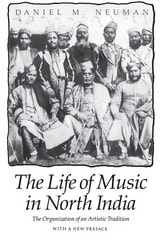
The Life of Music in North India
The Organization of an Artistic TraditionDaniel M. Neuman
University of Chicago Press, 1990
Drawing primarily from fieldwork performed in Delhi in 1969-71—from interviewing musicians, learning and performing on the Indian fiddle, and speaking with music connoisseurs—Neuman examines the cultural and social matrix in which Hindustani music is nurtured, listened and attended to, cultivated, and consumed in contemporary India. Through his interpretation of the impact that modern media, educational institutions, and public performances exert on the music and musicians, Neuman highlights the drama of a great musical tradition engaging a changing world, and presents the adaptive strategies its practitioners employ to practice their art. His work has gained the distinction of introducing a new approach to research on Indian music, and appears in this edition with a new preface by the author.

The Temple of Fame and Friendship
Portraits, Music, and History in the C. P. E. Bach CircleAnnette Richards
University of Chicago Press, 2020
One of the most celebrated German composers of the eighteenth century, C. P. E. Bach spent decades assembling an extensive portrait collection of some four hundred music-related items—from oil paintings to engraved prints. The collection was dispersed after Bach’s death in 1788, but with Annette Richards’s painstaking reconstruction, the portraits once again present a vivid panorama of music history and culture, reanimating the sensibility and humor of Bach’s time. Far more than a mere multitude of faces, Richards argues, the collection was a major part of the composer’s work that sought to establish music as an object of aesthetic, philosophical, and historical study.
The Temple of Fame and Friendship brings C. P. E. Bach’s collection to life, giving readers a sense of what it was like for visitors to tour the portrait gallery and experience music in rooms thick with the faces of friends, colleagues, and forebears. She uses the collection to analyze the “portraitive” aspect of Bach’s music, engaging with the influential theories of Swiss physiognomist Johann Caspar Lavater. She also explores the collection as a mode of cultivating and preserving friendship, connecting this to the culture of remembrance that resonates in Bach’s domestic music. Richards shows how the new music historiography of the late eighteenth century, rich in anecdote, memoir, and verbal portrait, was deeply indebted to portrait collecting and its negotiation between presence and detachment, fact and feeling.
The Unlikely Saga of a Singer from Ann Arbor
The Autobiography of Willis C. Patterson, BassoWillis Patterson
Michigan Publishing Services, 2015
The book’s main character begins his life, similar to a diamond in the rough, and over time evolves into a rare gem at maturity. These pages will reveal how Willis Patterson of Ann Arbor, Michigan developed from somewhat of a lost child in the 1930s into a: sophisticated academician (Ph.D. in Higher Education Administration and Supervision from Wayne State University in Detroit, MI); a superior vocal performer; Voice Department Chair, Fulbright Scholar; esteemed Master Voice Teacher; Choral and Glee Club director extraordinaire; University Leader in the recruitment and retention of Minority students (Voice/Performing/Composition); an established Church Choir Director; and Associate Academic Dean of the School of Music at one of America’s finest universities, the University of Michigan.
This book is about a very humble man of significant stature. Although he was motivated and driven to become the best he could be in his quest for excellence—by kicking open the door of opportunity whenever it was presented (audition ready)—he never forgot his family members or hometown acquaintances.
The Work of Music
Labor and Creativity in Germany's Long Nineteenth CenturyCelia Applegate
University of Wisconsin Press, 2025
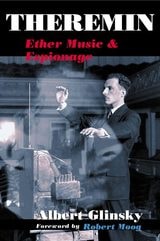
Theremin
Ether Music and EspionageAlbert Glinsky
University of Illinois Press, 2000
A creative genius and prolific inventor, Leon Theremin almost single-handedly launched the field of electronic music in 1920. The theremin--the only musical instrument that is played without being touched--created a sensation worldwide and paved the way for the modern synthesizer. But the otherworldly sound that entranced millions was only part of Theremin's epic life.
As a Soviet scientist, Theremin surrendered his life and work to the service of State espionage. On assignment in Depression-era America, he worked the engines of capitalist commerce while passing data on US industrial technology to the Soviet apparat. Following his sudden disappearance in 1938, Theremin vanished into the top-secret Soviet intelligence machine and was presumed dead for nearly thirty years. Using the same technology that spawned the theremin, he designed bugging devices and a host of other electronic wonders, including an early television and multimedia devices that anticipated performance art and virtual reality by decades.
Albert Glinsky's biography places the inventor at world events stretching from the Russian Revolution through the Cold War to perestroika. Throughout, he spins whimsy and treachery into an astonishing drama of one man's hidden loyalties, mixed motivations, and irrepressibly creative spirit.