55 books match the query 'New Perspectives' and 6 start with t
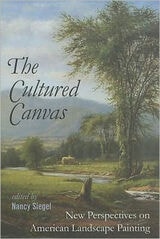
cover of The Cultured Canvas: New Perspectives on American Landscape Painting

The Cultured Canvas

New Perspectives on American Landscape Painting

Nancy Siegel

University of New Hampshire Press, 2012

Written from aesthetic, sociopolitical, cultural, and literary perspectives, The Cultured Canvas explores myriad ways in which American visual culture can be evaluated through newly conceived thematic and ideological approaches. This book moves beyond our accepted notion of the oil painting on canvas to consider the term as both a literal and figurative surface upon which artists construct or construe the landscape as an intellectual, cultural, or physical entity. It provides an innovative reevaluation of traditional thought concerning the Hudson River School, Luminism, and artists of the Civil War era.

As interdisciplinary emphases are employed with increasing frequency in arts and humanities courses, the breadth and depth of topics covered in this collection will provide a much-needed text for scholars in American art history, nineteenth-century American studies, and landscape studies, in addition to serving as a complement to courses in American literature and culture.

Hardcover is un-jacketed.

[more]
cover of The Language of Riddles: New Perspectives

The Language of Riddles

New Perspectives

W. J. Pepicello and Thomas A. Green

The Ohio State University Press, 1900
[more]
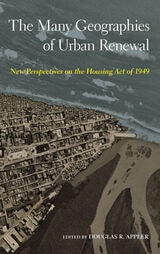
cover of The Many Geographies of Urban Renewal: New Perspectives on the Housing Act of 1949

The Many Geographies of Urban Renewal

New Perspectives on the Housing Act of 1949

Edited by Douglas R. Appler

Temple University Press, 2023

The consequences of the federal Housing Act of 1949—which supported the clearance and redevelopment of “blighted” areas across the nation—were felt by communities of all sizes, not just large cities. The Many Geographies of Urban Renewal presents a more comprehensive view of the federal urban renewal program by situating the experiences of large cities like Baltimore, MD and Philadelphia PA alongside other geographies, such as the small city of Waterville, ME, suburban St. Louis County in Missouri, the State of New York, the Commonwealth of Puerto Rico, and others.  Chapters identify trends and connections that cut across jurisdictional boundaries, investigate who used federal funds, how those funds were used, and examine the profound short and long-term consequences of the program.
 
Taken as a whole, the essays showcase the unexpected diversity of how different communities used the federal urban renewal program. The Many Geographies of Urban Renewal allows us to better understand what was arguably the most significant urban policy of the 20th century, and how that policy  shaped the American landscape.
 
Contributors include Francesca Russello Ammon, Brent Cebul, Robert B. Fairbanks, Leif Fredrickson, Colin Gordon, David Hochfelder, Robert K. Nelson, Benjamin D. Lisle, Stacy Kinlock Sewell and the editor.
 
[more]
cover of Thornton Wilder: New Perspectives

Thornton Wilder

New Perspectives

Lincoln Konkle

Northwestern University Press, 2013
The essays in Thornton Wilder: New Perspectives constitute a comprehensive critical reassessment at a time of renewed interest in the writer. Wilder is best known for Our Town and The Bridge of San Luis Rey, both winners of a Pulitzer Prize, making Wilder still the only writer to be so honored for both drama and fiction. His other fiction, in particular, is far less familiar to a wider readership. The authors of these essays aim to contextualize Wilder’s work historically and to show that Wilder’s handling of questions of religion, American identity, gender, and ethics should vault him into the ranks of major American novelists. Specifically, this anthologyincludes groundbreaking work on the application of queer theory to Our Town; on Wilder’s screenplay for the Alfred Hitchcock film Shadow of a Doubt; and on Wilder’s adaptations of Ibsen’s A Doll’s House, Farquhar’s The Beaux’ Stratagem, and his own The Long Christmas Dinner.
[more]
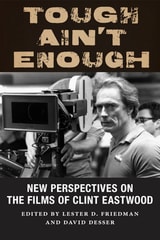
cover of Tough Ain't Enough: New Perspectives on the Films of Clint Eastwood

Tough Ain't Enough

New Perspectives on the Films of Clint Eastwood

Friedman, Lester D

Rutgers University Press, 2018
Throughout his lengthy career as both an actor and a director, Clint Eastwood has appeared in virtually every major film genre and, at this point in his career, has emerged as one of America’s most popular, recognizable, and respected filmmakers. He also remains a controversial figure in the political landscape, often characterized as the most prominent conservative voice in mostly liberal Hollywood. At Eastwood’s late age, his critical success as actor and director, his combative willingness to confront serious cultural issues in his films, and his undeniable talent behind the camera all call for a new and comprehensive study that considers and contextualizes his multiple roles, both on and off screen. Tough Ain’t Enough offers readers a series of original essays by prominent cinema scholars that explore the actor-director’s extensive career. The result is a far-reaching and nuanced portrait of one of America’s most prolific and thoughtful filmmakers.  
[more]
cover of Toward Better Problems: New Perspectives on Abortion, Animal Rights, the Environment, and Justice

Toward Better Problems

New Perspectives on Abortion, Animal Rights, the Environment, and Justice

Anthony Weston

Temple University Press, 1992

"Toward Better Problems is a work of considerable merit.... [Weston] is effective in showing how the 'theoretical' approach obscures the real values at issue and hinders their realization." --James Gouinlock, Emory University In Toward Better Problems, Anthony Weston develops a pragmatic approach to the pressing moral issues of our time. Weston seeks to address practical problems in the spirit of John Dewey: that is, by focusing on specific human concerns and multiple, overlapping values rather than on abstract philosophical principles. Weston showcases his method in sustained discussion of four highly controversial areas: abortion, animal rights, environmentalism, and justice. Weston takes up uncomfortable issues, such as how we raise food animals; test medicines, cosmetics, and chemicals on animals; and justify speciesism. He engages philosophically the treatment of land and seas as limitless garbage dumps, the creation of radioactive wastes and their disposal, and fundamental problems of social justice. But Weston's aim is not to "solve" such problems as if they were some kind of puzzle. The aim instead is to creatively transform such problematic situations into something more promising and tractable, thereby leaving us with "better problems."
[more]