Results by title
75 books match the query 'Nigeria' and 11 start with t
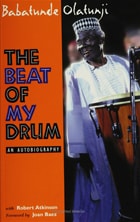
The Beat Of My Drum
An AutobiographyMichael Babatunde Olatunji
Temple University Press, 2005
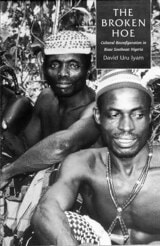
The Broken Hoe
Cultural Reconfiguration in Biase Southeast NigeriaDavid Uru Iyam
University of Chicago Press, 1995
The Biase today face social and economic pressures that seriously strain their ability to cope with the realities of modern Nigeria. Iyam, an anthropologist and a Biase, examines the relationship between culture and development as played out in projects in local communities.
Western technologies and beliefs alone cannot ensure economic growth and modernization, Iyam shows, and should not necessarily be imposed on poor rural groups who may not be prepared to incorporate them; neither, however, is it possible to recover indigenous coping strategies given the complexities of the postcolonial world. A successful development strategy, Iyam argues, needs to strengthen local managerial capacity, and he offers suggestions as to how this can be done in a range of cultural and social settings.
The Extinction of Menai
A NovelChuma Nwokolo
Ohio University Press, 2017
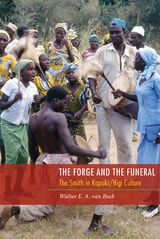
The Forge and the Funeral
The Smith in Kapsiki/Higi CultureWalter E. A. van Beek
Michigan State University Press, 2015
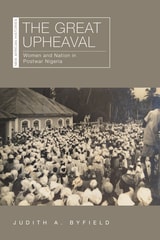
The Great Upheaval
Women and Nation in Postwar NigeriaJudith A. Byfield
Ohio University Press, 2021
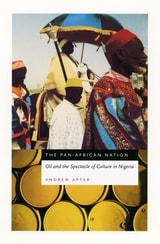
The Pan-African Nation
Oil and the Spectacle of Culture in NigeriaAndrew Apter
University of Chicago Press, 2005
According to Apter, FESTAC expanded the horizons of blackness in Nigeria to mirror the global circuits of its economy. By showcasing masks, dances, images, and souvenirs from its many diverse ethnic groups, Nigeria forged a new national culture. In the grandeur of this oil-fed confidence, the nation subsumed all black and African cultures within its empire of cultural signs and erased its colonial legacies from collective memory. As the oil economy collapsed, however, cultural signs became unstable, contributing to rampant violence and dissimulation.
The Pan-African Nation unpacks FESTAC as a historically situated mirror of production in Nigeria. More broadly, it points towards a critique of the political economy of the sign in postcolonial Africa.
The Persistence of Slavery
An Economic History of Child Trafficking in NigeriaRobin Phylisia Chapdelaine
University of Massachusetts Press, 2021
Despite efforts to abolish slavery throughout Africa in the nineteenth century, the coercive labor systems that constitute “modern slavery” have continued to the present day. To understand why, Robin Phylisia Chapdelaine explores child trafficking, pawning, and marriages in Nigeria's Bight of Biafra, and the ways in which British colonial authorities and Igbo, Ibibio, Efik, and Ijaw populations mobilized children's labor during the early twentieth century. Drawing on a wealth of primary sources that include oral interviews, British and Nigerian archival materials, newspaper holdings, and missionary and anthropological accounts, Chapdelaine argues that slavery's endurance can only be understood when we fully examine “the social economy of a child”—the broader commercial, domestic, and reproductive contexts in which children are economic vehicles.
The Persistence of Slavery provides an invaluable investigation into the origins of modern slavery and early efforts to combat it, locating this practice in the political, social, and economic changes that occurred as a result of British colonialism and its lingering effects, which perpetuate child trafficking in Nigeria today.
Thus Ruled Emir Abbas
Selected Cases from the Records of the Emir of Kano's Judicial CouncilAllen Christelow
Michigan State University Press, 1994
Thus Ruled Emir Abbas is an important new research tool that reveals much about daily life in Kano, the wealthiest and most populous emirate of the African Sokoto Caliphate. It contains a selection of Kano Judicial Council documents, as well as their English translations, that deal with matters such as land disputes, tax collection disputes, and theft. These documents are invaluable resources that reveal much about Kano social, economic, and political life before the region came under the influence of colonial institutions, law, and language. This selection of records for more than 415 cases, along with their translations, will become essential reading for those interested in Nigeria’s past and will certainly become a standard work in the field of Nigerian history and anthropology.
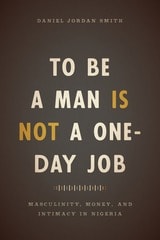
To Be a Man Is Not a One-Day Job
Masculinity, Money, and Intimacy in NigeriaDaniel Jordan Smith
University of Chicago Press, 2017
Drawing on twenty-five years of experience in southeastern Nigeria, Daniel Jordan Smith takes readers through the principal phases and arenas of men’s lives: the transition to adulthood; searching for work and making a living; courtship, marriage, and fatherhood; fraternal and political relationships; and finally, the attainment of elder status and death. He relates men’s struggles both to fulfill their own aspirations and to meet society’s expectations. He also considers men who behave badly, mistreat their wives and children, or resort to crime and violence. All of these men face similar challenges as they navigate the complex geometry of money and intimacy. Unraveling these connections, Smith argues, provides us with a deeper understanding of both masculinity and society in Nigeria.
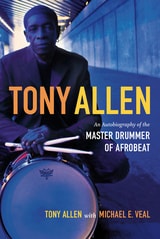
Tony Allen
An Autobiography of the Master Drummer of AfrobeatTony Allen, with Michael E. Veal
Duke University Press, 2013
Allen embraced the drum set, rather than African handheld drums, early in his career, when drum kits were relatively rare in Africa. His story conveys a love of his craft along with the specifics of his practice. It also provides invaluable firsthand accounts of the explosive creativity in postcolonial African music, and the personal and artistic dynamics in Fela's Koola Lobitos and Africa 70, two of the greatest bands to ever play African music.
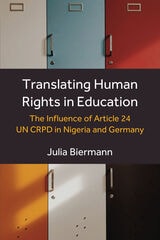
Translating Human Rights in Education
The Influence of Article 24 UN CRPD in Nigeria and GermanyJulia Biermann
University of Michigan Press, 2022
The 2006 United Nations Convention on the Rights of Persons with Disabilities (UN CRPD) is the first human rights treaty to explicitly acknowledge the right to education for persons with disabilities. In order to realize this right, the convention’s Article 24 mandates state parties to ensure inclusive education systems that overcome outright exclusion as well as segregation in special education settings. Despite this major global policy change to tackle the discriminations persons with disabilities face in education, this has yet to take effect in most school systems worldwide.
Focusing on the factors undermining the realization of disability rights in education, Julia Biermann probes current meanings of inclusive education in two contrasting yet equally challenged state parties to the UN CRPD: Nigeria, whose school system overtly excludes disabled children, and Germany, where this group primarily learns in special schools. In both countries, policy actors aim to realize the right to inclusive education by segregating students with disabilities into special education settings. In Nigeria, this demand arises from the glaring lack of such a system. In Germany, conversely, from its extraordinary long-term institutionalization. This act of diverting from the principles embodied in Article 24 is based on the steadfast and shared belief that school systems, which place students into special education, have an innate advantage in realizing the right to education for persons with disabilities. Accordingly, inclusion emerges to be an evolutionary and linear process of educational expansion that depends on institutionalized special education, not a right of persons with disabilities to be realized in local schools on an equal basis with others. This book proposes a refined human rights model of disability in education that shifts the analytical focus toward the global politics of formal mass schooling as a space where discrimination is sustained.