Results by title
80 books match the query 'Ontology' and 16 start with t
The Abyss of Freedom/Ages of the World
Slavoj Zizek and F.W.J. von Schelling
University of Michigan Press, 1997
Zizek argues that Schelling's most profound thoughts are found in the series of three consecutive attempts he made to formulate the "ages of the world/Weltalter," the stages of the self-development of the Absolute. Of the three versions, claims Zizek, it is the second that is the most eloquent and definitive encompassing of Schelling's lyrical thought. It centers on the problem of how the Absolute (God) himself, in order to become actual, to exist effectively, has to accomplish a radically contingent move of acquiring material, bodily existence. Never before available in English, this version finally renders accessible one of the key texts of modern philosophy, a text that is widely debated in philosophical circles today.
The Abyss of Freedom is Zizek's own reading of Schelling based upon Lacanian psychoanalytic theory. It focuses on the notion that Lacan's theory--which claims that the symbolic universe emerged from presymbolic drives--is prefigured in Schelling's idea of logos as given birth to from the vortex of primordial drives, or from what "in God is not yet God." For Zizek, this connection is monumental, showing that Schelling's ideas forcefully presage the post-modern "deconstruction" of logocentrism.
Slavoj Zizek is not a philosopher who stoops to conquer objects but a radical voice who believes that philosophy is nothing if it is not embodied, nothing if it is only abstract. For him, true philosophy always speaks of something rather than nothing. Those interested in the genesis of contemporary thought and the fate of reason in our "age of anxiety" will find this coupling of texts not only philosophically relevant, but vitally important.
Slavoj Zizek is the author of The Sublime Object of Ideology, Tarrying with the Negative: Kant, Hegel and the Critique of Ideology, and most recently, The Indivisible Remainder: An Essay on Schelling and Related Matters. Currently he is a Senior Researcher at the Institute for Social Sciences, University of Ljubljana. Judith Norman is Assistant Professor of Philosophy at Trinity University in San Antonio, Texas.
The Anatomy of Architecture
Ontology and Metaphor in Batammaliba Architectural ExpressionSuzanne Preston Blier
University of Chicago Press, 1994
"A splendid analysis of the centrality of architecture in the daily lives of the Batammaliba and its integral role in articulating social values....The story is beautifully told in the best of anthropological traditions."—Judith R. Blau, Contemporary Society
"A remarkable study....Blier's volume carries the study of African architecture to a qualitatively new level of scholarship. It introduces a new dimension whereby the architectural medium can be used to illuminate much of the entire belief system of any culture."—Labelle Prussin, African Arts
"In this excellent book Blier provides a richly detailed and searching account of what architecture means to the Batammaliba of northern Togo and Benin....The finest account I have yet read of the relations between systems of beliefs, ritual practices, and African aesthetics and plastic arts....The ethnography and basic insight should be the envy of any social anthropologist."—T.O. Beidelman, Man
The Being of the Beautiful
Plato's Theaetetus, Sophist, and StatesmanPlato
University of Chicago Press, 1984
“The translations are masterpieces of literalness. . . . They are honest, accurate, and give the reader a wonderful sense of the Greek.”—Drew A. Hyland, Review of Metaphysics
The Body Multiple
Ontology in Medical PracticeAnnemarie Mol
Duke University Press, 2002
The Body Multiple juxtaposes two distinct texts. Alongside Mol’s analysis of her ethnographic material—interviews with doctors and patients and observations of medical examinations, consultations, and operations—runs a parallel text in which she reflects on the relevant literature. Mol draws on medical anthropology, sociology, feminist theory, philosophy, and science and technology studies to reframe such issues as the disease-illness distinction, subject-object relations, boundaries, difference, situatedness, and ontology. In dialogue with one another, Mol’s two texts meditate on the multiplicity of reality-in-practice.
Presenting philosophical reflections on the body and medical practice through vivid storytelling, The Body Multiple will be important to those in medical anthropology, philosophy, and the social study of science, technology, and medicine.

The Democracy of Objects
Levi R. Bryant
Michigan Publishing Services, 2011
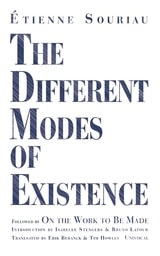
The Different Modes of Existence
Étienne Souriau
University of Minnesota Press, 2015
What relation is there between the existence of a work of art and that of a living being? Between the existence of an atom and that of a value like solidarity? These questions become our own each time a reality—whether it is a piece of music, someone we love, or a fictional character—is established and begins to take on an importance in our lives. Like William James or Gilles Deleuze, Souriau methodically defends the thesis of an existential pluralism. There are indeed different manners of existing and even different degrees or intensities of existence: from pure phenomena to objectivized things, by way of the virtual and the “super-existent,” to which works of art and the intellect, and even morality, bear witness. Existence is polyphonic, and, as a result, the world is considerably enriched and enlarged. Beyond all that exists in the ordinary sense of the term, it is necessary to allow for all sorts of virtual and ephemeral states, transitional realms, and barely begun realities, still in the making, all of which constitute so many “inter-worlds.”
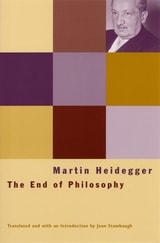
The End of Philosophy
Martin Heidegger
University of Chicago Press, 2003
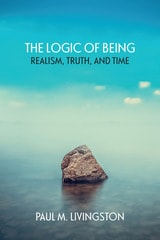
The Logic of Being
Realism, Truth, and TimePaul M. Livingston
Northwestern University Press, 2017
Livingston's formal and phenomenological analysis articulates and defends a realist position about being, time, and their relationship that understands that all of these are structured and constituted in a way that does not depend on the human mind, consciousness, or subjectivity. This approach provides a basis for new logically and phenomenologically based accounts of the structure of linguistic truth in relation to the appearance of objects and of the formal structure of time as given.
Livingston draws on philosophers from Plato and Aristotle to Davidson and Heidegger in this exploration. In it, readers and scholars will discover innovative connections between continental and analytic philosophy.
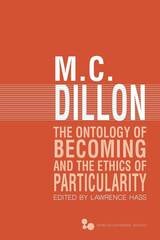
The Ontology of Becoming and the Ethics of Particularity
M. C. Dillon
Ohio University Press, 2012
M. C. Dillon (1938–2005) was widely regarded as a world-leading Merleau-Ponty scholar. His book Merleau-Ponty’s Ontology (1988) is recognized as a classic text that revolutionized the philosophical conversation about the great French phenomenologist. Dillon followed that book with two others: Semiological Reductionism, a critique of early-1990s linguistic reductionism, and Beyond Romance, a richly developed theory of love. At the time of his death, Dillon had nearly completed two further books to which he was passionately committed. The first one offers a highly original interpretation of Nietzsche’s ontology of becoming. The second offers a detailed ethical theory based on Merleau-Ponty’s account of carnal intersubjectivity. The Ontology of Becoming and the Ethics of Particularity collects these two manuscripts written by a distinguished philosopher at the peak of his powers—manuscripts that, taken together, offer a distinctive and powerful view of human life and ethical relations.
The Philosophy of Living
François Jullien
Seagull Books, 2015
Living holds us between two places. It expresses what is most elementary—to be alive—and the absoluteness of our aspiration—finally living! But could we desire anything other than to live? In The Philosophy of Living, François Jullien meditates on Far Eastern thought and philosophy to analyze concepts that can be folded into a complete philosophy of living, including the idea of the moment, the ambiguity of the in-between, and what he calls the “transparency of morning.” Jullien here develops a strategy of living that goes beyond morality and dwells in the space between health and spirituality.
The Possibility of Philosophy
Course Notes from the Collège de France, 1959–1961Maurice Merleau-Ponty, Edited by Stéphanie Ménasé with a foreword by Claude Lefort, Translated from the French by Keith Whitmoyer
Northwestern University Press, 2022
The Ultimate Why Question
Why Is There Nothing at All Rather than Nothing Whatsoever?John F. Wippel
Catholic University of America Press, 2011
The Unrealizable
Towards a Politics of OntologyGiorgio Agamben
Seagull Books, 2024
We are so used to distinguishing between the possible and the real, between essence and existence that we do not realize that these distinctions, which seem so obvious to us, are the result of a long and laborious process that has led to the splitting of being—the “matter” of thought—into two fragments that are both conflicting and intimately intertwined.
This book argues that the ontological-political machine of the West is based on the splitting of this “matter,” without which neither science nor politics would be possible. Without the partition of reality into essence and existence and into possibility and actuality, neither scientific knowledge nor the ability to control human action—which characterizes the historical power of the West—would have been possible.
If we could not suspend the exclusive concentration of our attention on what immediately exists (as animals seem to do), to think and define its essence, Western science and technology would not have experienced the advances that characterize them. And if the dimension of possibility disappeared entirely, neither plans nor projects would be thinkable, and human actions could be neither directed nor controlled. The incomparable power of the West has one of its essential presuppositions in this ontological machine.
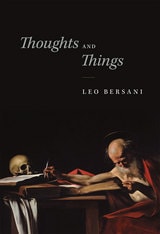
Thoughts and Things
Leo Bersani
University of Chicago Press, 2014
Thoughts and Things posits what would appear to be an irreducible gap between our thoughts (the human subject) and things (the world). Bersani departs from his psychoanalytic convictions to speculate on the oneness of being—of our intrinsic connectedness to the other that is at once external and internal to us. He addresses the problem of formulating ways to consider the undivided mind, drawing on various sources, from Descartes to cosmology, Freud, and Genet and succeeds brilliantly in diagramming new forms as well as radical failures of connectedness. Ambitious, original, and eloquent, Thoughts and Things will be of interest to scholars in philosophy, film, literature, and beyond.
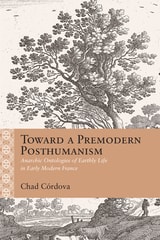
Toward a Premodern Posthumanism
Anarchic Ontologies of Earthly Life in Early Modern FranceChad Córdova
Northwestern University Press, 2025
Drawing on early modern French thought to free nature and aesthetics from metaphysical humanism
What good is aesthetics in a time of ecological crisis? Toward a Premodern Posthumanism: Anarchic Ontologies of Earthly Life in Early Modern France shows that philosophical aesthetics contains unheeded potentialities for challenging the ontological subjection of nature to the human subject. Drawing on deconstructive, ecological, and biopolitical thought, Chad Córdova uncovers in aesthetics something irreducible to humanist metaphysics: an account of how beings emerge and are interrelated, responsive, and even response-able without reason or why.
This anarchic and atelic ontology, recovered from Kant, becomes the guiding thread for a new, premodern trajectory of posthumanism. Charting a path from Aristotle to Heidegger to today’s plant-thinking, with new readings of Montaigne, Pascal, Diderot, Rousseau, and others along the way, this capacious study reveals the untimely relevance of pre-1800 practices of writing, science, and art. Enacting a multitemporal mode of reading, Córdova offers a defense and illustration of the importance of returning to early modern texts as a way to rethink nature, art, ethics, and politics in a time when these concepts are in flux and more contentious than ever.
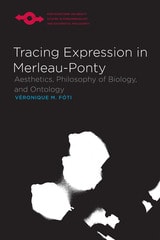
Tracing Expression in Merleau-Ponty
Aesthetics, Philosophy of Biology, and OntologyVéronique M. Fóti
Northwestern University Press, 2012
The French philosopher Renaud Barbaras remarked that late in Maurice Merleau-Ponty’s career, “The phenomenology of perception fulfills itself as a philosophy of expression.” In Tracing Expression in Merleau-Ponty: Aesthetics, Philosophy of Biology, and Ontology, Véronique M. Fótiaddresses the guiding yet neglected theme of expression in Merleau-Ponty’s thought. She traces Merleau-Ponty’s ideas about how individuals express creative or artistic impulses through his three essays on aesthetics, his engagement with animality and the “new biology” in the second of his lecture courses on nature of 1957–58, and in his late ontology, articulated in 1964 in the fragmentary text of Le visible et l’invisible (The Visible and the Invisible). With the exception of a discussion of Merleau-Ponty’s 1945 essay “Cezanne’s Doubt,” Fóti engages with Merleau-Ponty’s late and final thought, with close attention to both his scientific and philosophical interlocutors, especially the continental rationalists. Expression shows itself, in Merleau-Ponty’s thought, to be primordial, and this innate and fundamental nature of expression has implications for his understanding of artistic creation, science, and philosophy.