Results by title
65 books match the query 'Oral tradition' and 11 start with t
The Acoustic World of Early Modern England
Attending to the O-FactorBruce R. Smith
University of Chicago Press, 1999
In this ear-opening journey into the sound-worlds of Shakespeare's contemporaries, Bruce R. Smith explores both the physical aspects of human speech (ears, lungs, tongue) and the surrounding environment (buildings, landscape, climate), as well as social and political structures. Drawing on a staggeringly wide range of evidence, he crafts a historical phenomenology of sound, from reconstructions of the "soundscapes" of city, country, and court to detailed accounts of the acoustic properties of the Globe and Blackfriars theaters and how scripts designed for the two spaces exploited sound very differently.
Critical for anyone who wants to understand the world of early modern England, Smith's pathbreaking "ecology" of voice and listening also has much to offer musicologists and acoustic ecologists.
The Artistry of the Homeric Simile
William C. Scott
Dartmouth College Press, 2009
The Invention of the Oral
Print Commerce and Fugitive Voices in Eighteenth-Century BritainPaula McDowell
University of Chicago Press, 2017
Drawing on an impressive array of sources including travel narratives, elocution manuals, theological writings, ballad collections, and legal records, McDowell re-creates a world in which everyone from fishwives to philosophers, clergymen to street hucksters, competed for space and audiences in taverns, marketplaces, and the street. She argues that the earliest positive efforts to theorize "oral tradition," and to depict popular oral culture as a culture (rather than a lack of culture), were prompted less by any protodemocratic impulse than by a profound discomfort with new cultures of reading, writing, and even speaking shaped by print.
Challenging traditional models of oral versus literate societies and key assumptions about culture’s ties to the spoken and the written word, this landmark study reorients critical conversations across eighteenth-century studies, media and communications studies, the history of the book, and beyond.
The Last Cannibals
A South American Oral HistoryBy Ellen B. Basso
University of Texas Press, 1995
An especially comprehensive study of Brazilian Amazonian Indian history, The Last Cannibals is the first attempt to understand, through indigenous discourse, the emergence of Upper Xingú society. Drawing on oral documents recorded directly from the native language, Ellen Basso transcribes and analyzes nine traditional Kalapalo stories to offer important insights into Kalapalo historical knowledge and the performance of historical narratives within their nonliterate society.
This engaging book challenges the familiar view of biography as a strictly Western literary form. Of special interest are biographies of powerful warriors whose actions led to the emergence of a more recent social order based on restrained behaviors from an earlier time when people were said to be fierce and violent.
From these stories, Basso explores how the Kalapalo remember and understand their past and what specific linguistic, psychological, and ideological materials they employ to construct their historical consciousness. Her book will be important reading in anthropology, folklore, linguistics, and South American studies.
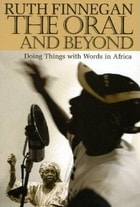
The Oral and Beyond
Doing Things with Words in AfricaRuth Finnegan
University of Chicago Press, 2007
The Oral and Beyond looks simultaneously backwards and forwards, reviewing and critiquing the achievements of scholarship on African oral literature, revisiting issues of perennial contention, and highlighting some of the most interesting new ideas and approaches in the field. Exploring such fundamental questions as how texts and textuality relate to performance, how ideology inflects language, and how traditional forms adapt to modern media and popular culture, Finnegan essentially crafts an intellectual history of her field. At the same time, she propels the ethnography of language forward, bringing the techniques and knowledge developed through her fieldwork in Africa to bear on issues that transcend African studies and reach into the larger world of anthropology and beyond.
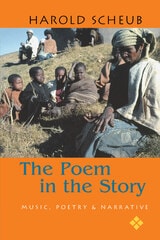
The Poem in the Story
Music, Poetry, and NarrativeHarold Scheub
University of Wisconsin Press, 2002
Fact and fiction meet at the boundaries, the betwixt and between where transformations occur. This is the area of ambiguity where fiction and fact become endowed with meaning, and this is the area—where ambiguity, irony, and metaphor join forces—that Harold Scheub exposes in all its nuanced and evocative complexity in The Poem in the Story.
In a career devoted to exploring the art of the African storyteller, Scheub has conducted some of the most interesting and provocative investigations into nonverbal aspects of storytelling, the complex relationship between artist and audience, and, most dramatically, the role played by poetry in storytelling. This book is his most daring effort yet, an unconventional work that searches out what makes a story artistically engaging and emotionally evocative, the metaphorical center that Scheub calls "the poem in the story." Drawing on extensive fieldwork in southern Africa and decades of experience as a researcher and teacher, Scheub develops an original approach—a blend of field notes, diary entries, photographs, and texts of stories and poems—that guides readers into a new way of viewing, even experiencing, meaning in a story. Though this work is largely focused on African storytelling, its universal applications emerge when Scheub brings the work of storytellers as different as Shakespeare and Faulkner into the discussion.
The Stranger's Welcome
Oral Theory and the Aesthetics of the Homeric Hospitality SceneSteve Reece
University of Michigan Press, 1993
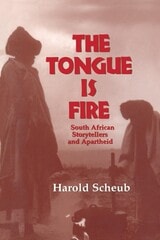
The Tongue Is Fire
South African Storytellers and ApartheidHarold E. Scheub
University of Wisconsin Press, 1996
With tape-recorder and camera in hand, Scheub registered the testaments of Swati, Xhosa, Ndebele, and Zulu storytellers, farming people who lived in the remote reaches of rural South Africa. While young people fought in the streets of Soweto and South African writers made the world aware of apartheid’s evils, the rural storytellers resisted apartheid in their own way, using myth and metaphor to preserve their traditions and confront their oppressors. For more than 20 years, Scheub kept the promise he made to the storytellers to publish his translations of their stories only when freedom came to South Africa. The Tongue Is Fire presents these voices of South African oral tradition—the historians, the poets, the epic-performers, the myth-makers—documenting their enduring faith in the power of the word to sustain tradition in the face of determined efforts to distort or eliminate it. These texts are a tribute to the storytellers who have always, in periods of crisis, exercised their art to inspire their own people.
The Uncoiling Python
South African Storytellers and ResistanceHarold Scheub
Ohio University Press, 2010
There are many collections of African oral traditions, but few as carefully organized as The Uncoiling Python. Harold Scheub, one of the world’s leading scholars of African oral traditions and folklore, explores the ways in which oral traditions have served to combat and subvert colonial domination in South Africa. From the time colonial forces first came to southern Africa in 1487, oral and written traditions have been a bulwark against what became 350 years of colonial rule, characterized by the racist policies of apartheid. The Uncoiling Python: South African Storytellers and Resistance is the first in-depth study of oral tradition as a means of survival.
In open insurrections and other subversive activities Africans resisted the daily humiliations of colonial rule, but perhaps the most effective and least apparent expression of subversion was through indigenous storytelling and poetic traditions. Harold Scheub has collected the stories and poetry of the Xhosa, Zulu, Swati, and Ndebele peoples to present a fascinating analysis of how the apparently harmless tellers of tales and creators of poetry acted as front-line soldiers.
Tracing Southern Storytelling in Black and White
Sarah Gilbreath Ford
University of Alabama Press, 2014
Exploring the shared storytelling traditions that shaped Southern literature across racial lines.
Tracing Southern Storytelling in Black and White is a study of the historical use of oral storytelling by southern writers in written works. In each chapter, Sarah Gilbreath Ford pairs a white and an African American writer to highlight points of confluence in black and white southern oral traditions. She argues that the connections between white and African American southern writers run deeper than critics have yet explored, and she uses textual comparisons to examine the racial mixing of oral culture.
On porches, in kitchens, and on the pages of their work, black and white southerners exchanged not just stories but strategies for telling stories. As a boy, Joel Chandler Harris listened to the stories of African American slaves, and he devised a framework to turn the oral stories into written ones. Harris’s use of the frame structure influenced how Charles Chesnutt recorded oral stories, but it led Alice Walker to complain that her heritage had been stolen. Mark Twain listened to African American storytellers as a child. His use of oral dialects then impacts how Ralph Ellison and William Faulkner employ oral storytelling and how Toni Morrison later writes in response to Faulkner. The interactions are not linear, not a chain of influence, but a network of interactions, borrowings, and revisions.
Ford’s pairings lead to new readings that reveal how the writers employ similar strategies in their narratives, due in part to shared historical context. While Zora Neale Hurston and William Faulkner, for example, use oral storytelling in the 1930s to examine the fear of racial mixing, Ellen Douglas and Ernest Gaines use it in the 1970s to build bridges between the races. Exploring the cultural crossing that occurs in the use of oral storytelling, Ford offers a different view of this common strategy in southern narrative and a new perspective on how culture is shared.
Tradition in the Twenty-First Century
Locating the Role of the Past in the PresentTrevor J. Blank and Robert Glenn Howard
Utah State University Press, 2013
Emphasizing how tradition adapts, survives, thrives, and either mutates or remains stable in today’s modern world, the contributors pay specific attention to how traditions now resist or expedite dissemination and adoption by individuals and communities. This complex and intimate portrayal of tradition in the twenty-first century offers a comprehensive overview of the folkloristic and popular conceptualizations of tradition from the past to present and presents a thoughtful assessment and projection of how “tradition” will fare in years to come. The book will be useful to advanced undergraduate or graduate courses in folklore and will contribute significantly to the scholarly literature on tradition within the folklore discipline.
Additional Contributors: Simon Bronner, Stephen Olbrys Gencarella, Merrill Kaplan, Lynne S. McNeill, Elliott Oring, Casey R. Schmitt, and Tok Thompson