Results by title
67 books match the query 'Painting' and 17 start with t
The Cultured Canvas
New Perspectives on American Landscape PaintingNancy Siegel
University of New Hampshire Press, 2012
Written from aesthetic, sociopolitical, cultural, and literary perspectives, The Cultured Canvas explores myriad ways in which American visual culture can be evaluated through newly conceived thematic and ideological approaches. This book moves beyond our accepted notion of the oil painting on canvas to consider the term as both a literal and figurative surface upon which artists construct or construe the landscape as an intellectual, cultural, or physical entity. It provides an innovative reevaluation of traditional thought concerning the Hudson River School, Luminism, and artists of the Civil War era.
As interdisciplinary emphases are employed with increasing frequency in arts and humanities courses, the breadth and depth of topics covered in this collection will provide a much-needed text for scholars in American art history, nineteenth-century American studies, and landscape studies, in addition to serving as a complement to courses in American literature and culture.
Hardcover is un-jacketed.

The Double Screen
Medium and Representation in Chinese PaintingWu Hung
University of Chicago Press, 1997
and pictorial representations, The Double Screen shows how the
collaboration and tension between material form and image gives life to
a painting. A Chinese painting is often reduced to the image it bears;
its material form is dismissed; its intimate connection with social
activities and cultural conventions neglected.
A screen occupies a space and divides it, supplies an ideal surface for
painting, and has been a favorite pictorial image in Chinese art since
antiquity. Wu Hung undertakes a comprehensive analysis of the screen,
which can be an object, an art medium, a pictorial motif, or all three
at once. With its diverse roles, the screen has provided Chinese
painters with endless opportunities to reinvent their art.
The Double Screen provides a powerful non-Western perspective on
issues from portraiture and pictorial narrative to voyeurism,
masquerade, and political rhetoric. It will be invaluable to anyone
interested in the history of art and Asian studies.
The Liberation of Painting
Modernism and Anarchism in Avant-Guerre ParisPatricia Leighten
University of Chicago Press, 2013
Leighten examines the circle of artists—Pablo Picasso, Juan Gris, František Kupka, Maurice de Vlaminck, Kees Van Dongen, and others—for whom anarchist politics drove the idea of avant-garde art, exploring how their aesthetic choices negotiated the myriad artistic languages operating in the decade before World War I. Whether they worked on large-scale salon paintings, political cartoons, or avant-garde abstractions, these artists, she shows, were preoccupied with social criticism. Each sought an appropriate subject, medium, style, and audience based on different conceptions of how art influences society—and their choices constantly shifted as they responded to the dilemmas posed by contradictory anarchist ideas. According to anarchist theorists, art should expose the follies and iniquities of the present to the masses, but it should also be the untrammeled expression of the emancipated individual and open a path to a new social order. Revealing how these ideas generated some of modernism’s most telling contradictions among the prewar Parisian avant-garde, The Liberation of Painting restores revolutionary activism to the broader history of modern art.
The Lure and the Truth of Painting
Selected Essays on ArtYves Bonnefoy
University of Chicago Press, 1995
The sixteen essays collected here show the breadth and depth of Bonnefoy's writings on art, aesthetics, and poetics. His lyrical ruminations range across centuries and cultures, from Byzantium to postwar France, from the paintings of Piero della Francesca to the sculptures of Alberto Giacometti and the photographs of Henri Cartier-Bresson, from the Italian Giorgio Morandi to the American Edward Hopper. Always fascinated in his poetry by the nature of color and light and the power of the image, Bonnefoy continues to pursue these themes in his discussion of the lure and truth of representation. He sees the painter as a poet whose language is a visual one, and seeks to find out what visual artists can teach those who work with words. More philosophical than historical and more poetic than critical, the essays express Bonnefoy's deep sympathy for the creative process and his great passion for individual works of art.
Bonnefoy's engagement with great art in The Lure and the Truth of Painting sheds light on the philosophy of presence and being that animates his poems. This book will be welcomed by lovers of Bonnefoy's poems and by everyone interested in the creation, history, and appreciation of art.
Yves Bonnefoy's numerous books include New and Selected Poems and In the Shadow's Light, both published by the University of Chicago Press. Richard Stamelman is director of the Center for Foreign Languages, Literatures, and Cultures and professor of romance languages at Williams College. He is the author of Lost beyond Telling: Representations of Death and Absence in Modern French Poetry.
"Few exponents of contemporary French letters deserve the attention of the reading public in America more than Yves Bonnefoy. . . . [His] writings . . . are an important lighthouse on the contemporary cultural coastline."—Emily Grosholz, The Hudson Review
The Merleau-Ponty Aesthetics Reader
Philosophy and PaintingEdited and with an Introduction by Galen A. Johnson; Michael B. Smith, Translation Editor
Northwestern University Press, 1993
The Ormesby Psalter
Patrons and Artists in Medieval East AngliaFrederica C. E. Law-Turner
Bodleian Library Publishing, 2005
Housed in Oxford’s Bodleian Library for over 150 years, this enigmatic masterpiece is perhaps the most magnificent yet enigmatic of the great Gothic psalters produced in East Anglia in the first half of the fourteenth century. Manuscript expert Frederica C. E. Law-Turner places the psalter within a wider historical context and then deciphers its lush illuminations—scenes that vary wildly in tone from the comic to the bawdy to the mythic. Full-color photographs illustrate the text’s many characters: falcons and hunting dogs at bay, kings and courtesans, and other animals dressed in human garb. Created over a period of decades by previously unrecognized scribes and artists, the Ormesby Psalter is an exceptional amalgam of medieval art and history. For scholars of medieval life, as well as art historians, this new study will be an invaluable resource.
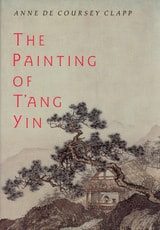
The Painting of T'ang Yin
Anne De Coursey Clapp
University of Chicago Press, 1991
Anne De Coursey Clapp's work also explores larger issues of Ming painting raised by the artist's turbulent career. She describes the social and intellectual values exalted in Ming Suchou, its system of patronage, the contrast between the professional and amateur artist, and the formative influence of twelfth-century Sung dynasty styles on Suchou painters. Clapp shows how T'ang Yin's artistic inventions were made in the course of leading the revival of Sung dynasty styles in Suchou: tracing T'ang Yin's early studies of ancient and contemporary masters, she describes how he reworked an antique style, converting it into a vehicle of expression that reached fruition in a long series of fresh and powerful paintings of landscapes and birds-and-flowers. In the process, she revises the distorted version of middle Ming painting written by later Chinese art theorists to justify their own social and artistic values, noting especially the role of art patrons and their effect on artistic production.
Clapp analyzes the increasing currency of painting as a means of social exchange in ancient China. In particular, she identifies commemorative painting as a major genre of the later dynasties and explores the role it played in the oeuvres of professional masters with its humanistic implications for the Chinese view of the ideal scholarly man. Her broad view of T'ang Yin's career shows him divided between the professional and amateur camps of his time: in landscape and figural subjects he was aligned with the professionals; in flower subjects with the amateurs. Clap argues that the uneven distribution of styles and genres between this master who was subject to the market, and those who were independent of it, suggests that T'ang deliberately tried to expand the range of his paintings in order to appeal to buyers in the lower educational and social strata. Illustrated by some of T'ang Yin's most celebrated paintings and by some which are published for the first time, her work is of tremendous importance to art, literary, and cultural historians of Ming China.
"In this important work, Anne de Coursey Clapp has drawn a clear picture of T'ang Yin's life, patronage relationships, and contribution to the history of Chinese painting. In the person of T'ang Yin, she has chosen an ideal focus around which to examine some of the misleading stereotypes
which have distorted our understanding of Chinese painting since the seventeenth century. Marked by analytical clarity and scrupulous scholarship, her work is a welcome addition to the few works in English on individual Chinese artists."—Louise Yuhas, Occidental College
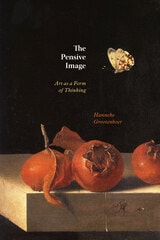
The Pensive Image
Art as a Form of ThinkingHanneke Grootenboer
University of Chicago Press, 2020
While the philosophical dimension of painting has long been discussed, a clear case for painting as a form of visual thinking has yet to be made. Traditionally, vanitas still life paintings are considered to raise ontological issues while landscapes direct the mind toward introspection. Grootenboer moves beyond these considerations to focus on what remains unspoken in painting, the implicit and inexpressible that manifests in a quality she calls pensiveness. Different from self-aware or actively desiring images, pensive images are speculative, pointing beyond interpretation. An alternative pictorial category, pensive images stir us away from interpretation and toward a state of suspension where thinking through and with the image can start.
In fluid prose, Grootenboer explores various modalities of visual thinking— as the location where thought should be found, as a refuge enabling reflection, and as an encounter that provokes thought. Through these considerations, she demonstrates that artworks serve as models for thought as much as they act as instruments through which thinking can take place. Starting from the premise that painting is itself a type of thinking, The Pensive Image argues that art is capable of forming thoughts and shaping concepts in visual terms.
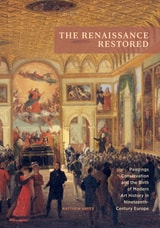
The Renaissance Restored
Paintings Conservation and the Birth of Modern Art History in Nineteenth-Century EuropeMatthew Hayes
J. Paul Getty Trust, The, 2021
Repairing works of art and writing about them—the practices that became art conservation and art history—share a common ancestry. By the nineteenth century the two fields had become inseparably linked. While the art historical scholarship of this period has been widely studied, its restoration practices have received less scrutiny—until now.
This book charts the intersections between art history and conservation in the treatment of Italian Renaissance paintings in nineteenth-century Europe. Initial chapters discuss the restoration of works by Giotto and Titian, framed by the contemporary scholarship of art historians such as Jacob Burckhardt, G. B. Cavalcaselle, and Joseph Crowe that was redefining the earlier age. Subsequent chapters recount how paintings conservation was integrated into museum settings. The narrative uses period texts, unpublished archival materials, and historical photographs in probing how paintings looked at a time when scholars were writing the foundational texts of art history, and how contemporary restorers were negotiating the appearances of these works. The book proposes a model for a new conservation history, object focused yet enriched by consideration of a wider cultural horizon.
The Rule of Art
Literature and Painting in the RenaissanceClark Hulse
University of Chicago Press, 1990
These are the questions Clark Hulse takes up in this sophisticated interdisciplinary study of Renaissance aesthetics. Proposing an archeology of artistic knowledge, Hulse examines the theoretical language through which the poets, painters, and patrons of the Renaissance conceived of the relationship between the arts. That language is embedded in what he calls a "rule of art," a specific set of categories, assumptions, and practices that defined the two art forms and the relationship between them. Hulse charts the rise of both forms to the status of liberal arts requiring special intellectual training for artist and patron alike. In the process, he uncovers the history of the practice of theory in the Renaissance, revealing how artistic discourse lived in the world.
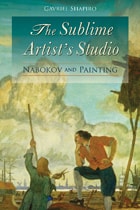
The Sublime Artist's Studio
Nabokov and PaintingGavriel Shapiro
Northwestern University Press, 2009
In his youth, Vladimir Nabokov aspired to become a landscape artist. Even though he eventually realized that his true vocation was literature, his keen sense of visual detail, nuanced perception of color, and vast knowledge of the fine arts are all manifest in his literary works, which abound with painters and paintings, real and imaginary, as well as with magnificent pictorial imagery rendered in a verbal medium. The relation of the visual arts to Nabokov’s work is the subject of The Sublime Artist’s Studio, an in-depth and detailed study of one of the most significant facets of this modern master’s oeuvre.
Gavriel Shapiro pursues his inquiry throughout Nabokov’s literary legacy—poetry, short prose, novels, plays, memoirs, lectures, essays, interviews, and letters. What is the import of Nabokov’s lifelong fascination with the Old Masters? How does landscape function in Nabokov’s writings? What was the author’s relationship to contemporary artists? By addressing these and other questions, while examining Nabokov’s references and allusions to the visual arts and to particular works and artists, Shapiro is able to reveal the centrality of painting to Nabokov’s belles lettres. His book offers a new and promising approach to one of the twentieth century’s most celebrated writers.
The Truth in Painting
Jacques Derrida
University of Chicago Press, 1987
The Truth in Painting
Jacques Derrida
University of Chicago Press, 1987
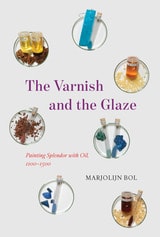
The Varnish and the Glaze
Painting Splendor with Oil, 1100–1500Marjolijn Bol
University of Chicago Press, 2023
Panel painters in both the middle ages and the fifteenth century created works that evoke the luster of precious stones, the sheen of polished gold and silver, and the colorful radiance of stained glass. Yet their approaches to rendering these materials were markedly different. Marjolijn Bol explores some of the reasons behind this radical transformation by telling the history of the two oil painting techniques used to depict everything that glistens and glows—varnish and glaze.
For more than a century after his death, the fifteenth-century painter Jan van Eyck was widely credited with inventing varnish and oil paint, on account of his unique visual realism. Once this was revealed to be a myth, the verisimilitude of his work was attributed instead to a new translucent painting technique: the glaze. Today, most theories about how Van Eyck achieved this realism revolve around the idea that he was the first to discover or refine the glazing technique. Bol, however, argues that, rather than being a fifteenth-century refinement, varnishing and glazing began centuries before. Drawing from an extensive body of recipes, Bol pieces together how varnishes and glazes were first developed as part of the medieval art of material mimesis. Artisans embellished metalwork and wood with varnishes and glazes to imitate gold and gems; infused rock crystal with oil, resin, and colorants to imitate more precious minerals; and oiled parchment to transform it into the appearance of green glass. Likewise, medieval panel painters used varnishes and glazes to create the look of enamel, silk, and more.
The explorations of materials and their optical properties by these artists stimulated natural philosophers to come up with theories about transparent and translucent materials produced by the earth. Natural historians, influenced by medieval artists’ understanding of refraction and reflection, developed theories about gems, their creation, and their optical qualities.

The Virgin and the Dynamo
Public Murals in American Architecture, 1893–1917Bailey Van Hook
Ohio University Press, 2003
The beaux-arts mural movement in America was fueled by energetic young artists and architects returning from training abroad. They were determined to transform American art and architecture to make them more thematically cosmopolitan and technically fluid and accomplished. The movement slowly coalesced around the decoration of mansions of the Gilded Age elite, mostly in New York, and of public buildings and institutions across the breadth of the country.
The Virgin and the Dynamo: Public Murals in American Architecture, 1893-1917 is the first book in almost a century to concentrate exclusively on the beaux-arts mural movement in the United States. Beginning with a short history of the movement from its inception in Boston during the American Renaissance, Bailey Van Hook focuses on the movement’s public manifestations in the period between the World’s Columbian Exposition in Chicago in 1893 and the First World War.
Professor Van Hook explores different aspects of the mural movement, the concept and meaning of “decoration,” the claim that murals are inherently democratic, the shift in preference from allegory to history, the gendered concept of modernity, the ideologies behind the iconography, and, finally, the decline of the movement when it began to be seen as old fashioned and anachronistic.
The Virgin and the Dynamo raises our understanding of the beaux-arts movement to a new level. For the general reader, this illustrated history will explain many familiar representations of local and national values.
To Destroy Painting
Louis Marin
University of Chicago Press, 1994
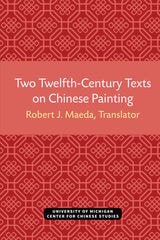
Two Twelfth-Century Texts on Chinese Painting
Robert J. Maeda, Translator
University of Michigan Press, 1970