68 books match the query 'Performance art' and 12 start with t
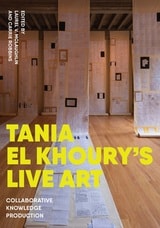
cover of Tania El Khoury's Live Art: Collaborative Knowledge Production

Tania El Khoury's Live Art

Collaborative Knowledge Production

Laurel V. McLaughlin

Amherst College Press, 2023
Tania El Khoury’s Live Art is the first book to examine the work of Tania El Khoury, a “live” artist deeply engaged in the politics and histories of the South West Asia and North Africa (SWANA) region. Since the 2011 Syrian uprisings, El Khoury has conceived and created works about lived experiences at and across international borders in collaboration with migrants, refugees, and displaced persons as well as other artists, performers, and revolutionaries. All of El Khoury’s works cross borders: between forms of artistic practice, between artists and audiences, and between art and activism. Facilitating critical dialogue about the politics of SWANA and the impact of globalization, her performances and installations also test the boundaries of aesthetic, political, and everyday norms. This interdisciplinary and multimedia reader features essays by artists, curators, and scholars who explore the dynamic possibilities and complexities of El Khoury’s art. From social workers to archeologists to archivists, contributing authors engage with the radical epistemological and political revolutions that El Khoury and her collaborators invite us all to join.
[more]
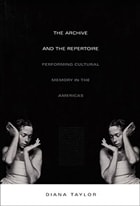
cover of The Archive and the Repertoire: Performing Cultural Memory in the Americas

The Archive and the Repertoire

Performing Cultural Memory in the Americas

Diana Taylor

Duke University Press, 2003

In The Archive and the Repertoire preeminent performance studies scholar Diana Taylor provides a new understanding of the vital role of performance in the Americas. From plays to official events to grassroots protests, performance, she argues, must be taken seriously as a means of storing and transmitting knowledge. Taylor reveals how the repertoire of embodied memory—conveyed in gestures, the spoken word, movement, dance, song, and other performances—offers alternative perspectives to those derived from the written archive and is particularly useful to a reconsideration of historical processes of transnational contact. The Archive and the Repertoire invites a remapping of the Americas based on traditions of embodied practice.

Examining various genres of performance including demonstrations by the children of the disappeared in Argentina, the Peruvian theatre group Yuyachkani, and televised astrological readings by Univision personality Walter Mercado, Taylor explores how the archive and the repertoire work together to make political claims, transmit traumatic memory, and forge a new sense of cultural identity. Through her consideration of performances such as Coco Fusco and Guillermo Gómez-Peña’s show Two Undiscovered Amerindians Visit . . . , Taylor illuminates how scenarios of discovery and conquest haunt the Americas, trapping even those who attempt to dismantle them. Meditating on events like those of September 11, 2001 and media representations of them, she examines both the crucial role of performance in contemporary culture and her own role as witness to and participant in hemispheric dramas. The Archive and the Repertoire is a compelling demonstration of the many ways that the study of performance enables a deeper understanding of the past and present, of ourselves and others.
[more]
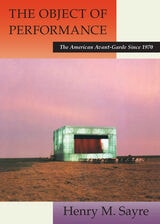
cover of The Object of Performance: The American Avant-Garde since 1970

The Object of Performance

The American Avant-Garde since 1970

Henry M. Sayre

University of Chicago Press, 1989

Sayre defines for the first time the apparently diffuse avant-garde art of the past two decades in terms of its distinctly postmodern concerns. The range of arts discussed here encompasses contemporary dance, photography, oral poetics, performance art, and earthworks.

"Sayre has written one of the most intelligent, sensible, and readable accounts of the tenents of Postmodern artmaking published to date."—Jeff Abell, New Art Examiner

"No one can read The Object of Performance without gaining a far better idea than before of what has happened to art, and, in some measure, why. . . . I find this book consistently illuminating."—Arthur C. Danto
[more]
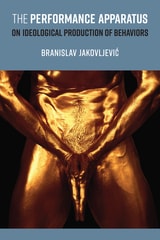
cover of The Performance Apparatus: On Ideological Production of Behaviors

The Performance Apparatus

On Ideological Production of Behaviors

Branislav Jakovljevic

University of Michigan Press, 2025

The publication of Louis Althusser’s 1969 article “Ideology and Ideological State Apparatuses,” made a deep impact on cultural studies and was instrumental in the formation of the apparatus theory in film studies. While contemporaneous with the emergence of performance art, this article and the questions of ideology and apparatus it raises barely registered in the field of performance studies, which was then in its formative phase. Jakovljević takes this absence of Althusser’s apparatus theory from performance studies as an indicator of the ideological position of the field at the moment of its emergence, arguing that, while theories of ideology played no major role in early performance studies, performance art itself offered a number of incisive critiques of ideology. Jakovljević looks at permutations of the apparatus by investigating the work of theorists such as Louis Althusser, Michel Foucault, Gilles Deleuze, and Judith Butler, and engagements with the apparatus by a number of artists, such as Amiri Baraka, Philippe Thomas, New York Art & Language, Terry Fox, Every house has a door, Clive Robertson, and Cassils.
 
Jakovljević suggests that the centrality of behavior in early performance theory is important for the understanding of contemporary society, which is dominated by surveillance capitalism. If ideology is lodged in behaviors, and if surveillance capitalism thrives on the monetization of the behavioral surplus, then performance theory can make significant contributions to our understanding of the moment in which we live and the future we are facing. The Performance Apparatus argues for the importance of continuing attention to the question of ideology in contemporary, neoliberal order.
[more]
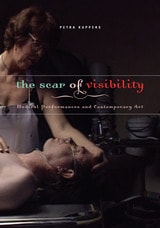
cover of The Scar of Visibility: Medical Performances and Contemporary Art

The Scar of Visibility

Medical Performances and Contemporary Art

Petra Kuppers

University of Minnesota Press, 2007
Contemporary visual and performance artists have adopted modern medical technologies such as MRIs and computer imaging—and the bodily access they imply—to reveal their limitations. In doing so they emphasize the unknowability of another’s bodily experience and the effects—physical, emotional, and social—of medical procedures.In The Scar of Visibility, Petra Kuppers examines the use of medical imagery practices in contemporary art, as well as different arts of everyday life (self-help groups, community events, Internet sites), focusing on fantasies and “knowledge projects” surrounding the human body. Among the works she investigates are the controversial Body Worlds exhibition of plastinized corpses; video projects by Shimon Attie on diabetes and Douglas Gordon on mental health and war trauma; performance pieces by Angela Ellsworth, Bob Flanagan, and Kira O’Reilly; films like David Cronenberg’s Crash and Marina de Van’s In My Skin that fetishize body wounds; representations of the AIDS virus in the National Museum of Health and on CSI: Crime Scene Investigations; and the paintings of outsider artist Martin Ramírez.At the heart of this work is the scar—a place of production, of repetition and difference, of multiple nerve sensations, fragile skin, outer sign, and bodily depth. Through the embodied sign of the scar, Kuppers articulates connections between subjective experience, history, and personal politics. Illustrated throughout, The Scar of Invisibility broadens our understanding of the significance of medical images in visual culture.Petra Kuppers is associate professor of English at the University of Michigan, Ann Arbor, and the author of Disability and Contemporary Performance: Bodies on Edge.
[more]
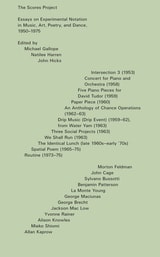
cover of The Scores Project: Essays on Experimental Notation in Music, Art, Poetry, and Dance, 1950–1975

The Scores Project

Essays on Experimental Notation in Music, Art, Poetry, and Dance, 1950–1975

Michael Gallope

J. Paul Getty Trust, The, 2025

A collection of essays examining experimental scores and source documents from the postwar avant-gardes, interpreted by experts on art, music, dance, and poetry.

Individuals working in and across the fields of visual art, music, poetry, theater, and dance in the mid–twentieth century began to use experimental scores in ways that revolutionized artistic practice and opened up new forms of interdisciplinary collaboration. Their experimental methods—associated with the neo-avant-garde, neo-Dadaism, intermedia, Fluxus, and postmodernism—exploded in notoriety during the 1960s in locales from New York to Europe, East Asia, and Latin America, becoming foundational to global trends in contemporary art and performance.

The Scores Project provides an in-depth view of this historical moment. Through expert commentaries from an interdisciplinary team of scholars with accompanying illustrations, this publication examines a series of experimental scores by John Cage, George Brecht, Sylvano Bussotti, Morton Feldman, Allan Kaprow, Alison Knowles, Jackson Mac Low, Benjamin Patterson, Yvonne Rainer, Mieko Shiomi, David Tudor, and La Monte Young. Ambitious, provocative, and playful, The Scores Project is an illuminating resource to scholars and students who seek to understand this innovative and historically complex moment in the history of art.

An expanded edition of this open-access publication is available for free online at 
www.getty.edu/publications/scores/. It includes more than 2,800 images, audio/video files, and interactive features. Also available are free PDF and EPUB downloads of the book.
[more]
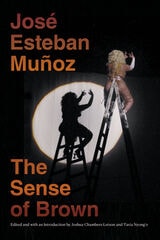
cover of The Sense of Brown

The Sense of Brown

José Esteban Muñoz. Edited and with an Introduction by Joshua Chambers-Letson and Tavia Nyong'o

Duke University Press, 2020

The Sense of Brown is José Esteban Muñoz's treatise on brownness and being as well as his most direct address to queer Latinx studies. In this book, which he was completing at the time of his death, Muñoz examines the work of playwrights Ricardo Bracho and Nilo Cruz, artists Nao Bustamante, Isaac Julien, and Tania Bruguera, and singer José Feliciano, among others, arguing for a sense of brownness that is not fixed within the racial and national contours of Latinidad. This sense of brown is not about the individualized brown subject; rather, it demonstrates that for brown peoples, being exists within what Muñoz calls the brown commons—a lifeworld, queer ecology, and form of collectivity. In analyzing minoritarian affect, ethnicity as a structure of feeling, and brown feelings as they emerge in, through, and beside art and performance, Muñoz illustrates how the sense of brown serves as the basis for other ways of knowing and being in the world.
[more]
cover of The Sensible Stage: Staging and the Moving Image

The Sensible Stage

Staging and the Moving Image

Edited by Bridget Crone

Intellect Books, 2017

Exploring the use of live performance and the moving image in contemporary art practice, The Sensible Stage brings together essays that examine how elements from theater and cinema are integrated into art, often in order to question the boundaries and mediations between the body and the image. Opening with a discussion between prominent philosopher Alain Badiou and Elie During, this book offers a unique mixture of theoretical, creative, and discursive reflections on the meeting of stage and screen.

This revised and expanded edition includes two new chapters that offer an updated look at how these ideas continue to develop in contemporary art practice.
[more]
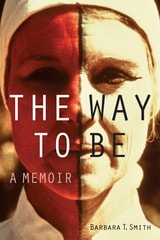
cover of The Way to Be: A Memoir

The Way to Be

A Memoir

Barbara T. Smith

J. Paul Getty Trust, The, 0

A firsthand account of the life and work of Barbara T. Smith, one of the most important yet underrecognized performance artists in the United States.
 
For over fifty years, Barbara T. Smith has been at the forefront of artistic movements in California. Her work across many mediums explores concepts that strike at the core of human nature, including sexuality, physical and spiritual sustenance, technology, and death. In this memoir, Smith weaves together descriptive accounts of her pioneering performances with an intimate narrative of her life.
 
The Way to Be covers the years 1931 to 1981, up to the artist’s fiftieth birthday, resulting in an exhaustive catalogue of her early work. It reveals the personal stories and events behind her pieces and the challenges she faced in an art world dominated by sexism and machismo. Drawing on Smith’s archive at the Getty Research Institute, this enthralling book presents previously unpublished notes, documents, photographs, and firsthand accounts of her life and practice, as well as her more recent reflections on the past. The Way to Be demonstrates Smith’s lasting contributions to the field of contemporary art and provides an engaging commentary on a recent period of great cultural and political change.
 
This volume is published to accompany an exhibition on view at the Getty Research Institute at the Getty Center from February 28 to July 16, 2023.
[more]
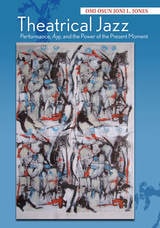
cover of Theatrical Jazz: Performance,  À??, and the Power of the Present Moment

Theatrical Jazz

Performance, À??, and the Power of the Present Moment

Omi Osun Joni L. Jones

The Ohio State University Press, 2015

Omi Osun Joni L. Jones provides the first full-length study of an artistic form, the theatrical jazz aesthetic, that draws on the jazz principles of ensemble—the break, the bridge, and the blue note. Theatrical Jazz:  Performance, À??, and the Power of the Present Moment is a study of the use of jazz aesthetics in theatre as created by major practitioners of the form, giving particular attention to three innovative artists: Laurie Carlos, Daniel Alexander Jones, and Sharon Bridgforth.
 
Theatrical Jazz examines how artists are made and how artists make art. In charting their overlapping artistic genealogies, the book also discusses the work of veteran artists Aishah Rahman, Robbie McCauley, Sekou Sundiata, Ntozake Shange, and Erik Ehn, as well as the next generation of theatrical jazz innovators, Grisha Coleman, Walter Kitundu, Florinda Bryant, and Zell Miller III. Using autocritography as a primary methodology, the author draws on her role as performer, collaborator, audience/witness, and dramaturg in theatrical jazz, and her experiences with Yoruba spiritual traditions, to excavate the layers and nuances of this performance form.  Jones’s use of performative writing, a blend of intellectual, artistic, and sensory experiences, allows scholars and students not only to read but also to “hear” the principles of theatrical jazz on the page.
 
[more]
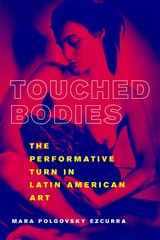
cover of Touched Bodies: The Performative Turn in Latin American Art

Touched Bodies

The Performative Turn in Latin American Art

Mara Polgovsky Ezcurra

Rutgers University Press, 2019

Shortlisted for the 2020 Association for the Study of the Arts of the Present Book Prize​
Winner of the 2019 Art Journal Prize from the College Art Association

What is the role of pleasure and pain in the politics of art? In Touched Bodies, Mara Polgovsky Ezcurra approaches this question as she examines the flourishing of live and intermedial performance in Latin America during times of authoritarianism and its significance during transitions to democracy. Based on original documents and innovative readings, her book brings politics and ethics to the discussion of artistic developments during the “long 1980s”. She describes the rise of performance art in the context of feminism, HIV-activism, and human right movements, taking a close look at the work of Diamela Eltit and Raúl Zurita from Chile, León Ferrari and Liliana Maresca from Argentina, and Marcos Kurtycz, the No Grupo art collective, and Proceso Pentágono from Mexico. The comparative study of the work of these artists attests to a performative turn in Latin American art during the 1980s that, like photography and film before, recast the artistic field as a whole, changing the ways in which we perceive art and understand its role in society.
[more]
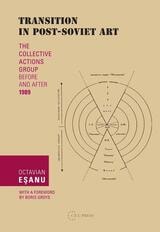
cover of Transition in Post-Soviet Art: The Collective Actions Group Before and After 1989

Transition in Post-Soviet Art

The Collective Actions Group Before and After 1989

Octavian Esanu

Central European University Press, 2013

The artistic tradition that emerged as a form of cultural resistance in the 1970s changed during the transition from socialism to capitalism. This volume presents the evolution of the Moscow-based conceptual artist group called Collective Actions, proposing it as a case-study for understanding the transformations that took place in Eastern European art after the fall of the Berlin Wall. Esanu introduces Moscow Conceptualism by performing a close examination of the Collective Actions group's ten-volume publication Journeys Outside the City and of the Dictionary of Moscow Conceptualism. He analyzes above all the evolution of Collective Actions through ten consecutive phases, discussing changes that occur in each new volume of the Journeys. Compares the part of the Journeys produced in the Soviet period with those volumes assembled after the dissolution of the USSR. The concept of "transition" and the activities of Soros Centers for Contemporary Art are also analyzed.
[more]