Results by title
117 books match the query 'Philippines' and 21 start with t
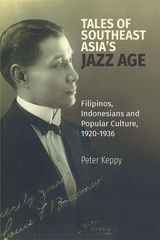
Tales of Southeast Asia’s Jazz Age
Filipinos, Indonesians and Popular Culture, 1920-1936Peter Keppy
National University of Singapore Press, 2019
This artistic era was marked by experimentation and adaption, and this was reflected in both Borromeo’s and Riboet’s styles. They were pioneering cultural brokers who dealt in hybrids. They were adept at combining high art and banal entertainment, tradition and modernity, and the foreign and the local.
Leaning on cultural studies and the work on cosmopolitanism and modernity by Henry Jenkins and Joel Kahn, Peter Keppy examines pop culture at this time as a contradictory social phenomenon. He challenges notions of Southeast Asia’s popular culture as lowbrow entertainment created by elites and commerce to manipulate the masses, arguing instead that audiences seized on this popular culture to channel emancipatory activities, to articulate social critique, and to propagate an inclusive nationalism without being radically anticolonial.
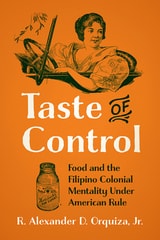
Taste of Control
Food and the Filipino Colonial Mentality under American RuleR. Alexander D. Orquiza, Jr.
Rutgers University Press, 2020
Winner of the 2021 Gourmand Awards, Asian Section & Culinary History Section
Filipino cuisine is a delicious fusion of foreign influences, adopted and transformed into its own unique flavor. But to the Americans who came to colonize the islands in the 1890s, it was considered inferior and lacking in nutrition. Changing the food of the Philippines was part of a war on culture led by Americans as they attempted to shape the islands into a reflection of their home country.
Taste of Control tells what happened when American colonizers began to influence what Filipinos ate, how they cooked, and how they perceived their national cuisine. Food historian René Alexander D. Orquiza, Jr. turns to a variety of rare archival sources to track these changing attitudes, including the letters written by American soldiers, the cosmopolitan menus prepared by Manila restaurants, and the textbooks used in local home economics classes. He also uncovers pockets of resistance to the colonial project, as Filipino cookbooks provided a defense of the nation’s traditional cuisine and culture.
Through the topic of food, Taste of Control explores how, despite lasting less than fifty years, the American colonial occupation of the Philippines left psychological scars that have not yet completely healed, leading many Filipinos to believe that their traditional cooking practices, crops, and tastes were inferior. We are what we eat, and this book reveals how food culture served as a battleground over Filipino identity.
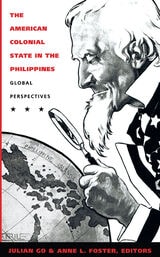
The American Colonial State in the Philippines
Global PerspectivesJulian Go and Anne L. Foster, eds.
Duke University Press, 2003
Written by social scientists and historians, these essays investigate various aspects of American colonial government through comparison with and contextualization within colonial regimes elsewhere in the world—from British Malaysia and Dutch Indonesia to Japanese Taiwan and America's other major overseas colony, Puerto Rico. Contributors explore the program of political education in the Philippines; constructions of nationalism, race, and religion; the regulation of opium; connections to politics on the U.S. mainland; and anticolonial resistance. Tracking the complex connections, circuits, and contests across, within, and between empires that shaped America's colonial regime, The American Colonial State in the Philippines sheds new light on the complexities of American imperialism and turn-of-the-century colonialism.
Contributors. Patricio N. Abinales, Donna J. Amoroso, Paul Barclay, Vince Boudreau, Anne L. Foster, Julian Go, Paul A. Kramer
The Archival Afterlives of Philippine Cinema
Bliss Cua Lim
Duke University Press, 2024
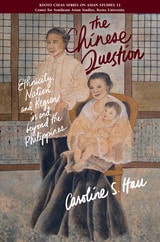
The Chinese Question
Ethnicity, Nation, and Region in and Beyond the PhilippinesCaroline S. Hau
National University of Singapore Press, 2014
With the revaluing of Chineseness has come a repositioning of “Chinese” racial and cultural identity. Philippine mestizos (people of mixed ancestry) form an important sub-group of the Filipino elite, but their Chineseness was occluded as they disappeared into the emergent Filipino nation. In the twentieth century, mestizos defined themselves and based claims to privilege on “white” ancestry, but mestizos are now actively reclaiming their “Chinese” heritage. At the same time, so-called “pure Chinese” are parlaying their connections into cultural, social, symbolic, or economic capital, and leaders of mainland Chinese state companies have entered into politico-business alliances with the Filipino national elite. As the meanings of “Chinese” and “Filipino” evolve, intractable contradictions are appearing in the concepts of citizenship and national belonging.
Through an examination of cinematic and literary works, The Chinese Question shows how race, class, ideology, nationality, territory, sovereignty, and mobility are shaping the discourses of national integration, regional identification, and global cosmopolitanism.
The Copy Generic
How the Nonspecific Makes Our Social WorldsScott MacLochlainn
University of Chicago Press, 2022
From off-brand products to elevator music, the “generic” is discarded as the copy, the knockoff, and the old. In The Copy Generic, anthropologist Scott MacLochlainn insists that more than the waste from the culture machine, the generic is a universal social tool, allowing us to move through the world with necessary blueprints, templates, and frames of reference. It is the baseline and background, a category that orders and values different types of specificity yet remains inherently nonspecific in itself. Across arenas as diverse as city planning, social media, ethnonationalism, and religion, the generic points to spaces in which knowledge is both overproduced and desperately lacking. Moving through ethnographic and historical settings in the Philippines, Europe, and the United States, MacLochlainn reveals how the concept of the generic is crucial to understanding how things repeat, circulate, and are classified in the world.
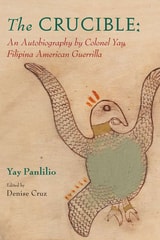
The Crucible
An Autobiography by Colonel Yay, Filipina American GuerrillaCruz, Denise
Rutgers University Press, 2010
On December 8, 1941, as the Pacific War reached the Philippines, Yay Panlilio, a Filipina-Irish American, faced a question with no easy answer: How could she contribute to the war?
In this 1950 memoir, The Crucible: An Autobiography by Colonel Yay, Filipina American Guerrilla, Panlilio narrates her experience as a journalist, triple agent, leader in the Philippine resistance against the Japanese, and lover of the guerrilla general Marcos V. Augustin. From the war-torn streets of Japanese-occupied Manila, to battlegrounds in the countryside, and the rural farmlands of central California, Panlilio blends wry commentary, rigorous journalistic detail, and popular romance.
Weaving together appearances by Douglas MacArthur and Carlos Romulo with dangerous espionage networks, this work provides an insightful perspective on the war. The Crucible invites readers to see new intersections in Filipina/o, Asian American, and American literature studies, and Denise Cruz's introduction imparts key biographical, historical, and cultural contexts to that purpose.
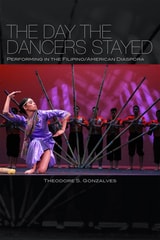
The Day the Dancers Stayed
Performing in the Filipino/American DiasporaTheodore S. Gonzalves
Temple University Press, 2009
Pilipino Cultural Nights at American campuses have been a rite of passage for youth culture and a source of local community pride since the 1980s. Through performances—and parodies of them—these celebrations of national identity through music, dance, and theatrical narratives reemphasize what it means to be Filipino American. In The Day the Dancers Stayed, scholar and performer Theodore Gonzalves uses interviews and participant observer techniques to consider the relationship between the invention of performance repertoire and the development of diasporic identification.
Gonzalves traces a genealogy of performance repertoire from the 1930s to the present. Culture nights serve several functions: as exercises in nostalgia, celebrations of rigid community entertainment, and occasionally forums for political intervention. Taking up more recent parodies of Pilipino Cultural Nights, Gonzalves discusses how the rebellious spirit that enlivened the original seditious performances has been stifled.
The Hispanization of the Philippines
John Phelan
University of Wisconsin Press, 1959
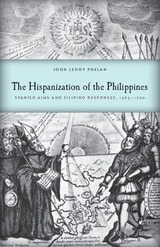
The Hispanization of the Philippines
Spanish Aims and Filipino Responses, 1565–1700John Leddy Phelan
University of Wisconsin Press, 1959
After conquest of the Philippine archipelago in the late sixteenth century, Spanish colonizers launched a sweeping social program designed to bring about dramatic religious, political, and economic changes. But the limitations of Spanish colonial resources, together with the reactions of Filipinos themselves, combined to shape the outcome of that effort in unique and unexpected ways, argues John Leddy Phelan. With no wealth in the islands to attract conquistadores, conquest was accomplished largely by missionaries scattered among isolated native villages. Native chieftains served as intermediaries, thus enabling the Filipinos to react selectively to Spanish innovations. The result was a form of hispanization in which the resilient and adaptable Filipinos played a creative part.
The Labor of Care
Filipina Migrants and Transnational Families in the Digital AgeValerie Francisco-Menchavez
University of Illinois Press, 2018
The Patchwork City
Class, Space, and Politics in Metro ManilaMarco Z. Garrido
University of Chicago Press, 2019
The Patchwork City illuminates how segregation, class relations, and democracy are all intensely connected. It makes clear, ultimately, that class as a social structure is as indispensable to the study of Manila—and of many other cities of the Global South—as race is to the study of American cities.
The Promise of the Foreign
Nationalism and the Technics of Translation in the Spanish PhilippinesVicente L. Rafael
Duke University Press, 2005
Through close readings of nationalist newspapers and novels, the vernacular theater, and accounts of the 1896 anticolonial revolution, Rafael traces the deep ambivalence with which elite nationalists and lower-class Filipinos alike regarded Castilian. The widespread belief in the potency of Castilian meant that colonial subjects came in contact with a recurring foreignness within their own language and society. Rafael shows how they sought to tap into this uncanny power, seeing in it both the promise of nationhood and a menace to its realization. Tracing the genesis of this promise and the ramifications of its betrayal, Rafael sheds light on the paradox of nationhood arising from the possibilities and risks of translation. By repeatedly opening borders to the arrival of something other and new, translation compels the nation to host foreign presences to which it invariably finds itself held hostage. While this condition is perhaps common to other nations, Rafael shows how its unfolding in the Philippine colony would come to be claimed by Filipinos, as would the names of the dead and their ghostly emanations.
The Sovereign Trickster
Death and Laughter in the Age of DuterteVicente L. Rafael
Duke University Press, 2022
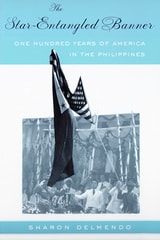
The Star-Entangled Banner
One Hundred Years of America in the PhilippinesDelmendo, Sharon
Rutgers University Press, 2004
During a ceremony held in 1996 to commemorate the fiftieth anniversary of formal Philippine independence, the U.S. flag was being lowered while the Philippine flag was being raised, and the two became entangled. In The Star-Entangled Banner, Sharon Delmendo demonstrates that this incident is indicative of the longstanding problematic relationship between the two countries. When faced with a national crisis or a compelling need to reestablish its autonomy, each nation paradoxically turns to its history with the other to define its place in the world.
Each chapter of the book deals with a separate issue in this linked history: the influence of Buffalo Bill’s show on the proto-nationalism of José Rizal, who is often described as the “First Filipino”; the portrayal of the Philippines in American children’s books; Back to Bataan, a World War II movie starring John Wayne; the post-independence fiction of F. Sionil José; and the refusal of the U..S military to return the Balangiga Bells, which were taken as war booty during the Philippine-American War. Ultimately, Delmendo demonstrates how the effects of U.S. imperialism in the Philippines continue to resonate in U.S. foreign policy in the post cold war era and the war on terrorism.
The Work of Mothering
Globalization and the Filipino DiasporaHarrod Suarez
University of Illinois Press, 2017
Harrod J. Suarez's innovative readings of this cultural production explores issues of diaspora, gender, and labor. He details the ways literature and cinema play critical roles in encountering, addressing, and problematizing what we think we know about overseas Filipina workers. Though often seen as compliant subjects, the Filipina mother can also destabilize knowledge production that serves the interests of global empire, capitalism, and Philippine nationalism. Suarez examines canonical writers like Nick Joaquín, Carlos Bulosan, and Jessica Hagedorn to explore this disruption and understand the maternal specificity of the construction of overseas Filipina workers. The result is a series of readings that develop new ways of thinking through diasporic maternal labor that engages with the sociological imaginary.
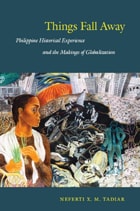
Things Fall Away
Philippine Historical Experience and the Makings of GlobalizationNeferti X. M. Tadiar
Duke University Press, 2009
Tadiar treats the historical experiences articulated in feminist, urban protest, and revolutionary literatures of the 1960s–90s as “cultural software” for the transformation of dominant social relations. She considers feminist literature in relation to the feminization of labor in the 1970s, when between 300,000 and 500,000 prostitutes were working in the areas around U.S. military bases, and in the 1980s and 1990s, when more than five million Filipinas left the country to toil as maids, nannies, nurses, and sex workers. She reads urban protest literature in relation to authoritarian modernization and crony capitalism, and she reevaluates revolutionary literature’s constructions of the heroic revolutionary subject and the messianic masses, probing these social movements’ unexhausted cultural resources for radical change.
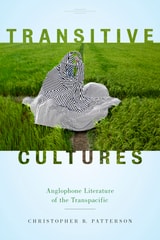
Transitive Cultures
Anglophone Literature of the TranspacificPatterson, Christopher B
Rutgers University Press, 2018
Texts written by Southeast Asian migrants have often been read, taught, and studied under the label of multicultural literature. But what if the ideology of multiculturalism—with its emphasis on authenticity and identifiable cultural difference—is precisely what this literature resists?
Transitive Cultures offers a new perspective on transpacific Anglophone literature, revealing how these chameleonic writers enact a variety of hybrid, transnational identities and intimacies. Examining literature from Malaysia, Singapore, and the Philippines, as well as from Southeast Asian migrants in Canada, Hawaii, and the U.S. mainland, this book considers how these authors use English strategically, as a means for building interethnic alliances and critiquing ruling power structures in both Southeast Asia and North America. Uncovering a wealth of texts from queer migrants, those who resist ethnic stereotypes, and those who feel few ties to their ostensible homelands, Transitive Cultures challenges conventional expectations regarding diaspora and minority writers.
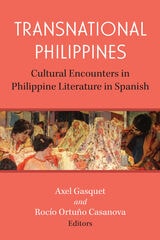
Transnational Philippines
Cultural Encounters in Philippine Literature in SpanishAxel Gasquet and Rocío Ortuño Casanova, Editors
University of Michigan Press, 2024
Yet Transnational Philippines also questions the constraints of traditional literary genres in order to make room for Philippine texts and other colonial and postcolonial texts, so that those texts can be taken into consideration in literary studies. Its chapters elaborate on the problems surrounding the cultural and identity relations of the Philippines with other regions and the literary nature of Philippine texts. By addressing the need for a postnational approach to Spanish-language Philippine literature, the book challenges the Spain/Latin America dichotomy existing in Spanish language literary studies and leans toward a global conception of the Hispanophone.
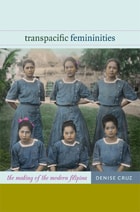
Transpacific Femininities
The Making of the Modern FilipinaDenise Cruz
Duke University Press, 2012
Through a careful study of multiple texts produced by Filipina and Filipino writers in the Philippines and the United States—including novels and short stories, newspaper and magazine articles, conduct manuals, and editorial cartoons—Cruz provides a new archive and fresh perspectives for understanding Philippine literature and culture. She demonstrates that the modern Filipina did not emerge as a simple byproduct of American and Spanish colonial regimes, but rather was the result of political, economic, and cultural interactions among the Philippines, Spain, the United States, and Japan. Cruz shows how the complex interplay of feminism, nationalism, empire, and modernity helped to shape, and were shaped by, conceptions of the transpacific Filipina.
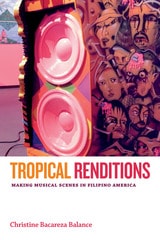
Tropical Renditions
Making Musical Scenes in Filipino AmericaChristine Bacareza Balance
Duke University Press, 2016