Results by title
50 books match the query 'Philosophy of nature' and 11 start with t
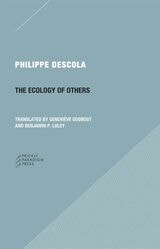
The Ecology of Others
Philippe Descola
Prickly Paradigm Press, 2013
Since the end of the nineteenth century, the division between nature and culture has been fundamental to Western thought. In this groundbreaking work, renowned anthropologist Philippe Descola seeks to break down this divide, arguing for a departure from the anthropocentric model and its rigid dualistic conception of nature and culture as distinct phenomena. In its stead, Descola proposes a radical new worldview, in which beings and objects, human and nonhuman, are understood through the complex relationships that they possess with one another.
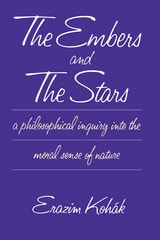
The Embers and the Stars
Erazim Kohák
University of Chicago Press, 1987
"Those who share Kohák's concern to understand nature as other than a mere resource or matter in motion will find his temporally oriented interpretation of nature instructive. It is here in particular that Kohák turns moments of experience to account philosophically, turning what we habitually overlook or avoid into an opportunity and basis for self-knowledge. This is an impassioned attempt to see the vital order of nature and the moral order of our humanity as one."—Ethics
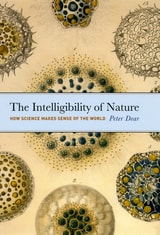
The Intelligibility of Nature
How Science Makes Sense of the WorldPeter Dear
University of Chicago Press, 2006
In The Intelligibility of Nature, Peter Dear considers how science as such has evolved and how it has marshaled itself to make sense of the world. His intellectual journey begins with a crucial observation: that the enterprise of science is, and has been, directed toward two distinct but frequently conflated ends—doing and knowing. The ancient Greeks developed this distinction of value between craft on the one hand and understanding on the other, and according to Dear, that distinction has survived to shape attitudes toward science ever since.
Teasing out this tension between doing and knowing during key episodes in the history of science—mechanical philosophy and Newtonian gravitation, elective affinities and the chemical revolution, enlightened natural history and taxonomy, evolutionary biology, the dynamical theory of electromagnetism, and quantum theory—Dear reveals how the two principles became formalized into a single enterprise, science, that would be carried out by a new kind of person, the scientist.
Finely nuanced and elegantly conceived, The Intelligibility of Nature will be essential reading for aficionados and historians of science alike.
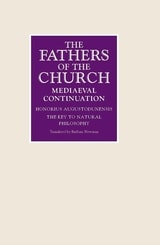
The Key to Natural Philosophy
Barbara Honorius Augustodunensis
Catholic University of America Press, 2026
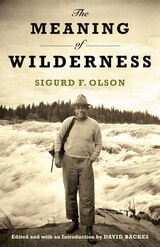
The Meaning of Wilderness
Sigurd F. Olson
University of Minnesota Press, 2015
Sigurd F. Olson (1899-1982) was one of the greatest environmentalists of the twentieth century. A conservation activist and popular writer, Olson introduced a generation of readers to the importance of wilderness. He served as president of the Wilderness Society and the National Parks Association and as a consultant to the federal government on wilderness preservation and ecological problems. He earned many honors, including the highest possible from the Sierra Club, National Wildlife Federation, and Izaak Walton League.
Olson is perhaps best known, though, for his many books that express the wonder, awe, and peace he found in the wilderness, including the nature classics The Singing Wilderness, Listening Point, and Reflections from the North Country. While these books have greatly influenced subsequent environmentalist movements and writers such as Annie Dillard and Barry Lopez, a major portion of Olson’s wilderness writing-much of it originating as speeches-has been relatively inaccessible, scattered in a number of magazines and obscure books over a period of more than fifty years, or never published at all.
The Meaning of Wilderness gathers together the most important of Sigurd Olson’s articles and speeches, making them available for the first time. The book also contains an introduction and chapter-by-chapter commentary by Olson’s authorized biographer, David Backes, that help the reader discover the various facets of Olson’s wilderness philosophy and their development over time. A lively look at the evolution of one of environmentalism’s greatest figures, The Meaning of Wilderness will be essential reading for Olson fans, historians, and outdoors people around the country.
The Moral Authority of Nature
Edited by Lorraine Daston and Fernando Vidal
University of Chicago Press, 2003
The Moral Authority of Nature offers a wide-ranging account of how people have used nature to think about what counts as good, beautiful, just, or valuable. The eighteen essays cover a diverse array of topics, including the connection of cosmic and human orders in ancient Greece, medieval notions of sexual disorder, early modern contexts for categorizing individuals and judging acts as "against nature," race and the origin of humans, ecological economics, and radical feminism. The essays also range widely in time and place, from archaic Greece to early twentieth-century China, medieval Europe to contemporary America.
Scholars from a wide variety of fields will welcome The Moral Authority of Nature, which provides the first sustained historical survey of its topic.
Contributors:
Danielle Allen, Joan Cadden, Lorraine Daston, Fa-ti Fan, Eckhardt Fuchs, Valentin Groebner, Abigail J. Lustig, Gregg Mitman, Michelle Murphy, Katharine Park, Matt Price, Robert N. Proctor, Helmut Puff, Robert J. Richards, Londa Schiebinger, Laura Slatkin, Julia Adeney Thomas, Fernando Vidal
The Simple Beauty of the Unexpected
A Natural Philosopher’s Quest for Trout and the Meaning of EverythingMarcelo Gleiser
Dartmouth College Press, 2016
The Simple Beauty of the Unexpected
A Natural Philosopher’s Quest for Trout and the Meaning of EverythingMarcelo Gleiser
Brandeis University Press, 2022
Marcelo Gleiser has had a passion for science and fishing since he was a boy growing up on the beaches of Rio de Janeiro. As a world-famous theoretical physicist with hundreds of scientific articles and several books of popular science to his credit, he felt it was time to once again connect with nature in less theoretical ways. After seeing a fly-fishing class on the Dartmouth College green, he decided to learn to fly-fish, a hobby, he says, that teaches humility. In The Simple Beauty of the Unexpected, Gleiser travels the world to scientific conferences, fishing wherever he goes. At each stop, he ponders the myriad ways physics informs the act of fishing; how, in its turn, fishing serves as a lens into nature’s inner workings; and how science engages with questions of meaning and spirituality, inspiring a sense of mystery and awe of the not yet known. Personal and engaging, The Simple Beauty of the Unexpected is a scientist’s tribute to nature, an affirmation of humanity’s deep connection with and debt to Earth, and an exploration of the meaning of existence, from atom to trout to cosmos.
This softcover edition features a new essay by Gleiser on how we need a profound change of worldview if we are to have a vibrant future for our species in this fragile environment. He describes how this book was an incubator for his current thinking.

The True Medicine
Oliva Sabuco de Nantes Barrera, Edited by Gianna Pomata, Translated by Gianna Pomata
Iter Press, 2010
This annotated translation allows the reader to locate the Dialogue on the True Medicine in the context of early modern medical and philosophical culture, identifying Sabuco’s ancient and modern sources. The editor’s introduction reviews the contested issue of authorship, offers new documentation for the history of the reception of Sabuco’s ideas in the seventeenth century, and relates Sabuco’s work to the Querelle des femmes, the protofeminist debate which had remarkable echoes in early modern medicine.
The modeling of nature
philosophy of science and philosophy of nature in synthesisWilliam A Wallace
Catholic University of America Press, 1996
Tunguska, or the End of Nature
A Philosophical DialogueMichael Hampe
University of Chicago Press, 2015
Tunguska, Or the End of Nature uses its four-man setup to tackle some of today’s burning issues—such as climate change, environmental destruction, and resource management—from a diverse range of perspectives. With a kind of foreboding, it asks what the world was like, and will be like, without us, whether we are negligible and the universe random, whether nature can truly be explained, whether it is good or evil, or whether nature is simply a thought we think. This is a profoundly unique work, a thrillingly interdisciplinary piece of scholarly literature that probes the mysteries of nature and humans alike.