Results by title
53 books match the query 'Playwriting' and 15 start with t
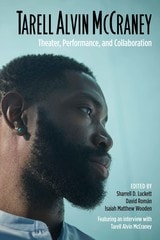
Tarell Alvin McCraney
Theater, Performance, and CollaborationEdited by Sharrell D. Luckett, David Román, and Isaiah Matthew Wooden
Northwestern University Press, 2020
Contributors consider McCraney’s innovations as a playwright, adapter, director, performer, teacher, and collaborator, bringing fresh and diverse perspectives to their observations and analyses. In so doing, they expand and enrich the conversations on his much-celebrated and deeply resonant body of work, which includes the plays Choir Boy, Head of Passes, Ms. Blakk for President, The Breach, Wig Out!, and the critically acclaimed trilogy The Brother/Sister Plays: In the Red and Brown Water, The Brothers Size, and Marcus; Or the Secret of Sweet, as well as the Oscar Award–winning film Moonlight, which was based on his play In Moonlight Black Boys Look Blue.
The Architecture of Story
A Technical Guide for the Dramatic WriterWill Dunne
University of Chicago Press, 2016
Through his workshops and book The Dramatic Writer’s Companion, Will Dunne has helped thousands of writers develop successful scripts. Now, in The Architecture of Story, he helps writers master the building blocks of dramatic storytelling by analyzing a trio of award-winning contemporary American plays: Doubt: A Parable by John Patrick Shanley, Topdog/Underdog by Suzan-Lori Parks, and The Clean House by Sarah Ruhl. Dismantling the stories and examining key components from a technical perspective enables writers to approach their own work with an informed understanding of dramatic architecture.
Each self-contained chapter focuses on one storytelling component, ranging from “Title” and “Main Event” to “Emotional Environment” and “Crisis Decision.” Dunne explores each component in detail, demonstrating how it has been successfully handled in each play and comparing and contrasting techniques. The chapters conclude with questions to help writers evaluate and improve their own scripts. The result is a nonlinear reference guide that lets writers work at their own pace and choose the topics that interest them as they develop new scripts. This flexible, interactive structure is designed to meet the needs of writers at all stages of writing and at all levels of experience.
The Deaf Way II Anthology
A Literary Collection by Deaf and Hard of Hearing WritersTonya M. Stremlau
Gallaudet University Press, 2002
In July 2002, the second Deaf Way Conference and Festival took place at Gallaudet University in Washington, D.C., attracting more than 5,000 people worldwide. Researchers, artists, performers, and others converged to create a singular blend of scholarship and social interaction, which inspired The Deaf Way II Anthology.
The Deaf Way II Anthology brings together stellar contributions by 16 international writers who are deaf or hard of hearing. This remarkable collection features poetry, essays, short stories, and one play, all of which offer thought-provoking perspectives on elements from the personal universes of these gifted authors. Many are American writers well-known for their past publications, such as Douglas Bullard, Willy Conley, Christopher Heuer, and Raymond Luczak, while the outstanding work of John Lee Clark, volume editor Tonya Stremlau, Melissa Whalen, and several others have been collected for the first time in this volume. The international contributions further distinguish this anthology, ranging from poetry by Romanian Carmen Cristiu, verse by Sibylle Gurtner May from Switzerland, to a play by Nigerian Sotonwa Opeoluwa.
All of the writers showcased in The Deaf Way II Anthology portray the Deaf experience with unmatched authenticity, presenting a perfect introduction to the Deaf world. Simultaneously, their work demonstrates that deaf and hard of hearing people can write at the highest aesthetic level and offer invaluable insights on the complete human spectrum.
The Death and Life of Drama
Reflections on Writing and Human NatureBy Lance Lee
University of Texas Press, 2005
What makes a film "work," so that audiences come away from the viewing experience refreshed and even transformed in the way they understand themselves and the world around them? In The Death and Life of Drama, veteran screenwriter and screenwriting teacher Lance Lee tackles this question in a series of personal essays that thoroughly analyze drama's role in our society, as well as the elements that structure all drama, from the plays of ancient Athens to today's most popular movies.
Using examples from well-known classical era and recent films, Lee investigates how writers handle dramatic elements such as time, emotion, morality, and character growth to demonstrate why some films work while others do not. He seeks to define precisely what "action" is and how the writer and the viewer understand dramatic reality. He looks at various kinds of time in drama, explores dramatic context from Athens to the present, and examines the concept of comedy. Lee also proposes a novel "five act" structure for drama that takes account of the characters' past and future outside the "beginning, middle, and end" of the story. Deftly balancing philosophical issues and practical concerns, The Death and Life of Drama offers a rich understanding of the principles of successful dramatic writing for screenwriters and indeed everyone who enjoys movies and wants to know why some films have such enduring appeal for so many people.
The Dramatic Writer's Companion, Second Edition
Tools to Develop Characters, Cause Scenes, and Build StoriesWill Dunne
University of Chicago Press, 2017
Having spent decades working with dramatists to refine and expand their existing plays and screenplays, Dunne effortlessly blends condensed dramatic theory with specific action steps—over sixty workshop-tested exercises that can be adapted to virtually any individual writing process and dramatic script. Dunne’s in-depth method is both instinctual and intellectual, allowing writers to discover new actions for their characters and new directions for their stories. The exercises can be used by those just starting the writing process and by those who have scripts already in development. With each exercise rooted in real-life issues from Dunne’s workshops, readers of this companion will find the combined experiences of more than fifteen hundred workshops in a single guide.
This second edition is fully aligned with a brand-new companion book, Character, Scene, and Story, which offers forty-two additional activities to help writers more fully develop their scripts. The two books include cross-references between related exercises, though each volume can also stand alone.
No ordinary guide to plotting, this handbook centers on the principle that character is key. “The character is not something added to the scene or to the story,” writes Dunne. “Rather, the character is the scene. The character is the story.” With this new edition, Dunne’s remarkable creative method will continue to be the go-to source for anyone hoping to take their story to the stage.
The Dramatic Writer's Companion
Tools to Develop Characters, Cause Scenes, and Build StoriesWill Dunne
University of Chicago Press, 2009
Moss Hart once said that you never really learn how to write a play; you only learn how to write this play. Crafted with that adage in mind, The Dramatic Writer’s Companion is designed to help writers explore their own ideas in order to develop the script in front of them. No ordinary guide to plotting, this handbook starts with the principle that character is key. “The character is not something added to the scene or to the story,” writes author Will Dunne. “Rather, the character is the scene. The character is the story.”
Having spent decades working with dramatists to refine and expand their existing plays and screenplays, Dunne effortlessly blends condensed dramatic theory with specific action steps—over sixty workshop-tested exercises that can be adapted to virtually any individual writing process and dramatic script. Dunne’s in-depth method is both instinctual and intellectual, allowing writers to discover new actions for their characters and new directions for their stories.
Dunne’s own experience is a crucial element of this guide. His plays have been selected by the Eugene O’Neill Theatre Center for three U.S. National Playwrights Conferences and have earned numerous honors, including a Charles MacArthur Fellowship, four Bay Area Theatre Critics Circle Awards, and two Drama-Logue Playwriting Awards. Thousands of individuals have already benefited from his workshops, and The Dramatic Writer’s Companion promises to bring his remarkable creative method to an even wider audience.
The Humana Festival
The History of New Plays at Actors Theatre of LouisvilleJeffrey Ullom
Southern Illinois University Press, 2008
Far from the glittering lights of Broadway, in a city known more for its horse racing than its artistic endeavors, an annual festival in Louisville, Kentucky, has transformed the landscape of the American theater. The Actors Theatre of Louisville—the Tony Award–winning state theater of Kentucky—in 1976 successfully created what became the nation's most respected new-play festival, the Humana Festival of New American Plays.
The Humana Festival: The History of New Plays at Actors Theatre of Louisville examines the success of the festival and theater’s Pulitzer Prize–winning productions that for decades have reflected new-play trends in regional theaters and on Broadway—the result of the calculated decisions, dogged determination, and good luck of its producing director, Jon Jory.
The volume details how Actors Theatre of Louisville was established, why the Humana Festival became successful in a short time, and how the event’s success has been maintained by the Louisville venue that has drawn theater critics from around the world for more than thirty years.
Author Jeffrey Ullom charts the theater’s early struggles to survive, the battles between troupe leaders, and the desperate measures to secure financial support from the Louisville community. He examines how Jory established and expanded the festival to garner extraordinary local support, attract international attention, and entice preeminent American playwrights to premier their works in the Kentucky city.
In The Humana Festival, Ullom provides a broad view of new-play development within artistic, administrative, and financial contexts. He analyzes the relationship between Broadway and regional theaters, outlining how the Humana Festival has changed the process of new-play development and even Broadway’s approach to discovering new work, and also highlights the struggles facing regional theaters across the country as they strive to balance artistic ingenuity and economic viability.
Offering a rare look at the annual event, The Humana Festival provides the first insider’s view of the extraordinary efforts that produced the nation’s most successful new-play festival.

The Morality of Mrs. Dulska
A Play by Gabriela ZapolskaGabriela Zapolska
Intellect Books, 2007
The Plays of Josefina Niggli
Recovered Landmarks of Latino LiteratureJosefina Niggli; Edited by William Orchard and Yolanda Padilla
University of Wisconsin Press, 2007
Although Niggli is perhaps best known for her fiction and folk plays, this anthology recovers her historical dramas, most of which have been long out of print or were never published. These plays are deeply concerned with the aftermath of the 1910 Mexican Revolution, imagining its implications for Mexico, Mexican Americans, and U.S.-Mexico relations. Included are Mexican Silhouettes (1928), Singing Valley (1936), The Cry of Dolores (1936), The Fair God (1936), Soldadera (1938), This is Villa! (1939), and The Ring of General Macias (1943). These works reflect on the making of history and often portray the Revolution through the lens of women’s experiences.
Also included in this volume are an extensive critical introduction to Niggli, a chronology of her life and writings, plus letters and reviews by, to, and about Josefina Niggli. that provide illuminating context for the plays.
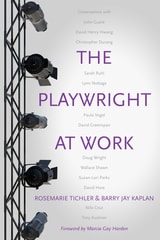
The Playwright at Work
ConversationsRosemarie Tichler
Northwestern University Press, 2012
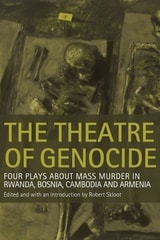
The Theatre of Genocide
Four Plays about Mass Murder in Rwanda, Bosnia, Cambodia, and ArmeniaEdited and with an introduction by Robert Skloot
University of Wisconsin Press, 2008
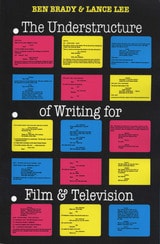
The Understructure of Writing for Film and Television
By Ben Brady and Lance Lee
University of Texas Press, 1988
This unique, comprehensive introduction to screenwriting offers practical advice for the beginning writer, whether college student or freelancer. Based on their experience as professional writers and as teachers in a large, successful screenwriting program at California State University, Northridge, the authors provide a progression of assignments at manageable screenwriting lengths for beginners. They lead students through development of a premise, treatment, stepsheet, and, finally, miniscreenplay—essential elements in writing a longer script.
A major feature of the text is the use of many example scenes from contemporary and classic American films, such as On the Waterfront, Kramer vs. Kramer, The Godfather, The Graduate, Tootsie, and more. Other scenes are drawn from international films and dramatic literature. The criticism of these scenes invites students to develop their own comparative models, while simultaneously providing exposure to the central analytical terms of good dramatic writing.
The authors also place screenwriting within the larger tradition of dramatic writing in order to put the beginning writer in touch with the wealth of art, experience, and practical ideas the drama contains. They provide an up-to-date, practical discussion of marketing and copywriting a screenplay, with addresses of relevant professional societies. Most importantly, they never offer an ill-advised shortcut or restrict students to only one way of thinking about a character, situation, or scene. In The Understructure of Writing for Film & Television, the student's thought and creativity are central.

Theatre History Studies 2018, Vol. 37
Sara Freeman
University of Alabama Press, 2018
THEATRE HISTORY STUDIES, VOLUME 37
STEFAN AQUILINA
Meyerhold and The Revolution: A Reading through Henri Lefebvre’s Theories on “Everyday Life”
VIVIAN APPLER
“Shuffled Together under the Name of a Farce”: Finding Nature in Aphra Behn’s The Emperor of the Moon
KRISTI GOOD
Kate Soffel’s Life of Crime: A Gendered Journey from Warden’s Wife to Criminal Actress
PETER A. CAMPBELL
Staging Ajax’s Suicide: A Historiography
BRIAN E. G. COOK
Rousing Experiences: Theatre, Politics, and Change
MEGAN LEWIS
Until You See the Whites of Their Eyes: Brett Bailey’s Exhibit B and the Consequences of Staging the Colonial Gaze
PATRICIA GABORIK
Taking the Theatre to the People: Performance Sponsorship and Regulation in Mussolini’s Italy
ILINCA TODORUT AND ANTHONY SORGE
To Image and to Imagine: Walid Raad, Rabih Mouré, and the Arab Spring
SHULAMITH LEV-ALADGEM
Where Has the Political Theatre in Israel Gone? Rethinking the Concept of Political Theatre Today
CHRISTINE WOODWORTH
“Equal Rights By All Means!”: Beatrice Forbes-Robertson’s 1910 Suffrage Matinee and the Onstage Junction of the US And UK Franchise Movements
LURANA DONNELS O’MALLEY
“Why I Wrote the Phyllis Wheatley Pageant-Play”: Mary Church Terrell’s Bicentennial Activism
JULIET GUZZETTA
The Lasting Theatre of Dario Fo and Franca Rame
ASHLEY E. LUCAS
Chavez Ravine: Culture Clash and the Political Project of Rewriting History
NOE MONTEZ
The Heavy Lifting: Resisting the Obama Presidency’s Neoliberalist Conceptions of the American Dream in Kristoffer Diaz’s The Elaborate Entrance of Chad Deity
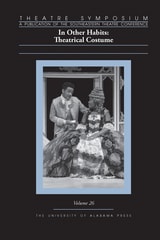
Theatre Symposium, Vol. 26
In Other Habits: Theatrical CostumeSarah McCarroll
University of Alabama Press, 2018
Stage costumes reveal character. They tell audiences who the character is or how a character functions within the world of the play, among other things. Theatrical costuming, however, along with other forms of theatre design, has often been considered merely a craft, rather than part of the deeply systemic creation of meaning onstage. In what ways do our clothes shape and reveal our habits of behavior? How do stage costumes work to reveal one kind of habit via the manipulation of another? How might theatre practitioners learn to most effectively exploit this dynamic? Theatre Symposium, Volume 26 analyzes the ways in which meaning is conveyed through costuming for the stage and explores the underlying assumptions embedded in theatrical practice and costume production.
THEATRE SYMPOSIUM, VOLUME 26
MICHELE MAJER
Plus que Reine: The Napoleonic Revival in Belle Epoque Theatre and Fashion
CAITLIN QUINN
Creating a Realistic Rendering Pedagogy: The Fashion Illustration Problem
ALY RENEE AMIDEI
Where'd I Put My Character?: The Costume Character Body and Essential Costuming for the Ensemble Actor
KYLA KAZUSCHYK
Embracing the Chaos: Creating Costumes for Devised Work
DAVID S. THOMPSON
Dressing the Image: Costumes in Printed Theatrical Advertising
LEAH LOWE
Costuming the Audience: Gentility, Consumption, and the Lady’s Theatre Hat in Gilded Age America
JORGE SANDOVAL
The RuPaul Effect: The Exploration of the Costuming Rituals of Drag Culture in Social Media and the Theatrical Performativity of the Male Body in the Ambit of the Everyday
GREGORY S. CARR
A Brand New Day on Broadway: The Genius of Geoffrey Holder’s Artistry and His Intentional Evocation of the African Diaspora
ANDREW GIBB
On the [Historical] Sublime: J. R. Planché’s King John and the Romantic Ideal of the Past
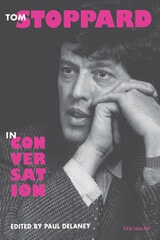
Tom Stoppard in Conversation
Paul Delaney, Editor
University of Michigan Press, 1994
This collection of interviews with British playwright Tom Stoppard, author of such well-known comedies as Travesties, Jumpers, and Rosencrantz and Guildenstern Are Dead, brings together for the first time Stoppard's most significant assessments of his own work.
A wide range of discussions are featured, from extensive conversations with the editors of Theatre Quarterly and Gambit to important interviews in lesser-known periodicals. The interviews include the playwright's unguarded comments to the daily press, from those of a dazzled young Stoppard the morning after the triumphant opening of Rosencrantz and Guildenstern to those of a veteran playwright still smarting from caustic reviews 36 hours after the opening of Hapgood. The interviews cover the full range of Stoppard's work, from his adaptations for the stage to his increasing involvement in film, and this volume makes many of them available for the first time. Also appearing for the first time in print are transcripts of radio interviews and an informal lecture by Stoppard called "The Event and the Text."
Tom Stoppard's conversations about his work shed light on questions of authorial intent and the creative process. Debates over interpretations of the plays will be enhanced by this record of Stoppard's own perceptions and insights. The collection also includes the most extensive bibliography and discography ever compiled of Stoppard's print interviews, broadcast interviews, and lectures.
Witty, illuminating, and informative, Tom Stoppard in Conversation will be of interest to scholars, students, directors, actors, and fans of Stoppard's work.