Results by title
191 books match the query 'Politics and literature' and 32 start with t
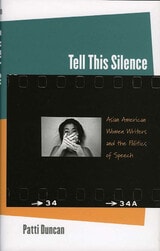
Tell This Silence
Asian American Women Writers And The Politics Of SpeechPatti Duncan
University of Iowa Press, 2004
However, as the writers discussed in Tell This Silence suggest, silence too has multiple meanings especially in contexts like the U.S., where speech has never been a guaranteed right for all citizens. Duncan argues that writers such as Maxine Hong Kingston, Mitsuye Yamada, Joy Kogawa, Theresa Hak Kyung Cha, Nora Okja Keller, and Anchee Min deploy silence as a means of resistance. Juxtaposing their “unofficial narratives” against other histories—official U.S. histories that have excluded them and American feminist narratives that have stereotyped them or distorted their participation—they argue for recognition of their cultural participation and offer analyses of the intersections among gender, race, nation, and sexuality.
Tell This Silence offers innovative ways to consider Asian American gender politics, feminism, and issues of immigration and language. This exciting new study will be of interest to literary theorists and scholars in women's, American, and Asian American studies.
Testimonio
On The Politics Of TruthJohn Beverley
University of Minnesota Press, 2004
A revealing perspective on the controversial literature of witnessing
These four germinal essays by John Beverley sparked the widespread discussion and debate surrounding testimonio—the socially and politically charged Latin American narrative of witnessing—that culminated with David Stoll’s highly publicized attack on Rigoberta Menchú’s celebrated testimonial text. Challenging Hardt and Negri’s Empire, Beverley’s extensive new introduction examines the broader historical, political, and ethical issues that this literature raises, tracing the development of testimonio from its emergence in the Cold War era to the rise of a globalized economy and U.S. political hegemony.
Informed by postcolonial studies and the current debate over multiculturalism and identity politics, Testimonio reaches across disciplinary boundaries to show how this particular literature at once represents and enacts new forms of agency on the part of previously repressed social subjects, as well as its potential as a new form of “alliance politics” between those subjects and artists, scientists, teachers, and intellectuals in a variety of local, national, and international contexts.
Text/Politics in Island Southeast Asia
Essays in InterpretationD.M. Roskies
Ohio University Press, 1993
Textual Conspiracies
Walter Benjamin, Idolatry, and Political TheoryJames R. Martel
University of Michigan Press, 2012
“This is a sophisticated and fascinating argument written in a very enjoyably entertaining style. It is hard for me to see how readers initially interested in these texts will not be ‘swept off their feet’ by the core assertions of this author, and the devastatingly comprehensive way in which he demonstrates those arguments.”
—Brent Steele, University of Kansas
In Textual Conspiracies, James R. Martel applies the literary, theological, and philosophical insights of Walter Benjamin to the question of politics and the predicament of the contemporary left. Through the lens of Benjamin’s theories, as influenced by Kafka, of the fetishization of political symbols and signs, Martel looks at the ways in which various political and literary texts “speak” to each other across the gulf of time and space, thereby creating a “textual conspiracy” that destabilizes grand narratives of power and authority and makes the narratives of alternative political communities more apparent.
However, in keeping with Benjamin’s insistence that even he is complicit with the fetishism that he battles, Martel decentralizes Benjamin’s position as the key theorist for this conspiracy and contextualizes Benjamin in what he calls a “constellation” of pairs of thinkers and writers throughout history, including Alexis de Tocqueville and Edgar Allen Poe, Hannah Arendt and Federico García Lorca, and Frantz Fanon and Assia Djebar.
The Avant-Garde and the Popular in Modern China
Tian Han and the Intersection of Performance and PoliticsLiang Luo
University of Michigan Press, 2014
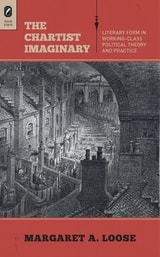
The Chartist Imaginary
Literary Form in Working-Class Political Theory and PracticeMargaret A. Loose
The Ohio State University Press, 2014
The Chartist Imaginary offers close readings of poems and fiction by Chartist figures from Ernest Jones and Thomas Cooper to W. J. Linton, Thomas Martin Wheeler, and Gerald Massey. It also draws on extensive archival research to examine, for the first time, working-class female Chartist poets Mary Hutton, E. L. E., and Elizabeth La Mont. Focusing on the literary form of these works, Loose strongly argues for the political power of the aesthetic in working-class literature.
The English Civil Wars in the Literary Imagination
Edited by Claude J. Summers & Ted-Larry Pebworth
University of Missouri Press, 1999
The English civil wars loom large in seventeenth-century history and literature. This period, which culminated in the execution of a king, the dismantling of the Established Church, the inauguration of a commonwealth, and the assumption of rule by a lord protector, was one of profound change and disequilibrium. Focusing on writers as major as Milton, Marvell, Herrick, and Vaughan, and as misunderstood as Fane, Overton, and the poet Eliza, the fifteen essays in this collection discuss not only the representation of the civil wars but also the ways in which the civil wars were anticipated, refigured, and refracted in the century's literary imagination.
Although all of the essays are historically grounded and critically based, they vary widely in their historical perspectives and critical techniques, as well as in their scope and area of concentration. Six of the essays are on Royalist literary figures, six are on figures traditionally associated with the Parliamentarian side of the civil wars, two consider both, and the remaining essay examines how Royalist writers refashioned a puritan literary trope.
Unified through the contributors' concentration on "moderate" voices and their recurrent concerns with the ambiguities of literary response, The English Civil Wars in the Literary Imagination provides an important understanding of the English civil wars' manifold and sometimes indirect presence in the literature of the period.
The Errant Art of Moby-Dick
The Canon, the Cold War, and the Struggle for American StudiesWilliam V. Spanos
Duke University Press, 1995
Combining Heideggerian ontology with a sociopolitical perspective derived primarily from Foucault, the reading of Moby-Dick that forms the center of this book demonstrates that the traditional identification of Melville’s novel as a "romance" renders it complicitous in the discourse of the Cold War. At the same time, Spanos shows how New Americanist criticism overlooks the degree to which Moby-Dick anticipates not only America’s self-representation as the savior of the world against communism, but also the emergent postmodern and anti-imperial discourse deployed against such an image. Spanos’s critique reveals the extraordinary relevance of Melville’s novel as a post-Cold War text, foreshadowing not only the self-destructive end of the historical formation of the American cultural identity in the genocidal assault on Vietnam, but also the reactionary labeling of the current era as "the end of history."
This provocative and challenging study presents not only a new view of the development of literary history in the United States, but a devastating critique of the genealogy of ideology in the American cultural establishment.
The Fragmented Novel in Mexico
The Politics of FormBy Carol Clark D'Lugo
University of Texas Press, 1997
From Mariano Azuela's 1915 novel Los de abajo to Rosamaría Roffiel's Amora of 1989, fragmented narrative has been one of the defining features of innovative Mexican fiction in the twentieth century. In this innovative study, Carol Clark D'Lugo examines fragmentation as a literary strategy that reflects the social and political fissures within modern Mexican society and introduces readers to a more participatory reading of texts.
D'Lugo traces defining moments in the development of Mexican fiction and the role fragmentation plays in each. Some of the topics she covers are nationalist literature of the 1930s and 1940s, self-referential novels of the 1950s that focus on the process of reading and writing, the works of Carlos Fuentes, novels of La Onda that came out of rebellious 1960s Mexican youth culture, gay and lesbian fiction, and recent women's writings.
With its sophisticated theoretical methodology that encompasses literature and society, this book serves as an admirable survey of the twentieth-century Mexican novel. It will be important reading for students of Latin American culture and history as well as literature.
The Insubordination of Signs
Political Change, Cultural Transformation, and Poetics of the CrisisNelly Richard
Duke University Press, 2004
In The Insubordination of Signs Richard theorizes the cultural reactions—particularly within the realms of visual arts, literature, and the social sciences—to the oppression of the Chilean dictatorship. She reflects on the role of memory in the historical shadow of the military regime and on the strategies offered by marginal discourses for critiquing institutional systems of power. She considers the importance of Walter Benjamin for the theoretical self-understanding of the Latin American intellectual left, and she offers revisionary interpretations of the Chilean neo-avantgarde in terms of its relationships with the traditional left and postmodernism. Exploring the gap between Chile’s new left social sciences and its “new scene” aesthetic and critical practices, Richard discusses how, with the return of democracy, the energies that had set in motion the democratizing process seemed to exhaust themselves as cultural debate was attenuated in order to reduce any risk of a return to authoritarianism.
The Left Bank
Writers, Artists, and Politics from the Popular Front to the Cold WarHerbert Lottman
University of Chicago Press, 1998
"Surprisingly fresh and intense. . . . A retrospective travelogue of the Left Bank in the days when it was the setting for almost all French intellectual activity. . . . Absorbing."—Naomi Bliven, New Yorker
"As an introduction to a period in French history already legendary, The Left Bank is superb."—Michael Dirda, Washington Post Book World
"An intellectual history. A history of the interaction between politics and letters. And a rumination on the limitless credulity of intellectuals."—Christopher Hitchens, New Statesman
The News from Poems
Essays on the 21st-Century American Poetry of EngagementJeffrey Gray and Ann Keniston
University of Michigan Press, 2016
The News from Poems brings together newly commissioned essays by eminent poets and scholars of poetry and serves as a companion volume to an earlier anthology of engaged poetry compiled by the editors. Essays by Bob Perelman, Steven Gould Axelrod, Tony Hoagland, Eleanor Wilner, and others reveal how recent poetry has redefined our ideas of politics, authorship, identity, and poetics.
The volume showcases the diversity of contemporary American poetry, discussing mainstream and experimental poets, including some whose work has sparked significant controversy. These and other poets of our time, the volume suggests, are engaged not only with public events and topics but also with new ways of imagining subjectivity, otherness, and poetry itself.
The Novel and the American Left
Critical Essays on Depression-Era FictionJanet Galligani Casey
University of Iowa Press, 2004
The first collection of critical essays to focus specifically on the fiction produced by American novelists of the Depression era, The Novel and the American Left contributes substantially to the newly emerging emphasis on twentieth-century American literary radicalism. Recent studies have recovered this body of work and redefined in historical and theoretical terms its vibrant contribution to American letters. Casey consolidates and expands this field of study by providing a more specific consideration of individual novels and novelists, many of which are reaching new contemporary audiences through reprints.
The Novel and the American Left focuses exclusively on left-leaning fiction of the Depression era, lending visibility and increased critical validity to these works and showing the various ways in which they contributed not only to theorizations of the Left but also to debates about the content and form of American fiction. In theoretical terms, the collection as a whole contributes to the larger reconceptualization of American modernity currently under way. More pragmatically, individual essays suggest specific authors, texts, and approaches to teachers and scholars seeking to broaden and/or complicate more traditional “American modernism” syllabi and research agendas.
The selected essays take up, among others, such “hard-core"” leftist writers as Mike Gold and Myra Page, who were associated with the Communist Party; the popular novels of James M. Cain and Kenneth Fearing, whose works were made into successful films; and critically acclaimed but nonetheless “lost” novelists such as Josephine Johnson, whose Now in November (Pulitzer Prize, 1936) anticipates and complicates the more popular agrarian mythos of Steinbeck’s The Grapes of Wrath.
This volume will be of interest not only to literary specialists but also to historians, social scientists, and those interested in American cultural studies.
The Plight of Feeling
Sympathy and Dissent in the Early American NovelJulia A. Stern
University of Chicago Press, 1997
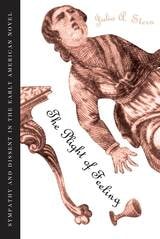
Stern argues that these novels gave voice to a collective mourning over the violence of the Revolution and the foreclosure of liberty for the nation's noncitizens—women, the poor, Native and African Americans. Properly placed in the context of late eighteenth-century thought, the republican novel emerges as essentially political, offering its audience gothic and feminized counternarratives to read against the dominant male-authored accounts of national legitimation.
Drawing upon insights from cultural history and gender studies as well as psychoanalytic, narrative, and genre theory, Stern convincingly exposes the foundation of the republic as an unquiet crypt housing those invisible Americans who contributed to its construction.
The Political Arrays of American Indian Literary History
James H. Cox
University of Minnesota Press, 2019
Bringing fresh insight to a century of writing by Native Americans
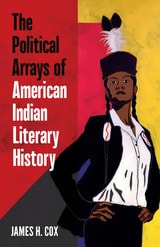
The Political Arrays of American Indian Literary History challenges conventional views of the past one hundred years of Native American writing, bringing Native American Renaissance and post-Renaissance writers into conversation with their predecessors. Addressing the political positions such writers have adopted, explored, and debated in their work, James H. Cox counters what he considers a “flattening” of the politics of American Indian literary expression and sets forth a new method of reading Native literature in a vexingly politicized context.
Examining both canonical and lesser-known writers, Cox proposes that scholars approach these texts as “political arrays”: confounding but also generative collisions of conservative, moderate, and progressive ideas that together constitute the rich political landscape of American Indian literary history. Reviewing a broad range of genres including journalism, short fiction, drama, screenplays, personal letters, and detective fiction—by Lynn Riggs, Will Rogers, Sherman Alexie, Thomas King, Leslie Marmon Silko, Louise Erdrich, Winona LaDuke, Carole laFavor, and N. Scott Momaday—he demonstrates that Native texts resist efforts to be read as advocating a particular set of politics
Meticulously researched, The Political Arrays of American Indian Literary History represents a compelling case for reconceptualizing the Native American Renaissance as a literary–historical constellation. By focusing on post-1968 Native writers and texts, argues Cox, critics have often missed how earlier writers were similarly entangled, hopeful, frustrated, contradictory, and unpredictable in their political engagements.
The Politics of Privacy in Contemporary Native, Latinx, and Asian American Metafictions
Colleen G. Eils
The Ohio State University Press, 2020
Eils breaks strict disciplinary silos by putting visibility/surveillance studies, ethnic studies, and narrative studies in conversation with one another. Eils also puts texts in the Native, Latinx, and Asian American literary canon in conversation with each other. She focuses on texts by Viet Thanh Nguyen, David Treuer, Monique Truong, Rigoberto González, Nam Le, and Stephen Graham Jones that call into question our positions as readers and critics. In deliberately and self-consciously evading readers through the form of their fiction, these writers seize privacy as a political tool for claiming and wielding power in both representational and material registers.
The Politics of Revelation in the English Renaissance
Ester Gilman Richey
University of Missouri Press, 1998
Recognizing that the seventeenth century's volatile debate over apocalyptic interpretation has since become a one-sided discussion, Esther Gilman Richey develops a context that recovers the dynamism so inherent in the writings of the period and provides illuminating details that enhance the prophetic continuum. The Politics of Revelation in the English Renaissance does not ignore the familiar prophetic verse of Spenser and Milton, but it significantly expands the scope of study by examining the interpretations of both men and women who represent a range of ecclesiastical and political perspectives.
Richey rejects Barbara Lewalski's claim that the radical, prophetic writers and metaphysical poets of the seventeenth century drew inspiration from distinct biblical models, the former from the Apocalypse and the latter from the Psalms. Instead she contends that even writers such as Donne and Herbert, whom we have long considered "literary," were in reality using their poetry to participate in the hottest debates of the time.
While the radical writers, such as Spenser and Milton, were immediately responsive to ecclesiastical and political controversies, the conservative, metaphysical poets—Donne, Herbert, and Vaughan—were posing equally politically charged questions: Is the pope Antichrist? Is the Bride of Christ pure? Is the Temple a model of ecclesiastical reform? The writers of the period did not move in divided and distinguished worlds, but in fact constantly responded to one another through poetic and politically charged dialogue.
By drawing from the writings of various individuals, both radical and conformist, male and female, Richey traces the shifting representations of the apocalyptic Bride and Temple over time. Organized chronologically, the chapters of The Politics of Revelation in the English Renaissance reveal the escalating debate among the pacifists, conformists, militants, and feminists. Not only does Richey uncover the prophetic dimension of conformist writers usually described as apolitical and devotional, but she also explores the writings of lesser-known women prophets: Aemilia Lanyer, Mary Cary, Anna Trapnel, and Margaret Fell. In such biblical passages as the apocalyptic "woman clothed with the sun," these early feminists find the authority for their own prophetic speech.
This provocative analysis—at once far-reaching and tightly focused—reveals the complexity of the apocalyptic discourse that transpired among Renaissance writers and poets.
The Problem of the Future World
W. E. B. Du Bois and the Race Concept at MidcenturyEric Porter
Duke University Press, 2010
The Pull of Politics
Steinbeck, Wright, Hemingway, and the Left in the Late 1930sMilton A. Cohen
University of Missouri Press, 2018
The Ruse of Repair
US Neoliberal Empire and the Turn from CritiquePatricia Stuelke
Duke University Press, 2021
The Sound of Listening
Poetry as Refuge and ResistancePhilip Metres
University of Michigan Press, 2018
Philip Metres stakes a claim for the cultural work that poems can perform—from providing refuge to embodying resistance, from recovering silenced voices to building a more just world, in communities of solitude and solidarity. Gathering a decade of his writing on poetry, he widens our sense of poetry as a way of being in the world, proposing that poems can offer a permeability to marginalized voices and a shelter from the imperial noise and despair that can silence us. The Sound of Listening ranges between expansive surveys of the poetry of 9/11, Arab American poetry, documentary poetry, landscape poetry, installation poetry, and peace poetry; personal explorations of poets such as Adrienne Rich, Khalil Gibran, Lev Rubinstein, and Arseny Tarkovsky; and intimate dialogues with Randa Jarrar, Fady Joudah, and Micah Cavaleri, that illuminate Metres’s practice of listening in his 2015 work, Sand Opera.

The Springs of Liberty
The Satiric Tradition and Freedom of SpeechStewart Justman
Northwestern University Press, 1999

The Subaltern Ulysses
Enda Duffy
University of Minnesota Press, 1994
The Subaltern Ulysses was first published in 1994. Minnesota Archive Editions uses digital technology to make long-unavailable books once again accessible, and are published unaltered from the original University of Minnesota Press editions.
How might an IRA bomb and James Joyce's Ulysses have anything in common? Could this masterpiece of modernism, written at the violent moment of Ireland's national emergence, actually be the first postcolonial novel? Exploring the relation of Ulysses to the colony in which it is set, and to the nation being born as the book was written, Enda Duffy uncovers a postcolonial modernism and in so doing traces another unsuspected strain within the one-time critical monolith. In the years between 1914 and 1921, as Joyce was composing his text, Ireland became the first colony of the British Empire to gain its independence in this century after a violent anticolonial war. Duffy juxtaposes Ulysses with documents and photographs from the archives of both empire and insurgency, as well as with recent postcolonial literary texts, to analyze the political unconscious of subversive strategies, twists on class and gender, that render patriarchal colonialist culture unfamiliar.
Ulysses, Duffy argues, is actually a guerrilla text, and here he shows how Joyce's novel pinpoints colonial regimes of surveillance, mocks imperial stereotypes of the "native," exposes nationalism and other chauvinistic ideologies of "imagined community" as throwbacks to the colonial ethos, and proposes versions of a postcolonial subject. A significant intervention in the massive "Joyce industry" founded on the rhetoric and aesthetics of high modernism, Duffy's insights show us not only Ulysses, but also the origins of postcolonial textuality, in a startling new way.Enda Duffy is assistant professor of English at the University of California at Santa Barbara.
The Transformation of Authorship in America
Grantland S. Rice
University of Chicago Press, 1997
Rice shows that the rigorous censorship practiced by Puritan authorities conferred an implicit prestige on texts as civic interventions, helping to foster a vigorous and indigenous tradition of sociopolitical criticism. With special attention to the sudden emergence of the novel in post-revolutionary America, Rice reveals how the emergence of economic liberalism undermined the earlier tradition of political writing by transforming American authorship from an expression of individual civic conscience to a market-oriented profession.
Includes discussions of the writings of Benjamin Franklin, Michel-Guillaume-Jean de Crèvecoeur, and Hugh Henry Brackenridge.

The Unruly Voice
Rediscovering Pauline Elizabeth HopkinsEdited by John Cullen Gruesser
University of Illinois Press, 1996
The work and times of the Black writer, editor, and intellectual
John Cullen Gruesser edits essays that explore the literary and journalistic career of Pauline Elizabeth Hopkins. A Black woman writer at the turn of the twentieth century, Hopkins worked as the unacknowledged editor-in-chief of the Colored American Magazine but also wrote short fiction, novels, nonfiction articles, and a play believed to be the first by a Black woman. Versatile and politically committed, she was fired when her strong editorial stands and non-conciliatory politics offended the new owner of Colored American Magazine.
A rare examination of an overlooked figure in Black letters, The Unruly Voice explores Hopkins’s writing and her significance for contemporary readers.
Contributors: Elizabeth Ammons; Kristina Brooks; Lois Lamphere Brown; C. K. Doreski; John Cullen Gruesser; Jennie A. Kassanoff; Kate McCullough; Nelly Y. McKay; and Cynthia D. Schrager
The Untimely Present
Postdictatorial Latin American Fiction and the Task of MourningIdelber Avelar
Duke University Press, 1999
Avelar starts by offering new readings of works produced before the dictatorship era, in what is often considered the boom of Latin American fiction. Distancing himself from previous celebratory interpretations, he understands the boom as a manifestation of mourning for literature’s declining aura. Against this background, Avelar offers a reassessment of testimonial forms, social scientific theories of authoritarianism, current transformations undergone by the university, and an analysis of a number of novels by some of today’s foremost Latin American writers—such as Ricardo Piglia, Silviano Santiago, Diamela Eltit, João Gilberto Noll, and Tununa Mercado. Avelar shows how the ‘untimely’ quality of these narratives is related to the position of literature itself, a mode of expression threatened with obsolescence.
This book will appeal to scholars and students of Latin American literature and politics, cultural studies, and comparative literature, as well as to all those interested in the role of literature in postmodernity.
The Vanishing Frame
Latin American Culture and Theory in the Postdictatorial EraBy Eugenio Claudio Di Stefano
University of Texas Press, 2018
In the postdictatorial era, Latin American cultural production and criticism have been defined by a series of assumptions about politics and art—especially the claim that political freedom can be achieved by promoting a more direct experience between the textual subject (often a victim) and the reader by eliminating the division between art and life. The Vanishing Frame argues against this conception of freedom, demonstrating how it is based on a politics of human rights complicit with economic injustices. Presenting a provocative counternarrative, Eugenio Claudio Di Stefano examines literary, visual, and interdisciplinary artists who insist on the autonomy of the work of art in order to think beyond the politics of human rights and neoliberalism in Latin American theory and culture.
Di Stefano demonstrates that while artists such as Diamela Eltit, Ariel Dorfman, and Albertina Carri develop a concept of justice premised on recognizing victims’ experiences of torture or disappearance, they also ignore the injustice of economic inequality and exploitation. By examining how artists such as Roberto Bolaño, Alejandro Zambra, and Fernando Botero not only reject an aesthetics of experience (and the politics it entails) but also insist on the work of art as a point of departure for an anticapitalist politics, this new reading of Latin American cultural production offers an alternative understanding of recent developments in Latin American aesthetics and politics that puts art at its center and the postdictatorship at its end.
The Visceral Logics of Decolonization
Neetu Khanna
Duke University Press, 2020
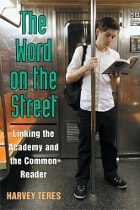
The Word on the Street
Linking the Academy and the Common ReaderHarvey Michael Teres
University of Michigan Press, 2010
"The Word On the Street invites humanities scholars to move beyond the classroom and the monograph to share the pleasures of art in ways that engage the intelligence of the common reader, cultivating the critical imagination so vital to American cultural democracy. Lively and thought-provoking, Teres lays out contemporary debates and wades into them with gusto."
---Nancy Cantor, Syracuse University
"At a moment when questions about the literary, 'bookishness,' and the future of print are being urgently raised, with incessant national attention to the perceived crises of literacy and reading, Teres' thoughtful, broadly democratic, but also tough-minded examination of both 'common readers' and academic readers makes a real contribution to the debate."
---Julie Ellison, University of Michigan
Despite significant changes since the mid-twentieth century in American critical culture---the culture emanating from the serious review of books, ideas, and the arts---it attracts only a small and declining minority of Americans. However productive this culture has been, American society has not approached the realization of Emerson's or Dewey's vision of a highly participatory American cultural democracy. Such a culture requires critics who are read by the average citizen, but the migration of critics and intellectuals from the public to the academy has resulted in fewer efforts to engage with ordinary citizens. The Word on the Street investigates this disjunction between the study of literature in the academy and the interests of the common reader and society at large, arguing the vital importance of publicly engaged scholarship in the humanities. Teres chronicles how the once central function of the humanities professorate---to teach students to appreciate and be inspired by literature---has increasingly been lost to literary and cultural studies in the last thirty years.
The Word on the Street argues for a return to an earlier model of the public intellectual and a literary and cultural criticism that is accessible to ordinary citizens. Along the way, Teres offers an illuminating account of the current problem and potential solutions, with the goal of prompting a future vision of publicly engaged scholarship that resonates with the common reader and promotes an informed citizenry.
Harvey Teres is Associate Professor of English at Syracuse University.
Cover image: Ruth Fremson/The New York Times/Redux
The New Public Scholarship
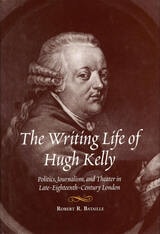
The Writing Life of Hugh Kelly
Politics, Journalism, and Theatre in Late-Eighteenth-Century LondonRobert R. Bataille
Southern Illinois University Press, 2000
Robert R. Bataille demonstrates convincingly that between 1767 and 1777, Anglo-Irish writer Hugh Kelly made major contributions in three areas of British culture: politics, journalism, and theater. Bataille shows how all three activities were integrated in Kelly’s life, suggesting that such interrelationships often existed in the rough and ready London culture during the early reign of King George III.
When he discovered several newspaper campaigns that Kelly orchestrated as a paid political propagandist for George III and his ministers, Bataille understood in part how important Kelly was to his era. In his capacity as propagandist, Kelly defended Hanoverian colonial policies on the eve of the American Revolution, served as a key opponent of the radical Wilkites, and promoted the acceptance of the 1774 Quebec Bill, which established, among other things, the right of the recently defeated French citizens of Quebec to maintain the French language.
A belletristic journalist, Kelly published theater reviews and essays that played a major role in shaping the taste of his era. He wrote in defense of the controversial sentimental drama, and whenever he could, he promoted the major theatrical figure of the age, David Garrick. Under his editorship, the newspaper Public Ledger became a leading source of theater information. Seeking to raise the status of the profession of journalism, he wrote essays and articles that provided his middle-class readers with an insider’s view of the operations of the journalist.
Assessing Kelly’s contributions to the novel and drama, Bataille argues that this powerful journalist stands in the vanguard in the larger struggle against traditional attitudes supporting male superiority and aristocratic privilege. Kelly wrote in favor of gender equality and middle-class respectability, striving to inculcate what modern scholars refer to as the values of sensibility. Bataille also argues, however, that Kelly knew his audience. Instrumental in the rise of professional writing and popular culture, he understood that he had to observe the needs of his audience, detecting cultural trends and using the skills of the rhetorician.
Trespasses
Selected WritingsMasao Miyoshi
Duke University Press, 2010
This volume brings together eleven selections of Miyoshi’s previously published writing, a major new essay, a critical introduction to his life and work, and an interview in which Miyoshi reflects on the trajectory of his thought and the institutional history of modern Japan studies. In the new essay, “Literary Elaborations,” he provides a masterful overview of the nature of the contemporary university, closing with a call for a global environmental protection studies that would radically reconfigure academic disciplines and merge the hard sciences with the humanities and the social sciences. In the other, chronologically arranged selections, Miyoshi addresses cross-culture relations between Japan and the United States, English literary studies in Japan, and Japan studies in the U.S., as well as the organization of urban space and the integrity of art and architecture in aggressively marketed-oriented environments. Trespasses is an invaluable introduction to the work of a fearless cultural critic.
Tyrants Writing Poetry
Albrecht Koschorke
Central European University Press, 2018