Results by title
54 books match the query 'Populism' and 12 start with t

The Humane Economy
Populism, Capitalism, and DemocracyPollack, Norman
Rutgers University Press, 1990

The Impact of Populism on the Party System
The Experience of European Democracies (2000–2020)Edited by Jirí Kocián, Michal Kubát, and Martin Mejstrík
Karolinum Press, 2026
Analyzes the influence of populism on the development and transformation of parties and party systems in seven European countries between 2000 and 2020.
The Impact of Populism on the Party System: The Experience of European Democracies (2000–2020) analyzes the influence of populism on the development and transformation of parties and party systems in Hungary, Poland, Greece, Germany, Spain, Czechia, and France in the first two decades of the twenty-first century. In individual case studies, the international team of authors asks to what extent the rise of populist parties witnessed during the period in question caused increased polarization and ideological distance between parties in a given country, and whether this polarization led to a transformation in party system. Moderate party systems can be transformed into polarized party systems under the influence of populism, with a high degree of polarization affecting the functioning of the entire democratic regime. In extreme cases, the very democratic essence of European political regimes may be threatened.
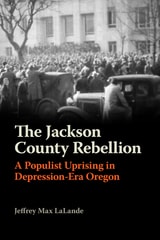
The Jackson County Rebellion
A Populist Uprising in Depression-Era OregonJeffrey Max LaLande
Oregon State University Press, 2023
The Jackson County Rebellion explores a dramatic if little-known populist insurgency in the American West. Author Jeff LaLande takes a deep dive into a tumultuous uprising that captured national attention as it played out in rural Oregon. First tracing its roots back to the area’s tradition of protest, including the Ku Klux Klan of the 1920s, he focuses on Jackson County’s politics of upheaval during the worst days of the Great Depression. The broad strokes of the episode may be familiar to contemporary readers: Demagogues fanning rage — relentlessly accusing an elite of corruption and conspiracy. The strife-torn episode featured nativist and anti-Semitic elements.
The local press played a key role in the events. Two inflammatory newspapers, one owned by wealthy orchardist Llewellyn Banks and the other by politician Earl Fehl, became the vehicles by which these men won the loyalty of rural and working-class residents. Partners in demagoguery, Banks and Fehl created a movement — dubbed the “Good Government Congress” that very nearly took over county government through direct action, ballot theft, and threats of violence. Among those opposing the two men was Harvard-educated Robert Ruhl, owner/editor of the Medford Mail-Tribune, who faced off against Banks and Fehl. Despite boycotts and threats of sabotage. Ruhl ran a resolute editorial campaign against the populist threat in his Mail-Tribune, which won a Pulitzer Prize for its reporting on the uprising.
The rebellion blazed hotly but not for long. Its end was marked by the arrest of its leaders after the fiercely contested 1932 election and by Banks’s murder of the police officer sent to arrest him. Placing the Jackson County Rebellion squarely within America’s long tradition of populist uprisings against the perceived sins of an allegedly corrupt, affluent local elite, LaLande argues that this little-remembered episode is part of a long history of violent conflict in the West that continues today.

The Long March of Coxey’s Army
The Path of Protest from Populism to the New DealWesley R. Bishop
University of Illinois Press, 2027
Wesley R. Bishop explores how Coxey and his allies organized the first national protest to bring citizens to Washington, D.C. Though the march failed in its immediate goals, for the next forty years its ideas influenced America’s political parties. The demonstration pioneered marching for economic justice while its push for federal public works projects and government responsibility for unemployment helped shaped the New Deal. But in the years after the march, racism and other types of exclusion muddied hopes and tainted demands for democratic and economic fairness.
Eye-opening and insightful, The Long March of Coxey’s Army examines the influence and aftermath of an important historical event.

The Macroeconomics of Populism in Latin America
Edited by Rudiger Dornbusch and Sebastian Edwards
University of Chicago Press, 1991
Economists and political scientists from the United States and Latin America detail in this volume how and why such programs go wrong and what leads policymakers to repeatedly adopt these policies despite a history of failure. Authors examine this pattern in Argentina, Brazil, Chile, Mexico, Nicaragua, and Peru—and show how Colombia managed to avoid it. Despite differences in how each country implemented its policies, the macroeconomic consequences were remarkably similar.
Scholars of Latin America will find this work a valuable resource, offering a distinctive macroeconomic perspective on the continuing controversy over the dynamics of populism.

The Perils of Populism
Sarah Tobias
Rutgers University Press, 2022
The Perils of Populism shows how a feminist lens can help diagnose the factors behind the global rise of right-wing populism and teach us how to resist the threat it presents to democracy. Featuring interdisciplinary essays about politics in the United States, the Middle East, Europe, and India from a variety of acclaimed theorists and activists, the volume contributes to a rapidly expanding literature on gender and the far right. Together, these chapters offer a truly intersectional analysis of the problem, addressing everything from how populism has thrived in a “post-truth” era to the ways it appeals to working-class voters looking for an alternative to neoliberalism. Yet the authors also find reasons to be hopeful, as they showcase forms of grassroots feminist activism that challenge right-wing populism by advocating for racial and economic justice.
The Politics of Petulance
America in an Age of ImmaturityAlan Wolfe
University of Chicago Press, 2018
Alan Wolfe has an answer. In The Politics of Petulance he argues that the core of our problem isn’t Trump himself—it’s that we are mired in an age of political immaturity. That immaturity is not grounded in any one ideology, nor is it a function of age or education. It’s in an abdication of valuing the character of would-be leaders; it’s in a failure to acknowledge, even welcome the complexity of government and society; and it’s in a loss of the ability to be skeptical without being suspicious. In 2016, many Americans were offered tantalizingly simple answers to complicated problems, and, like children being offered a lunch of Pop Rocks and Coke, they reflexively—and mindlessly—accepted.
The good news, such as it is, is that we’ve been here before. Wolfe reminds us that we know how to grow up and face down Trump and other demagogues. Wolfe reinvigorates the tradition of public engagement exemplified by midcentury intellectuals such as Richard Hofstadter, Reinhold Niebuhr, and Lionel Trilling—and he draws lessons from their battles with McCarthyism and conspiratorial paranoia. Wolfe mounts a powerful case that we can learn from them to forge a new path for political intervention today.
Wolfe has been thinking and writing about American life and politics for decades. He sees this moment as one of real risk. But he’s not throwing up his hands; he’s bracing us. We’ve faced demagogues before. We can find the intellectual maturity to fight back. Yes we can.
The Rise of Populist Nationalism
Social Resentments and Capturing the Constitution in HungaryBalázs Majtényi
Central European University Press, 2020

The Road to Rebellion
Class Formation and Kansas Populism, 1865-1900Scott G. McNall
University of Chicago Press, 1988
McNall rejects the traditional view that blames the failure of the Alliance on a turn to mass-based electoral politics, but rather sees the move into national politics by the Farmer's Alliance as part of a rational strategy to better wage their fight for economic justice. The Kansas populists failed, he argues, because of their inability to embrace a broad, working-class base, to provide an effective alternative vision, and ultimately to create a distinct class organization. Debates about how classes come into being, or how democracy is to be realized, cannot be settled in the abstract. McNall's recreation of this heroic struggle is a model in the analysis of class formation. At the same time, The Road to Rebellion is dynamic social history, which holds vital lessons for structuring and realizing alternative political agendas today.

The Shape of Populism
Serbia before the Dissolution of YugoslaviaMarko Grdešic
University of Michigan Press, 2019
The University and the People
Envisioning American Higher Education in an Era of Populist ProtestScott M. Gelber
University of Wisconsin Press, 2011
The University and the People chronicles the influence of Populism—a powerful agrarian movement—on public higher education in the late nineteenth century. Revisiting this pivotal era in the history of the American state university, Scott Gelber demonstrates that Populists expressed a surprising degree of enthusiasm for institutions of higher learning. More fundamentally, he argues that the mission of the state university, as we understand it today, evolved from a fractious but productive relationship between public demands and academic authority.
Populists attacked a variety of elites—professionals, executives, scholars—and seemed to confirm academia’s fear of anti-intellectual public oversight. The movement’s vision of the state university highlighted deep tensions in American attitudes toward meritocracy and expertise. Yet Populists also promoted state-supported higher education, with the aims of educating the sons (and sometimes daughters) of ordinary citizens, blurring status distinctions, and promoting civic engagement. Accessibility, utilitarianism, and public service were the bywords of Populist journalists, legislators, trustees, and sympathetic professors. These “academic populists” encouraged state universities to reckon with egalitarian perspectives on admissions, financial aid, curricula, and research. And despite their critiques of college “ivory towers,” Populists supported the humanities and social sciences, tolerated a degree of ideological dissent, and lobbied for record-breaking appropriations for state institutions.

Toward a Cooperative Commonwealth
The Transplanted Roots of Farmer-Labor Radicalism in TexasThomas Alter II
University of Illinois Press, 2022
A rare look at the German roots of radicalism in Texas, Toward a Cooperative Commonwealth illuminates the labor movements and populist ideas that changed the nation’s course at a pivotal time in its history.