138 books match the query 'Postcolonialism' and 28 start with t
cover of Taboo Memories, Diasporic Voices

Taboo Memories, Diasporic Voices

Ella Shohat

Duke University Press, 2006

Taboo Memories, Diasporic Voices brings together for the first time a selection of trailblazing essays by Ella Shohat, an internationally renowned theorist of postcolonial and cultural studies of Iraqi-Jewish background. Written over the past two decades, these twelve essays—some classic, some less known, some new—trace a powerful intellectual trajectory as Shohat rigorously teases out the consequences of a deep critique of Eurocentric epistemology, whether to rethink feminism through race, nationalism through ethnicity, or colonialism through sexuality.

Shohat’s critical method boldly transcends disciplinary and geographical boundaries. She explores such issues as the relations between ethnic studies and area studies, the paradoxical repercussions for audio-visual media of the “graven images” taboo, the allegorization of race through the refiguring of Cleopatra, the allure of imperial popular culture, and the gender politics of medical technologies. She also examines the resistant poetics of exile and displacement; the staging of historical memory through the commemorations of the two 1492s, the anomalies of the “national” in Zionist discourse, the implications of the hyphen in the concept “Arab-Jew,” and the translation of the debates on orientalism and postcolonialism across geographies. Taboo Memories, Diasporic Voices not only illuminates many of the concerns that have animated the study of cultural politics over the past two decades; it also points toward new scholarly possibilities.

[more]
cover of Tempest In The Caribbean

Tempest In The Caribbean

Jonathan Goldberg

University of Minnesota Press, 2003
Places sexuality at the center of Caribbean responses to Shakespeare's play. Shakespeare's The Tempest has long been claimed by colonials and postcolonial thinkers alike as the dramatic work that most enables them to confront their entangled history, recognized as early modernity's most extensive engagement with the vexing issues of colonialism--race, dispossession, language, European displacement and occupation, disregard for native culture. Tempest in the Caribbean reads some of the "classic" anticolonial texts--by Aimé Césaire, Roberto Fernández Retamar, George Lamming, and Frantz Fanon, for instance--through the lens of feminist and queer analysis exemplified by the theoretical essays of Sylvia Wynter and the work of Michelle Cliff. Extending the Tempest plot, Goldberg considers recent works by Caribbean authors and social theorists, among them Patricia Powell, Jamaica Kincaid, and Hilton Als. These rewritings, he suggests, and the lived conditions to which they testify, present alternatives to the masculinist and heterosexual bias of the legacy that has been derived from The Tempest. By placing gender and sexuality at the center of the debate about the uses of Shakespeare for anticolonial purposes, Goldberg's work points to new possibilities that might be articulated through the nexus of race and sexuality. Jonathan Goldberg is Sir William Osler Professor of English Literature at The Johns Hopkins University. His previous books include Shakespeare's Hand (2003), Desiring Women Writing (1997), Sodometries (1992), and, as editor, Reclaiming Sodom (1994) and Queering the Renaissance (1994).
[more]
cover of Tendings: Feminist Esoterisms and the Abolition of Man

Tendings

Feminist Esoterisms and the Abolition of Man

Nathan Snaza

Duke University Press, 2024
In Tendings, Nathan Snaza brings contemporary feminist and queer popular culture’s resurging interest in esoteric practices like tarot and witchcraft into conversation with Black feminist and new materialist thought. Analyzing writing and performances by Maryse Condé, Barbara Ehrenreich and Deirdre English, Starhawk, Christina Sharpe, Alexis Pauline Gumbs, and others, Snaza introduces his theory of tending as a concept that links ontology, attunement, care, and anticipatory action to explore how worlds persist through everyday acts of participation. In contrast to the universalizing presuppositions of the enlightenment, Snaza shows how certain feminist occult and esoteric practices constitute what he calls an endarkenment that embraces decolonial spiritual knowledge. Highlighting how endarkenment practices challenge universal presumptions and reject the racializing and colonialist mission of enlightenment modernity, Snaza demonstrates the ways esoterism affirms a pluriversal worldview that reimagines what it means to live in a more-than-human world.
[more]
cover of The Appearances of Memory: Mnemonic Practices of Architecture and Urban Form in Indonesia

The Appearances of Memory

Mnemonic Practices of Architecture and Urban Form in Indonesia

Abidin Kusno

Duke University Press, 2010

In The Appearances of Memory, the Indonesian architectural and urban historian Abidin Kusno explores the connections between the built environment and political consciousness in Indonesia during the colonial and postcolonial eras. Focusing primarily on Jakarta, he describes how perceptions of the past, anxieties about the rapid pace of change in the present, and hopes for the future have been embodied in architecture and urban space at different historical moments. He argues that the built environment serves as a reminder of the practices of the past and an instantiation of the desire to remake oneself within, as well as beyond, one’s particular time and place.

Addressing developments in Indonesia since the fall of President Suharto’s regime in 1998, Kusno delves into such topics as the domestication of traumatic violence and the restoration of order in the urban space, the intense interest in urban history in contemporary Indonesia, and the implications of “superblocks,” large urban complexes consisting of residences, offices, shops, and entertainment venues. Moving farther back in time, he examines how Indonesian architects reinvented colonial architectural styles to challenge the political culture of the state, how colonial structures such as railway and commercial buildings created a new, politically charged cognitive map of cities in Java in the early twentieth century, and how the Dutch, in attempting to quell dissent, imposed a distinctive urban visual order in the 1930s. Finally, the present and the past meet in his long-term considerations of how Java has responded to the global flow of Islamic architecture, and how the meanings of Indonesian gatehouses have changed and persisted over time. The Appearances of Memory is a pioneering look at the roles of architecture and urban development in Indonesia’s ongoing efforts to move forward.
[more]
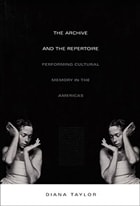
cover of The Archive and the Repertoire: Performing Cultural Memory in the Americas

The Archive and the Repertoire

Performing Cultural Memory in the Americas

Diana Taylor

Duke University Press, 2003

In The Archive and the Repertoire preeminent performance studies scholar Diana Taylor provides a new understanding of the vital role of performance in the Americas. From plays to official events to grassroots protests, performance, she argues, must be taken seriously as a means of storing and transmitting knowledge. Taylor reveals how the repertoire of embodied memory—conveyed in gestures, the spoken word, movement, dance, song, and other performances—offers alternative perspectives to those derived from the written archive and is particularly useful to a reconsideration of historical processes of transnational contact. The Archive and the Repertoire invites a remapping of the Americas based on traditions of embodied practice.

Examining various genres of performance including demonstrations by the children of the disappeared in Argentina, the Peruvian theatre group Yuyachkani, and televised astrological readings by Univision personality Walter Mercado, Taylor explores how the archive and the repertoire work together to make political claims, transmit traumatic memory, and forge a new sense of cultural identity. Through her consideration of performances such as Coco Fusco and Guillermo Gómez-Peña’s show Two Undiscovered Amerindians Visit . . . , Taylor illuminates how scenarios of discovery and conquest haunt the Americas, trapping even those who attempt to dismantle them. Meditating on events like those of September 11, 2001 and media representations of them, she examines both the crucial role of performance in contemporary culture and her own role as witness to and participant in hemispheric dramas. The Archive and the Repertoire is a compelling demonstration of the many ways that the study of performance enables a deeper understanding of the past and present, of ourselves and others.
[more]
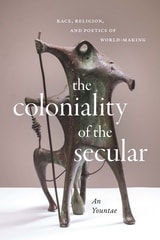
cover of The Coloniality of the Secular: Race, Religion, and Poetics of World-Making

The Coloniality of the Secular

Race, Religion, and Poetics of World-Making

An Yountae

Duke University Press, 2024

In The Coloniality of the Secular, An Yountae investigates the collusive ties between the modern concepts of the secular, religion, race, and coloniality in the Americas. Drawing on the work of Édouard Glissant, Frantz Fanon, Aimé Césaire, Sylvia Wynter, and Enrique Dussel, An maps the intersections of revolutionary non-Western thought with religious ideas to show how decoloniality redefines the sacred as an integral part of its liberation vision. He examines these thinkers’ rejection of colonial religions and interrogates the narrow conception of religion that confines it within colonial power structures. An explores decoloniality’s conception of the sacred in relation to revolutionary violence, gender, creolization, and racial phenomenology, demonstrating its potential for reshaping religious paradigms. Pointing out that the secular has been pivotal to regulating racial hierarchies under colonialism, he advocates for a broader understanding of religion that captures the fundamental ideas that drive decolonial thinking. By examining how decolonial theory incorporates the sacred into its vision of liberation, An invites readers to rethink the transformative power of decoloniality and religion to build a hopeful future.
[more]
cover of The Common Cause: Postcolonial Ethics and the Practice of Democracy, 1900-1955

The Common Cause

Postcolonial Ethics and the Practice of Democracy, 1900-1955

Leela Gandhi

University of Chicago Press, 2014

Europeans and Americans tend to hold the opinion that democracy is a uniquely Western inheritance, but in The Common Cause, Leela Gandhi recovers stories of an alternate version, describing a transnational history of democracy in the first half of the twentieth century through the lens of ethics in the broad sense of disciplined self-fashioning. Gandhi identifies a shared culture of perfectionism across imperialism, fascism, and liberalism—an ethic that excluded the ordinary and unexceptional. But, she also illuminates an ethic of moral imperfectionism, a set of anticolonial, antifascist practices devoted to ordinariness and abnegation that ranged from doomed mutinies in the Indian military to Mahatma Gandhi’s spiritual discipline.
 
Reframing the way we think about some of the most consequential political events of the era, Gandhi presents moral imperfectionism as the lost tradition of global democratic thought and offers it to us as a key to democracy’s future. In doing so, she defends democracy as a shared art of living on the other side of perfection and mounts a postcolonial appeal for an ethics of becoming common.
[more]
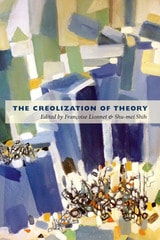
cover of The Creolization of Theory

The Creolization of Theory

Françoise Lionnet and Shu-mei Shih, eds.

Duke University Press, 2011

Introducing this collection of essays, Françoise Lionnet and Shu-mei Shih argue that looking back—investigating the historical, intellectual, and political entanglements of contemporary academic disciplines—offers a way for scholars in the humanities to move critical debates forward. They describe how disciplines or methodologies that seem distinct today emerged from overlapping intellectual and political currents in the 1960s and early 1970s, in the era of decolonization, the U.S. civil rights movement, and antiwar activism. While both American ethnic studies programs and “French theory” originated in decolonial impulses, over time, French theory became depoliticized in the American academy. Meanwhile, ethnic studies, and later also postcolonial studies, developed politically and historically grounded critiques of inequality. Suggesting that the abstract universalisms of Euro-American theory may ultimately be the source of its demise, Lionnet and Shih advocate the creolization of theory: the development of a reciprocal, relational, and intersectional critical approach attentive to the legacies of colonialism. This use of creolization as a theoretical and analytical rubric is placed in critical context by Dominique Chancé, who provides a genealogy of the concept of creolization. In their essays, leading figures in their fields explore the intellectual, disciplinary, and ethical implications of the creolized theory elaborated by Lionnet and Shih. Édouard Glisssant links the extremes of globalization to those of colonialism and imperialism in an interview appearing for the first time in English in this volume. The Creolization of Theory is a bold intervention in debates about the role of theory in the humanities.

Contributors. Étienne Balibar, Dominique Chancé, Pheng Cheah, Leo Ching, Liz Constable, Anne Donadey, Fatima El-Tayeb, Julin Everett, Édouard Glissant, Barnor Hesse, Ping-hui Liao, Françoise Lionnet, Walter Mignolo, Andrea Schwieger Hiepko, Shu-mei Shih

[more]
cover of The Empire at Home: Internal Colonies and the End of Britain

The Empire at Home

Internal Colonies and the End of Britain

James Trafford

Pluto Press, 2021

Modern Britain is forged through the redeployment of structures that facilitated and legitimized slavery, exploitation and extermination. This is the 'empire at home' and it is inseparable from the strategies of neo-colonial extraction and oppression of subjects abroad. Here, James Trafford develops the notion of internal colonies, arguing that methods and structures used in colonial rule are re-deployed internally in contemporary Britain in order to recreate and solidify imperial power relations. Using examples including housing segregation, targeted surveillance and counter-insurgency techniques used in the fight against terrorism, Trafford reveals Britain's internal colonialism to be a reactive mechanism to retain British sovereignty. As politics appears limited by nationalism and protectionism, The Empire at Home issues a powerful challenge to contemporary politics, demanding that Britain as an imperial structure must end.
[more]
cover of The End of Pax Americana: The Loss of Empire and Hikikomori Nationalism

The End of Pax Americana

The Loss of Empire and Hikikomori Nationalism

Naoki Sakai

Duke University Press, 2022

In The End of Pax Americana, Naoki Sakai focuses on U.S. hegemony's long history in East Asia and the effects of its decline on contemporary conceptions of internationality. Engaging with themes of nationality in conjunction with internationality, the civilizational construction of differences between East and West, and empire and decolonization, Sakai focuses on the formation of a nationalism of hikikomori, or “reclusive withdrawal”—Japan’s increasingly inward-looking tendency since the late 1990s, named for the phenomenon of the nation’s young people sequestering themselves from public life. Sakai argues that the exhaustion of Pax Americana and the post--World War II international order—under which Taiwan, South Korea, Hong Kong, and China experienced rapid modernization through consumer capitalism and a media revolution—signals neither the “decline of the West” nor the rise of the East, but, rather a dislocation and decentering of European and North American political, economic, diplomatic, and intellectual influence. This decentering is symbolized by the sense of the loss of old colonial empires such as those of Japan, Britain, and the United States.
[more]
cover of The Extractive Zone: Social Ecologies and Decolonial Perspectives

The Extractive Zone

Social Ecologies and Decolonial Perspectives

Macarena Gómez-Barris

Duke University Press, 2017

In The Extractive Zone Macarena Gómez-Barris traces the political, aesthetic, and performative practices that emerge in opposition to the ruinous effects of extractive capital. The work of Indigenous activists, intellectuals, and artists in spaces Gómez-Barris labels extractive zones—majority indigenous regions in South America noted for their biodiversity and long history of exploitative natural resource extraction—resist and refuse the terms of racial capital and the continued legacies of colonialism. Extending decolonial theory with race, sexuality, and critical Indigenous studies, Gómez-Barris develops new vocabularies for alternative forms of social and political life. She shows how from Colombia to southern Chile artists like filmmaker Huichaqueo Perez and visual artist Carolina Caycedo formulate decolonial aesthetics. She also examines the decolonizing politics of a Bolivian anarcho-feminist collective and a coalition in eastern Ecuador that protects the region from oil drilling. In so doing, Gómez-Barris reveals the continued presence of colonial logics and locates emergent modes of living beyond the boundaries of destructive extractive capital.
[more]
cover of The Fernando Coronil Reader: The Struggle for Life Is the Matter

The Fernando Coronil Reader

The Struggle for Life Is the Matter

Fernando Coronil

Duke University Press, 2019
In The Fernando Coronil Reader Venezuelan anthropologist Fernando Coronil challenges us to rethink our approaches to key contemporary epistemological, political, and ethical questions. Consisting of work written between 1991 and 2011, this posthumously published collection includes Coronil's landmark essays “Beyond Occidentalism” and “The Future in Question” as well as two chapters from his unfinished book manuscript, "Crude Matters." Taken together, the essays highlight his deep concern with the Global South, Latin American state formation, theories of nature, empire, and postcolonialism, and anthrohistory as an intellectual and ethical approach. Presenting a cross section of Coronil's oeuvre, this volume cements his legacy as one of the most innovative critical social thinkers of his generation.
[more]
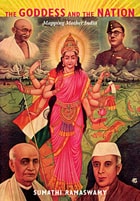
cover of The Goddess and the Nation: Mapping Mother India

The Goddess and the Nation

Mapping Mother India

Sumathi Ramaswamy

Duke University Press, 2010

Making the case for a new kind of visual history, The Goddess and the Nation charts the pictorial life and career of Bharat Mata, “Mother India,” the Indian nation imagined as mother/goddess, embodiment of national territory, and unifying symbol for the country’s diverse communities. Soon after Mother India’s emergence in the late nineteenth century, artists, both famous and amateur, began to picture her in various media, incorporating the map of India into her visual persona. The images they produced enabled patriotic men and women in a heterogeneous population to collectively visualize India, affectively identify with it, and even become willing to surrender their lives for it. Filled with illustrations, including 100 in color, The Goddess and the Nation draws on visual studies, gender studies, and the history of cartography to offer a rigorous analysis of Mother India’s appearance in painting, print, poster art, and pictures from the late nineteenth century to the present.

By exploring the mutual entanglement of the scientifically mapped image of India and a (Hindu) mother/goddess, Sumathi Ramaswamy reveals Mother India as a figure who relies on the British colonial mapped image of her dominion to distinguish her from the other goddesses of India, and to guarantee her novel status as embodiment, sign, and symbol of national territory. Providing an exemplary critique of ideologies of gender and the science of cartography, Ramaswamy demonstrates that images do not merely reflect history; they actively make it. In The Goddess and the Nation, she teaches us about pictorial ways of learning the form of the nation, of how to live with it—and ultimately to die for it.
[more]
cover of The Hybrid Muse: Postcolonial Poetry in English

The Hybrid Muse

Postcolonial Poetry in English

Jahan Ramazani

University of Chicago Press, 2001

In recent decades, much of the most vital literature written in English has come from the former colonies of Great Britain. But while postcolonial novelists such as Chinua Achebe, Salman Rushdie, and V. S. Naipaul have been widely celebrated, the achievements of postcolonial poets have been strangely neglected.

In The Hybrid Muse, Jahan Ramazani argues that postcolonial poets have also dramatically expanded the atlas of literature in English, infusing modern and contemporary poetry with indigenous metaphors and creoles. A rich and vibrant poetry, he contends, has issued from the hybridization of the English muse with the long resident muses of Africa, India, and the Caribbean. Starting with the complex case of Ireland, Ramazani closely analyzes the work of leading postcolonial poets and explores key questions about the relationship between poetry and postcolonialism. As inheritors of both imperial and native cultures, poets such as W. B. Yeats, Derek Walcott, Louise Bennett, A. K. Ramanujan, and Okot p'Bitek invent compelling new forms to articulate the tensions and ambiguities of their cultural in-betweeness. They forge hybrid figures, vocabularies, and genres that embody the postcolonial condition.

Engaging an array of critical topics, from the aesthetics of irony and metaphor to the politics of nationalism and anthropology, Ramazani reconceptualizes issues central to our understanding of both postcolonial literatures and twentieth-century poetry. The first book of its kind, The Hybrid Muse will help internationalize the study of poetry, and in turn, strengthen the place of poetry in postcolonial studies.



[more]
cover of The Invention of Order: On the Coloniality of Space

The Invention of Order

On the Coloniality of Space

Don Thomas Deere

Duke University Press, 2025
In The Invention of Order, Don Thomas Deere retraces the colonial origins of spatial organization in the Americas and the Caribbean and its lasting impact on modern structures of knowledge, power, race, gender as well as understandings of global modernity. The coloniality of space dispossessed Indigenous, African, and mixed populations as it constructed new systems of control and movement. Deere demonstrates how these developments manifested, among other forms, in urban grid patterns imposed during the development of Spanish colonial cities as well as totalizing trade routes crisscrossing the Atlantic. Drawing on a range of thinkers including Enrique Dussel, Édouard Glissant, and Sylvia Wynter, Deere reveals how movement—who travels, who settles, and who is excluded—becomes an essential component of control under colonial rule. Against the violence of spatial reordering, Deere outlines how novel forms of resistance and insurgency geographies still take hold, particularly in the Caribbean, where landscapes remain excessive, eruptive, and uncaptured by the order of modernity.
[more]
cover of The Nature of Politics: State Building and the Conservation Estate in Postcolonial Botswana

The Nature of Politics

State Building and the Conservation Estate in Postcolonial Botswana

Annette A. LaRocco

Ohio University Press, 2024

This case study of Botswana focuses on the state-building qualities of biodiversity conservation in southern Africa. Drawing on extensive fieldwork, Annette A. LaRocco argues that discourses and practices related to biodiversity conservation are essential to state building in the postcolonial era. These discourses and practices invoke the ways the state exerts authority over people, places, and resources; enacts and remakes territorial control; crafts notions of ideal citizenship and identity; and structures economic relationships at the local, national, and global levels. The book’s key innovation is its conceptualization of the “conservation estate,” a term most often used as an apolitical descriptor denoting land set aside for the purpose of conservation. LaRocco argues that this description is inadequate and proposes a novel and much-needed alternative definition that is tied to its political elements. The components of conservation—control over land, policing of human behavior, and structuring of the authority that allows or disallows certain subjectivities—render conservation a political phenomenon that can be analyzed separately from considerations of “nature” or “wildlife.” In doing so, it addresses a gap in the scholarship of rural African politics, which focuses overwhelmingly on productive agrarian dynamics and often fails to recognize that land nonuse can be as politically significant and wide reaching as land use. Botswana is an ideal empirical case study upon which to base these theoretical claims. With 39 percent of its land set aside for conservation, Botswana is home to large populations of wildlife, particularly charismatic megafauna, such as the largest herd of elephants on the continent. Utilizing more than two hundred interviews, participant observation, and document analysis, this book examines a series of conservation policies and their reception by people living on the conservation estate. These phenomena include securitized antipoaching enforcement, a national hunting ban (2014–19), restrictions on using wildlife products, forced evictions from conservation areas, limitations on mobility and freedom of movement, the political economy of Botswana’s wildlife tourism industry, and the conservation of globally important charismatic megafauna species.
[more]
cover of The Politics of Decolonial Investigations

The Politics of Decolonial Investigations

Walter D. Mignolo

Duke University Press, 2021
In The Politics of Decolonial Investigations Walter D. Mignolo provides a sweeping examination of how coloniality has operated around the world in its myriad forms from the sixteenth century to the twenty-first. Decolonial border thinking allows Mignolo to outline how the combination of the self-fashioned narratives of Western civilization and the hegemony of Eurocentric thought served to eradicate all knowledges in non-European languages and praxes of living and being. Mignolo also traces the geopolitical origins of racialized and gendered classifications, modernity, globalization, and cosmopolitanism, placing them all within the framework of coloniality. Drawing on the work of theorists and decolonial practitioners from the Global South and the Global East, Mignolo shows how coloniality has provoked the emergence of decolonial politics initiated by delinking from all forms of Western knowledge and subjectivities. The urgent task, Mignolo stresses, is the epistemic reconstitution of categories of thought and praxes of living destituted in the very process of building Western civilization and the idea of modernity. The overcoming of the long-lasting hegemony of the West and its distorted legacies is already underway in all areas of human existence. Mignolo underscores the relevance of the politics of decolonial investigations, in and outside the academy, to liberate ourselves from canonized knowledge, ways of knowing, and praxes of living.
[more]
cover of The Politics of Operations: Excavating Contemporary Capitalism

The Politics of Operations

Excavating Contemporary Capitalism

Sandro Mezzadra and Brett Neilson

Duke University Press, 2019
In The Politics of Operations Sandro Mezzadra and Brett Neilson investigate how capital reshapes its relation with politics through operations that enable the extraction and exploitation of mineral resources, labor, data, and cultures. They show how capital—which they theorize as a direct political actor—operates through the logistical organization of relations between people, property, and objects as well as through the penetration of financialization into all realms of economic life. Mezzadra and Neilson present a capacious analysis of a wide range of issues, from racial capitalism, the convergence of neoliberalism and nationalism, and Marx's concept of aggregate capital to the financial crisis of 2008 and how colonialism, empire, and globalization have shaped the modern state since World War II. In so doing, they illustrate the distinctive rationality and logics of contemporary capitalism while calling for a politics based on collective institutions that exist outside the state.
[more]
cover of The Postcolonial Jewish Question: Colonialism and the Politics of Difference in Postwar France

The Postcolonial Jewish Question

Colonialism and the Politics of Difference in Postwar France

Mendel Kranz

University of Chicago Press, 2026

A history of how decolonization shaped Jewish political identity in late-twentieth-century France.

In The Postcolonial Jewish Question, Mendel Kranz shows how France’s colonial history fundamentally shaped contemporary debates among Jews in France about racism, discrimination, and minority politics during the late twentieth century. As the wider country confronted the legacies of the Holocaust and the decline of its colonial empire, Jewish thinkers questioned the boundaries of their own political identity and challenged prevailing paradigms of Western universalism. This book traces how prominent and lesser-known thinkers—including Albert Memmi, Emmanuel Levinas, Alain Finkielkraut, and Wladimir Rabi—as well as organizations like the Colloque des intellectuels juifs de langue française engaged with issues of oppression, nationhood, and communal identity, and the ways that colonialism and its afterlives shaped those discussions. Kranz reveals how the Jewish question itself changed shape through confrontations with postcolonial politics. In doing so, he calls for a reassessment of the parameters of the Jewish question amid colonialism’s enduring legacies in the present.
[more]
cover of The Postcolonial Science and Technology Studies Reader

The Postcolonial Science and Technology Studies Reader

Sandra Harding, ed.

Duke University Press, 2011

For twenty years, the renowned philosopher of science Sandra Harding has argued that science and technology studies, postcolonial studies, and feminist critique must inform one another. In The Postcolonial Science and Technology Studies Reader, Harding puts those fields in critical conversation, assembling the anthology that she has long wanted for classroom use. In classic and recent essays, international scholars from a range of disciplines think through a broad array of science and technology philosophies and practices. The contributors reevaluate conventional accounts of the West’s scientific and technological projects in the past and present, rethink the strengths and limitations of non-Western societies’ knowledge traditions, and assess the legacies of colonialism and imperialism. The collection concludes with forward-looking essays, which explore strategies for cultivating new visions of a multicultural, democratic world of sciences and for turning those visions into realities. Feminist science and technology concerns run throughout the reader and are the focus of several essays. Harding provides helpful background for each essay in her introductions to the reader’s four sections.

Contributors
Helen Appleton
Karen Bäckstrand
Lucille H. Brockway
Stephen B. Brush
Judith Carney
Committee on Women, Population, and the Environment
Arturo Escobar
Maria E. Fernandez
Ward H. Goodenough
Susantha Goonatilake
Sandra Harding
Steven J. Harris
Betsy Hartmann
Cori Hayden
Catherine L. M. Hill
John M. Hobson
Peter Mühlhäusler
Catherine A. Odora Hoppers
Consuelo Quiroz
Jenny Reardon
Ella Reitsma
Ziauddin Sardar
Daniel Sarewitz
Londa Schiebinger
Catherine V. Scott
Colin Scott
Mary Terrall
D. Michael Warren
[more]
cover of The Postcolonial State in Africa: Fifty Years of Independence, 1960–2010

The Postcolonial State in Africa

Fifty Years of Independence, 1960–2010

Crawford Young

University of Wisconsin Press, 2012

In The Postcolonial State in Africa, Crawford Young offers an informed and authoritative comparative overview of fifty years of African independence, drawing on his decades of research and first-hand experience on the African continent.
    Young identifies three cycles of hope and disappointment common to many of the African states (including those in North Africa) over the last half-century: initial euphoria at independence in the 1960s followed by disillusionment with a lapse into single-party autocracies and military rule; a period of renewed confidence, radicalization, and ambitious state expansion in the 1970s preceding state crisis and even failure in the disastrous 1980s; and a phase of reborn optimism during the continental wave of democratization beginning around 1990. He explores in depth the many African civil wars—especially those since 1990—and three key tracks of identity: Africanism, territorial nationalism, and ethnicity.
    Only more recently, Young argues, have the paths of the fifty-three African states begun to diverge more dramatically, with some leading to liberalization and others to political, social, and economic collapse—outcomes impossible to predict at the outset of independence.

“This book is the best volume to date on the politics of the last 50 years of African independence.”—International Affairs

“The book shares Young’s encyclopedic knowledge of African politics, providing in a single volume a comprehensive rendering of the first 50 years of independence. The book is sprinkled with anecdotes from his vast experience in Africa and that of his many students, and quotations from all of the relevant literature published over the past five decades. Students and scholars of African politics alike will benefit immensely from and enjoy reading The Postcolonial State in Africa.”—Political Science Quarterly

“The study of African politics will continue to be enriched if practitioners pay homage to the erudition and the nobility of spirit that has anchored the engagement of this most esteemed doyen of Africanists with the continent.”—African History Review

“The book’s strongest attribute is the careful way that comparative political theory is woven into historical storytelling throughout the text. . . . Written with great clarity even for all its detail, and its interwoven use of theory makes it a great choice for new students of African studies.”—Australasian Review of African Studies
[more]
cover of The Postcolonial and the Global

The Postcolonial and the Global

Revathi Krishnaswamy

University of Minnesota Press, 2007

This interdisciplinary work brings the humanities and social sciences into dialogue by examining issues such as globalized capital, discourses of antiterrorism, and identity politics. Essayists from the fields of postcolonial studies and globalization theory address the ethical and pragmatic ramifications of opposing interpretations of these issues and, for the first time, seek common ground.

Contributors: Pal Ahluwalia, U of California, San Diego; Arjun Appadurai, New School U; Geoffrey Bowker, Santa Clara U; Timothy Brennan, U of Minnesota; Ruth Buchanan, U of British Columbia; Verity Burgmann, U of Melbourne; Pheng Cheah, U of California, Berkeley; Inderpal Grewal, U of California, Irvine; Ramon Grosfoguel, U of California, Berkeley; Barbara Harlow, U of Texas, Austin; Anouar Majid, U of New England; John McMurtry, U of Guelph; Walter D. Mignolo, Duke U; Sundhya Pahuja, U of Melbourne; R. Radhakrishnan, U of California, Irvine; Ileana Rodriguez, Ohio State U; E. San Juan, Philippine Forum, New York; Saskia Sassen, U of Chicago; Ella Shohat, New York U; Leslie Sklair, London School of Economics; Robert Stam, New York U; Madina Tlostanova, Russian Peoples’ Friendship U; Harish Trivedi, U of Delhi.

Revathi Krishnaswamy is associate professor of English at San Jose State University.

John C. Hawley is professor and chair of English at Santa Clara University.
[more]
cover of The Pre-occupation of Postcolonial Studies

The Pre-occupation of Postcolonial Studies

Fawzia Afzal-Khan and Kalpana Seshadri-Crooks, eds.

Duke University Press, 2000

The Pre-Occupation of Postcolonial Studies contains essays by both leading figures and younger scholars engaged in the field of postcolonial studies. In this state-of-the-field reader, editors Fawzia Afzal-Khan and Kalpana Seshadri-Crooks have created a dynamic forum for contributors from a variety of theoretical and disciplinary vantage points to question both the limits and the limitations of postcolonial thought.
Since it burst on the academic scene as the “hot” new disciplinary field during the final decade of the twentieth century, postcolonial studies has faced criticism from those who question its “troubling” trajectories, its sometimes suspect epistemological and pedagogical methods, and its relatively narrow focus. With diverse essays that emerge from such disciplines as South Asian, Latin American, Arab, and Jewish studies, this volume responds to skeptics and adherers alike, addressing not only the broad theoretical issues at stake within the field but also the position of the field itself within the academy, as well as its relationship to modern, postmodern, and Marxist discourses. Contributors offer critiques on ahistorical and universalizing tendencies in postcolonial work and confront the need for scholars to attend to issues of class, ideology, and the effects of neocolonial practices. Seeking to broaden the field’s traditionally literary spectrum of methodologies, these essayists take up large thematic issues to examine specific sites of colonial activities with all of their historical, political, and cultural significance. Closing the volume is an insightful interview with Homi Bhabha, in which he discusses postcolonial studies in the context of contemporary cultural politics and theory.
The Pre-Occupation of Postcolonial Studies not only offers an overview of the discipline but also pushes and pulls at the edges of postcolonial studies, offering a comprehensive view of the field’s diversity of thought and envisioning clear pathways for its future.

Contributors. Fawzia Afzal-Khan, Ali Behdad, Homi Bhabha, Daniel Boyarin, Neil Larsen, Saree Makdisi, Joseph Massad, Walter Mignolo, Hamid Naficy, Ngugi Wa Thingo, Timothy B. Powell, R. Radhakrishnan, Bruce Robbins, Kalpana Seshadri-Crooks, Ella Shohat, Rajeswari Sunder Rajan

[more]
cover of The Sign of the Cannibal: Melville and the Making of a Postcolonial Reader

The Sign of the Cannibal

Melville and the Making of a Postcolonial Reader

Geoffrey Sanborn

Duke University Press, 1998

In The Sign of the Cannibal Geoffrey Sanborn offers a major reassessment of the work of Herman Melville, a definitive history of the post-Enlightenment discourse on cannibalism, and a provocative contribution to postcolonial theory. These investigations not only explore mid–nineteenth century resistance to the colonial enterprise but argue that Melville, using the discourse on cannibalism to critique colonialism, contributed to the production of resistance.
Sanborn focuses on the representations of cannibalism in three of Melville’s key texts—Typee, Moby-Dick, and “Benito Cereno.” Drawing on accounts of Pacific voyages from two centuries and virtually the entire corpus of the post-Enlightenment discourse on cannibalism, he shows how Melville used his narratives to work through the ways in which cannibalism had been understood. In so doing, argues Sanborn, Melville sought to move his readers through stages of possible responses to the phenomenon in order to lead them to consider alternatives to established assumptions and conventions—to understand that in the savage they see primarily their own fear and fascination. Melville thus becomes a narrator of the postcolonial encounter as he uncovers the dynamic of dread and menace that marks the Western construction of the “non-savage” human.
Extending the work of Slavoj Zizek and Homi Bhabha while providing significant new insights into the work of Melville, The Sign of the Cannibal represents a breakthrough for students and scholars of postcolonial theory, American literary history, critical anthropology, race, and masculinity.
[more]
cover of The Suicide Archive: Reading Resistance in the Wake of French Empire

The Suicide Archive

Reading Resistance in the Wake of French Empire

Doyle D. Calhoun

Duke University Press, 2024
Throughout the French empire, from the Atlantic and the Caribbean to West and North Africa, men, women, and children responded to enslavement, colonization, and oppression through acts of suicide. In The Suicide Archive, Doyle D. Calhoun charts a long history of suicidal resistance to French colonialism and neocolonialism, from the time of slavery to the Algerian War for Independence to the “Arab Spring.” Noting that suicide was either obscured in or occluded from French colonial archives, Calhoun turns to literature and film to show how aesthetic forms and narrative accounts can keep alive the silenced histories of suicide as a political language. Drawing on scientific texts, police files, and legal proceedings alongside contemporary African and Afro-Caribbean novels, film, and Senegalese oral history, Calhoun outlines how such aesthetic works rewrite histories of resistance and loss. Consequently, Calhoun offers a new way of writing about suicide, slavery, and coloniality in relation to literary history.
[more]
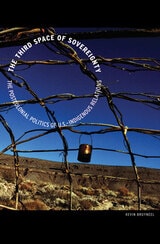
cover of The Third Space of Sovereignty: The Postcolonial Politics of U.S.–Indigenous Relations

The Third Space of Sovereignty

The Postcolonial Politics of U.S.–Indigenous Relations

Kevin Bruyneel

University of Minnesota Press, 2007

The imposition of modern American colonial rule has defined U.S.–indigenous relations since the time of the American Civil War. In resistance, Kevin Bruyneel asserts, indigenous political actors work across American spatial and temporal boundaries, demanding rights and resources from the government while also challenging the imposition of colonial rule over their lives. This resistance engenders what he calls a “third space of sovereignty,” which resides neither inside nor outside the U.S. political system but rather exists on its boundaries, exposing both the practices and limitations of American colonial rule. 

The Third Space of Sovereignty offers fresh insights on such topics as the crucial importance of the formal end of treaty-making in 1871, indigenous responses to the prospect of U.S. citizenship in the 1920s, native politics during the tumultuous civil rights era of the 1960s, the question of indigenousness in the special election of California’s governor in 2003, and the current issues surrounding gaming and casinos.

In this engaging and provocative work, Bruyneel shows how native political actors have effectively contested the narrow limits that the United States has imposed on indigenous people’s ability to define their identity and to develop economically and politically on their own terms.

Kevin Bruyneel is assistant professor of politics at Babson College.
[more]
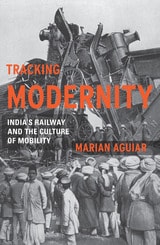
cover of Tracking Modernity: India’s Railway and the Culture of Mobility

Tracking Modernity

India’s Railway and the Culture of Mobility

Marian Aguiar

University of Minnesota Press, 2010

From Mohandas Gandhi’s nineteenth-century tour in a third-class compartment to the recent cinematic shenanigans of Wes Anderson’s The Darjeeling Limited, the railway has been one of India’s most potent emblems of modern life. In the first in-depth analysis of representations of the Indian railway, Marian Aguiar interprets modernity through the legacy of this transformative technology.

Since the colonial period in India, the railway has been idealized as a rational utopia—a moving box in which racial and class differences might be amalgamated under a civic, secular, and public order. Aguiar charts this powerful image into the postcolonial period, showing how the culture of mobility exposes this symbol of reason as surprisingly dynamic and productive. Looking in turn at the partition of India, labor relations, rituals of travel, works of literature and film, visual culture, and the Mumbai train bombings of 2006, Aguiar finds incongruities she terms “counternarratives of modernity” to signify how they work both with and against the dominant rhetoric.  Revealing railways as a microcosm of tensions within Indian culture, Aguiar demonstrates how their representations have challenged prevailing ideas of modernity.
[more]
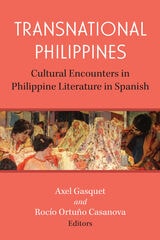
cover of Transnational Philippines: Cultural Encounters in Philippine Literature in Spanish

Transnational Philippines

Cultural Encounters in Philippine Literature in Spanish

Axel Gasquet and Rocío Ortuño Casanova, Editors

University of Michigan Press, 2024

Transnational Philippines: Cultural Encounters in Philippine Literature in Spanish approaches literature that has been forgotten or neglected in studies on other literatures in Spanish due, in part, to the fact that today Spanish is no longer spoken in the Philippines or in Asia. However, isolation has not always been the case, and by omitting Philippine literature in Spanish from the picture of world literatures and Spanish-language literatures, the landscape of these disciplines is incomplete. Transnational Philippines studies how this literary production stemmed from its relationship with other cultures, literature, and arts. It attempts to break this literature’s isolation and show how it is part of the broad literary system of literature written in Spanish. 

Yet Transnational Philippines also questions the constraints of traditional literary genres in order to make room for Philippine texts and other colonial and postcolonial texts, so that those texts can be taken into consideration in literary studies. Its chapters elaborate on the problems surrounding the cultural and identity relations of the Philippines with other regions and the literary nature of Philippine texts. By addressing the need for a postnational approach to Spanish-language Philippine literature, the book challenges the Spain/Latin America dichotomy existing in Spanish language literary studies and leans toward a global conception of the Hispanophone.
[more]