Results by title
52 books match the query 'Public administration' and 11 start with t
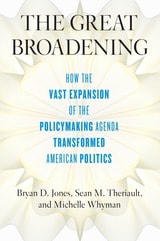
The Great Broadening
How the Vast Expansion of the Policymaking Agenda Transformed American PoliticsBryan D. Jones, Sean M. Theriault, and Michelle Whyman
University of Chicago Press, 2019
With The Great Broadening, Bryan D. Jones, Sean M. Theriault, and Michelle Whyman examine in detail the causes, internal dynamics, and consequences of this extended burst of activity. They argue that the broadening of government responsibilities into new policy areas such as health care, civil rights, and gender issues and the increasing depth of existing government programs explain many of the changes in America politics since the 1970s. Increasing government attention to particular issues was motivated by activist groups. In turn, the beneficiaries of the government policies that resulted became supporters of the government’s activity, leading to the broad acceptance of its role. This broadening and deepening of government, however, produced a reaction as groups critical of its activities organized to resist and roll back its growth.

The Information Master
Jean-Baptiste Colbert's Secret State Intelligence SystemJacob Soll
University of Michigan Press, 2011
"Colbert has long been celebrated as Louis XIV's minister of finance, trade, and industry. More recently, he has been viewed as his minister of culture and propaganda. In this lively and persuasive book, Jake Soll has given us a third Colbert, the information manager."
---Peter Burke, University of Cambridge
"Jacob Soll gives us a road map drawn from the French state under Colbert. With a stunning attention to detail Colbert used knowledge in the service of enhancing
royal power. Jacob Soll's scholarship is impeccable and his story long
overdue and compelling."
---Margaret Jacob, University of California, Los Angeles
"Nowadays we all know that information is the key to power, and that the masters of information rule the world. Jacob Soll teaches us that Jean-Baptiste Colbert had grasped this principle three and a half centuries ago, and used it to construct a new kind of state. This imaginative, erudite, and powerfully written book re-creates the history of libraries and archives in early modern Europe, and ties them in a novel and convincing way to the new statecraft of Europe's absolute monarchs."
---Anthony Grafton, Princeton University
"Brilliantly researched, superbly told, and timely, Soll's story is crucial for the history of the modern state."
---Keith Baker, Stanford University
When Louis XIV asked his minister Jean-Baptiste Colbert---the man who was to oversee the building of Versailles and the Royal Academy of Sciences, as well as the navy, the Paris police force, and French industry---to build a large-scale administrative government, Colbert created an unprecedented information system for political power. In The Information Master, Jacob Soll shows how the legacy of Colbert's encyclopedic tradition lies at the very center of the rise of the modern state and was a precursor to industrial intelligence and Internet search engines.
Soll's innovative look at Colbert's rise to power argues that his practice of collecting knowledge originated from techniques of church scholarship and from Renaissance Italy, where merchants recognized the power to be gained from merging scholarship, finance, and library science. With his connection of interdisciplinary approaches---regarding accounting, state administration, archives, libraries, merchant techniques, ecclesiastical culture, policing, and humanist pedagogy---Soll has written an innovative book that will redefine not only the history of the reign of Louis XIV and information science but also the study of political and economic history.
Jacob Soll is Associate Professor of History at Rutgers University and the author of Publishing The Prince: History, Reading, and the Birth of Political Criticism (University of Michigan Press, 2005), and winner of the 2005 Jacques Barzun Prize from the American Philosophical Society and a 2009 Guggenheim Fellowship. Soll edited a special issue of Journal of the History of Ideas titled "The Uses of Historical Evidence in Early Modern Europe"; has cofounded the online journal Republics of Letters; and is editor, along with Anthony Grafton and Ann Blair, of the series Cultures of Knowledge in the Early Modern World.

The Intellectual Crisis in American Public Administration
Vincent Ostrom
University of Alabama Press, 1989

The Intellectual Crisis in American Public Administration
Vincent Ostrom
University of Alabama Press, 2007
Rethinking governance: Where democracy meets administration.
This revised and expanded third edition extends Ostrom’s analysis to account for the most resent developments in American politics, including those of the Clinton and Bush administrations.
First published in 1973, The Intellectual Crisis in American Public Administration remains one of the most influential critiques of the administrative state. Vincent Ostrom examines the intellectual roots of American public administration, questioning whether centralized bureaucratic systems align with the constitutional principles of self-governance. Through a rigorous analysis of institutional design, federalism, and public choice theory, Ostrom advocates for polycentric governance—an approach that empowers citizens and decentralizes authority. This seminal work continues to inspire debates on accountability, legitimacy, and the future of democratic administration.
The Language of Public Administration
Bureaucracy, Modernity, and PostmodernityDavid John Farmer
University of Alabama Press, 1995
Rethinking bureaucracy through the lenses of modernity, postmodernity, and administrative imagination.
Coping with the practical problems of bureaucracy is hampered by the limited self-conception and the constricted mindsets of mainstream public administration thinking. Modernist public administration theory, although valuable and capable of producing ever more remarkable results, is limiting as an explanatory and catalytic force in resolving fundamental problems about the nature, size, scope, and functioning of public bureaucracy and in transforming public bureaucracy into a more positive force.
This original study specifies a reflexive language paradigm for public administration thinking and shows how a postmodern perspective permits a revolution in the character of thinking about public bureaucracy. The author considers imagination, deconstruction, deterritorialization, and alterity. Farmer's work emphasizes the need for an expansion in the character and scope of public administration's disciplinary concerns and shows clearly how the study and practice of public administration can be reinvigorated.
The Practical Imagination
The German Sciences of State in the Nineteenth CenturyDavid F. Lindenfeld
University of Chicago Press, 1997
Lindenfeld argues that these sciences of state developed a technique of deliberation on practical issues such as tax policy and welfare, that serves as a model for contemporary administrations.
The Predicaments of Publicness
An Inquiry into the Conceptual Ambiguity of Public AdministrationUdo Pesch
Eburon Academic Publishers, 2006
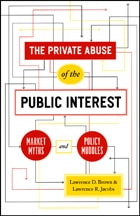
The Private Abuse of the Public Interest
Market Myths and Policy MuddlesLawrence D. Brown and Lawrence R. Jacobs
University of Chicago Press, 2008
The authors support their pragmatic approach with evidence drawn from in-depth analyses of education, transportation, and health care policies. In each policy area, initiatives such as school choice, deregulation of airlines and other carriers, and the promotion of managed care have introduced or enlarged the role of market forces with the aim of eliminating bureaucratic inefficiency. But in each case, the authors show, reality proved to be much more complex than market models predicted. This complexity has resulted in a political cycle—strikingly consistent across policy spheres—that culminates in public interventions to sustain markets while protecting citizens from their undesirable effects. Situating these case studies in the context of more than two hundred years of debate about the role of markets in society, Brown and Jacobs call for a renewed focus on public-private partnerships that recognize and respect each sector’s vital—and fundamentally complementary—role.
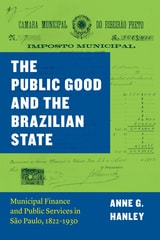
The Public Good and the Brazilian State
Municipal Finance and Public Services in São Paulo, 1822–1930Anne G. Hanley
University of Chicago Press, 2018
In The Public Good and the Brazilian State, Anne G. Hanley assembles an economic history of public revenues as they developed in nineteenth-century Brazil. Specifically, Hanley investigates the financial life of the municipality—a district comparable to the county in the United States—to understand how the local state organized and prioritized the provision of public services, what revenues paid for those services, and what happened when the revenues collected failed to satisfy local needs. Through detailed analyses of municipal ordinances, mayoral reports, citizen complaints, and financial documents, Hanley sheds light on the evolution of public finance and its effect on the early economic development of Brazilian society. This deeply researched book offers valuable insights for anyone seeking to better understand how municipal finance informs histories of inequality and underdevelopment.
The State You See
How Government Visibility Creates Political Distrust and Racial InequalityAaron J. Rosenthal
University of Michigan Press, 2023
The State You See uncovers a racial gap in the way the American government appears in people’s lives. It makes it clear that public policy changes over the last fifty years have driven all Americans to distrust the government that they see in their lives, even though Americans of different races are not seeing the same kind of government.
For white people, these policy changes have involved a rising number of generous benefits submerged within America’s tax code, which taken together cost the government more than Social Security and Medicare combined. Political attention focused on this has helped make welfare and taxes more visible representations of government for white Americans. As a result, white people are left with the misperception that government does nothing for them, apart from take their tax money to spend on welfare. Distrust of government is the result. For people of color, distrust is also rampant but for different reasons. Over the last fifty years, America has witnessed increasingly overbearing policing and swelling incarceration numbers. These changes have disproportionately impacted communities of color, helping to make the criminal legal system a unique visible manifestation of government in these communities.
While distrust of government emerges in both cases, these different roots lead to different consequences. White people are mobilized into politics by their distrust, feeling that they must speak up in order to reclaim their misspent tax dollars. In contrast, people of color are pushed away from government due to a belief that engaging in American elections will yield the same kind of unresponsiveness and violence that comes from interactions with the police. The result is a perpetuation of the same kind of racial inequality that has always been present in American democracy. The State You See is essential reading for anyone interested in understanding how the American government engages in subtle forms of discrimination and how it continues to uphold racial inequality in the present day.
The Structure of Policy Change
Derek A. Epp
University of Chicago Press, 2018
Derek A. Epp argues that some agencies can indeed do that and that instability is at least partially a function of poor institutional design. While it is inherently more challenging to maintain stability around complex problems like immigration or climate change, the deliberative process itself can affect the degree of stability around an issue. Epp looks at whether agencies follow a deliberative model for decision making, in which policies are developed by means of debate among a small group of policymakers, or a collective model, in which the opinions of many people are aggregated, as with the stock market. He argues that, in many instances, the collective model produces more informed and stable policy outcomes that can be adapted more readily to new information and changing public priorities.