Results by title
56 books match the query 'Public schools' and 11 start with t
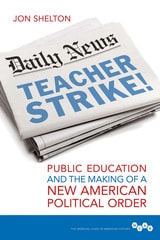
Teacher Strike!
Public Education and the Making of a New American Political OrderJon Shelton
University of Illinois Press, 2017
As Shelton shows, many working- and middle-class whites sided with corporate interests in seeing themselves as society's only legitimate, productive members. This alliance increasingly argued that public employees and the urban poor took but did not give. Drawing on a wealth of research ranging from school board meetings to TV news reports, Shelton puts readers in the middle of fraught, intense strikes in Newark, St. Louis, and three other cities where these debates and shifting attitudes played out. He also demonstrates how the labor actions contributed to the growing public perception of unions as irrelevant or even detrimental to American prosperity. Foes of the labor movement, meanwhile, tapped into cultural and economic fears to undermine not just teacher unionism but the whole of liberalism.
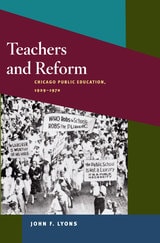
Teachers and Reform
Chicago Public Education, 1929-70John F. Lyons
University of Illinois Press, 2007
Examining teachers' unions and public education from the bottom up, Lyons shows how the CTU and its members sought rigorous reforms. A combination of political action, public relations campaigns, and community alliances helped the CTU to achieve better salaries and benefits, increased school budgets, reformed curricula, and greater equality for women within the public education system. But its agenda was also constrained by internal divisions over race and gender and by ongoing external disputes with the school administration, politicians, and business and civic organizations.
Detailed and informed by rich interviews, Teachers and Reform: Chicago Public Education, 1929-1970 tells the story of how committed union members effected changes to public education and to local politics that still benefit Chicago teachers, students, and the city today.
Testing Education
A Teacher's MemoirKathy Greeley
University of Massachusetts Press, 2024
Since the 2002 implementation of No Child Left Behind, the American public education system has been fundamentally changed. Excessive testing, standardized curriculums, destructive demands on children, corporate-style evaluations, and top-down mandates have become the norm. In response, record numbers of demoralized educators have quit, and millions of students have been left educationally impoverished. This troubling transformation has been exhaustively critiqued by scholars and commentators. Yet one crucial voice has been missing, until now.
In Testing Education, Kathy Greeley recounts the impact of education reform from a teacher’s point of view. Based on a teaching career spanning nearly forty years, Greeley details how schools went from learning communities infused with excitement, intellectual stimulation, and joy to sterile spaces of stress, intimidation, and fear. In this ultimately hopeful memoir, Greeley asks us to learn from the past to reimagine the future of public education.
The Enduring Classroom
Teaching Then and NowLarry Cuban
University of Chicago Press, 2023
The quality and effectiveness of teaching are a constant subject of discussion within the profession and among the broader public. Most of that conversation focuses on the question of how teachers should teach. In The Enduring Classroom, veteran teacher and scholar of education Larry Cuban explores different questions, ones that just might be more important: How have teachers actually taught? How do they teach now? And what can we learn from both?
Examining both past and present is crucial, Cuban explains. If reformers want teachers to adopt new techniques, they need to understand what teachers are currently doing if they want to have any hope of having their innovations implemented. Cuban takes us into classrooms then and now, using observations from contemporary research as well as a rich historical archive of classroom accounts, along the way asking larger questions about teacher training and the individual motivations of people in the classroom. Do teachers freely choose how to teach, or are they driven by their beliefs and values about teaching and learning? What role do students play in determining how teachers teach? Do teachers teach as they were taught? By asking and answering these and other policy questions with the aid of concrete data about actual classroom practices, Cuban helps us make a crucial step toward creating reforms that could actually improve instruction.
The Enduring Legacy
Structured Inequality in America's Public SchoolsMark Ryan
University of Michigan Press, 2020

The Legal Status of Church-State Relationships in the United States
With Special Reference to the Public SchoolsAlvin Johnson
University of Minnesota Press, 1934
The Market Comes to Education in Sweden
An Evaluation of Sweden's Surprising School ReformsAnders Bjorklund
Russell Sage Foundation, 2005
The Money Myth
School Resources, Outcomes, and EquityW. Norton Grubb
Russell Sage Foundation, 2009
The Public School Advantage
Why Public Schools Outperform Private SchoolsChristopher A. Lubienski and Sarah Theule Lubienski
University of Chicago Press, 2013
For decades research showing that students at private schools perform better than students at public ones has been used to promote the benefits of the private sector in education, including vouchers and charter schools—but much of these data are now nearly half a century old. Drawing on two recent, large-scale, and nationally representative databases, the Lubienskis show that any benefit seen in private school performance now is more than explained by demographics. Private schools have higher scores not because they are better institutions but because their students largely come from more privileged backgrounds that offer greater educational support. After correcting for demographics, the Lubienskis go on to show that gains in student achievement at public schools are at least as great and often greater than those at private ones. Even more surprising, they show that the very mechanism that market-based reformers champion—autonomy—may be the crucial factor that prevents private schools from performing better. Alternatively, those practices that these reformers castigate, such as teacher certification and professional reforms of curriculum and instruction, turn out to have a significant effect on school improvement.
Despite our politics, we all agree on the fundamental fact: education deserves our utmost care. The Public School Advantage offers exactly that. By examining schools within the diversity of populations in which they actually operate, it provides not ideologies but facts. And the facts say it clearly: education is better off when provided for the public by the public.
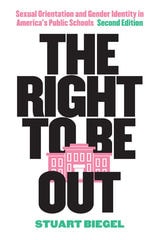
The Right to Be Out
Sexual Orientation and Gender Identity in America's Public Schools, Second EditionStuart Biegel
University of Minnesota Press, 2018
An updated edition of this measured, practical, and timely guide to LGBT rights and issues for educators and school officials
With ongoing battles over transgender rights, bullying cases in the news almost daily, and marriage equality only recently the law of the land, the information in The Right to Be Out could not be more timely or welcome. In an updated second edition that explores the altered legal terrain of LGBT rights for students and educators, Stuart Biegel offers expert guidance on the most challenging concerns in this fraught context.
Taking up the pertinent questions likely to arise regarding curriculum and pedagogy in the classroom, school sports, and transgender issues, Biegel reviews the dramatic legal developments of the past decades, identifies the principles at work, and analyzes the policy considerations that result from these changes. Central to his work is an understanding of the social, political, and personal tensions regarding the nature and extent of the right to be out, which includes both the First Amendment right to express an identity and the Fourteenth Amendment right to be treated equally. Acknowledging that LGBT issues affect people of every sexual orientation and gender identity, Biegel provides a road map of viable strategies for school officials and educators.
The Right to Be Out, informed by the latest research-based findings, advances the proposition that a safe and supportive educational environment, built upon shared values and geared toward a greater appreciation of our pluralistic society, can lead to a better world for everyone.
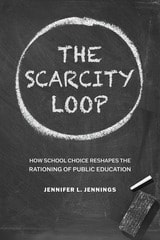
The Scarcity Loop
How School Choice Reshapes the Rationing of Public Educationjennings
Russell Sage Foundation, 2026
School choice promises to free families from the limits of where they live. The Scarcity Loop asks what happens when that promise is made in school systems where more children seek desirable schools than those schools can serve. Focused on New York City’s high school admissions system, sociologist Jennifer L. Jennings argues that choice becomes another way to ration scarce educational opportunity, shifting where rationing happens, who must manage it, and how families understand the outcomes that follow.
Jennings begins with the admissions process itself. New York City asks every eighth grader to choose from hundreds of options. On paper, the system offers extraordinary possibility. But that possibility still has to be converted into a seat. Someone has to learn the rules, compare schools, manage deadlines, make trips, and decide how much risk a thirteen-year-old can bear. Jennings calls this the work of getting in and shows that the capacity to do that work is not evenly distributed. Some families enter choice systems with the fluency and flexibility to turn options into opportunity. Others confront it with fewer supports and far less room for error. Some teenagers shoulder decisions with little adult help. Counselors translate complicated rules under impossible constraints. Principals are not passive actors. Jennings shows how they recruit and adapt as they try to build schools families will choose while managing demand and reputation.
Jennings contends that reforms meant to expand access can reorganize the very competition they aim to resolve. As one barrier recedes, another becomes more consequential. Residence matters less, but advantage does not disappear; it travels through information, timing, and familiarity with the rules. Inequality persists not because nothing changes, but because advantage finds new points of entry as reforms change rules. As the work of securing opportunity shifts, so do understandings of inequality. Unequal outcomes can come to look less like consequences of how educational opportunities are organized and more like reflections of how families navigate the system.
Drawing on more than 450 interviews, participant observation, administrative data, and archival research, The Scarcity Loop follows students, parents, counselors, and principals as they navigate school choice at scale. Jennings traces who must do the work of making choice real, clarifying what is at stake when public education becomes something families must know how to secure.
The Scarcity Loop skillfully shows the consequences of scarcity in public education on schools and families, and reveals how scarcity reproduces itself, even when reforms are sincere.
JENNIFER L. JENNINGS is the Class of 1988 Professor in Domestic Policy and Professor of Sociology and Public Affairs, Princeton University