Results by title
101 books match the query 'Publishers & Publishing Industry' and 31 start with t
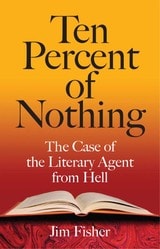
Ten Percent of Nothing
The Case of the Literary Agent from HellJim Fisher
Southern Illinois University Press, 2004
Former FBI agent Jim Fisher upends the genteel racket of fee-based literary agents and vanity publishers in this searing look at the rise and fall of one bogus entrepreneur who systematically swindled thousands of would-be writers out of millions of dollars with promises of having their work turned into salable books. In divulging the details of this colossal and shocking confidence game, Ten Percent of Nothing: The Case of the Literary Agent from Hell exposes a growing and serious crime against writers and a dark, ugly secret about the American publishing industry.
In 1989, Dorothy L. Deering, possessing a high school degree, a recent embezzlement conviction, and no experience as a professional writer, editor, or publisher, began operating a fee-based literary agency out of her garage in Nicholasville, Kentucky. Over the next ten years, she racked up a fortune in reading and marketing fees, learning the business of sham publishing as she went along. Later, as the owner of a vanity press, she bilked 1.5 million dollars out of her clients, masterfully manufacturing dreams of literary success until she was brought to justice by Fisher’s investigative journalism, an FBI probe, and the retaliation and testimonies of numerous victims.
Deering never sold a single manuscript to a major publisher. With the money in her pocket and her clients’ hopes and hard work wrapped up in fraudulent contracts, Deering produced a few copies of four cheaply printed, poorly edited paperbacks. These she used as bait to hoodwink more clients. She was abetted by her husband, Charles, a former car salesman; his son, Daniel, a drug user with a ninth-grade education; and her brother, Bill, a fugitive from the law at the time he headed her vanity press.
By successfully impersonating a literary agent for ten years, Deering operated one of the longest-running confidence games in American history. The financial loss for her clients was devastating, and the heartbreak was extreme. Drawing on victims’ experiences and documents recovered from the Deering venture, Fisher shows how Deering engineered and executed her scam, emphasizing the warning signs of sham agents, crook book doctors, and mendacious publishers.
Ten Percent of Nothing provides essential information for aspiring writers and publishing professionals. Fisher’s findings also prompt new inquiries into the potential licensing of literary agents and the prosecution of interstate scam artists. The volume’s gallery of illustrations includes reproductions of correspondence, newsletters, and advertisements used by the Deering operation.

The Author and His Publisher
Lectures Delivered in Mainz and AustinSiegfried Unseld
University of Chicago Press, 1980
Through close examination of four writers, Unseld shows how the author's personality can affect the publisher's dilemma. Hermann Hesse, by virtue of his loyalty and his desire for financial independence, enjoyed an exemplary relationship with his publishers. With Bertolt Brecht it was all confusion; with Rainer Maria Rilke, a one-author-one-publisher lifetime alliance; with Swiss poet Robert Walser, a mire of difficulties ("Each book printed," he once said, was "a grave for its author").
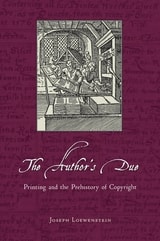
The Author's Due
Printing and the Prehistory of CopyrightJoseph Loewenstein
University of Chicago Press, 2002
As Loewenstein shows, copyright is a form of monopoly that developed alongside a range of related protections such as commercial trusts, manufacturing patents, and censorship, and cannot be understood apart from them. The regulation of the press pitted competing interests and rival monopolistic structures against one another—guildmembers and nonprofessionals, printers and booksellers, authors and publishers. These struggles, in turn, crucially shaped the literary and intellectual practices of early modern authors, as well as early capitalist economic organization.
With its probing look at the origins of modern copyright, The Author's Due will prove to be a watershed for historians, literary critics, and legal scholars alike.
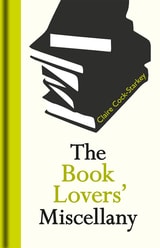
The Book Lovers' Miscellany
Claire Cock-Starkey
Bodleian Library Publishing, 2017
The Book Lovers’ Miscellany is a cornucopia for bibliophiles. With customary wisdom and wit, Claire Cock-Starkey presents a brief illustrated history of paper, binding, printing, and dust jackets, with a wealth of arcane facts that even the most avid book lovers may be hard-pressed to answer: Which natural pigments were used to decorate medieval bibles? Which animal is needed for the making of vellum? Curious facts are drawn from throughout the history of books and publishing, including many more recent examples, such as a short history of the comic and the story behind the massively successful Harlequin romance imprint Mills and Boon. Readers can explore the output of the most prolific writers and marvel at the youth of the youngest published authors—or lament the decisions of the publishers who rejected books that later became colossal bestsellers. The book also includes a collection of lists, including unfinished novels, books that have faced bans, books printed with mistakes, the most influential academic books of all time, and the longest established literary families.
The perfect gift for every bibliophile, The Book Lovers’ Miscellany is equally well suited to reading straight through or dipping into here and there.
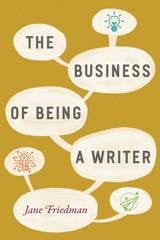
The Business of Being a Writer
Jane Friedman
University of Chicago Press, 2018
The Business of Being a Writer offers the business education writers need but so rarely receive. It is meant for early-career writers looking to develop a realistic set of expectations about making money from their work or for working writers who want a better understanding of the industry. Writers will gain a comprehensive picture of how the publishing world works—from queries and agents to blogging and advertising—and will learn how they can best position themselves for success over the long term.
Jane Friedman has more than twenty years of experience in the publishing industry, with an emphasis on digital media strategy for authors and publishers. She is encouraging without sugarcoating, blending years of research with practical advice that will help writers market themselves and maximize their writing-related income. It will leave them empowered, confident, and ready to turn their craft into a career.
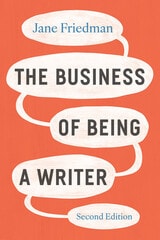
The Business of Being a Writer, Second Edition
Jane Friedman
University of Chicago Press, 2025
Writers talk about their work in many ways: as an art, as a calling, as a lifestyle. Too often missing from these conversations is the fact that writing is also a business, and those who want to make a living from their writing must understand the basic business principles underlying the industry. The Business of Being a Writer offers the business education writers need but so rarely receive.
Jane Friedman is one of today’s leading experts on the publishing industry. Through her website, social media presence, online courses, email newsletters, and other media, she helps writers understand how to navigate the industry with confidence and intentionality. This book advises writers on how to build a platform in a way that aligns with their values, how to spot critical mindset issues that might sabotage their efforts before they even begin, how to publish strategically, and what it means to diversify income streams beyond book sales. For this second edition, Friedman has updated every topic to reflect how the industry has evolved over the past half decade. New features include a section on business and legal issues commonly faced by writers, exercises at the end of each chapter, and a wealth of sample materials posted on a companion website.
Reaching beyond the mechanical aspects of publishing, The Business of Being a Writer will help both new and experienced writers approach their careers with the same creative spirit as their writing. Friedman is encouraging without sugarcoating reality, blending years of research with practical advice that will help writers market themselves and maximize their writing-related income. Her book will leave them empowered, confident, and ready to turn their craft into a sustainable career.
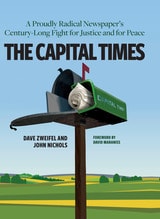
The Capital Times
A Proudly Radical Newspaper’s Century Long Fight for Justice and for PeaceJohn Nichols
Wisconsin Historical Society Press, 2017
As Madison’s Capital Times marks its 100th anniversary in 2017, editors Dave Zweifel and John Nichols recall the remarkable history of a newspaper that served as the tribune of Robert M. La Follette and the progressive movement, earned the praise of Franklin Delano Roosevelt for its stalwart opposition to fascism, battled Joe McCarthy during the "Red Scare," championed civil rights, women’s rights, and LGBTQ rights, opposed the Vietnam War and the invasion of Iraq, and stood with Russ Feingold when he cast the only US Senate vote against the Patriot Act. The Capital Times did not do this from New York or Washington but from the middle of America, with a readership of farmers, factory workers, teachers, and shopkeepers who stood by The Cap Times when the newspaper was boycotted, investigated, and attacked for its determination.
At a point when journalism is under assault, when newspapers struggle to survive, and "old media" struggles to find its way in a digital age, The Capital Times remains unbowed—still living up to the description Lord Francis Williams, the British newspaper editor, wrote 50 years ago: "The vast majority of American papers are as dull as weed-covered ditch-water; vast Saharas of cheap advertising with occasional oases of editorial matter written to bring happiness to the Chamber of Commerce and pain and irritation to none; the bland leading the bland.… Just here and there are a few relics of the old fighting muckraking tradition of American journalism, like The Capital Times of Madison."
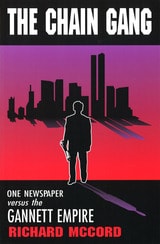
The Chain Gang
One Newspaper versus the Gannett EmpireRichard McCord
University of Missouri Press, 2001
"They're closing in on me, Dick, and I'm afraid they're going to get me," said Frank Wood, publisher of the Green Bay News-Chronicle, in a phone call to his friend and colleague, Richard McCord. Drained of cash and spirit, Wood could not hold out much longer against a devouring giant, the Gannett Company. As editor and publisher of the nationally distinguished weekly Santa Fe Reporter, McCord had successfully fended off Gannett's "Operation Demolition" when it moved into town. Now Wood was seeking the help of a survivor.
Startling case histories of the dubious tactics practiced by Gannett, unsparing insights into the newspaper industry, and harsh conclusions all come together in the dramatic story of these two men's efforts to save the small Green Bay daily from being obliterated at the hands of the nation's largest newspaper chain. Their success is a metaphor for one of the oldest triumphs of the world: that of David over Goliath.
"McCord has done something marvelous with this. He's taken a deeply disturbing nationwide trend and put it on a small midwestern stage with real characters. The Chain Gang's message needs to be heard by as many Americans as read newspapers. Already Gannett's monopoly tactics have impoverished communities across the country. McCord is one man fighting back, coolly, rationally, creatively, and stubbornly. Let's join him."—Michael Shnayerson, Contributing Editor, Vanity Fair
"More graphically than almost any other available record of the era, the Gannett piracy is what has happened to this country, tolled where the price is truly paid, in the lives of communities and people."—Roger Morris, winner of the Investigative Reporters and Editors' National Award for Distinguished Investigative Journalism
"Richard McCord's The Chain Gang takes the losing battle for the soul of American newspapers from the euphoric accounts on financial pages to show what corporate news chains can mean in human terms to the people and the vitality of the victimized cities and towns. His is a unique account of the power and depredations of the Gannett Chain under its glib empire builder, Allen Neuharth. It goes behind the facade of slick public relations and financial killings for investors to show what happens when a ruthless and ambitious wheeler-dealer gets control of our news."—Ben H. Bagdikian, media critic and Pulitzer Prize winner
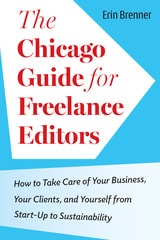
The Chicago Guide for Freelance Editors
How to Take Care of Your Business, Your Clients, and Yourself from Start-Up to SustainabilityErin Brenner
University of Chicago Press, 2024
You’ve been thinking about shifting into the world of freelance editing, but you don’t know where to start. In a time when editors are seeking greater flexibility in their work arrangements and schedules, freelancing is an increasingly common career option. But deciding to go it alone means balancing the risks with the rewards. From the publisher of The Chicago Manual of Style comes The Chicago Guide for Freelance Editors, the definitive guide to running your business and finding greater control and freedom in your work life.
In this book, Erin Brenner—an industry leader and expert on the business of editorial freelancing—gathers everything you need to know into a single resource. Brenner has run her own successful editing business for over two decades and has helped hundreds of editors launch or improve their businesses through her teaching, blog writing, and coaching.
The Chicago Guide for Freelance Editors will walk you through the entire process of conceiving, launching, and working in a freelance editing business, from deciding on services and rates to choosing the best business structure to thinking through branding and marketing strategies and beyond. This book is ideal for beginning freelancers looking to get set up and land their first clients, but it’s equally valuable to those who have already been freelancing, with detailed coverage of such issues as handling difficult clients and continuing professional development. You’ll find a collection of advice from other successful freelance editors in this guide, as well as an extensive list of resources and tools. In the final and perhaps most important chapter, Brenner teaches you how to care for the key component of the business: yourself.
The Chicago Manual of Style, 15th Edition
Edited by University of Chicago Press Staff
University of Chicago Press, 2003
In the 1890s, a proofreader at the University of Chicago Press prepared a single sheet of typographic fundamentals intended as a guide for the University community. That sheet grew into a pamphlet, and the pamphlet grew into a book—the first edition of the Manual of Style, published in 1906. Now in its fifteenth edition, The Chicago Manual of Style—the essential reference for authors, editors, proofreaders, indexers, copywriters, designers, and publishers in any field—is more comprehensive and easier to use than ever before.
Those who work with words know how dramatically publishing has changed in the past decade, with technology now informing and influencing every stage of the writing and publishing process. In creating the fifteenth edition of the Manual, Chicago's renowned editorial staff drew on direct experience of these changes, as well as on the recommendations of the Manual's first advisory board, composed of a distinguished group of scholars, authors, and professionals from a wide range of publishing and business environments.
Every aspect of coverage has been examined and brought up to date—from publishing formats to editorial style and method, from documentation of electronic sources to book design and production, and everything in between. In addition to books, the Manual now also treats journals and electronic publications. All chapters are written for the electronic age, with advice on how to prepare and edit manuscripts online, handle copyright and permissions issues raised by technology, use new methods of preparing mathematical copy, and cite electronic and online sources.
A new chapter covers American English grammar and usage, outlining the grammatical structure of English, showing how to put words and phrases together to achieve clarity, and identifying common errors. The two chapters on documentation have been reorganized and updated: the first now describes the two main systems preferred by Chicago, and the second discusses specific elements and subject matter, with examples of both systems. Coverage of design and manufacturing has been streamlined to reflect what writers and editors need to know about current procedures. And, to make it easier to search for information, each numbered paragraph throughout the Manual is now introduced by a descriptive heading.
Clear, concise, and replete with commonsense advice, The Chicago Manual of Style, fifteenth edition, offers the wisdom of a hundred years of editorial practice while including a wealth of new topics and updated perspectives. For anyone who works with words, whether on a page or computer screen, this continues to be the one reference book you simply must have.
What's new in the Fifteenth Edition:
* Updated material throughout to reflect current style, technology, and professional practice
* Scope expanded to include journals and electronic publications
* Comprehensive new chapter on American English grammar and usage by Bryan A. Garner (author of A Dictionary of Modern American Usage)
* Updated and rewritten chapter on preparing mathematical copy
* Reorganized and updated chapters on documentation, including guidance on citing electronic sources
* Streamlined coverage of current design and production processes, with a glossary of key terms
* Descriptive headings on all numbered paragraphs for ease of reference
* New diagrams of the editing and production processes for both books and journals, keyed to chapter discussions
* New, expanded Web site with special tools and features for Manual users at www.chicagomanualofstyle.org.
The Chicago Manual of Style, 16th Edition
Edited by University of Chicago Press Staff
University of Chicago Press, 2010
**The 16th edition of The Chicago Manual of Style has been superseded by the 17th edition.**
While digital technologies have revolutionized the publishing world in the twenty-first century, one thing still remains true: The Chicago Manual of Style is the authoritative, trusted source that writers, editors, and publishers turn to for guidance on style and process. For the sixteenth edition, every aspect of coverage has been reconsidered to reflect how publishing professionals work today. Though processes may change, the Manual continues to offer the clear, well-considered style and usage advice it has for more than a century.
The sixteenth edition offers expanded information on producing electronic publications, including web-based content and e-books. An updated appendix on production and digital technology demystifies the process of electronic workflow and offers a primer on the use of XML markup, and a revised glossary includes a host of terms associated with electronic as well as print publishing. The Chicago system of documentation has been streamlined and adapted for a variety of online and digital sources. Figures and tables are updated throughout the book—including a return to the Manual’s popular hyphenation table and new, comprehensive listings of Unicode numbers for special characters.
The Chicago Manual of Style, 17th Edition
The University of Chicago Press Editorial Staff
University of Chicago Press, 2017
In the seven years since the previous edition debuted, we have seen an extraordinary evolution in the way we create and share knowledge. This seventeenth edition of The Chicago Manual of Style has been prepared with an eye toward how we find, create, and cite information that readers are as likely to access from their pockets as from a bookshelf. It offers updated guidelines on electronic workflows and publication formats, tools for PDF annotation and citation management, web accessibility standards, and effective use of metadata, abstracts, and keywords. It recognizes the needs of those who are self-publishing or following open access or Creative Commons publishing models. The citation chapters reflect the ever-expanding universe of electronic sources—including social media posts and comments, private messages, and app content—and also offer updated guidelines on such issues as DOIs, time stamps, and e-book locators.
Other improvements are independent of technological change. The chapter on grammar and usage includes an expanded glossary of problematic words and phrases and a new section on syntax as well as updated guidance on gender-neutral pronouns and bias-free language. Key sections on punctuation and basic citation style have been reorganized and clarified. To facilitate navigation, headings and paragraph titles have been revised and clarified throughout. And the bibliography has been updated and expanded to include the latest and best resources available.
This edition continues to reflect expert insights gathered from Chicago’s own staff and from an advisory board of publishing experts from across the profession. It also includes suggestions inspired by emails, calls, and even tweets from readers. No matter how much the means of communication change, The Chicago Manual of Style remains the ultimate resource for those who care about getting the details right.
The Collaborative Editor
How to Build Trust with Writers Through Queries and Other CommunicationsChristine Steele and Lourdes Venard
University of Chicago Press, 0
Discover the techniques and tools for building a successful editor-writer relationship.
Becoming an effective editor involves not only working proficiently with words but also learning to forge successful working relationships with the people responsible for those words. Yet this critical element of the profession is often treated as an afterthought. In this book, long-time editors Christine Steele and Lourdes Venard offer strategies for approaching the editor-writer relationship in a spirit of collaboration and trust.
The Collaborative Editor moves beyond the red pen to explore editing as a creative partnership. It teaches editors how to communicate clearly and confidently, how to listen deeply to the writer, and how to thoughtfully ask questions. By prioritizing empathy and communication, editors can build trust with writers and strip away the adversarial tension that can, at times, characterize the feedback process. With advice based on their own years of experience and drawing from interviews with a wide range of editorial professionals, Steele and Venard begin by establishing what an ideal editor-writer relationship looks like in different settings, whether freelance developmental editing for a publishing house, copyediting in a corporate setting, or other scenarios in journalism, academic publishing, and other fields. They also discuss the elements of effective feedback and how to honor cultural and contextual sensitivity in a writer’s work. Several chapters concern querying, including specific examples and suggestions. The final part of the book covers tools to help editors communicate better with writers—including generative AI—and mental health and well-being practices that support both writers and editors.
Whether you are a beginning editor or a seasoned professional, this book will help you transform your workflow from a transactional service into a true collaboration.
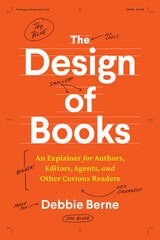
The Design of Books
An Explainer for Authors, Editors, Agents, and Other Curious ReadersDebbie Berne
University of Chicago Press, 2024
Design is central to the appeal, messaging, and usefulness of books, but to most readers, it’s mysterious or even invisible. Through interiors as well as covers, designers provide structure and information that shape the meaning and experience of books. In The Design of Books, Debbie Berne shines a light on the conventions and processes of her profession, revealing both the aesthetic and market-driven decisions designers consider to make books readable and beautiful. In clear, unstuffy language, Berne reveals how books are put together, with discussions of production considerations, typography and fonts, page layouts, use of images and color, special issues for ebooks, and the very face of each book: the cover.
The Design of Books speaks to readers and directly to books’ creators—authors, editors, and other publishing professionals—helping them to become more informed partners in the design of their projects. Berne lays out the practical steps at each stage of the design process, providing insight into who does what when and offering advice for authors on how to be effective advocates for their ideas while also letting go and trusting their manuscripts with teams of professionals. She includes guidance as well for self-publishing authors, including where to find a designer, what to expect from that relationship, and how to art direct your own book.
Throughout, Berne teaches how understanding the whats, hows, and whys of book design heightens our appreciation of these cherished objects and helps everyone involved in the process to create more functional, desirable, and wonderful books.
The Dissertation-to-Book Workbook
Exercises for Developing and Revising Your Book ManuscriptKatelyn E. Knox and Allison Van Deventer
University of Chicago Press, 2023
So, you’ve written a dissertation. Congratulations! But how do you turn it into a book? Even if you know what to do when revising your dissertation, do you know how to do those things? This workbook by Katelyn E. Knox and Allison Van Deventer, creators of the successful online Dissertation-to-Book Boot Camp, offers a series of manageable, concrete steps with exercises to help you revise your academic manuscript into publishable book form.
The Dissertation-to-Book Workbook uses targeted exercises and prompts to take the guesswork out of writing a book. You’ll clarify your book’s core priorities, pinpoint your organizing principle, polish your narrative arc, evaluate your evidence, and much more. Using what this workbook calls “book questions and chapter answers,” you’ll figure out how to thread your book’s main ideas through its chapters. Then, you’ll assemble an argument, and finally, you’ll draft any remaining material and revise the manuscript. And most important, by the time you complete the workbook, you’ll have confidence that your book works as a book—that it’s a cohesive, focused manuscript that tells the story you want to tell.
Indispensible to anyone with an academic manuscript in progress, the prompts, examples, checklists, and activities will give you confidence about all aspects of your project—that it is structurally sound, coherent, free of the hallmarks of “dissertationese," and ready for submission to an academic publisher.
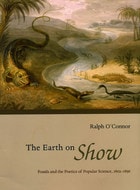
The Earth on Show
Fossils and the Poetics of Popular Science, 1802-1856Ralph O'Connor
University of Chicago Press, 2007
Shrewd science-writers, O’Connor shows, marketed spectacular visions of past worlds, piquing the public imagination with glimpses of man-eating mammoths, talking dinosaurs, and sea-dragons spawned by Satan himself. These authors—including men of science, women, clergymen, biblical literalists, hack writers, blackmailers, and prophets—borrowed freely from the Bible, modern poetry, and the urban entertainment industry, creating new forms of literature in order to transport their readers into a vanished and alien past.
In exploring the use of poetry and spectacle in the promotion of popular science, O’Connor proves that geology’s success owed much to the literary techniques of its authors. An innovative blend of the history of science, literary criticism, book history, and visual culture, The Earth on Show rethinks the relationship between science and literature in the nineteenth century.
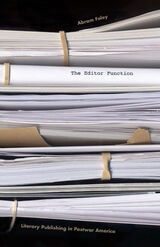
The Editor Function
Literary Publishing in Postwar AmericaAbram Foley
University of Minnesota Press, 2021
Offering the everyday tasks of literary editors as inspired sources of postwar literary history
Michel Foucault famously theorized “the author function” in his 1969 essay “What Is an Author?” proposing that the existence of the author limits textual meaning. Abram Foley shows a similar critique at work in the labor of several postwar editors who sought to question and undo the corporate “editorial/industrial complex.” Marking an end to the powerful trope of the editor as gatekeeper, The Editor Function demonstrates how practices of editing and publishing constitute their own kinds of thought, calling on us to rethink what we read and how.
The Editor Function follows avant-garde American literary editors and the publishing practices they developed to compete against the postwar corporate consolidation of the publishing industry. Foley studies editing and publishing through archival readings and small press and literary journal publishing lists as unique sites for literary inquiry. Pairing histories and analyses of well- and lesser-known figures and publishing formations, from Cid Corman’s Origin and Nathaniel Mackey’s Hambone to Dalkey Archive Press and Semiotext(e), Foley offers the first in-depth engagement with major publishing initiatives in the postwar United States.
The Editor Function proposes that from the seemingly mundane tasks of these editors—routine editorial correspondence, line editing, list formation—emerge visions of new, better worlds and new textual and conceptual spaces for collective action.

The Holocaust & the Exile of Yiddish
A History of the Algemeyne EntsiklopedyeBarry Trachtenberg
Rutgers University Press, 2022
The Holocaust & the Exile of Yiddish untangles the complicated saga of the Algemeyne entsiklopedye and its editors. The editors continued to publish volumes and revise the encyclopedia’s mission while their primary audience, Eastern European Jews, faced persecution and genocide under Nazi rule, and the challenge of reestablishing themselves in the first decades after World War II. Historian Barry Trachtenberg reveals how, over the course of the middle decades of the twentieth century, the project sparked tremendous controversy in Jewish cultural and political circles, which debated what the purpose of a Yiddish encyclopedia should be, as well as what knowledge and perspectives it should contain. Nevertheless, this is not only a story about destruction and trauma, but also one of tenacity and continuity, as the encyclopedia’s compilers strove to preserve the heritage of Yiddish culture, to document its near-total extermination in the Holocaust, and to chart its path into the future.
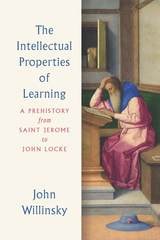
The Intellectual Properties of Learning
A Prehistory from Saint Jerome to John LockeJohn Willinsky
University of Chicago Press, 2017
Willinsky begins with Saint Jerome in the fifth century, then traces the evolution of reading, writing, and editing practices in monasteries, schools, universities, and among independent scholars through the medieval period and into the Renaissance. He delves into the influx of Islamic learning and the rediscovery of classical texts, the dissolution of the monasteries, and the founding of the Bodleian Library before finally arriving at John Locke, whose influential lobbying helped bring about the first copyright law, the Statute of Anne of 1710. Willinsky’s bravura tour through this history shows that learning gave rise to our idea of intellectual property while remaining distinct from, if not wholly uncompromised by, the commercial economy that this concept inspired, making it clear that today’s push for marketable intellectual property threatens the very nature of the quest for learning on which it rests.
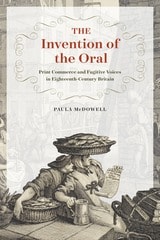
The Invention of the Oral
Print Commerce and Fugitive Voices in Eighteenth-Century BritainPaula McDowell
University of Chicago Press, 2017
Drawing on an impressive array of sources including travel narratives, elocution manuals, theological writings, ballad collections, and legal records, McDowell re-creates a world in which everyone from fishwives to philosophers, clergymen to street hucksters, competed for space and audiences in taverns, marketplaces, and the street. She argues that the earliest positive efforts to theorize "oral tradition," and to depict popular oral culture as a culture (rather than a lack of culture), were prompted less by any protodemocratic impulse than by a profound discomfort with new cultures of reading, writing, and even speaking shaped by print.
Challenging traditional models of oral versus literate societies and key assumptions about culture’s ties to the spoken and the written word, this landmark study reorients critical conversations across eighteenth-century studies, media and communications studies, the history of the book, and beyond.
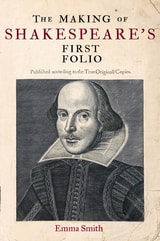
The Making of Shakespeare's First Folio
Emma Smith
Bodleian Library Publishing, 2015
The Making of Shakespeare’s First Folio offers the first comprehensive biography of the earliest collected edition of Shakespeare’s plays. In November 1623, the book arrived in the bookshop of the London publisher Edward Blount at the Black Bear. Long in the making, Master William Shakespeare’s Comedies, Histories, and Tragedies—as the First Folio was then known—appeared seven years after Shakespeare’s death. Nearly one thousand pages in length, the collection comprised thirty-six plays, half of which had never been previously published. Emma Smith tells the story of the First Folio’s origins, locating it within the social and political context of Jacobean London and bringing in the latest scholarship on the seventeenth-century book trade.
Extensively illustrated, The Making of Shakespeare’s First Folio is a landmark addition to the copious literature on Shakespeare. It will shed much-needed light on the birth of the First Folio—of which fewer than 250 copies remain—and the birth of Shakespeare’s towering reputation.
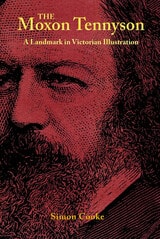
The Moxon Tennyson
A Landmark in Victorian IllustrationSimon Cooke
Ohio University Press, 2021
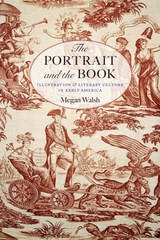
The Portrait and the Book
Illustration and Literary Culture in Early AmericaMegan Walsh
University of Iowa Press, 2017
Illustrations played a key role in American literary culture despite the fact there was little demand for books by American writers. Indeed, most of the illustrated books bought, sold, and shared by Americans were either imported British works or reprinted versions of those imported editions. As a result, in addition to embellishing books, illustrations provided readers with crucial information about the country’s status as a former colony.
Through an examination of readers’ portrait-collecting habits, writers’ employment of ekphrasis, printers’ efforts to secure American-made illustrations for periodicals, and engravers’ reproductions of British book illustrations, Walsh uncovers in late eighteenth-century America a dynamic but forgotten visual culture that was inextricably tied to the printing industry and to the early US literary imagination.
The Riddle of Literary Quality
A Computational ApproachKarina van Dalen-Oskam
Amsterdam University Press, 2023
Using evidence from almost 14,000 readers and building on more textual data than ever before, Van Dalen-Oskam and her team uncovered unconscious biases that shed new light on prejudices many people assumed no longer existed. This monograph explains in an accessible way how the project unfolded, which methods were used, and how the results may change the future of Literary Studies.
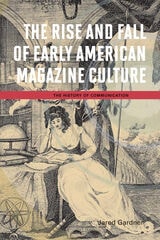
The Rise and Fall of Early American Magazine Culture
Jared Gardner
University of Illinois Press, 2014
The Scholarly Workflow in the Digital Age
Steven Weiland
Against the Grain, LLC, 2021
As this Briefing explains, the workflow features planning and structure, and a recognizable sequence of activities. But so too is there room for imagination, improvisation, and serendipity. Science and scholarship are human activities and the workflow in all disciplines reflects both convention and innovation as scholars discover the extent and meanings of their professional interactions with technology. In the digital age the workflow is in a new stage of representing what scholars do to advance knowledge and their careers, at the same time it displays the durability of traditional research practices.

The Scientific Journal
Authorship and the Politics of Knowledge in the Nineteenth CenturyAlex Csiszar
University of Chicago Press, 2018
The Scientific Journal tells the story of how that changed. Alex Csiszar takes readers deep into nineteenth-century London and Paris, where savants struggled to reshape scientific life in the light of rapidly changing political mores and the growing importance of the press in public life. The scientific journal did not arise as a natural solution to the problem of communicating scientific discoveries. Rather, as Csiszar shows, its dominance was a hard-won compromise born of political exigencies, shifting epistemic values, intellectual property debates, and the demands of commerce. Many of the tensions and problems that plague scholarly publishing today are rooted in these tangled beginnings. As we seek to make sense of our own moment of intense experimentation in publishing platforms, peer review, and information curation, Csiszar argues powerfully that a better understanding of the journal’s past will be crucial to imagining future forms for the expression and organization of knowledge.
The Scientific Literature
A Guided TourEdited by Joseph E. Harmon and Alan G. Gross
University of Chicago Press, 2007
The scientific article has been a hallmark of the career of every important western scientist since the seventeenth century. Yet its role in the history of science has not been fully explored. Joseph E. Harmon and Alan G. Gross remedy this oversight with The Scientific Literature, a collection of writings—excerpts from scientific articles, letters, memoirs, proceedings, transactions, and magazines—that illustrates the origin of the scientific article in 1665 and its evolution over the next three and a half centuries.
Featuring articles—as well as sixty tables and illustrations, tools vital to scientific communication—that represent the broad sweep of modern science, The Scientific Literature is a historical tour through both the rhetorical strategies that scientists employ to share their discoveries and the methods that scientists use to argue claims of new knowledge. Commentaries that explain each excerpt’s scientific and historical context and analyze its communication strategy accompany each entry.
A unique anthology, The Scientific Literature will allow both the scholar and the general reader to experience first hand the development of modern science.
The Secret of the Hardy Boys
Leslie McFarlane and the Stratemeyer SyndicateMarilyn S. Greenwald
Ohio University Press, 2004
For generations of readers, the Hardy Boys were the creations of the legendary Franklin W. Dixon—except Dixon never existed. Behind the iconic series stood the Stratemeyer Syndicate, a powerhouse of children’s publishing, and one gifted but largely unrecognized writer: Leslie McFarlane.
In The Secret of the Hardy Boys, acclaimed biographer Marilyn S. Greenwald uncovers the remarkable story of the man who first brought Frank and Joe Hardy to life. A young Canadian journalist with ambitions beyond formula fiction, McFarlane infused the Syndicate’s rigid plots with wit, atmosphere, and narrative vitality—helping to shape one of the most enduring franchises in children’s literature.
Bound by contract and reluctant to claim authorship, McFarlane kept his role a secret for decades, receiving little financial reward for books that sold in the millions. Yet his story is far from one of regret. Drawing on extensive research, Greenwald paints a vivid portrait of a versatile writer who navigated the shifting landscape of twentieth-century media, from pulp magazines to radio and film.
Rich in literary history and human insight, The Secret of the Hardy Boys is both a revealing behind-the-scenes account of a cultural phenomenon and an inspiring testament to creativity, resilience, and the quiet architects of beloved stories.
The Subversive Copy Editor, Second Edition
Advice from Chicago (or, How to Negotiate Good Relationships with Your Writers, Your Colleagues, and Yourself)Carol Fisher Saller
University of Chicago Press, 2016
In this second edition, Saller adds new chapters, on the dangers of allegiance to outdated grammar and style rules and on ways to stay current in language and technology. She expands her advice for writers on formatting manuscripts for publication, on self-editing, and on how not to be “difficult.” Saller’s own gaffes provide firsthand (and sometimes humorous) examples of exactly what not to do. The revised content reflects today’s publishing practices while retaining the self-deprecating tone and sharp humor that helped make the first edition so popular. Saller maintains that through carefulness, transparency, and flexibility, editors can build trust and cooperation with writers.
The Subversive Copy Editor brings a refreshingly levelheaded approach to the classic battle between writers and editors. This sage advice will prove useful and entertaining to anyone charged with the sometimes perilous task of improving the writing of others.
Travels into Print
Exploration, Writing, and Publishing with John Murray, 1773-1859Innes M. Keighren, Charles W. J. Withers, and Bill Bell
University of Chicago Press, 2015
Drawing on detailed examination of the John Murray Archive of manuscripts, images, and the firm’s correspondence with its many authors—a list that included such illustrious explorers and scientists as Charles Darwin and Charles Lyell, and literary giants like Jane Austen, Lord Byron, and Sir Walter Scott—Travels into Print considers how journeys of exploration became published accounts and how travelers sought to demonstrate the faithfulness of their written testimony and to secure their personal credibility. This fascinating study in historical geography and book history takes modern readers on a journey into the nature of exploration, the production of authority in published travel narratives, and the creation of geographical authorship—a journey bound together by the unifying force of a world-leading publisher.