Results by title
81 books match the query 'Publishing' and 17 start with t
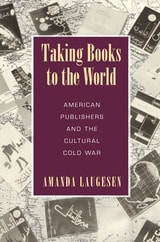
Taking Books to the World
American Publishers and the Cultural Cold WarAmanda Laugesen
University of Massachusetts Press, 2017
In Taking Books to the World, Amanda Laugesen tells the story of this purposeful enterprise, demonstrating the mix of goodwill and political drive behind its efforts to create modern book industries in developing countries. Examining the project through a clarifying lens, she reveals the ways Franklin's work aligned with cultural currents, exposing the imperial beliefs, charitable hopes, and intellectual reasoning behind this global experiment.
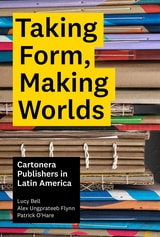
Taking Form, Making Worlds
Cartonera Publishers in Latin AmericaLucy Bell, Alex Ungprateeb Flynn, Patrick O’Hare
University of Texas Press, 2022
2023 LASA Visual Culture Studies Section Book Prize, Latin American Studies Association (LASA)
The first comprehensive study of cartonera, a vibrant publishing phenomenon born in Latin America.
A publishing phenomenon and artistic project, cartonera was born in the wake of Argentina’s 2001 economic crisis. Infused with a rebellious spirit, it has exploded in popularity, with hundreds of publishers across Latin America and Europe making colorful, low-cost books out of cardboard salvaged from the street. Taking Form, Making Worlds is the first comprehensive study of cartonera. Drawing on interdisciplinary research conducted across Mexico, Brazil, and Argentina, the authors show how this hands-on practice has fostered a politically engaged network of writers, artists, and readers. More than a social movement, cartonera uses texts, workshops, encounters, and exhibitions to foster community and engagement through open-ended forms that are at once artistic and social. For various groups including waste-pickers, Indigenous communities, rural children, and imprisoned women, cartonera provides a platform for unique stories and sparks collaborations that bring the walls of the “lettered city” tumbling down. In contexts of stigma and exclusion, cartonera collectives give form to a decolonial aesthetics of resistance, making possible a space of creative experimentation through which plural worlds can be brought to life.
The Archival Turn in Feminism
Outrage in OrderKate Eichhorn
Temple University Press, 2014
A volume in the American Literatures Initiative
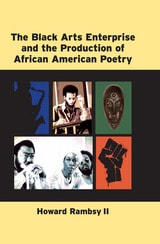
The Black Arts Enterprise and the Production of African American Poetry
Howard Rambsy II
University of Michigan Press, 2013
The outpouring of creative expression known as the Black Arts Movement of the 1960s and 1970s spawned a burgeoning number of black-owned cultural outlets, including publishing houses, performance spaces, and galleries. Central to the movement were its poets, who in concert with editors, visual artists, critics, and fellow writers published a wide range of black verse and advanced new theories and critical approaches for understanding African American literary art.
The Black Arts Enterprise and the Production of African American Poetry offers a close examination of the literary culture in which BAM's poets (including Amiri Baraka, Nikki Giovanni, Sonia Sanchez, Larry Neal, Haki Madhubuti, Carolyn Rodgers, and others) operated and of the small presses and literary anthologies that first published the movement's authors. The book also describes the role of the Black Arts Movement in reintroducing readers to poets such as Langston Hughes, Robert Hayden, Margaret Walker, and Phillis Wheatley.
Focusing on the material production of Black Arts poetry, the book combines genetic criticism with cultural history to shed new light on the period, its publishing culture, and the writing and editing practices of its participants. Howard Rambsy II demonstrates how significant circulation and format of black poetic texts—not simply their content—were to the formation of an artistic movement. The book goes on to examine other significant influences on the formation of Black Arts discourse, including such factors as an emerging nationalist ideology and figures such as John Coltrane and Malcolm X.

The Book of the Play
Playwrights, Stationers, and Readers in Early Modern EnglandMarta Straznicky
University of Massachusetts Press, 2006
The Book of the Play is a collection of essays that examines early modern drama in the context of book history. Focusing on the publication, marketing, and readership of plays opens fresh perspectives on the relationship between the cultures of print and performance and more broadly between drama and the public sphere. Marta Straznicky's introduction offers a survey of approaches to the history of play reading in this period, and the collection as a whole consolidates recent work in textual, bibliographic, and cultural studies of printed drama.
Individually, the essays advance our understanding of play reading as a practice with distinct material forms, discourses, social settings, and institutional affiliation. Part One, “Real and Imagined Communities,” includes four essays on play-reading communities and the terms in which they are distinguished from the reading public at large. Cyndia Clegg surveys the construction of readers in prefaces to published plays; Lucy Munro traces three separate readings of a single play, Edward Sharpham's The Fleer; Marta Straznicky studies women as readers of printed drama; and Elizabeth Sauer describes how play reading was mobilized for political purposes in the period of the Civil War.
In Part Two, “Play Reading and the Book Trade,” five essays consider the impact of play reading on the public sphere through the lens of publishing practices. Zachary Lesser offers a revisionist account of black-letter typeface and the extent to which it may be understood as an index of popular culture; Alan Farmer examines how the emerging news trade of the 1620s and 1630s affected the marketing of printed drama; Peter Berek traces the use of generic terms on title pages of plays to reveal their intersection with the broader culture of reading; Lauren Shohet demonstrates that the Stuart masque had a parallel existence in the culture of print; and Douglas Brooks traces the impact print had on eclipsing performance as the medium in which the dramatist could legitimately lay claim to having authored his text.
The individual essays focus on selected communities of readers, publication histories, and ideologies and practices of reading; the collection as a whole demonstrates the importance of textual production and reception to understanding the place of drama in the early modern public sphere.
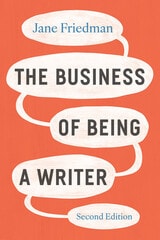
The Business of Being a Writer, Second Edition
Jane Friedman
University of Chicago Press, 2025
Writers talk about their work in many ways: as an art, as a calling, as a lifestyle. Too often missing from these conversations is the fact that writing is also a business, and those who want to make a living from their writing must understand the basic business principles underlying the industry. The Business of Being a Writer offers the business education writers need but so rarely receive.
Jane Friedman is one of today’s leading experts on the publishing industry. Through her website, social media presence, online courses, email newsletters, and other media, she helps writers understand how to navigate the industry with confidence and intentionality. This book advises writers on how to build a platform in a way that aligns with their values, how to spot critical mindset issues that might sabotage their efforts before they even begin, how to publish strategically, and what it means to diversify income streams beyond book sales. For this second edition, Friedman has updated every topic to reflect how the industry has evolved over the past half decade. New features include a section on business and legal issues commonly faced by writers, exercises at the end of each chapter, and a wealth of sample materials posted on a companion website.
Reaching beyond the mechanical aspects of publishing, The Business of Being a Writer will help both new and experienced writers approach their careers with the same creative spirit as their writing. Friedman is encouraging without sugarcoating reality, blending years of research with practical advice that will help writers market themselves and maximize their writing-related income. Her book will leave them empowered, confident, and ready to turn their craft into a sustainable career.
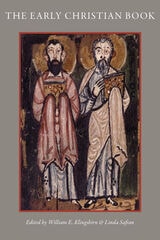
The Early Christian Book (CUA Studies in Early Christianity)
William E. Klingshirn
Catholic University of America Press, 2007

The Enlightenment and the Book
Scottish Authors and Their Publishers in Eighteenth-Century Britain, Ireland, and AmericaRichard B. Sher
University of Chicago Press, 2007
The late eighteenth century witnessed an explosion of intellectual activity in Scotland by such luminaries as David Hume, Adam Smith, Hugh Blair, William Robertson, Adam Ferguson, James Boswell, and Robert Burns. And the books written by these seminal thinkers made a significant mark during their time in almost every field of polite literature and higher learning throughout Britain, Europe, and the Americas.
In this magisterial history, Richard B. Sher breaks new ground for our understanding of the Enlightenment and the forgotten role of publishing during that period. The Enlightenment and the Book seeks to remedy the common misperception that such classics as The Wealth of Nations and The Life of Samuel Johnson were written by authors who eyed their publishers as minor functionaries in their profession. To the contrary, Sher shows how the process of bookmaking during the late eighteenth-century involved a deeply complex partnership between authors and their publishers, one in which writers saw the book industry not only as pivotal in the dissemination of their ideas, but also as crucial to their dreams of fame and monetary gain. Similarly, Sher demonstrates that publishers were involved in the project of bookmaking in order to advance human knowledge as well as to accumulate profits.
The Enlightenment and the Book explores this tension between creativity and commerce that still exists in scholarly publishing today. Lavishly illustrated and elegantly conceived, it will be must reading for anyone interested in the history of the book or the production and diffusion of Enlightenment thought.
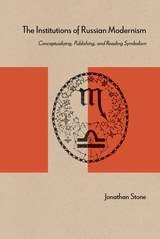
The Institutions of Russian Modernism
Conceptualizing, Publishing, and Reading SymbolismJonathan Stone
Northwestern University Press, 2017
The Institutions of Russian Modernism illuminates the key role of Symbolism as the earliest form of modernism in Russia, emerging seemingly ex nihilo at the end of the nineteenth century. Combining book history, periodical studies, and reception theory, Jonathan Stone examines the poetry and theory of Russian Symbolism within the framework of the institutions that organized, published, and disseminated the works to Russian readers. Surveying a wealth of examples of books, journals, and almanacs, Stone traces how publishers of Symbolist works marketed the movement and fashioned a Symbolist reader. His persuasive argument that after its eclipse Symbolism's legacy remained embedded in the heart of Russian modernism will be of interest to scholars and general readers.

The Last Days of Publishing
A NovelThomas M. Engelhardt
University of Massachusetts Press, 2005
Koppes, who came of age in the sixties, is an editor slowly running off the rails. In the six episodes of The Last Days of Publishing, he refights the Vietnam War in a Chinese restaurant, discovers that the paleontological is political in a natural history museum, mixes it up with a flamboyant literary agent who went underground decades earlier, and encounters a hippie cultural oligarch on the forty-fifth floor of Multimedia's transnational entertainment headquarters.
Tom Engelhardt, himself a publishing veteran, has produced a tumultuous vision of the new world in which the word finds itself hustling for a living. By turns hilarious, sardonic, and poignant, his novel deftly captures the ways in which publishing, which has long put our world between covers but has seldom been memorialized in fiction, is being transformed.
The Literary Text in the Digital Age
Richard J. Finneran, Editor
University of Michigan Press, 1996
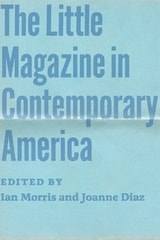
The Little Magazine in Contemporary America
Edited by Ian Morris and Joanne Diaz
University of Chicago Press, 2015
In this collection, Ian Morris and Joanne Diaz gather the reflections of twenty-three prominent editors whose little magazines have flourished over the past thirty-five years. Highlighting the creativity and innovation driving this diverse and still vital medium, contributors offer insights into how their publications sometimes succeeded, sometimes reluctantly folded, but mostly how they evolved and persevered. Other topics discussed include the role of little magazines in promoting the work and concerns of minority and women writers, the place of universities in supporting and shaping little magazines, and the online and offline future of these publications.
Selected contributors
Betsy Sussler, BOMB; Lee Gutkind, Creative Nonfiction; Bruce Andrews, L=A=N=G=U=A=G=E; Dave Eggers, McSweeney’s; Keith Gessen, n+1; Don Share, Poetry; Jane Friedman, VQR; Amy Hoffman, Women’s Review of Books; and more.
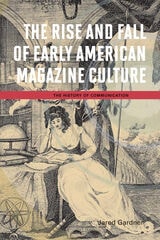
The Rise and Fall of Early American Magazine Culture
Jared Gardner
University of Illinois Press, 2014
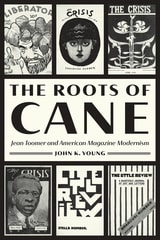
The Roots of Cane
Jean Toomer and American Magazine ModernismJohn K. Young
University of Iowa Press, 2024
Young interweaves a periodical-studies approach to modernism with book history and critical race theory, resituating Toomer’s uneasy place within Black modernism by asking how original readers would have encountered his work. The different contexts in which those audiences were engaging with Toomer’s portraits of racialized identity in the Jim Crow United States, yield often surprising results.

The Scientific Journal
Authorship and the Politics of Knowledge in the Nineteenth CenturyAlex Csiszar
University of Chicago Press, 2018
The Scientific Journal tells the story of how that changed. Alex Csiszar takes readers deep into nineteenth-century London and Paris, where savants struggled to reshape scientific life in the light of rapidly changing political mores and the growing importance of the press in public life. The scientific journal did not arise as a natural solution to the problem of communicating scientific discoveries. Rather, as Csiszar shows, its dominance was a hard-won compromise born of political exigencies, shifting epistemic values, intellectual property debates, and the demands of commerce. Many of the tensions and problems that plague scholarly publishing today are rooted in these tangled beginnings. As we seek to make sense of our own moment of intense experimentation in publishing platforms, peer review, and information curation, Csiszar argues powerfully that a better understanding of the journal’s past will be crucial to imagining future forms for the expression and organization of knowledge.

The Secret of the Hardy Boys
Leslie McFarlane and the Stratemeyer SyndicateMarilyn S. Greenwald
Ohio University Press, 2004
For generations of readers, the Hardy Boys were the creations of the legendary Franklin W. Dixon—except Dixon never existed. Behind the iconic series stood the Stratemeyer Syndicate, a powerhouse of children’s publishing, and one gifted but largely unrecognized writer: Leslie McFarlane.
In The Secret of the Hardy Boys, acclaimed biographer Marilyn S. Greenwald uncovers the remarkable story of the man who first brought Frank and Joe Hardy to life. A young Canadian journalist with ambitions beyond formula fiction, McFarlane infused the Syndicate’s rigid plots with wit, atmosphere, and narrative vitality—helping to shape one of the most enduring franchises in children’s literature.
Bound by contract and reluctant to claim authorship, McFarlane kept his role a secret for decades, receiving little financial reward for books that sold in the millions. Yet his story is far from one of regret. Drawing on extensive research, Greenwald paints a vivid portrait of a versatile writer who navigated the shifting landscape of twentieth-century media, from pulp magazines to radio and film.
Rich in literary history and human insight, The Secret of the Hardy Boys is both a revealing behind-the-scenes account of a cultural phenomenon and an inspiring testament to creativity, resilience, and the quiet architects of beloved stories.
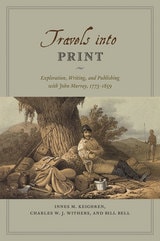
Travels into Print
Exploration, Writing, and Publishing with John Murray, 1773-1859Innes M. Keighren, Charles W. J. Withers, and Bill Bell
University of Chicago Press, 2015
Drawing on detailed examination of the John Murray Archive of manuscripts, images, and the firm’s correspondence with its many authors—a list that included such illustrious explorers and scientists as Charles Darwin and Charles Lyell, and literary giants like Jane Austen, Lord Byron, and Sir Walter Scott—Travels into Print considers how journeys of exploration became published accounts and how travelers sought to demonstrate the faithfulness of their written testimony and to secure their personal credibility. This fascinating study in historical geography and book history takes modern readers on a journey into the nature of exploration, the production of authority in published travel narratives, and the creation of geographical authorship—a journey bound together by the unifying force of a world-leading publisher.