Results by title
1201 books match the query 'Race relations' and 209 start with t
Tacit Racism
Anne Warfield Rawls and Waverly Duck
University of Chicago Press, 2020
Every time we interact with another human being, we unconsciously draw on a set of expectations to guide us through the encounter. What many of us in the United States—especially white people—do not recognize is that centuries of institutional racism have inescapably molded those expectations. This leads us to act with implicit biases that can shape everything from how we greet our neighbors to whether we take a second look at a resume. This is tacit racism, and it is one of the most pernicious threats to our nation.
In Tacit Racism, Anne Warfield Rawls and Waverly Duck illustrate the many ways in which racism is coded into the everyday social expectations of Americans, in what they call Interaction Orders of Race. They argue that these interactions can produce racial inequality, whether the people involved are aware of it or not, and that by overlooking tacit racism in favor of the fiction of a “color-blind” nation, we are harming not only our society’s most disadvantaged—but endangering the society itself.
Ultimately, by exposing this legacy of racism in ordinary social interactions, Rawls and Duck hope to stop us from merely pretending we are a democratic society and show us how we can truly become one.
Taifa
Making Nation and Race in Urban TanzaniaJames R. Brennan
Ohio University Press, 2012
Taifa is a story of African intellectual agency, but it is also an account of how nation and race emerged out of the legal, social, and economic histories in one major city, Dar es Salaam. Nation and race—both translatable as taifa in Swahili—were not simply universal ideas brought to Africa by European colonizers, as previous studies assume. They were instead categories crafted by local African thinkers to make sense of deep inequalities, particularly those between local Africans and Indian immigrants. Taifa shows how nation and race became the key political categories to guide colonial and postcolonial life in this African city.
Using deeply researched archival and oral evidence, Taifa transforms our understanding of urban history and shows how concerns about access to credit and housing became intertwined with changing conceptions of nation and nationhood. Taifa gives equal attention to both Indians and Africans; in doing so, it demonstrates the significance of political and economic connections between coastal East Africa and India during the era of British colonialism, and illustrates how the project of racial nationalism largely severed these connections by the 1970s.
Take Up the Black Man's Burden
Kansas City's African American Communities, 1865-1939Charles E. Coulter
University of Missouri Press, 2006
Talking about Race
Community Dialogues and the Politics of DifferenceKatherine Cramer Walsh
University of Chicago Press, 2007
It is a perennial question: how should Americans deal with racial and ethnic diversity? More than 400 communities across the country have attempted to answer it by organizing discussions among diverse volunteers in an attempt to improve race relations. In Talking about Race, Katherine Cramer Walsh takes an eye-opening look at this strategy to reveal the reasons behind the method and the effects it has in the cities and towns that undertake it.
With extensive observations of community dialogues, interviews with the discussants, and sophisticated analysis of national data, Walsh shows that while meeting organizers usually aim to establish common ground, participants tend to leave their discussions with a heightened awareness of differences in perspective and experience. Drawing readers into these intense conversations between ordinary Americans working to deal with diversity and figure out the meaning of citizenship in our society, she challenges many preconceptions about intergroup relations and organized public talk. Finally disputing the conventional wisdom that unity is the only way forward, Walsh prescribes a practical politics of difference that compels us to reassess the place of face-to-face discussion in civic life and the critical role of conflict in deliberative democracy.
Talking to Strangers
Anxieties of Citizenship since Brown v. Board of EducationDanielle Allen
University of Chicago Press, 2004
Returning to the landmark Brown v. Board of Education decision of 1954 and to the famous photograph of Elizabeth Eckford, one of the Little Rock Nine, being cursed by fellow "citizen" Hazel Bryan, Allen argues that we have yet to complete the transition to political friendship that this moment offered. By combining brief readings of philosophers and political theorists with personal reflections on race politics in Chicago, Allen proposes strikingly practical techniques of citizenship. These tools of political friendship, Allen contends, can help us become more trustworthy to others and overcome the fossilized distrust among us.
Sacrifice is the key concept that bridges citizenship and trust, according to Allen. She uncovers the ordinary, daily sacrifices citizens make to keep democracy working—and offers methods for recognizing and reciprocating those sacrifices. Trenchant, incisive, and ultimately hopeful, Talking to Strangers is nothing less than a manifesto for a revitalized democratic citizenry.
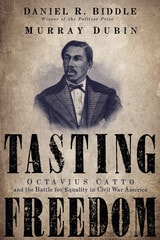
Tasting Freedom
Octavius Catto and the Battle for Equality in Civil War AmericaDaniel R. Biddle
Temple University Press, 2017
Octavius Valentine Catto was an orator who shared stages with Frederick Douglass, a second baseman on Philadelphia’s best black baseball team, a teacher at the city’s finest black school and an activist who fought in the state capital and on the streets for equal rights. With his racially-charged murder, the nation lost a civil rights pioneer—one who risked his life a century before Selma and Birmingham.
In Tasting Freedom Murray Dubin and Pulitzer Prize winner Dan Biddle painstakingly chronicle the life of this charismatic black leader—a “free” black whose freedom was in name only. Born in the American south, where slavery permeated everyday life, he moved north where he joined the fight to be truly free—free to vote, go to school, ride on streetcars, play baseball and even participate in July 4th celebrations.
Catto electrified a biracial audience in 1864 when he proclaimed, “There must come a change,” calling on free men and women to act and educate the newly freed slaves. With a group of other African Americans who called themselves a “band of brothers,” they challenged one injustice after another. Tasting Freedom presents the little-known stories of Catto and the men and women who struggled to change America.
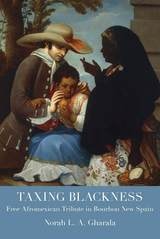
Taxing Blackness
Free Afromexican Tribute in Bourbon New SpainNorah L. A. Gharala
University of Alabama Press, 2019
A definitive analysis of the most successful tribute system in the Americas as applied to Afromexicans
During the eighteenth century, hundreds of thousands of free descendants of Africans in Mexico faced a highly specific obligation to the Spanish crown, a tax based on their genealogy and status. This royal tribute symbolized imperial loyalties and social hierarchies. As the number of free people of color soared, this tax became a reliable source of revenue for the crown as well as a signal that colonial officials and ordinary people referenced to define and debate the nature of blackness.
Taxing Blackness: Free Afromexican Tribute in Bourbon New Spain examines the experiences of Afromexicans and this tribute to explore the meanings of race, political loyalty, and legal privileges within the Spanish colonial regime. Norah L. A. Gharala focuses on both the mechanisms officials used to define the status of free people of African descent and the responses of free Afromexicans to these categories and strategies. This study spans the eighteenth century and focuses on a single institution to offer readers a closer look at the place of Afromexican individuals in Bourbon New Spain, which was the most profitable and populous colony of the Spanish Atlantic.
As taxable subjects, many Afromexicans were deeply connected to the colonial regime and ongoing debates about how taxpayers should be defined, whether in terms of reputation or physical appearance. Gharala shows the profound ambivalence, and often hostility, that free people of African descent faced as they navigated a regime that simultaneously labeled them sources of tax revenue and dangerous vagabonds. Some free Afromexicans paid tribute to affirm their belonging and community ties. Others contested what they saw as a shameful imposition that could harm their families for generations. The microhistory includes numerous anecdotes from specific cases and people, bringing their history alive, resulting in a wealth of rural and urban, gender, and family insight.
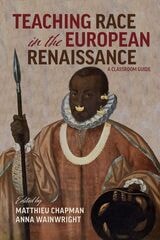
Teaching Race in the European Renaissance
A Classroom GuideEdited by Anna Wainwright and Matthieu Chapman
Arizona Center for Medieval and Renaissance Studies, 2023
Teaching Race in the European Renaissance: A Classroom Guide provides both educators and students the tools they need to discuss race in the European Renaissance both in its unique historical contexts and as part of a broader continuum with racial thinking today. The volume gathers scholars of the English, French, Italian, and Iberian Renaissances to provide exercises, lesson plans, methodologies, readings, and other resources designed to bring discussions of race into a broad spectrum of classes on the early modern period, from literature to art history to the history of science. This book is designed to help educators create more diverse and inclusive syllabi and curricula that engage and address a diverse, twenty-first-century student body composed of students from a growing variety of cultural, national, ethnic, and racial backgrounds. By providing clear, concise, and diverse methodologies and analytical focuses, Teaching Race in the European Renaissance: A Classroom Guide will help educators in all areas of Renaissance Studies overcome the anxiety and fear that can come with stepping outside of their expertise to engage with the topic of race, while also providing expert scholars of race in the Renaissance with new techniques and pedagogies to enhance the classroom experience of their students.
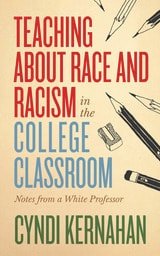
Teaching about Race and Racism in the College Classroom
Notes from a White ProfessorCyndi Kernahan
West Virginia University Press, 2019
Teaching about race and racism can be a difficult business. Students and instructors alike often struggle with strong emotions, and many people have robust preexisting beliefs about race. At the same time, this is a moment that demands a clear understanding of racism. It is important for students to learn how we got here and how racism is more than just individual acts of meanness. Students also need to understand that colorblindness is not an effective anti-racism strategy.
In this book, Cyndi Kernahan argues that you can be honest and unflinching in your teaching about racism while also providing a compassionate learning environment that allows for mistakes and avoids shaming students. She provides evidence for how learning works with respect to race and racism along with practical teaching strategies rooted in that evidence to help instructors feel more confident. She also differentiates between how white students and students of color are likely to experience the classroom, helping instructors provide a more effective learning experience for all students.
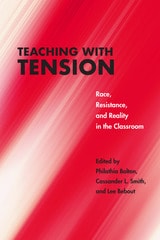
Teaching with Tension
Race, Resistance, and Reality in the ClassroomEdited by Philathia Bolton, Cassander L. Smith, and Lee Bebout
Northwestern University Press, 2019
Drawing together personal reflection, pedagogical strategies, and critical theory, Teaching with Tension offers concrete examinations that will foster student learning. The essays are organized into three thematic sections: "Teaching in Times and Places of Struggle" examines the dynamics of teaching race during the current moment, marked by neoconservative politics and twenty-first century freedom struggles. "Teaching in the Neoliberal University" focuses on how pressures and exigencies of neoliberalism (such as individualism, customer-service models of education, and online courses) impact the way in which race is taught and conceptualized in college classes. The final section, "Teaching How to Read Race and (Counter)Narratives," homes in on direct strategies used to historicize race in classrooms comprised of millennials who grapple with race neutral ideologies. Taken together, these sections and their constitutive essays offer rich and fruitful insight into the complex dynamics of contemporary race and ethnic studies education.
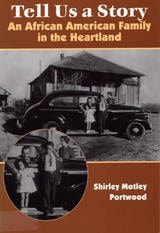
Tell Us a Story
An African American Family in the HeartlandShirley Motley Portwood
Southern Illinois University Press, 2000
Illinois State Historical Society's Certificate of Excellence (2002)
Supplemented by recollections from the present era, Tell Us a Story is a colorful mosaic of African American autobiography and family history set in Springfield, Illinois, and in rural southern Illinois, Missouri, and Arkansas from the 1920s through the 1950s.
Shirley Motley Portwood shares rural, African American family and community history through a collection of vignettes about the Motley family. Initially transcribed accounts of the Motleys’ rich oral history, these stories have been passed among family members for nearly fifty years. In addition to her personal memories, Portwood presents interviews with her father, three brothers, and two sisters plus notes and recollections from their annual family reunions. The result is a composite view of the Motley family.
A historian, Portwood enhances the Motley family story by investigating primary data such as census, marriage, school, and land records, newspaper accounts, city directories, and other sources. The backbone of this saga, however, is oral history gathered from five generations, extending back to Portwood's grandparents, born more than one hundred years ago. Information regarding two earlier generations—her great- grandfather and great-great-grandparents, who were slaves—is based on historical research into state archives, county and local records, plantation records, and manuscript censuses.
A rich source for this material—the Motley family reunions—are week-long retreats where four generations gather at the John Motley house in Burlington, Connecticut, the Portwood home in Godfrey, Illinois, or other locations. Here the Motleys, all natural storytellers, pass on the family traditions. The stories, ranging from humorous to poignant, reveal much about the culture and history of African Americans, especially those from nonurban areas. Like many rural African Americans, the Motleys have a rich and often joyful family history with traditions reaching back to the slave past. They have known the harsh poverty that made even the necessities difficult to obtain and the racial prejudice that divided whites and blacks during the era of Jim Crow segregation and inequality; yet they have kept a tremendous faith in self-improvement through hard work and education.
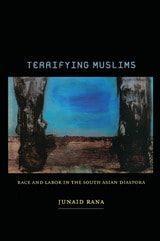
Terrifying Muslims
Race and Labor in the South Asian DiasporaJunaid Rana
Duke University Press, 2011
Texan Crucible
How the Irish, Germans, and Czechs Became AngloMarian J. Barber
University of Texas Press, 2026
A history of European immigrants in Texas and how they redefined racial identity.
While the creation of a Black-White racial binary was foundational to most of the United States, nineteenth-century Texas developed a unique tripartite system that acknowledged the role of individuals of Mexican ancestry in a region that was Spanish, Mexican, and an independent nation before becoming a US (and briefly Confederate) state. Yet this framework was fraught, struggling to accommodate new arrivals from beyond North America, in particular the Irish, Germans, and Czechs. Texan Crucible tells the story of these immigrants and how they became Anglo.
Marian Barber reveals the ways language, religion, alcohol use, and attitudes toward slavery distinguished these newcomers to Texas from those arriving from the eastern United States and how they nevertheless created thriving, influential communities. Their status was shaped by events inside and far beyond Texas, including an 1887 prohibition fight, the Civil War, and two world wars that encouraged them to erase their distinctiveness. As segregation was formally outlawed and civil rights activism grew, understandings of race shifted, cementing these groups’ status as Anglo. Texan Crucible recovers the histories of German, Irish, and Czech immigrants and unveils the social construction of racial difference underpinning Texan identity.
Texas Mexican Americans and Postwar Civil Rights
By Maggie Rivas-Rodriguez
University of Texas Press, 2015
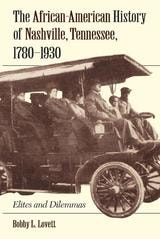
The African-American History of Nashville, Tennessee, 1780-1930
Elites and DilemmasBobby L. Lovett
University of Arkansas Press, 1999
Since its founding, Nashville has been a center of black urban culture in the Upper South. Blacks—slave and free—made up 20 percent of Fort Nashborough’s settlers in 1779. From these early years through the Civil War, a growing black community in Nashville, led by a small group of black elites, quietly built the foundations of a future society, developing schools, churches, and businesses. The Civil War brought new freedoms and challenges as the black population of Nashville increased and as black elites found themselves able—even obliged—to act more openly. To establish a more stable and prosperous African-American community, the elites found that they had to work within a system bound to the interests of whites. But the aims of this elite did not always coincide with those of the black community at large. By 1930, younger blacks, in particular, were moving towards protest and confrontation. As democratization and higher education spread, the lines distinguishing Nashville’s black elite became blurred.
Bobby L. Lovett presents a complex analysis of black experience in Nashville during the years between 1780 and 1930, exploring the impact of civil rights, education, politics, religion, business, and neighborhood development on a particular African-American community. This study of black Nashville examines lives lived within a web of shifting alliances and interests—the choices made, the difficulties overcome.
Fifteen years in the making, illustrated with maps and photographs, this work is the first detailed study of any of Tennessee’s major urban black communities. Lovett here collects, organizes, and interprets a large, rich body of data, making this material newly accessible to all interested in the black urban experience.
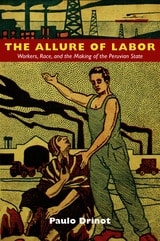
The Allure of Labor
Workers, Race, and the Making of the Peruvian StatePaulo Drinot
Duke University Press, 2011
Although the vast majority of laboring peoples in Peru were indigenous, in the minds of social reformers indigeneity was not commensurable with labor: Indians could not be workers and were therefore excluded from the labor policies enacted in the 1920s and 1930s and, more generally, from elite conceptions of industrial progress. Drinot shows how the incommensurability of indigeneity with labor was expressed in the 1920 constitution, in specific labor policies, and in the activities of state agencies created to oversee collective bargaining and provide workers with affordable housing, inexpensive food, and social insurance. He argues that the racialized assumptions of the modernizing Peruvian state are reflected in the enduring inequalities of present-day Peru.
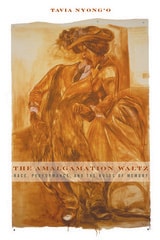
The Amalgamation Waltz
Race, Performance, and the Ruses of MemoryTavia Nyong’o
University of Minnesota Press, 2009
Does racial hybridity offer a future beyond racial difference?
At a time when the idea of a postracial society has entered public discourse, The Amalgamation Waltz investigates the practices that conjoined blackness and whiteness in the nineteenth and twentieth centuries. Scrutinizing widely diverse texts—archival, musical, visual, and theatrical—Tavia Nyong’o traces the genealogy of racial hybridity, analyzing how key events in the nineteenth century spawned a debate about interracialism that lives on today.
Deeply interested in how discussions of racial hybridity have portrayed the hybrid as the recurring hope for a distant raceless future, Nyong’o is concerned with the ways this discourse deploys the figure of the racial hybrid as an alibi for a nationalism that reinvents the racist logics it claims to have broken with. As Nyong’o demonstrates, the rise of a pervasive image of racially anomalous bodies responded to the appearance of an independent black public sphere and organized politics of black uplift. This newfound mobility was apprehended in the political imaginary as a bodily and sexual scandal, and the resultant amalgamation discourse, he argues, must be recognized as one of the earliest and most enduring national dialogues on sex and sexuality. Nyong’o tracks the emergence of the concept of the racial hybrid as an ideological modernization of the older concept of the mongrel and shows how this revision brought race-thinking in line with new understandings of sex and gender, providing a racial context for the shift toward modern heterosexuality, the discourse on which postracial metaphors so frequently rely. A timely rebuttal to our contemporary fascination with racial hybridity, The Amalgamation Waltz questions the vision of a national future without racial difference or conflict.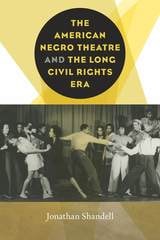
The American Negro Theatre and the Long Civil RIghts Era
Jonathan Shandell
University of Iowa Press, 2018
Jonathan Shandell provides the first in-depth study of the historic American Negro Theatre (ANT) and its lasting influence on American popular culture. Founded in 1940 in Harlem, the ANT successfully balanced expressions of African American consciousness with efforts to gain white support for the burgeoning civil rights movement. The theatre company featured innovative productions with emerging artists—Sidney Poitier, Harry Belafonte, Ruby Dee, and many others—who would become giants of stage, film, and television. In 1944, the ANT made theatrical history by creating the smash hit Anna Lucasta, the most popular play with an African American cast ever to perform on Broadway. Starting from a shoestring budget, the ANT grew into one of the most important companies in the history of African American theatre. Though the group folded in 1949, it continued to shape American popular culture through the creative work of its many talented artists.
Examining oral histories, playbills, scripts, production stills, and journalistic accounts, Shandell gives us the most complete picture to date of the theatre company by analyzing well-known productions alongside groundbreaking and now-forgotten efforts. Shedding light on this often-overlooked chapter of African American history, which fell between the New Negro Renaissance and the Black Arts Movement, Shandell reveals how the ANT became a valued community institution for Harlem—an important platform for African American artists to speak to racial issues—and a trailblazer in promoting integration and interracial artistic collaboration in the U.S. In doing so, Shandell also demonstrates how a small amateur ensemble of the 1940s succeeded in challenging, expanding, and transforming how African Americans were portrayed in the ensuing decades. The result is a fascinating and entertaining examination that will be of interest to scholars and students of African American and American studies and theatre history, as well as popular culture enthusiasts.
The American Non-Dilemma
Racial Inequality Without RacismNancy DiTomaso
Russell Sage Foundation, 2013
The Anti-Black City
Police Terror and Black Urban Life in BrazilJaime Amparo Alves
University of Minnesota Press, 2018
An important new ethnographic study of São Paulo’s favelas revealing the widespread use of race-based police repression in Brazil
While Black Lives Matter still resonates in the United States, the movement has also become a potent rallying call worldwide, with harsh police tactics and repressive state policies often breaking racial lines. In The Anti-Black City, Jaime Amparo Alves delves into the dynamics of racial violence in Brazil, where poverty, unemployment, residential segregation, and a biased criminal justice system create urban conditions of racial precarity.
The Anti-Black City provocatively offers race as a vital new lens through which to view violence and marginalization in the supposedly “raceless” São Paulo. Ironically, in a context in which racial ambiguity makes it difficult to identify who is black and who is white, racialized access to opportunities and violent police tactics establish hard racial boundaries through subjugation and death. Drawing on two years of ethnographic research in prisons and neighborhoods on the periphery of this mega-city, Alves documents the brutality of police tactics and the complexity of responses deployed by black residents, including self-help initiatives, public campaigns against police violence, ruthless gangs, and self-policing of communities.
The Anti-Black City reveals the violent and racist ideologies that underlie state fantasies of order and urban peace in modern Brazil. Illustrating how “governing through death” has become the dominant means for managing and controlling ethnic populations in the neoliberal state, Alves shows that these tactics only lead to more marginalization, criminality, and violence. Ultimately, Alves’s work points to a need for a new approach to an intractable problem: how to govern populations and territories historically seen as “ungovernable.”

The Anti-Chinese Movement in California
Elmer Clarence Sandmeyer. Foreword and supplementary bibliographies by Roger Daniels
University of Illinois Press, 1991
The Atlanta Youth Murders and the Politics of Race
Bernard Headley
Southern Illinois University Press, 1998
At least twenty-nine black children and young adults were murdered by an Atlanta serial killer between the summer of 1979 and the spring of 1981. Drawing national media attention, the “Atlanta tragedy,” as it became known, was immediately labeled a hate crime. However, when a young black man was arrested and convicted for the killings, public attention quickly shifted. Noted criminologist Bernard Headley was in Atlanta as the tragedy unfolded and provides here a thoughtful exploration of the social and political implications of the case both locally and nationally. Focusing on a singular historical event, Headley exposes broader tensions of race and class in contemporary America.
The Avenue, Clayton City
C. Eric Lincoln
Duke University Press, 1996
In this novel, originally published in 1988, Lincoln creates with deft skill the drama that rises from the lives of the people of Clayton City. In turn amusing, disgusting, enraging, wistful, and, as one hears the secrets hidden deep in their hearts, shocking, they exist in a place whose vibrant personality is itself a unique configuration of geography, relationships, patterns of behavior, and events. It is also a place whose unspoken and hidden power lies in its crushing compulsion to maintain itself as it already is—a power that forces everyone to succumb to an inflexible social order.
The Battle for the University of Alabama
The Perilous Path of Higher Education in the Reconstruction SouthWilliam Warren Rogers, Jr.
University of Alabama Press, 2025
Traces the little-known story of the bitter contest for the fate of the University of Alabama after the Civil War.
In The Battle for the University of Alabama, William Warren Rogers Jr. gives a fascinating account of the fierce struggle over the nature of the University of Alabama after the Civil War. Union forces reduced the campus to ruins as the war ended, and the university did not reopen until 1869. In the interregnum, powerful forces shifted the trajectory of the school. Alabama Republicans authored an egalitarian state constitution that delivered oversight of the university to the Republican Party. That set the stage for turmoil and confrontation. This book tells the story of that conflict.
In the next few years, Democrats charged Republicans with turning the university into a “radical” institution. They alleged that a handful of unqualified individuals had gained faculty positions because of their political allegiance, which resulted in the university’s academic desecration. Professors were bitterly denounced in the state newspaper press and quite personally in Tuscaloosa. Administration of the university became part of the fratricidal political debate in the state. Political violence and questions concerning race, specifically the possible integration of the university, illuminated the controversies of the Reconstruction years. Many of these questions resonate even today.
This authoritative account sets events at the University of Alabama against the backdrop of what occurred at other state universities in the Reconstruction South. The University of North Carolina experienced controversy similar to Alabama’s. At the University of Georgia, however, calm prevailed. This story of the incendiary events at Alabama’s flagship university charts new ground and provides a revelatory look into the extraordinary partisanship that characterized the South after the Civil War.
The Black Citizen-Soldiers of Kansas, 1864-1901
Roger D. Cunningham
University of Missouri Press, 2008
Roger Cunningham examines a lost history to show that, in addition to black regulars, hundreds of other black militiamen and volunteers from the Sunflower State provided military service from the Civil War until the dawn of the twentieth century. He tells how African Americans initially filled segregated companies hurriedly organized to defend the state from the threat of Confederate invasion, with some units ordered into battle around Kansas City. Then after the state constitution was amended to admit blacks into the Kansas National Guard, but its generals still refused to integrate, blacks served in reserve militia and independent companies and in all-black regiments that were raised for the Spanish-American and Philippine wars.
Cunningham has researched service records, African American newspapers, and official correspondence to give voice to these citizen-soldiers. He shares stories of real people like William D. Matthews, a captain in the First Kansas Colored Infantry who was refused a commission when his regiment was mustered into the Union army; Charles Grinsted, who commanded the first black militia company after the Civil War; and other unsung heroes.
More than a military history, Cunningham’s account records the quest of black men, many of them former slaves, for inclusion in American society. Many came from the bottom of the socioeconomic order and found that as militiamen they could gain respect within their communities. And by marching in public ceremonies and organizing fund-raising activities to compensate for lack of financial support from the state, they also strengthened the ties that bound African American communities together.
The Black Image in the White Mind
Media and Race in AmericaRobert M. Entman and Andrew Rojecki
University of Chicago Press, 2001
Using the media, and especially television, as barometers of race relations, Robert Entman and Andrew Rojecki explore but then go beyond the treatment of African Americans on network and local news to incisively uncover the messages sent about race by the entertainment industry-from prime-time dramas and sitcoms to commercials and Hollywood movies. While the authors find very little in the media that intentionally promotes racism, they find even less that advances racial harmony. They reveal instead a subtle pattern of images that, while making room for Blacks, implies a racial hierarchy with Whites on top and promotes a sense of difference and conflict. Commercials, for example, feature plenty of Black characters. But unlike Whites, they rarely speak to or touch one another. In prime time, the few Blacks who escape sitcom buffoonery rarely enjoy informal, friendly contact with White colleagues—perhaps reinforcing social distance in real life.
Entman and Rojecki interweave such astute observations with candid interviews of White Americans that make clear how these images of racial difference insinuate themselves into Whites' thinking.
Despite its disturbing readings of television and film, the book's cogent analyses and proposed policy guidelines offer hope that America's powerful mediated racial separation can be successfully bridged.
"Entman and Rojecki look at how television news focuses on black poverty and crime out of proportion to the material reality of black lives, how black 'experts' are only interviewed for 'black-themed' issues and how 'black politics' are distorted in the news, and conclude that, while there are more images of African-Americans on television now than there were years ago, these images often don't reflect a commitment to 'racial comity' or community-building between the races. Thoroughly researched and convincingly argued."—Publishers Weekly
"Drawing on their own research and that of a wide array of other scholars, Entman and Rojecki present a great deal of provocative data showing a general tendency to devalue blacks or force them into stock categories."—Ben Yagoda, New Leader
Winner of the Frank Luther Mott Award for best book in Mass Communication and the Robert E. Lane Award for best book in political psychology.
The Black Intellectual Tradition
African American Thought in the Twentieth CenturyEdited by Derrick P. Alridge, Cornelius L. Bynum, and James B. Stewart
University of Illinois Press, 2021
From 1900 to the present, people of African descent living in the United States have drawn on homegrown and diasporic minds to create a Black intellectual tradition engaged with ideas on race, racial oppression, and the world. This volume presents essays on the diverse thought behind the fight for racial justice as developed by African American artists and intellectuals; performers and protest activists; institutions and organizations; and educators and religious leaders. By including both women’s and men’s perspectives from the U.S. and the Diaspora, the essays explore the full landscape of the Black intellectual tradition. Throughout, contributors engage with important ideas ranging from the consideration of gender within the tradition, to intellectual products generated outside the intelligentsia, to the ongoing relationship between thought and concrete effort in the quest for liberation.
Expansive in scope and interdisciplinary in practice, The Black Intellectual Tradition delves into the ideas that animated a people’s striving for full participation in American life.
Contributors: Derrick P. Alridge, Keisha N. Blain, Cornelius L. Bynum, Jeffrey Lamar Coleman, Pero Gaglo Dagbovie, Stephanie Y. Evans, Aaron David Gresson III, Claudrena N. Harold, Leonard Harris, Maurice J. Hobson, La TaSha B. Levy, Layli Maparyan, Zebulon V. Miletsky, R. Baxter Miller, Edward Onaci, Venetria K. Patton, James B. Stewart, and Nikki M. Taylor
The Black Tax
150 Years of Theft, Exploitation, and Dispossession in AmericaAndrew W. Kahrl
University of Chicago Press, 2024
American taxation is unfair, and it is most unfair to the very people who critically need its support. Not only do taxpayers with fewer resources—less wealth, power, and land—pay more than the well-off, but they are forced to fight for their rights within an unjust system that undermines any attempts to improve their position or economic standing. In The Black Tax, Andrew W. Kahrl reveals the shocking history and ruinous consequences of inequitable and predatory tax laws in this country—above all, widespread and devastating racial dispossession.
Throughout the twentieth century, African Americans acquired substantial amounts of property nationwide. But racist practices, obscure processes, and outright theft diminished their holdings and their power. Of these, Kahrl shows, few were more powerful, or more quietly destructive, than property taxes. He examines all the structural features and hidden traps within America’s tax system that have forced Black Americans to pay more for less and stripped them of their land and investments, and he reveals the staggering cost. The story of America’s now enormous concentration of wealth at the top—and the equally enormous absence of wealth among most Black households—has its roots here.
Kahrl exposes the painful history of these practices, from Reconstruction up to the present, and tells, for the first time, the story of Black Americans’ experiences as taxpayers and their fight for a more fair and equitable system for raising and spending the public’s money. This is a history that deepens our understanding of the disadvantages and persistent inequalities that African American households continue to face and reveals hidden engines of economic inequality in America. Detailing the hows and whys of America’s profoundly unequal tax system, The Black Tax equips readers with the knowledge needed to combat inequality and injustice today.
The Black Worker
Race, Labor, and Civil Rights Since EmancipationEdited by Eric Arnesen
University of Illinois Press, 2006
Uniting the latest scholarship on race, labor, and civil rights, The Black Worker aims to establish the richness of the African American working-class experience, and the indisputable role of black workers in shaping the politics and history of labor and race in the United States.
To capture the complexity of African Americans’ experiences in the workplace, this reader examines workers engaged in a wide array of jobs, including sharecropping, coal mining, domestic service, longshoring, automobile manufacturing, tobacco processing, railroading, prostitution, lumbering, and municipal employment. The essays’ subjects include black migration, strikebreaking, black conservatism, gender, and the multiple forms of employment discrimination in the South and North. Other contributions deal explicitly with state policy and black workers during the transition from slavery to freedom, World Wars I and II, and the 1960s.
The variety of challenges made by these workers, both quiet and overt, served as clear reminders to the supporters of white supremacy that, despite their best efforts through violence, fraud, and the law, as long as they insisted on racial inequality, the “race question” would never be fully resolved.
Contributors: Eric Arnesen, Beth Tompkins Bates, Cynthia M. Blair, Tera W. Hunter, William Powell Jones, Brian Kelly, Robert Korstad, Nelson Lichtenstein, Joseph A. McCartin, Steven A. Reich, Leslie A. Schwalm, Nan Elizabeth Woodruff
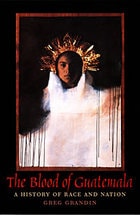
The Blood of Guatemala
A History of Race and NationGreg Grandin
Duke University Press, 2000
Focusing on Mayan elites in the community of Quetzaltenango, Grandin shows how their efforts to maintain authority over the indigenous population and secure political power in relation to non-Indians played a crucial role in the formation of the Guatemalan nation. To explore the close connection between nationalism, state power, ethnic identity, and political violence, Grandin draws on sources as diverse as photographs, public rituals, oral testimony, literature, and a collection of previously untapped documents written during the nineteenth century. He explains how the cultural anxiety brought about by Guatemala’s transition to coffee capitalism during this period led Mayan patriarchs to develop understandings of race and nation that were contrary to Ladino notions of assimilation and progress. This alternative national vision, however, could not take hold in a country plagued by class and ethnic divisions. In the years prior to the 1954 coup, class conflict became impossible to contain as the elites violently opposed land claims made by indigenous peasants.
This “history of power” reconsiders the way scholars understand the history of Guatemala and will be relevant to those studying nation building and indigenous communities across Latin America.
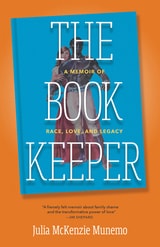
The Book Keeper
A Memoir of Race, Love, and LegacyJulia McKenzie Munemo
Ohio University Press, 2020
“A fiercely felt memoir about family shame and the transformative power of love even as it’s also an ongoing meditation on privilege and race in twenty-first-century America. This is a debut striking in its empathetic imagination, observational acuity, and emotional intelligence.” — Jim Shepard, author of Like You’d Understand, Anyway.
In a memoir that’s equal parts love story, investigation, and racial reckoning, Munemo unravels and interrogates her whiteness, a shocking secret, and her family’s history.
When interracial romance novels written by her long-dead father landed on Julia McKenzie Munemo’s kitchen table, she—a white woman—had been married to a black man for six years and their first son was a toddler. Out of shame about her father’s secret career as a writer of “slavery porn,” she hid the books from herself, and from her growing mixed-race family, for more than a decade. But then, with police shootings of African American men more and more in the public eye, she realized that understanding her own legacy was the only way to begin to understand her country.
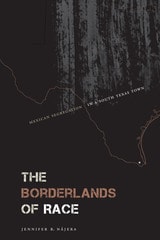
The Borderlands of Race
Mexican Segregation in a South Texas TownBy Jennifer R. Nájera
University of Texas Press, 2015
Throughout much of the twentieth century, Mexican Americans experienced segregation in many areas of public life, but the structure of Mexican segregation differed from the strict racial divides of the Jim Crow South. Factors such as higher socioeconomic status, lighter skin color, and Anglo cultural fluency allowed some Mexican Americans to gain limited access to the Anglo power structure. Paradoxically, however, this partial assimilation made full desegregation more difficult for the rest of the Mexican American community, which continued to experience informal segregation long after federal and state laws officially ended the practice.
In this historical ethnography, Jennifer R. Nájera offers a layered rendering and analysis of Mexican segregation in a South Texas community in the first half of the twentieth century. Using oral histories and local archives, she brings to life Mexican origin peoples’ experiences with segregation. Through their stories and supporting documentary evidence, Nájera shows how the ambiguous racial status of Mexican origin people allowed some of them to be exceptions to the rule of Anglo racial dominance. She demonstrates that while such exceptionality might suggest the permeability of the color line, in fact the selective and limited incorporation of Mexicans into Anglo society actually reinforced segregation by creating an illusion that the community had been integrated and no further changes were needed. Nájera also reveals how the actions of everyday people ultimately challenged racial/racist ideologies and created meaningful spaces for Mexicans in spheres historically dominated by Anglos.
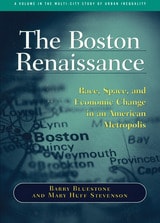
The Boston Renaissance
Race, Space, and Economic Change in an American MetropolisBarry Bluestone
Russell Sage Foundation, 2000
The Browning of the New South
Jennifer A. Jones
University of Chicago Press, 2019
The Business of Racism
Labor and Environment in Brazil's Racial CapitalismIan Carrillo
Duke University Press, 2026
The Cana Sanctuary
History, Diplomacy, and Black Catholic Marriage in Antebellum St. Augustine, FloridaFrank Marotti, Jr.
University of Alabama Press, 2012
In the late seventeenth century a group of about a dozen escaped African slaves from the English colony of Carolina reached the Spanish settlement of St. Augustine. In a diplomatic bid for sanctuary, to avoid extradition and punishment, they requested the sacrament of Catholic baptism from the Spanish Catholic Church. Their negotiations brought about their baptism and with it their liberation. The Cana Sanctuary focuses on what author Frank Marotti terms “folk diplomacy”—political actions conducted by marginalized, non-state sectors of society—in this instance by formerly enslaved African Americans in antebellum East Florida. The book explores the unexpected transformations that occurred in seventeenth- and eighteenth-century St. Augustine as more and more ex-slaves arrived to find their previously disregarded civil rights upheld under sacred codes by an international, nongovernmental, authoritative organization.
With the Catholic Church acting as an equalizing, empowering force for escaped African slaves, the Spanish religious sanctuary policy became part of popular historical consciousness in East Florida. As such, it allowed for continual confrontations between the law of the Church and the law of the South. Tensions like these survived, ultimately lending themselves to an “Afro-Catholicism” sentiment that offered support for antislavery arguments.
The Captive Stage
Performance and the Proslavery Imagination of the Antebellum NorthDouglas A. Jones, Jr.
University of Michigan Press, 2014

The Changing Past
Trends in South African Historical WritingKen Smith
Ohio University Press, 1989
E.H. Carr said: “Before you study the history, study the historian.” Written history often tells us more about the historian’s own times than it does of the times about which he is writing. The historians and the way in which each generation has rewritten history in the light of its own preoccupations is the subject of The Changing Past. This is the first book-length survey in English that covers all the main trends in South African historiography. Starting with the first documents and histories, it goes on to trace the 19th century. British and settler “schools,” Afrikaans historiography from its pre-academic 19th century phase to the present, and the liberal historians who struck out in a new direction from the 1920s. The book highlights the break with the past that historians of the “new radical school” have made in the last 15 years, and surveys the position of historical writing to the present.
The canvas is delineated in bold strokes that sketch in the main outlines rather than seek an exhaustive treatment of all existing literature. This, together with a conscious effort to minimize theoretical discussion, makes it a highly readable text.

The Changing Pattern of Black Politics in Britain
Kalbir Shukra
Pluto Press, 1998
The Changing Terrain of Race and Ethnicity
Maria Krysan
Russell Sage Foundation, 2004

The Changs Next Door to the Díazes
Remapping Race in Suburban CaliforniaWendy Cheng
University of Minnesota Press, 2013
U.S. suburbs are typically imagined to be predominantly white communities, but this is increasingly untrue in many parts of the country. Examining a multiracial suburb that is decidedly nonwhite, Wendy Cheng unpacks questions of how identity—especially racial identity—is shaped by place. She offers an in-depth portrait, enriched by nearly seventy interviews, of the San Gabriel Valley, not far from downtown Los Angeles, where approximately 60 percent of residents are Asian American and more than 30 percent are Latino. At first glance, the cities of the San Gabriel Valley look like stereotypical suburbs, but almost no one who lives there is white.
The Changs Next Door to the Díazes reveals how a distinct culture is being fashioned in, and simultaneously reshaping, an environment of strip malls, multifamily housing, and faux Mediterranean tract homes. Informed by her interviews as well as extensive analysis of three episodic case studies, Cheng argues that people’s daily experiences—in neighborhoods, schools, civic organizations, and public space—deeply influence their racial consciousness. In the San Gabriel Valley, racial ideologies are being reformulated by these encounters. Cheng views everyday landscapes as crucial terrains through which racial hierarchies are learned, instantiated, and transformed. She terms the process “regional racial formation,” through which locally accepted racial orders and hierarchies complicate and often challenge prevailing notions of race.
There is a place-specific state of mind here, Cheng finds. Understanding the processes of racial formation in the San Gabriel Valley in the contemporary moment is important in itself but also has larger value as a model for considering the spatial dimensions of racial formation and the significant demographic shifts taking place across the national landscape.
The Chinese in Mexico, 1882-1940
By Robert Chao Romero
University of Arizona Press, 2010
Robert Romero argues that Chinese immigrants turned to Mexico as a new land of economic opportunity after the passage of the U.S. Chinese Exclusion Act of 1882. As a consequence of this legislation, Romero claims, Chinese immigrants journeyed to Mexico in order to gain illicit entry into the United States and in search of employment opportunities within Mexico’s developing economy. Romero details the development, after 1882, of the “Chinese transnational commercial orbit,” a network encompassing China, Latin America, Canada, and the Caribbean, shaped and traveled by entrepreneurial Chinese pursuing commercial opportunities in human smuggling, labor contracting, wholesale merchandising, and small-scale trade.
Romero’s study is based on a wide array of Mexican and U.S. archival sources. It draws from such quantitative and qualitative sources as oral histories, census records, consular reports, INS interviews, and legal documents. Two sources, used for the first time in this kind of study, provide a comprehensive sociological and historical window into the lives of Chinese immigrants in Mexico during these years: the Chinese Exclusion Act case files of the U.S. Immigration and Naturalization Service and the 1930 Mexican municipal census manuscripts. From these documents, Romero crafts a vividly personal and compelling story of individual lives caught in an extensive network of early transnationalism.
The Civil Rights Lobby
The Leadership Conference on Civil Rights and the Second ReconstructionShamira Gelbman
Temple University Press, 2021
As the lobbying arm of the civil rights movement, the Leadership Conference on Civil Rights (LCCR)—which has operated since the early 1950s—was instrumental in the historic legislative breakthroughs of the Second Reconstruction. The Civil Rights Lobby skillfully recounts the LCCR’s professional and grassroots lobbying that contributed to these signature civil rights policy achievements in the 1950s and ’60s.
Shamira Gelbman explains how the diversity of this interest group coalition both hindered and enabled lobbyists to generate broad-based support for reforms that often seemed risky to legislators. They coordinated their efforts by identifying common ground among member organizations, developing coalitional positions on substantive and strategic questions, and exhorting organizations to mobilize professional and grassroots lobbying resources accordingly. The result was to “speak with one booming voice” to ultimately help secure the passage of the Civil Rights Act of 1964.
The Civil Rights Lobby concludes by reprising key lessons from the LCCR’s organizational development and participation in civil rights policymaking. Gelbman suggests new directions for research on interest group coalitions and explores how the Leadership Conference’s experience sheds light on the politics of the Second Reconstruction.
The Colonel's Dream
Charles W. Chesnutt
West Virginia University Press, 2014
Charles Waddell Chesnutt (1858-1932) was an African American writer, essayist, Civil Rights activist, legal-stenography businessman, and lawyer whose novels and short stories explore race, racism, and the problematic contours of African Americans’ social and cultural identities in post-Civil War South. He was the first African American to be published by a major American publishing house and served as a beacon-point for future African American writers.
The Colonel’s Dream, written in 1905, is a compelling tale of the post-Civil War South’s degeneration into a region awash with virulent racist practices against African Americans: segregation, lynchings, disenfranchisement, convict-labor exploitation, and endemic violent repression. The events in this novel are powerfully depicted from the point of view of a philanthropic but unreliable southern white colonel. Upon his return to the South, the colonel learns to abhor this southern world, as a tale of vicious racism unfolds. Throughout this narrative, Chesnutt confronts the deteriorating position of African Americans in an increasingly hostile South. Upon its publication The Colonel’s Dream was considered too controversial and unpalatable because of its bitter criticisms of southern white prejudice and northern indifference, and so this groundbreaking story failed to gain public attention and acclaim.
This is the first scholarly edition of The Colonel’s Dream. It includes an introduction and notes by R. J. Ellis and works to reestablish this great novel’s reputation.
The Color Line
Legacy for the Twenty-First CenturyJohn Hope Franklin
University of Missouri Press, 1993
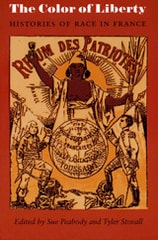
The Color of Liberty
Histories of Race in FranceSue Peabody and Tyler Stovall, eds.
Duke University Press, 2003
The Color of Liberty addresses four major themes: the evolution of race as an idea in France; representations of "the other" in French literature, art, government, and trade; the international dimensions of French racial thinking, particularly in relation to colonialism; and the impact of racial differences on the shaping of the modern French city. The many permutations of race in French history—as assigned identity, consumer product icon, scientific discourse, philosophical problem, by-product of migration, or tool in empire building—here receive nuanced treatments confronting the malleability of ideas about race and the uses to which they have been put.
Contributors. Leora Auslander, Claude Blanckaert, Alice Conklin, Fred Constant, Laurent Dubois, Yaël Simpson Fletcher, Richard Fogarty, John Garrigus, Dana Hale, Thomas C. Holt, Patricia M. E. Lorcin, Dennis McEnnerney, Michael A. Osborne, Lynn Palermo, Sue Peabody, Pierre H. Boulle, Alyssa Goldstein Sepinwall, Tyler Stovall, Michael G. Vann, Gary Wilder

The Color of Love
Racial Features, Stigma, and Socialization in Black Brazilian FamiliesBy Elizabeth Hordge-Freeman
University of Texas Press, 2015
Winner, Section on the Sociology of Emotions Outstanding Recent Contribution (Book) Award, American Sociological Association, 2016
Charles Horton Cooley Award for Recent Book, Society for the Study of Symbolic Interaction, 2017
Best Publication Award, Section on Body and Embodiment, American Sociological Association (ASA), 2018
The Color Of Love reveals the power of racial hierarchies to infiltrate our most intimate relationships. Delving far deeper than previous sociologists have into the black Brazilian experience, Elizabeth Hordge-Freeman examines the relationship between racialization and the emotional life of a family. Based on interviews and a sixteen-month ethnography of ten working-class Brazilian families, this provocative work sheds light on how families simultaneously resist and reproduce racial hierarchies. Examining race and gender, Hordge-Freeman illustrates the privileges of whiteness by revealing how those with “blacker” features often experience material and emotional hardships. From parental ties, to sibling interactions, to extended family and romantic relationships, the chapters chart new territory by revealing the connection between proximity to whiteness and the distribution of affection within families.
Hordge-Freeman also explores how black Brazilian families, particularly mothers, rely on diverse strategies that reproduce, negotiate, and resist racism. She frames efforts to modify racial features as sometimes reflecting internalized racism, and at other times as responding to material and emotional considerations. Contextualizing their strategies within broader narratives of the African diaspora, she examines how Salvador’s inhabitants perceive the history of the slave trade itself in a city that is referred to as the “blackest” in Brazil. She argues that racial hierarchies may orchestrate family relationships in ways that reflect and reproduce racial inequality, but black Brazilian families actively negotiate these hierarchies to assert their citizenship and humanity.
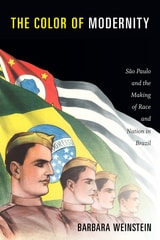
The Color of Modernity
São Paulo and the Making of Race and Nation in BrazilBarbara Weinstein
Duke University Press, 2015
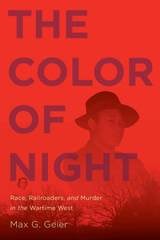
The Color of Night
Race, Railroaders, and Murder in the Wartime WestMax Geier
Oregon State University Press, 2015
In this deeply researched and detailed account, Geier explores how race, gender, and class affected the attitudes of local town-folk, law officers, and courtroom jurors toward Black trainmen on the West Coast, at a time when militarization skewed perceptions of virtue, status, and authority. He delves into the working conditions and experiences of unionized Black trainmen in their “home and away” lives in Los Angeles and Portland, while illuminating the different ways that they, and other residents of Oregon and southern California, responded to news of “Oregon’s murdered war bride.” Reporters, civil rights activists, and curiosity seekers transformed the trial and appeals process into a public melodrama.
The investigation, trial, and conviction of Robert Folkes galvanized civil rights activists, labor organizers, and community leaders into challenging the flawed judicial process and ultimately the death penalty in Oregon, serving as a catalyst for civil rights activism that bridged rural and urban divides. The Color of Night will appeal to “true crime” aficionados, and to anyone interested in the history of race and labor relations, working conditions, community priorities, and attitudes toward the death penalty in the first half of the 20th century.