Results by title
88 books match the query 'Religion and politics' and 17 start with t
The Anarchy of Black Religion
A Mystic SongJ. Kameron Carter
Duke University Press, 2023
The Charismatic Gymnasium
Breath, Media, and Religious Revivalism in Contemporary BrazilMaria José de Abreu
Duke University Press, 2020
The Coloniality of the Secular
Race, Religion, and Poetics of World-MakingAn Yountae
Duke University Press, 2024
The Crisis of Secularism in India
Anuradha Dingwaney Needham and Rajeswari Sunder Rajan, eds.
Duke University Press, 2007
Scholars of history, anthropology, religion, politics, law, philosophy, and media studies take on a broad range of concerns. Some consider the history of secularism in India; others explore theoretical issues such as the relationship between secularism and democracy or the shortcomings of the categories “majority” and “minority.” Contributors examine how the debates about secularism play out in schools, the media, and the popular cinema. And they address two of the most politically charged sites of crisis: personal law and the right to practice and encourage religious conversion. Together the essays inject insightful analysis into the fraught controversy about the shortcomings and uncertain future of secularism in the world today.
Contributors. Flavia Agnes, Upendra Baxi, Shyam Benegal, Akeel Bilgrami, Partha Chatterjee, V. Geetha, Sunil Khilnani, Nivedita Menon, Ashis Nandy, Anuradha Dingwaney Needham, Gyanendra Pandey, Gyan Prakash, Arvind Rajagopal, Paula Richman, Sumit Sarkar, Dwaipayan Sen, Rajeswari Sunder Rajan, Shabnum Tejani, Romila Thapar, Ravi S. Vasudevan, Gauri Viswanathan
The Culture of Islam
Changing Aspects of Contemporary Muslim LifeLawrence Rosen
University of Chicago Press, 2002
Through a series of poignant tales—from the struggle by a group of friends against daily corruption to the contest over a saint's identity, from nostalgia for the departed Jews to Salman Rushdie's vision of doubt in a world of religious certainty—Rosen shows how a dazzling array of potential changes are occurring alongside deeply embedded continuity, a process he compares to a game of chess in which infinite variations of moves can be achieved while fundamental aspects of "the game" have had a remarkably enduring quality. Whether it is the potential fabrication of new forms of Islam by migrants to Europe (creating a new "Euro-Islam," as Rosen calls it), the emphasis put on individuals rather than institutions, or the heartrending problems Muslims may face when their marriages cross national boundaries, each story and each interpretation offers a window into a world of contending concepts and challenged coherence.
The Culture of Islam is both an antidote to simplified versions of Islam circulating today and a consistent story of the continuities that account for much of ordinary Muslim life. It offers, in its human stories and its insights, its own contribution, as the author says, "to the mutual understanding and forgiveness that alone will make true peace possible."
The Elusive Empire
Kazan and the Creation of Russia, 1552–1671Matthew P. Romaniello
University of Wisconsin Press, 2012
In 1552, Muscovite Russia conquered the city of Kazan on the Volga River. It was the first Orthodox Christian victory against Islam since the fall of Constantinople, a turning point that, over the next four years, would complete Moscow’s control over the river. This conquest provided a direct trade route with the Middle East and would transform Muscovy into a global power. As Matthew Romaniello shows, however, learning to manage the conquered lands and peoples would take decades.
Russia did not succeed in empire-building because of its strength, leadership, or even the weakness of its neighbors, Romaniello contends; it succeeded by managing its failures. Faced with the difficulty of assimilating culturally and religiously alien peoples across thousands of miles, the Russian state was forced to compromise in ways that, for a time, permitted local elites of diverse backgrounds to share in governance and to preserve a measure of autonomy. Conscious manipulation of political and religious language proved more vital than sheer military might. For early modern Russia, empire was still elusive—an aspiration to political, economic, and military control challenged by continuing resistance, mismanagement, and tenuous influence over vast expanses of territory.
The Feeling Intellect
Selected WritingsPhilip Rieff
University of Chicago Press, 1989
The Good Road
A K’iche’ Revolutionary TheopoliticsCarlota McAllister
Duke University Press, 2026
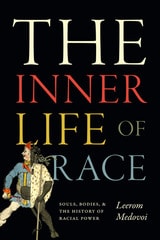
The Inner Life of Race
Souls, Bodies, and the History of Racial PowerLeerom Medovoi
Duke University Press, 2024
The Loss and Recovery of Truth
Selected Writings of Gerhart NiemeyerGerhart Niemeyer
St. Augustine's Press, 2013
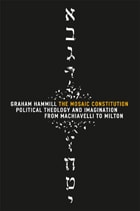
The Mosaic Constitution
Political Theology and Imagination from Machiavelli to MiltonGraham Hammill
University of Chicago Press, 2012
It is a common belief that scripture has no place in modern, secular politics. Graham Hammill challenges this notion in The Mosaic Constitution, arguing that Moses’s constitution of Israel, which created people bound by the rule of law, was central to early modern writings about government and state.

The Politics of Compassion and Transformation
And TransformationDick Simpson
Ohio University Press, 1989
In our time, we require a religion, ethics, and politics adequate to confront the global crises we face. In our scientific era of “progress,” we might expect to look with confidence to the “scientific” disciplines of political science, sociology, and economics to solve the problems of our civilization. We might also look to the older disciplines of religion and ethics to determine our values and to tell us what we ought to do. But the sad truth is that the dominant paradigms, methods, and conclusions of the social sciences and humanities are inadequate to this task. We need a new “politics of compassion and transformation.”
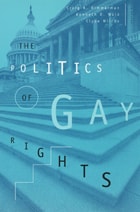
The Politics of Gay Rights
Edited by Craig A. Rimmerman, Kenneth D. Wald, and Clyde Wilcox
University of Chicago Press, 2000
Forcefully argued and accessibly written, this collection is an important contribution to the current discussion about civil rights for gays and lesbians.
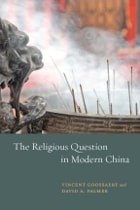
The Religious Question in Modern China
Vincent Goossaert and David A. Palmer
University of Chicago Press, 2011
Recent events—from strife in Tibet and the rapid growth of Christianity in China to the spectacular expansion of Chinese Buddhist organizations around the globe—vividly demonstrate that one cannot understand the modern Chinese world without attending closely to the question of religion. The Religious Question in Modern China highlights parallels and contrasts between historical events, political regimes, and cultural movements to explore how religion has challenged and responded to secular Chinese modernity, from 1898 to the present.
Vincent Goossaert and David A. Palmer piece together the puzzle of religion in China not by looking separately at different religions in different contexts, but by writing a unified story of how religion has shaped, and in turn been shaped by, modern Chinese society. From Chinese medicine and the martial arts to communal temple cults and revivalist redemptive societies, the authors demonstrate that from the nineteenth century onward, as the Chinese state shifted, the religious landscape consistently resurfaced in a bewildering variety of old and new forms. The Religious Question in Modern China integrates historical, anthropological, and sociological perspectives in a comprehensive overview of China’s religious history that is certain to become an indispensible reference for specialists and students alike.
The Spirit of Religion and the Spirit of Liberty
The Tocqueville Thesis RevisitedEdited by Michael P. Zuckert
University of Chicago Press Journals, 2017
Theology and the Political
The New Debate, sic vCreston Davis, John Milbank and Slavoj Žižek, eds.
Duke University Press, 2005
Contributors. Anthony Baker, Daniel M. Bell Jr., Phillip Blond, Simon Critchley, Conor Cunningham, Creston Davis, William Desmond, Hent de Vries, Terry Eagleton, Rocco Gangle, Philip Goodchild, Karl Hefty, Eleanor Kaufman, Tom McCarthy, John Milbank, Antonio Negri, Catherine Pickstock, Patrick Aaron Riches, Mary-Jane Rubenstein, Regina Mara Schwartz, Kenneth Surin, Graham Ward, Rowan Williams, Slavoj Žižek
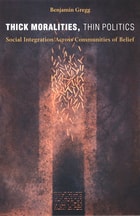
Thick Moralities, Thin Politics
Social Integration Across Communities of BeliefBenjamin Gregg
Duke University Press, 2003
Thick Moralities, Thin Politics grapples with the work of theorists from both sides of the Atlantic, including Jürgen Habermas, Anthony Giddens, and Niklas Luhmann, as well as George Herbert Mead, Erving Goffman, and Harold Garfinkel. Gregg develops a model of validity for arguments made in the public sphere, for understanding among competing worldviews, and for adjudicating disputes generated by normative differences. He applies his theory of politics to specific issues of contemporary social life, including those relating to the place of women, minorities, and multiculturalism in American and European society today. He also addresses the scientific study of religion, issues of legal interpretation, and the critique of ideology, in each case illuminating how different epistemic systems, as well as competing value systems, can achieve some understanding of one another. Gregg demonstrates, ultimately, that thin politics actually further, rather than reduce, citizens' engagement in the political process.