Results by title
145 books match the query 'Report writing' and 27 start with t
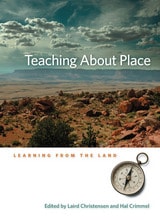
Teaching About Place
Learning From The LandLaird Christensen
University of Nevada Press, 2008
Teaching College Writing to Diverse Student Populations
Dana R. Ferris
University of Michigan Press, 2013
Statistical and anecdotal evidence documents that even states with relatively little ethnic or cultural diversity are beginning to notice and ask questions about long-term resident immigrants in their classes. As shifts in student population become more widespread, there is an even greater need for second language specialists, composition specialists, program administrators, and developers in colleges and universities to understand and adapt to the needs of the changing student audience(s).
Teaching Composition As A Social Process
Bruce McComiskey
Utah State University Press, 2000
Bruce McComiskey is a strong advocate of social approaches to teaching writing. However, he opposes composition teaching that relies on cultural theory for content, because it too often prejudges the ethical character of institutions and reverts unnecessarily to product-centered practices in the classroom. He opposes what he calls the "read-this-essay-and-do-what-the-author-did method of writing instruction: read Roland Barthes's essay 'Toys' and write a similar essay; read John Fiske's essay on TV and critique a show."
McComiskey argues for teaching writing as situated in discourse itself, in the constant flow of texts produced within social relationships and institutions. He urges writing teachers not to neglect the linguistic and rhetorical levels of composing, but rather to strengthen them with attention to the social contexts and ideological investments that pervade both the processes and products of writing.
A work with a sophisticated theory base, and full of examples from McComiskey's own classrooms, Teaching Composition as a Social Process will be valued by experienced and beginning composition teachers alike.
Teaching With Student Texts
Essays Toward an Informed PracticeJoseph Harris
Utah State University Press, 2010
Harris, Miles and Paine ask: What happens when the texts that students write become the focus of a writing course? In response, a distinguished group of scholar/teachers suggests that teaching with students texts is not simply a classroom technique, but a way of working with writing that defines composition as a field.
In Teaching with Student Texts, authors discuss ways of revaluing student writing as intellectual work, of circulating student texts in the classroom and beyond, and of changing our classroom practices by bringing student writings to the table. Together, these essays articulate a variety of ways that student texts can take a central place in classroom work and can, in the process, redefine the ways our field talks about writing.
Teaching Writing That Works
A Group Approach to Practical EnglishEric S. Rabkin and Macklin Smith
University of Michigan Press, 1990
Teaching Writing as a Second Language
Alice S. Horning. Foreword by W. Ross Winterowd
Southern Illinois University Press, 1986
Classrooms filled with glassy-eyed students provide an experiential base for Alice S. Horning’s new comprehensive theory about basic writers.
Horning explores the theory of writing acquisition in detail. Her examination of spoken and written language and redundancy give a theoretical base to her argument that academic discourse is a separate linguistic system characterized by particular psycholinguistic features. She proposes that basic writers learn to write as other learners master a second language because for them, academic written English is a whole new language.
She explores the many connections to be found in second language acquisition research to the teaching and learning of writing and gives special attention to the interlanguage hypothesis, pidginization theory, and the Monitor theory. She also addresses the role of affective factors (feelings, attitudes, emotions, and motivation) in the success or failure of writing students.
Teaching Writing
Landmarks and HorizonsEdited by Christina Russell McDonald and Robert L. McDonald. Foreword by Gary Tate. Postscript by Steve North
Southern Illinois University Press, 2002
Teaching Writing: Landmarks and Horizons, edited by Christina Russell McDonald and Robert L. McDonald, is designed to present an overview of some of the major developments in the establishment of composition studies as a field during the past thirty-five years. The essays are theoretically grounded but are focused on pedagogy as well. Divided into two parts, the first presents nine landmark essays, selected and introduced by distinguished composition scholars, and the second brings together eight new essays by emerging scholars.
Teaching/Writing in Thirdspaces
The Studio ApproachRhonda C. Grego and Nancy S. Thompson
Southern Illinois University Press, 2007
Teaching/Writing in Thirdspaces: The Studio Approach examines a dynamic approach to teaching composition that reimagines not only the physical space in which writing and learning occurs but also the place occupied by composition in the power structure of universities and colleges.
In response to financial and programmatic cutbacks at the University of South Carolina in the 1990s, authors Rhonda C. Grego and Nancy S. Thompson used their academic backgrounds in composition and English education, along with their personal histories in working-class families, to look at compositional spaces and places with an eye to challenging the embedded issues of race, class, and gender within the university hierarchies. The result was a supplemental writing program that they called the writing studio.
The studio model emphasizes individual participation in a small group that allows students to present work they are preparing for outside classes, discuss their challenges, and refine their ideas with other students and staff facilitators. This “interactional inquiry” is replicated and reinforced by the facilitators, who meet in their own small groups to analyze larger patterns, possibilities, and needs as they arise in their studios.
Grego and Thompson argue that because the studio is physically and institutionally “outside but alongside” both students’ other coursework and the hierarchy of the institution, it represents a “thirdspace,” a unique position in which to effect institutional change. The focus on interactional inquiry challenges traditional power hierarchies within classrooms and shifts the nature of discourse. As a bottom-up approach to the development of educational programs within institutions that have different needs, demographies, and histories, the studio model can address a multitude of different institutional needs with little disruption to the curriculum.
The studio model allows university administrators, teachers, student aides, and students to continually adapt to changing institutional environments with new teaching and learning strategies. Teaching/Writing in Thirdspaces provides an alternative approach to traditional basic writing courses that can be adopted in educational institutions of all types and at all levels.
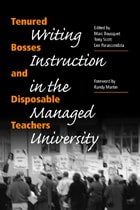
Tenured Bosses and Disposable Teachers
Writing Instruction in the Managed UniversityEdited by Marc Bousquet, Tony Scott, and Leo Parascondola. Foreword by Randy Martin
Southern Illinois University Press, 2003
Tenured Bosses and Disposable Teachers: Writing Instruction in the Managed University exposes the poor working conditions of contingent composition faculty and explores practical alternatives to the unfair labor practices that are all too common on campuses today.
Editors Marc Bousquet, Tony Scott, and Leo Parascondola bring together diverse perspectives from pragmatism to historical materialism to provide a perceptive and engaging examination of the nature, extent, and economics of the managed labor problem in composition instruction—a field in which as much as ninety-three percent of all classes are taught by graduate students, adjuncts, and other “disposable” teachers. These instructors enjoy few benefits, meager wages, little or no participation in departmental governance, and none of the rewards and protections that encourage innovation and research. And it is from this disenfranchised position that literacy workers are expected to provide some of the core instruction in nearly everyone's higher education experience.
Twenty-six contributors explore a range of real-world solutions to managerial domination of the composition workplace, from traditional academic unionism to ensemble movement activism and the pragmatic rhetoric, accommodations, and resistances practiced by teachers in their daily lives.
Contributors are Leann Bertoncini, Marc Bousquet, Christopher Carter, Christopher Ferry, David Downing, Amanda Godley, Robin Truth Goodman, Bill Hendricks, Walter Jacobsohn, Ruth Kiefson, Paul Lauter, Donald Lazere, Eric Marshall, Randy Martin, Richard Ohmann, Leo Parascondola, Steve Parks, Gary Rhoades, Eileen Schell, Tony Scott, William Thelin, Jennifer Seibel Trainor, Donna Strickland, William Vaughn, Ray Watkins, and Katherine Wills.
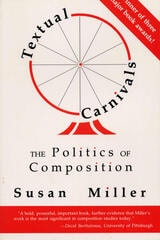
Textual Carnivals
The Politics of CompositionSusan Miller
Southern Illinois University Press, 1993
This is the first book-length study of the status of composition in English studies and the uneasy relationship between composition and literature. Composition studies and institutional histories of English studies have long needed this kind of clarification of the historical and political contexts of composition teaching, research, and administration.
Susan Miller argues that composition constitutes a major national industry, citing the four million freshman-level students enrolled in such courses each year, the $40 million annual expenditure for textbooks, and the more than $50 million in teacher salaries. But this concrete magnitude is not expressed in political power within departments. Miller calls on her associates in composition to engage in a persistent critique of the social practices and political agenda of the discipline that have been responsible for its institutional marginalization. Drawing on her own long experience as a composition administrator, teacher, and scholar, as well as on a national survey of composition professionals, Miller argues that composition teachers inadvertently continue to foster the negative myth about composition’s place in the English studies hierarchy by assuming an assigned, self-sacrificial cultural identity. Composition has been regarded as subcollegiate, practical, a "how-to," and has been denied intellectual rigor in order to preserve literature’s presentations of quasi-religious textual ideals.
Winner of three major book awards:
The Modern Language Association’s Mina P. Shaughnessy Prize
The Conference on College Composition and Communication’s Outstanding Book Award
The Teachers of Advanced Composition’s W. Ross Winterowd Award
The Activist WPA
Changing Stories About Writing and WritersLinda Adler-Kassner
Utah State University Press, 2008
Drawing on recent developments in framing theory and the resurgent traditions of progressive organizers, Linda Adler-Kassner calls upon composition teachers and administrators to develop strategic programs of collective action that do justice to composition’s best principles. Adler-Kassner argues that the “story” of college composition can be changed only when writing scholars bring the wonders down, to articulate a theory framework that is pragmatic and intelligible to those outside the field--and then create messages that reference that framework. In The Activist WPA, she makes a case for developing a more integrated vision of outreach, English education, and writing program administration.

The College Student's Research Companion
Finding, Evaluating, and Citing the Resources You Need to SucceedArlene Rodda Quaratiello
American Library Association, 2010
The End of Composition Studies
David W. Smit
Southern Illinois University Press, 2007
The Idea of a Writing Laboratory
Neal Lerner
Southern Illinois University Press, 2009
The Idea of a Writing Laboratory is a book about possibilities, about teaching and learning to write in ways that can transform both teachers and students.
Author Neal Lerner explores higher education’s rich history of writing instruction in classrooms, writing centers and science laboratories. By tracing the roots of writing and science educators’ recognition that the method of the lab––hands-on student activity—is essential to learning, Lerner offers the hope that the idea of a writing laboratory will be fully realized more than a century after both fields began the experiment.
Beginning in the late nineteenth century, writing instructors and science teachers recognized that mass instruction was inadequate for a burgeoning, “non-traditional” student population, and that experimental or laboratory methods could prove to be more effective. Lerner traces the history of writing instruction via laboratory methods and examines its successes and failures through case studies of individual programs and larger reform initatives. Contrasting the University of Minnesota General College Writing Laboratory with the Dartmouth College Writing Clinic, for example, Lerner offers a cautionary tale of the fine line between experimenting with teaching students to write and “curing” the students of the disease of bad writing.
The history of writing within science education also wends its way through Lerner’s engaging work, presenting the pedagogical origins of laboratory methods to offer educators in science in addition to those in writing studies possibilities for long-sought after reform. The Idea of a Writing Laboratory compels readers and writers to “don those white coats and safety glasses and discover what works” and asserts that “teaching writing as an experiment in what is possible, as a way of offering meaning-making opportunities for students no matter the subject matter, is an endeavor worth the struggle.”
The Memoir of Ednah Shepard Thomas
Ednah Shepard Thomas
University Press of Colorado, 2017
The New Isearch, You Search, We All Learn to Research
A How-To-Do-It Manual for Teaching Research Using Web 2.0 Tools and Digital ResourcesAmerican Library Association, 2012
The Student's Survival Guide to Research
Monty L. McAdoo
American Library Association, 2015
The Wealth of Reality
An Ecology of CompositionMargaret A. Syverson
Southern Illinois University Press, 1999
Margaret A. Syverson discusses the ways in which a theory of composing situations as ecological systems might productively be applied in composition studies. She demonstrates not only how new research in cognitive science and complex systems can inform composition studies but also how composing situations can provide fruitful ground for research in cognitive science.
Syverson first introduces theories of complex systems currently studied in diverse disciplines. She describes complex systems as adaptive, self-organizing, and dynamic; neither utterly chaotic nor entirely ordered, these systems exist on the boundary between order and chaos. Ecological systems are "metasystems" composed of interrelated complex systems. Writers, readers, and texts, together with their environments, constitute one kind of ecological system.
Four attributes of complex systems provide a theoretical framework for this study: distribution, embodiment, emergence, and enaction. Three case studies provide evidence for the application of these concepts: an analysis of a passage from an autobiographical poem by Charles Reznikoff, a study of first-year college students writing collaboratively, and a conflict in a computer forum of social scientists during the Gulf War. The diversity of these cases tests the robustness of theories of distributed cognition and complex systems and suggests possibilities for wider application.
The Writing Cure
Psychoanalysis, Composition, and the Aims of EducationMark Bracher
Southern Illinois University Press, 1999
Psychoanalysis and writing instruction have much to offer each other, asserts Mark Bracher. In this book, Bracher examines the intersection between these two fields and proposes pedagogical uses of psychoanalytic technique for writing instruction.
Psychoanalysis reveals that the writing process is profoundly affected by factors that current theories have largely neglected—forces such as enjoyment, desire, fantasy, and anxiety, which, moreover, are often unconscious. Articulating an approach based on the work of Jacques Lacan, Bracher shows how a psychoanalytic perspective can offer useful insights into the nature of the writing process, the sources of writing problems, and the dynamics of writing instruction. He further demonstrates that writing instruction constitutes the most favorable venue outside of individual psychoanalytic treatment for pursuing psychoanalytic research and practice. Like psychoanalytic treatment proper, writing instruction can function as a way of reducing psychological conflict and as a means of pursuing psychoanalytic research into the workings of the mind. Empirical studies and personal testimonies have demonstrated the psychological (and even the physical) benefits of writing about personal conflict in an academic setting; such benefits promise to be enhanced and consolidated through the application of psychoanalytic principles to the teaching of writing.
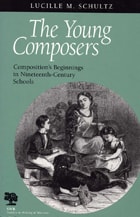
The Young Composers
Composition's Beginnings in Nineteenth-Century SchoolsLucille M. Schultz
Southern Illinois University Press, 1999
Lucille M. Schultz's The Young Composers: Composition's Beginnings in Nineteenth-Century Schools is the first full-length history of school-based writing instruction. Schultz demonstrates that writing instruction in nineteenth-century American schools is much more important in the overall history of writing instruction than we have previously assumed.
Drawing on primary materials that have not been considered in previous histories of writing instruction—little-known textbooks and student writing that includes prize-winning essays, journal entries, letters, and articles written for school newspapers—Schultz shows that in nineteenth-century American schools, the voices of the British rhetoricians that dominated college writing instruction were attenuated by the voice of the Swiss education reformer Johann Heinrich Pestalozzi. Partly through the influence of Pestalozzi's thought, writing instruction for children in schools became child-centered, not just a replica or imitation of writing instruction in the colleges.
It was also in these nineteenth-century American schools that personal or experience-based writing began and where the democratization of writing was institutionalized. These schools prefigured some of our contemporary composition practices: free writing, peer editing, and the use of illustrations as writing prompts. It was in these schools, in fact, where composition instruction as we know it today began, Schultz argues.
This book features a chapter on the agency of textbook iconography, which includes illustrations from nineteenth-century composition books as well as a cultural analysis of those illustrations. Schultz also includes a lengthy bibliography of nineteenth-century composition textbooks and student and school newspapers.
Toward a Grammar of Passages
Richard M. Coe
Southern Illinois University Press, 1988
Richard M. Coe has developed such a “grammar,” one which uses a simple graphic instrument to analyze the meaningful relationships between sentences in a passage and to clarify the function of structure in discourse. Working in the tradition of Christensen’s generative rhetoric, Coe presents a two-dimensional graphic matrix that effectively analyzes the logical relations between statements by mapping coordinate, subordinate, and superordinate relationships.
Coe demonstrates the power of his discourse matrix by applying it to a variety of significant problems, such as how to demonstrate discourse differences between cultures (especially between Chinese and English), how to explain precisely what is “bad” about the structure of passages that do not work, and how best to teach structure. This new view of the structure of passages helps to articulate crucial questions about the relations between form and function, language, thought and culture, cognitive and social processes.
Toward a Phenomenological Rhetoric
Writing, Profession, and AltruismBarbara Couture
Southern Illinois University Press, 1998
Current rhetorical and critical theory for the most part separates writing from consciousness and presumes relative truth to be the only possible expressive goal for rhetoric. These presumptions are reflected in our tradition of persuasive rhetoric, which values writing that successfully argues one person’s belief at the expense of another’s. Barbara Couture presents a case for a phenomenological rhetoric, one that values and respects consciousness and selfhood and that restores to rhetoric the possibility of seeking an all-embracing truth through pacific and cooperative interaction.
Couture discusses the premises on which current interpretive theory has supported relative truth as the philosophical grounding for rhetoric, premises, she argues, that have led to constraints on our notion of truth that divorce it from human experience. She then shows how phenomenological philosophy might guide the theory and practice of rhetoric, reanimating its role in the human enterprise of seeking a shared truth. She proposes profession and altruism as two guiding metaphors for the phenomenological activity of "truth-seeking through interaction."
Among the contemporary rhetoricians and philosophers who influence Couture are Pierre Teilhard de Chardin, Martin Buber, Charles Altieri, Charles Taylor, Alasdair Maclntyre, and Jürgen Habermas.
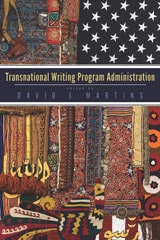
Transnational Writing Program Administration
David S. Martins
Utah State University Press, 2014
While local conditions remain at the forefront of writing program administration, transnational activities are slowly and thoroughly shifting the questions we ask about writing curricula, the space and place in which writing happens, and the cultural and linguistic issues at the heart of the relationships forged in literacy work. Transnational Writing Program Administration challenges taken-for-granted assumptions regarding program identity, curriculum and pedagogical effectiveness, logistics and quality assurance, faculty and student demographics, innovative partnerships and research, and the infrastructure needed to support writing instruction in higher education.
Well-known scholars and new voices in the field extend the theoretical underpinnings of writing program administration to consider programs, activities, and institutions involving students and faculty from two or more countries working together and highlight the situated practices of such efforts. The collection brings translingual graduate students at the forefront of writing studies together with established administrators, teachers, and researchers and intends to enrich the efforts of WPAs by examining the practices and theories that impact our ability to conceive of writing program administration as transnational.
This collection will enable writing program administrators to take the emerging locations of writing instruction seriously, to address the role of language difference in writing, and to engage critically with the key notions and approaches to writing program administration that reveal its transnationality.
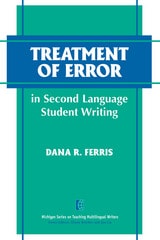
Treatment of Error in Second Language Student Writing
Dana R. Ferris
University of Michigan Press, 2002
Unlike a teachers' manual or a handbook that purports to give all the answers needed, Ferris's research-based volume offers a solid scholarly foundation for the practical ideas presented together with an abundance of illustrative sample texts. This book will be a rich resource in language teaching methodology courses, but experienced teachers too will no doubt benefit from the depth and breadth of Ferris's coverage of various error response techniques as well as of the research that motivates those techniques.
Ferris offers a realistic, well-reasoned account of what second language (L2) writing teacher--or teachers with L2 students in their classes--need to know about error and how to put what they know to use. She persuasively addresses the fundamental error treatment questions that plague novice and expert writing specialists alike: What types of errors should teachers respond to? When should we respond to them? What are the most efficacious ways of responding to them? And ultimately, what role should error treatment play in the teaching of the process of writing?
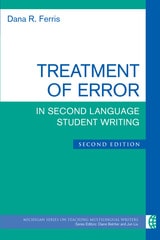
Treatment of Error in Second Language Student Writing, Second Edition
Dana R. Ferris
University of Michigan Press, 2011
Treatment of Error offers a realistic, well-reasoned account of what teachers of multilingual writers need to know about error and how to put what they know to use. As in the first edition, Ferris again persuasively addresses the fundamental error treatment questions that plague novice and expert writing specialists alike: What types of errors should teachers respond to? When should we respond to them? What are the most efficacious ways of responding to them? And ultimately, what role should error treatment play in the teaching of the process of writing?
The second edition improves upon the first by exploring changes in the field since 2002, such as the growing diversity in what is called “L2 writers,” the blurring boundaries between “native” and “non-native” speakers of English, the influence of genre studies and corpus linguistics on the teaching of writing, and the need the move beyond “error” to “second language development” in terms of approaching students and their texts. It also explores what teacher preparation programs need to do to train teachers to treat student error.
The second edition features
* an updating of the literature in all chapters
* a new chapter on academic language development
* a postscript on how to integrate error treatment/language development suggestions in Chapters 4-6 into a writing class syllabus
* the addition of discussion/analysis questions at the end of each chapter, plus suggested readings, to make the book more useful in pedagogy or teacher development workshops
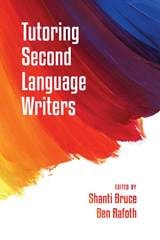
Tutoring Second Language Writers
Shanti Bruce
Utah State University Press, 2015
Tutoring Second Language Writers, a complete update of Bruce and Rafoth’s 2009 ESL Writers, is a guide for writing center tutors that addresses the growing need for tutors who are better prepared to work with the increasingly international population of students seeking guidance at the writing center.
Drawing upon philosopher John Dewey’s belief in reflective thinking as a way to help build new knowledge, the book is divided into four parts. Part 1: Actions and Identities is about creating a proactive stance toward language difference, thinking critically about labels, and the mixed feelings students may have about learning English. Part 2: Research Opportunities demonstrates writing center research projects and illustrates methods tutors can use to investigate their questions about writing center work. Part 3: Words and Passages offers four personal stories of inquiry and discovery, and Part 4: Academic Expectations describes some of the challenges tutors face when they try to help writers meet readers’ specific expectations.
Advancing the conversations tutors have with one another and their directors about tutoring second language writers and writing, Tutoring Second Language Writers engages readers with current ideas and issues that highlight the excitement and challenge of working with those who speak English as a second or additional language.
Contributors include Jocelyn Amevuvor, Rebecca Day Babcock, Valerie M. Balester, Shanti Bruce, Frankie Condon, Michelle Cox, Jennifer Craig, Kevin Dvorak, Paula Gillespie, Glenn Hutchinson, Pei-Hsun Emma Liu, Bobbi Olson, Pimyupa W. Praphan, Ben Rafoth, Jose L. Reyes Medina, Guiboke Seong, and Elizabeth (Adelay) Witherite.
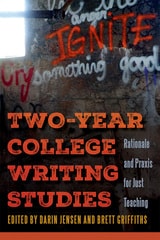
Two-Year College Writing Studies
Rationale and Praxis for Just TeachingDarin Jensen
Utah State University Press, 2023
Contributors draw on theories of identity, rhetorical third space, and linguistics to articulate a praxis of just teaching. They describe existing institutional challenges and opportunities that foster equity and offer cautionary tales of educational systems dismantled for short-term economic and political gains. Two-year college writing studies—when properly resourced—holds the potential to foster (or undermine) democratic ideals of civic literacy and uplift. Chapters in this volume offer case study examples of changes in departmental practices for reflection, interaction, and assessment that empower faculty to break free and engage directly with institutional, regional, state, and national constraints.
By making these resilient practices visible, Two-Year College Writing Studies amplifies the voices and validates the experiences of instructors engaging in this work. It will serve generalists, specialists, and academics interested in the subdiscipline of student success pedagogies and the political histories of two-year colleges and be useful for instructors new to the field, as professional development for veteran instructors, and as an introduction for graduate students entering two-year college writing studies programs.