Results by title
51 books match the query 'Reptiles & Amphibians' and 22 start with t
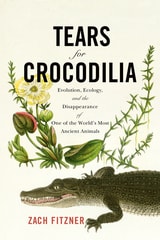
Tears for Crocodilia
Evolution, Ecology, and the Disappearance of One of the World's Most Ancient AnimalsZach Fitzner
Westholme Publishing, 2025
Seventy million years ago in what would become North America, a monstrous thirty-five-foot-long Cretaceous crocodile lurked on a marshy riverbank. Springing suddenly, its huge jaws trapped and crushed a juvenile hadrosaur. Today, the remains of that ancient crocodile are being painstakingly reconstructed in Colorado, where naturalist Zach Fitzner continues his life-long fascination with this amazing animal family.
In Tears for Crocodilia: Evolution, Ecology, and the Disappearance of One of the World’s Most Ancient Animals, Fitzner tracks the evolution of crocodilians from prehistoric predators to modern endangered wildlife, using his own experiences with these reptiles as a lens to understanding wildlife conservation and our relationship with the natural world. Traveling the world to interact with crocodiles, from observing alligators in a wildlife refuge in Texas and paddling a canoe in the Everglades searching for crocodiles to trekking the jungles in Nepal to find endangered gharials, the author expresses a wonder in exploring these diverse ecosystems, making a connection between crocodilians and the lands they live in. As the story follows crocodilians, it also illuminates their often complicated relationship with humans, from crocodile cults in ancient Egypt to American alligators living on golf courses. Fitzner also closely examines the dark side of this relationship, including habitat destruction and poaching as well as the mechanistic view of traditional conservation that turns these magnificent animals into agricultural products. Tears for Crocodilia delves deeply into issues of wildlife conservation, ethics, and how we can coexist with other creatures. It is also a tribute to a magnificent group of animals, survivors from the age of dinosaurs.
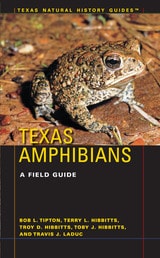
Texas Amphibians
A Field GuideBy Bob L. Tipton, Terry L. Hibbitts, Troy D. Hibbitts, Toby J. Hibbitts, and Travis J. LaDuc
University of Texas Press, 2012
With a wide variety of habitats ranging from southeastern swamps to western deserts, Texas is home to numerous species of frogs, toads, and salamanders. Each area of Texas has a particular set of species that has evolved there over thousands of years. Indeed, most amphibians are not very mobile, and many live their entire lives within a few square meters. This makes them particularly vulnerable to environmental degradation and habitat destruction.
Texas Amphibians is the only field guide focused exclusively on the state’s frogs, toads, and salamanders. It presents brief, general accounts of the two orders and fifteen families. Then it identifies each of the seventy-two species in detail, including size, description, voice (if applicable), similar species, distribution (with maps), natural history, reproduction, subspecies (if applicable), and comments and conservation information. Color photographs illustrate the species.
The book also includes a general introduction to amphibian natural history, conservation, observation and collection, maintenance in captivity, museum and preserved specimens, and scientific and common names, as well as scientific keys to Texas salamanders and frogs and a generic key to amphibian larvae. This wealth of information, compiled by a team of experts who collectively have over a century of experience in field herpetology, will increase our appreciation for amphibians and the vital role they play as an early indicator of threats to the quality of the environment that we all share.
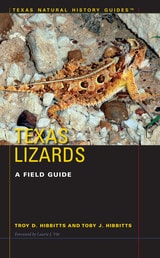
Texas Lizards
A Field GuideBy Troy and Toby Hibbitts
University of Texas Press, 2015
“Texas offers the opportunity to observe lizard diversity like no other part of the country,” writes Laurie J. Vitt in the foreword to Texas Lizards. From the moist eastern Piney Woods to the western deserts, lizards can be found in every part of Texas. The state has forty-five native and six naturalized species of lizards, almost half of the 115 species that live in the continental United States. Yet Texas lizards have not received full coverage in regional field guides, and no other guide dedicated solely to the state’s lizards has ever been published.
Texas Lizards is a complete identification guide to all fifty-one native and established exotic lizard species. It offers detailed species accounts, range maps, and excellent color photographs (including regional, gender, and age variations for many species) to aid field identification. The authors, two of the state’s most knowledgeable herpetologists, open the book with a broad overview of lizard natural history, conservation biology, observation, and captive maintenance before providing a key to Texas lizards and accounts of the various lizard families and species. Appendices list species of questionable occurrence in Texas and nonestablished exotic species. Informational resources on Texas lizards, a map of Texas counties, a glossary, a bibliography, and indexes of common and scientific names round out the volume.
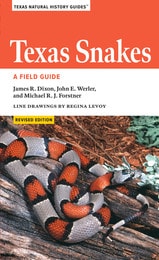
Texas Snakes
A Field GuideBy James R. Dixon, John E. Werler, and Michael R. J. Forstner; Line drawings by Regina Levoy
University of Texas Press, 2020
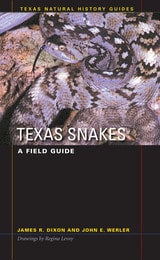
Texas Snakes
A Field GuideBy James R. Dixon and John E. Werler
University of Texas Press, 2005
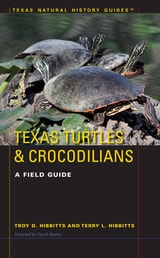
Texas Turtles & Crocodilians
A Field GuideBy Troy D. Hibbitts and Terry L. Hibbitts
University of Texas Press, 2016
Texas has a large and diverse turtle population, with forms that are found nowhere else (Cagle’s Map Turtle and the Texas Map Turtle) and wide-ranging species that barely touch the state, including the Painted Turtles and the Rough-footed Mud Turtle. From the Sabine River to El Paso, and from the Rio Grande to the Panhandle, thirty-one native and established exotic turtle species are definitely known in Texas, along with one crocodilian, the American Alligator.
Texas Turtles & Crocodilians is the first complete identification guide to all the state’s turtles and to its single alligator. It offers detailed species accounts, range maps, and excellent color photographs to aid in field identification. The authors, two of the state’s most knowledgeable herpetologists, open the book with a broad overview of turtle natural history, conservation biology, observation, and captive maintenance before providing a key to Texas turtles and accounts of the various turtle families and species. Appendices provide brief accounts of species that occurred prehistorically in Texas and non-established exotic species, as well as a table of Texas’ major watersheds and the turtle diversity in each one. Informational resources on Texas turtles and alligators, a map of Texas counties, a glossary, a bibliography, and indexes of common and scientific names complete the volume.
The Amphibians and Reptiles of Arkansas
Stanley E. Trauth
University of Arkansas Press, 2004
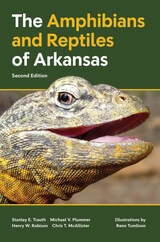
The Amphibians and Reptiles of Arkansas
Stanley E. Trauth
University of Arkansas Press, 2026
The rich diversity of Arkansas’s amphibian and reptilian species comes alive in this thoroughly updated second edition of The Amphibians and Reptiles of Arkansas. An indispensable resource for both professionals and enthusiasts, and praised for its accessible language and scientific rigor, this field guide not only reflects the latest in taxonomic research but also celebrates the surge in herpetological studies in Arkansas over the past two decades, showcasing a thriving academic interest while addressing gaps in the first edition.
Building on the foundation of the acclaimed first edition, this updated work introduces enhanced color maps, updated range data, and an array of new illustrations, capturing a more vivid and comprehensive picture of Arkansas’s herpetofauna. Meticulously illustrated identification keys, species accounts, and pictorial guides make this a valuable tool for identifying species in the field, in classrooms, or in one’s own backyard.
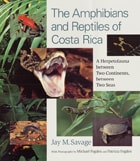
The Amphibians and Reptiles of Costa Rica
A Herpetofauna between Two Continents, between Two SeasJay M. Savage
University of Chicago Press, 2006
Costa Rica has played, and continues to play, a pivotal role in the study of tropical biology as well as the development of ecotourism and ecoprospecting, in part because more than half of the amphibians and reptiles in Costa Rica are also found elsewhere in Central America. The Amphibians and Reptiles of Costa Rica will be an essential book for a wide audience of nature lovers, naturalists, ecotourists, field biologists, conservationists, government planners, and those interested in Central America more generally.
"Written for the enthusiast as well as for the field researcher, this work is an excellent reference source for each of the 396 species of amphibians and reptiles that can be found in Costa Rica. Includes complete full-color photographs of all known species in the region, as well as maps showing their distribution patterns. . . . A must-have book for any library with interests in this subject area."—J. Elliott, Southeastern Naturalist
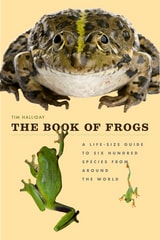
The Book of Frogs
A Life-Size Guide to Six Hundred Species from around the WorldTim Halliday
University of Chicago Press, 2015
The Book of Frogs commemorates the diversity and magnificence of all of these creatures, and many more. Six hundred of nature’s most fascinating frog species are displayed, with each entry including a distribution map, sketches of the frogs, species identification, natural history, and conservation status. Life-size color photos show the frogs at their actual size—including the colossal seven-pound Goliath Frog. Accessibly written by expert Tim Halliday and containing the most up-to-date information, The Book of Frogs will captivate both veteran researchers and amateur herpetologists.
As frogs increasingly make headlines for their troubling worldwide decline, the importance of these fascinating creatures to their ecosystems remains underappreciated. The Book of Frogs brings readers face to face with six hundred astonishingly unique and irreplaceable species that display a diverse array of adaptations to habitats that are under threat of destruction throughout the world.
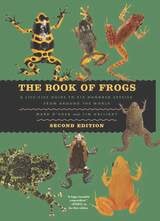
The Book of Frogs
A Life-Size Guide to Six Hundred Species from around the World, Second EditionMark O'Shea and Tim Halliday
University of Chicago Press, 2025
With almost nine thousand known species, frogs display a stunning array of forms and behaviors. A single gram of the toxin produced by the skin of the Golden Poison Frog can kill one hundred thousand people. Male Darwin’s Frogs carry their tadpoles in their vocal sacs for sixty days before coughing them out into the world. And the Wood Frogs of North America freeze every winter, reanimating in the spring.
The Book of Frogs documents the diversity and magnificence of all these anurans and many more. Readers meet six hundred of nature’s most fascinating frogs, with each entry including a distribution map, illustrations, species identification, natural history, and conservation status. Color photos show the frogs at their actual size—from Papua New Guinea’s diminutive Paedophryne amauensis, smaller than a coin, to Cameroon’s colossal Goliath Frog, heavier than some dogs. Written by experts Mark O’Shea and Tim Halliday and containing updated information on one hundred species and nearly twenty new entries, this revised edition will enthrall both veteran researchers and amateur herpetologists.
As frogs increasingly make headlines for their troubling worldwide decline, The Book of Frogs brings readers face to face with six hundred astonishingly unique and irreplaceable species that display a diverse array of adaptations to habitats that are ever changing.
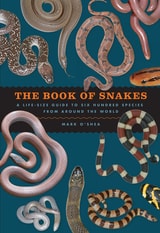
The Book of Snakes
A Life-Size Guide to Six Hundred Species from around the WorldMark O'Shea
University of Chicago Press, 2018
The Book of Snakes presents 600 species of snakes from around the world, covering nearly one in six of all snake species. It will bring greater understanding of a group of reptiles that have existed for more than 160 million years, and that now inhabit every continent except Antarctica, as well as two of the great oceans.
This volume pairs spectacular photos with easy-to-digest text. It is the first book on these creatures that combines a broad, worldwide sample with full-color, life-size accounts. Entries include close-ups of the snake’s head and a section of the snake at actual size. The detailed images allow readers to examine the intricate scale patterns and rainbow of colors as well as special features like a cobra’s hood or a rattlesnake’s rattle. The text is written for laypeople and includes a glossary of frequently used terms. Herpetologists and herpetoculturists alike will delight in this collection, and even those with a more cautious stance on snakes will find themselves drawn in by the wild diversity of the suborder Serpentes.
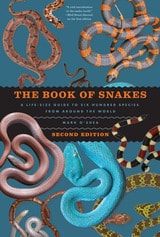
The Book of Snakes
A Life-Size Guide to Six Hundred Species from around the WorldMark O'Shea
University of Chicago Press, 2023
For millennia, humans have regarded snakes with an exceptional combination of fascination and revulsion. Some people recoil in fear at the very suggestion of these creatures, while others happily keep them as pets. Snakes can convey both beauty and menace in a single tongue flick, and so these creatures have held a special place in our cultures. Yet, for as many meanings as we attribute to snakes—from fertility and birth to sin and death—the real-life species represent an even wider array of wonders.
Now in a new edition, reflecting the most recent species classifications, The Book of Snakes presents 600 species of snakes from around the world, covering roughly one in seven of all snake species. It will bring greater understanding of a group of reptiles that have existed for more than 160 million years and that now inhabit every continent except Antarctica, as well as two of the great oceans.
This volume pairs spectacular photos with easy-to-digest text. It is the first book on these creatures that combines a broad, worldwide sample with full-color, life-size accounts. Entries include close-ups of the snake’s head and a section of the snake at actual size. The detailed images allow readers to examine the intricate scale patterns and rainbow of colors as well as special features like a cobra’s hood or a rattlesnake’s rattle. The text is written for laypeople and includes a glossary of frequently used terms. Herpetologists and herpetoculturists alike will delight in this collection, and even those with a more cautious stance on snakes will find themselves drawn in by the wild diversity of the suborder Serpentes.
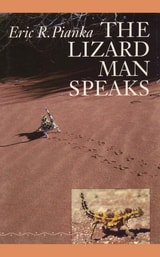
The Lizard Man Speaks
By Eric R. Pianka
University of Texas Press, 1994
Alone on the endless red-sand desert in the Australian outback, tracking Varanus giganteus, the perentie lizard that grows to be more than six feet long...for desert rat Eric Pianka, such adventures have led to a satisfying, if unusual, way of life, as well as a distinguished career as a field biologist.
In The Lizard Man Speaks, Pianka recounts more than thirty years of adventures in reptile studies. He tells of "lizarding" in the North American deserts, the Kalahari Desert of southern Africa, and the Great Victoria Desert in Western Australia. His vivid imagery draws the reader into a world where lions lurk in the darkness beyond a gecko hunter's lights, where being stranded by car trouble miles from the last outpost is a constant danger, and where the wilderness still deserves to be called wild.
Along the way, Pianka provides much general information about lizard ecology, the fire succession cycle, and the interaction of humans with the landscape. And he reveals the springs of his own determined spirit and love of solitude, describing a near-fatal boyhood accident and its shaping and character-building effect on the life that followed.

The Natural History of the Snakes and Lizards of Iowa
Terry VanDeWalle
University of Iowa Press, 2022
While readers will be able to identify Iowa’s snakes and lizards through its species accounts, identification keys, and beautiful photographs and illustrations, this book is intended to be more than a field guide. What makes it truly unique is the comparison of historic data collected by Iowa herpetologists in the 1930s and 1940s with data collected by the author, along with James L. Christiansen and others, since 1960. Custom maps show the reader how species’ distributions have changed over time.
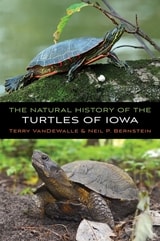
The Natural History of the Turtles of Iowa
Terry VanDeWalle
University of Iowa Press, 2024
While readers will be able to identify Iowa’s turtles through its species accounts, identification keys, and beautiful photographs and illustrations, this book is intended to be more than a field guide. What makes it truly unique is the comparison of historic data collected by Iowa herpetologists in the 1930s and 1940s with data collected by the authors, along with James L. Christiansen and others, since 1960. Custom maps show the reader how species’ distributions have changed over time. This book contains Iowa-specific data found nowhere else and is essential to all who study turtles in the Midwest.
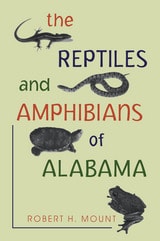
The Reptiles and Amphibians of Alabama
Robert H. Mount
University of Alabama Press, 1980
Generously illustrated, it contains photographs and range maps for each species, showing the specific locality from which each specimen on record was collected. The text includes keys, detailed descriptions, accounts of habitats and life histories, remarks about variations and ecological disturbances, as well as general information on such topics as collecting and care in captivity. The volume is an essential guide for herpetologists of all ages.

Their Blood Runs Cold
Adventures with Reptiles and AmphibiansWhit Gibbons
University of Alabama Press, 1983
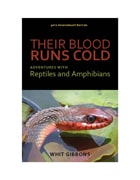
Their Blood Runs Cold
Adventures with Reptiles and AmphibiansWhit Gibbons
University of Alabama Press, 2013
Enter the fascinating world of reptiles and amphibians through the eyes of a pioneering field scientist.
Their Blood Runs Cold is entertaining, informative reading that not only enhances our understanding of a unique group of animals, but also provides genuine insight into the mind and character of a research scientist.
Whit Gibbons possesses the rare talent of conveying the challenge and excitement of scientific inquiry. A research ecologist who specializes in the study of reptiles and amphibians, he gives accounts of work in the field that are as readable as good short stories.
From the dangers of being chased by an angry rattlesnake to the exhilaration of discovering a previously undescribed species, Gibbons brings to life the everyday experiences of the herpetologist as he chases down lizards, turtles, snakes, alligators, salamanders, and frogs in their natural habitats. With essays like “Turtles May Be Slow but They’re 200 Million Years Ahead of Us” and “How to Catch an Alligator in One Uneasy Lesson,” Their Blood Runs Cold both entertains and informs.
The thirtieth anniversary edition of Their Blood Runs Cold features a new prologue and epilogue, additions that address changes in the taxonomy and study of reptiles and amphibians that have occurred since the publication of the original edition and offer suggestions for further reading that highlight the explosion of interest in the topic.
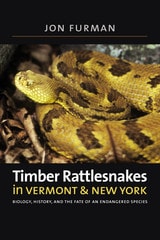
Timber Rattlesnakes in Vermont & New York
Biology, History, and the Fate of an Endangered SpeciesJon Furman
University Press of New England, 2007
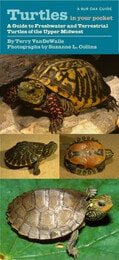
Turtles in Your Pocket
A Guide to Freshwater and Terrestrial Turtles of the Upper MidwestTerry VanDeWalle
University of Iowa Press, 2011
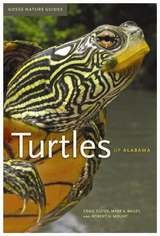
Turtles of Alabama
Craig Guyer, Mark A. Bailey, and Robert H. Mount
University of Alabama Press, 2015
From Riverbeds to Coastlines: The Ultimate Guide to Alabama’s Turtles.
For nearly 200 million years, Earth has been occupied by reptiles—a lineage of terrestrial vertebrates that includes some, like birds, that have invaded the aerial environment, and others, like turtles, that have invaded aquatic environments. With thirty-nine known species, Alabama harbors more turtle species than any other state in the nation, and its Mobile River basin is the center of the world's greatest biodiversity in turtles, surpassing all other river systems around the globe, including the Amazon and the Nile. Turtles of Alabama documents that extraordinary wealth and presents each species in full, describing its physical appearance, habitat and range, behavior, conservation and management, and taxonomy.
In addition to providing sixty-five full-color photographs of juveniles and adults along with forty-two colorfully detailed distribution maps, this volume features an introductory section explaining the physiography, climate, and habitats of the state, and offers illustrated taxonomic keys for all the species considered, including the oceanic behemoths that lay their eggs on Alabama's gulf beaches and the lumbering gopher tortoise that provides safe haven for countless other animals and arthropods in its underground burrows of the Coastal Plain. With fine line drawings to highlight various distinguishing attributes of the animals, this volume is the definitive guide to the state’s fascinating and diverse turtle populations—freshwater, marine, and terrestrial.
Although they are notoriously slow-moving, turtles still survive on Earth because of their remarkable adaptations—an exterior shell for body protection, long lives, high reproductive output, stamina, and a capacity for doing without. Turtles are cold-blooded reptiles that were here long before mammals, and they're still around, continuing to adapt to many different habitats and ecological niches, still interbreeding, evolving, and speciating. Turtles of Alabama is a fitting celebration of that phenomenal variety and strength.