Results by title
63 books match the query 'Road' and 34 start with t
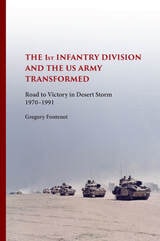
The First Infantry Division and the U.S. Army Transformed
Road to Victory in Desert Storm, 1970-1991Gregory Fontenot
University of Missouri Press, 2017
From the author's introduction:
“My purpose is a narrative history of the 1st Infantry Division from 1970 through the Operation Desert Storm celebration held 4th of July 1991. This story is an account of the revolutionary changes in the late Cold War. The Army that overran Saddam Hussein’s Legions in four days was the product of important changes stimulated both by social changes and institutional reform. The 1st Infantry Division reflected benefits of those changes, despite its low priority for troops and material. The Division was not an elite formation, but rather excelled in the context of the Army as an institution.”
This book begins with a preface by Gordon R. Sullivan, General, USA, Retired. In twelve chapters, author Gregory Fontenot explains the history of the 1st infantry Division from 1970 to 1991. In doing so, his fast-paced narrative includes elements to expand the knowledge of non-military readers. These elements include a glossary, a key to abbreviations, maps, nearly two dozen photographs, and thorough bibliography.
The First infantry Division and the U.S. Army Transformed: Road to Victory in Desert Storm is published with support from the First Division Museum at Cantigny.
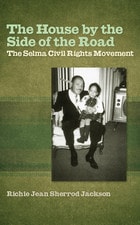
The House by the Side of the Road
The Selma Civil Rights MovementRichie Jean Sherrod Jackson
University of Alabama Press, 2011
King’s informal headquarters in Selma was the home of Dr. Sullivan and Richie Jean Sherrod Jackson and their young daughter, Jawana. The House by the Side of the Road is Richie Jean’s firsthand account of the private meetings King and his lieutenants, including Ralph David Abernathy and John Lewis, held in the haven of the Jackson home.
Sullivan Jackson was an African American dentist in Selma and a prominent supporter of the civil rights movement. Richie Jean was a close childhood friend of King’s wife, Coretta Scott King, a native of nearby Marion, Alabama. Richie Jean’s fascinating account narrates how, in the fraught months of 1965 that preceded the Voting Rights March, King and his inner circle held planning sessions and met with Assistant Attorney General John Doar to negotiate strategies for the event.
Just eight days after Bloody Sunday, President Lyndon Johnson made a televised addressed to a joint session of Congress on Monday, March 15. Jackson relates the intimate scene of King and his lieutenants watching as Johnson called the nation to dedicate itself to equal rights for all and ending his address with the words: “We shall overcome.” Five months later, Congress passed the 1965 Voting Rights Act on August 6.
The major motion picture Selma now commemorates the fiftieth anniversary of Bloody Sunday and the 1965 Voting Rights Act. In it, Niecy Nash and Kent Faulcon star as Sullivan and Richie Jean Jackson among a cast including Oprah Winfrey, Tom Wilkinson, and Cuba Gooding Jr. A gripping primary source, The House by the Side of the Road illuminates the private story whose public outcomes electrified the world and changed the course of American history.
The Most Activist Supreme Court in History
The Road to Modern Judicial ConservatismThomas M. Keck
University of Chicago Press, 2004
Ranging from 1937 to the present, The Most Activist Supreme Court in History traces the legal and political forces that have shaped the modern Court. Thomas M. Keck argues that the tensions within modern conservatism have produced a court that exercises its own power quite actively, on behalf of both liberal and conservative ends. Despite the long-standing conservative commitment to restraint, the justices of the Rehnquist Court have stepped in to settle divisive political conflicts over abortion, affirmative action, gay rights, presidential elections, and much more. Keck focuses in particular on the role of Justices O'Connor and Kennedy, whose deciding votes have shaped this uncharacteristically activist Court.

The Next Bend in the Road
Michael Fried
University of Chicago Press, 2004
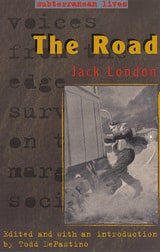
The Road
DePastino, Todd
Rutgers University Press, 2006
In 1894, an eighteen-year-old Jack London quit his job shoveling coal, hopped a freight train, and left California on the first leg of a ten thousand-mile odyssey. His adventure was an exaggerated version of the unemployed migrations made by millions of boys, men, and a few women during the original "great depression of the 1890s. By taking to the road, young wayfarers like London forged a vast hobo subculture that was both a product of the new urban industrial order and a challenge to it. As London's experience suggests, this hobo world was born of equal parts desperation and fascination. "I went on 'The Road,'" he writes, "because I couldn't keep away from it . . . Because I was so made that I couldn't work all my life on 'one same shift'; because-well, just because it was easier to than not to."
The best stories that London told about his hoboing days can be found in The Road, a collection of nine essays with accompanying illustrations, most of which originally appeared in Cosmopolitan magazine between 1907 and 1908. His virile persona spoke to white middle-class readers who vicariously escaped their desk-bound lives and followed London down the hobo trail. The zest and humor of his tales, as Todd DePastino explains in his lucid introduction, often obscure their depth and complexity. The Road is as much a commentary on London's disillusionment with wealth, celebrity, and the literary marketplace as it is a picaresque memoir of his youth.
The Road to Armageddon
The Martial Spirit in English Popular Literature, 1870–1914Cecil D. Eby
Duke University Press, 1988
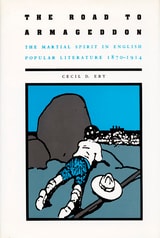
In The Road to Armageddon Cecil Eby shows how the widely admired writers of English popular fiction and poetry contributed, at least in England, to a romantic militarism coupled with xenophobia that helped create the climate that made World War I seem almost inevitable.
Between the close of the Franco-Prussian War of 1871 and the opening guns of 1914, the works of such widely read and admired writers as H. G. Wells, Rudyard Kipling, J. M. Barrie, and Rupert Brooke, as well as a host of now almost forgotten contemporaries, bombarded their avid readers with strident warnings of imminent invasions and prophecies of the collapse of civilization under barbarian onslaught and internal moral collapse.
Eby seems these narratives as growing from and in turn fueling a collective neurosis in which dread of coming war coexisted with an almost loving infatuation with it. The author presents a vivid panorama of a militant mileau in which warfare on a scale hitherto unimaginable was largely coaxed into being by works of literary imagination. The role of covert propaganda, concealed in seemingly harmless literary texts, is memorably illustrated.
The Road to Blair Mountain
Saving a Mine Wars Battlefield from King CoalCharles B. Keeney
West Virginia University Press, 2021
In 1921 Blair Mountain in southern West Virginia was the site of the country’s bloodiest armed insurrection since the Civil War, a battle pitting miners led by Frank Keeney against agents of the coal barons intent on quashing organized labor. It was the largest labor uprising in US history. Ninety years later, the site became embroiled in a second struggle, as activists came together to fight the coal industry, state government, and the military- industrial complex in a successful effort to save the battlefield—sometimes dubbed “labor’s Gettysburg”—from destruction by mountaintop removal mining.
The Road to Blair Mountain is the moving and sometimes harrowing story of Charles Keeney’s fight to save this irreplaceable landscape. Beginning in 2011, Keeney—a historian and great-grandson of Frank Keeney—led a nine-year legal battle to secure the site’s placement on the National Register of Historic Places. His book tells a David-and-Goliath tale worthy of its own place in West Virginia history. A success story for historic preservation and environmentalism, it serves as an example of how rural, grassroots organizations can defeat the fossil fuel industry.

The Road to Citizenship
What Naturalization Means for Immigrants and the United StatesAptekar, Sofya
Rutgers University Press, 2015
The Road to Concord
How Four Stolen Cannon Ignited the Revolutionary WarJ. L. Bell
Westholme Publishing, 2016
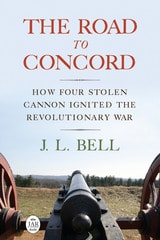
In the early spring of 1775, on a farm in Concord, Massachusetts, British army spies located four brass cannon belonging to Boston’s colonial militia that had gone missing months before. British general Thomas Gage had been searching for them, both to stymie New England’s growing rebellion and to erase the embarrassment of having let cannon disappear from armories under redcoat guard. Anxious to regain those weapons, he drew up plans for his troops to march nineteen miles into unfriendly territory. The Massachusetts Patriots, meanwhile, prepared to thwart the general’s mission. There was one goal Gage and his enemies shared: for different reasons, they all wanted to keep the stolen cannon as secret as possible. Both sides succeeded well enough that the full story has never appeared until now.
The Road to Concord: How Four Stolen Cannon Ignited the Revolutionary War by historian J. L. Bell reveals a new dimension to the start of America’s War for Independence by tracing the spark of its first battle back to little-known events beginning in September 1774. The author relates how radical Patriots secured those four cannon and smuggled them out of Boston, and how Gage sent out spies and search parties to track them down. Drawing on archives in the United States, United Kingdom, and Canada, the book creates a lively, original, and deeply documented picture of a society perched on the brink of war.
The Road to El Cielo
Mexico's Forest in the CloudsBy Fred and Marie S. Webster
University of Texas Press, 2002
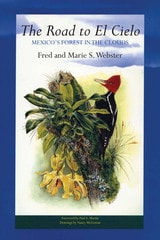
Hidden high in the Sierra de Guatemala mountain range of northeastern Mexico in the state of Tamaulipas is the northernmost tropical cloud forest of the Western Hemisphere. Within its humid oak-sweetgum woodlands, tropical and temperate species of plants and animals mingle in rare diversity, creating a mecca for birders and other naturalists.
Fred and Marie Webster first visited Rancho del Cielo, cloud forest home of Canadian immigrant Frank Harrison, in 1964, drawn by the opportunity to see such exotic birds as tinamous, trogons, motmots, and woodcreepers only 500 miles from their Austin, Texas, home. In this book, they recount their many adventures as researchers and tour leaders from their base at Rancho del Cielo, interweaving their reminiscences with a history of the region and of the struggle by friends from both sides of the border to have some 360,000 acres of the mountain declared an area protected from exploitation—El Cielo Biosphere Reserve. Their firsthand reporting, enlivened with vivid tales of the people, land, and birds of El Cielo, adds an engagingly personal chapter to the story of conservation in Mexico.
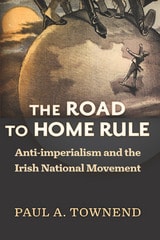
The Road to Home Rule
Anti-imperialism and the Irish National MovementPaul A. Townend
University of Wisconsin Press, 2016
Paul Townend shows that a growing critique of British imperialism shaped a rapidly evolving Irish political consciousness and was a crucial factor giving momentum to the Home Rule and Land League campaigns. Examining newspaper accounts, the rich political cartoons of the era, and the rhetoric and actions of Irish nationalists, he argues that anti-imperialism was a far more important factor in the formation of the independence movement than has been previously recognized in historical scholarship.

The Road to Love Canal
Managing Industrial Waste before EPABy Craig E. Colten and Peter N. Skinner
University of Texas Press, 1995
The toxic legacy of Love Canal vividly brought the crisis in industrial waste disposal to public awareness across the United States and led to the passage of the Superfund legislation in 1980. To discover why disasters like Love Canal have occurred and whether they could have been averted with knowledge available to waste managers of the time, this book examines industrial waste disposal before the formation of the Environmental Protection Agency in 1970.
Colten and Skinner build their study around three key questions. First, what was known before 1970 about the hazards of certain industrial wastes and their potential for causing public health problems? Second, what were the technical capabilities for treating or containing wastes during that time? And third, what factors other than technical knowledge guided the actions of waste managers before the enactment of explicit federal laws?
The authors find that significant information about the hazards of industrial wastes existed before 1970. Their explanations of why this knowledge did not prevent the toxic legacy now facing us will be essential reading for environmental historians and lawyers, public health personnel, and concerned citizens.
The Road to Marion Town
The Settlement of Osceola County, State of MichiganJ. August Lithen
Parkhurst Brothers, Inc., 2018
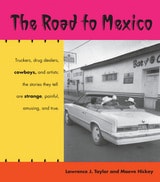
The Road to Mexico
Lawrence J. Taylor and Maeve Hickey
University of Arizona Press, 1997
Equipped with camera, pen, and a lively curiosity, photographer Maeve Hickey and writer Lawrence J. Taylor set out to capture whatever might come their way on the road to Mexico. They roamed and rambled, they stayed well off the beaten track, and they talked to nearly everyone they met, from wisecracking waitresses to landed gentry to street urchins dressed in rags. Their book brings to life the calf ropers and casinos, the saints and sinners, the mariachis and miracles in a no-man's-land that sometimes seems to belong neither to the United States nor to Mexico.
Following the footsteps of earlier travelers-traders, warriors, missionaries, and explorers-these modern pilgrims take a hands-on approach to their journey. Throughout, both writer and photographer convey the sizzle and spice of a land where Indian, Mexican, and Anglo worlds have collided, coexisted, and melted into each other for centuries. Their eye for the hidden telling detail carries the reader straight into the action, and their zest for excitement spurs any traveler to drop everything, grab a bag, and hit the road to Mexico.
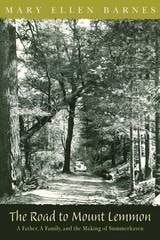
The Road to Mount Lemmon
A Father, A Family, and the Making of SummerhavenMary Ellen Barnes
University of Arizona Press, 2009
The Santa Catalina Mountains first captivated Tony Zimmerman on a 1937 hunting trip. Regard for the alpine beauty must have been in his genes—he was the son of Swiss German immigrants—and by 1940 the Tucson schoolteacher had begun taking his family to Mount Lemmon to spend the summer. Back then, the road up the mountain was a rough two-track dirt road from Oracle, and Summerhaven was nothing but a sleepy cluster of summer cabins. But Tony Zimmerman was to help change all of that.
The Road to Mount Lemmon is a beguiling memoir of the Catalina Mountains told by the daughter of one of the pioneers in the life and development of Mount Lemmon’s communities. Mary Ellen Barnes tells how her father Tony resigned from teaching in 1943 to devote his career to the development of this mountain oasis. He not only sold real estate for long time landowner Randolph Jenks, he even bought the village’s tiny two-room store, installing a sawmill to build a larger store, and built the Mount Lemmon Inn. And as she spins Tony’s personal saga, she also gives readers a glimpse of the Catalinas before Tucson became a boom town, recalling idyllic adventures in wild country and the cowboys, rangers, ranchers, and loggers who worked there.
Barnes tells Tony’s story as if sharing it with family, evoking her father’s personality on every page. The Road to Mount Lemmon is an intimate view of a mountain community over the course of nearly sixty years—a view that few people have shared but one all can appreciate.
The Road to OPEC
United States Relations with Venezuela, 1919-1976By Stephen G. Rabe
University of Texas Press, 1982
On September 10, 1960, Venezuela spearheaded the formation of the Organization of Petroleum Exporting Countries (other original members included Saudi Arabia, Iran, Iraq, and Kuwait). However, in a world abundantly supplied with oil, the United States could and did ignore Venezuelan suggestions that OPEC and the consuming nations work together to control production and to increase prices. Then, in late 1973, OPEC sent shudders throughout the world economy, and an energy crisis struck with full force. Emboldened by the power of their oil cartel, Venezuelan leaders denounced the old economic relationship with the United States, nationalized U.S. oil and steel holdings, and fashioned a foreign economic policy that differed sharply from Washington's.
The Road to OPEC is the story of the fiery debates among U.S. oil companies, the Department of State, and the Venezuelan government over oil policies—clashes that led Venezuela to establish OPEC and to nationalize U.S.-owned properties. In addition, this is the first study of twentieth-century Venezuelan-U.S. relations. Its focus on oil diplomacy is placed within the context of key U.S. policies toward Latin America and such programs as the Open Door, the Good Neighbor, and the Alliance for Progress. The author also provides insight into both the politics of the contemporary energy crisis and the growing split between raw-material producers and their industrial customers.
The Road to OPEC is based on extensive archival research, as well as the author's successful use of the Freedom of Information Act to declassify files of such agencies as the National Security Council and the CIA.

The Road to Rebellion
Class Formation and Kansas Populism, 1865-1900Scott G. McNall
University of Chicago Press, 1988
McNall rejects the traditional view that blames the failure of the Alliance on a turn to mass-based electoral politics, but rather sees the move into national politics by the Farmer's Alliance as part of a rational strategy to better wage their fight for economic justice. The Kansas populists failed, he argues, because of their inability to embrace a broad, working-class base, to provide an effective alternative vision, and ultimately to create a distinct class organization. Debates about how classes come into being, or how democracy is to be realized, cannot be settled in the abstract. McNall's recreation of this heroic struggle is a model in the analysis of class formation. At the same time, The Road to Rebellion is dynamic social history, which holds vital lessons for structuring and realizing alternative political agendas today.
The Road to Renewal
Victor Joseph Reed and Oklahoma Catholicism, 1905–1971Jeremy BONNER
Catholic University of America Press, 2008
The Road to Santiago
Walking the Way of St JamesRené Freund
Haus Publishing, 2016
As René Freund learns, when you reach the edge of the European continent having walked along the Way of St. James—which pilgrims of former times thought to be the end of the world—only then do you realize that the old pilgrim’s saying is true: the journey does not end in Santiago. The journey begins in Santiago. In this vivid travelogue, Freund not only introduces us to the overwhelming natural beauty he encountered along the way, but also shares his experience of reaching his physical and psychological limits during the arduous journey.
The Road to Seneca Falls
Elizabeth Cady Stanton and the First Woman's Rights ConventionJudith Wellman
University of Illinois Press, 2004
The convention succeeded by uniting powerful elements of the antislavery movement, radical Quakers, and the campaign for legal reform under a common cause. Wellman shows that these three strands converged not only in Seneca Falls, but also in the life of women's rights pioneer Elizabeth Cady Stanton. It is this convergence, she argues, that foments one of the greatest rebellions of modern times.
Rather than working heavy-handedly downward from their official "Declaration of Sentiments," Wellman works upward from richly detailed documentary evidence to construct a complex tapestry of causes that lay behind the convention, bringing the struggle to life. Her approach results in a satisfying combination of social, community, and reform history with individual and collective biographical elements.
The Road to Seneca Falls challenges all of us to reflect on what it means to be an American trying to implement the belief that "all men and women are created equal," both then and now. A fascinating story in its own right, it is also a seminal piece of scholarship for anyone interested in history, politics, or gender.
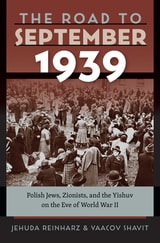
The Road to September 1939
Polish Jews, Zionists, and the Yishuv on the Eve of World War IIJehuda Reinharz and Yaacov Shavit
Brandeis University Press, 2018
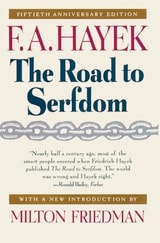
The Road to Serfdom
F. A. Hayek
University of Chicago Press, 1994
First published by the University of Chicago Press on September 18, 1944, The Road to Serfdom garnered immediate attention from the public, politicians, and scholars alike. The first printing of 2,000 copies was exhausted instantly, and within six months more than 30,000 were sold. In April of 1945, Reader's Digest published a condensed version of the book, and soon thereafter the Book-of-the-Month Club distributed this condensation to more than 600,000 readers. A perennial best-seller, the book has sold over a quarter of a million copies in the United States, not including the British edition or the nearly twenty translations into such languages as German, French, Dutch, Swedish, and Japanese, and not to mention the many underground editions produced in Eastern Europe before the fall of the iron curtain.
After thirty-two printings in the United States, The Road to Serfdom has established itself alongside the works of Alexis de Tocqueville, John Stuart Mill, and George Orwell for its timeless meditation on the relation between individual liberty and government authority. This fiftieth anniversary edition, with a new introduction by Milton Friedman, commemorates the enduring influence of The Road to Serfdom on the ever-changing political and social climates of the twentieth century, from the rise of socialism after World War II to the Reagan and Thatcher "revolutions" in the 1980s and the transitions in Eastern Europe from communism to capitalism in the 1990s.
F. A. Hayek (1899-1992), recipient of the Medal of Freedom in 1991 and co-winner of the Nobel Memorial Prize in Economics in 1974, was a pioneer in monetary theory and the principal proponent of libertarianism in the twentieth century.
On the first American edition of The Road to Serfdom:
"One of the most important books of our generation. . . . It restates for our time the issue between liberty and authority with the power and rigor of reasoning with which John Stuart Mill stated the issue for his own generation in his great essay On Liberty. . . . It is an arresting call to all well-intentioned planners and socialists, to all those who are sincere democrats and liberals at heart to stop, look and listen."—Henry Hazlitt, New York Times Book Review, September 1944
"In the negative part of Professor Hayek's thesis there is a great deal of truth. It cannot be said too often—at any rate, it is not being said nearly often enough—that collectivism is not inherently democratic, but, on the contrary, gives to a tyrannical minority such powers as the Spanish Inquisitors never dreamt of."—George Orwell, Collected Essays
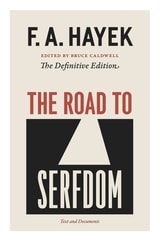
The Road to Serfdom
Text and Documents--The Definitive EditionF. A. Hayek
University of Chicago Press, 2007
First published by the University of Chicago Press on September 18, 1944, The Road to Serfdom garnered immediate, widespread attention. The first printing of 2,000 copies was exhausted instantly, and within six months more than 30,000 books were sold. In April 1945, Reader’s Digest published a condensed version of the book, and soon thereafter the Book-of-the-Month Club distributed this edition to more than 600,000 readers. A perennial best seller, the book has sold 400,000 copies in the United States alone and has been translated into more than twenty languages, along the way becoming one of the most important and influential books of the century.
With this new edition, The Road to Serfdom takes its place in the series The Collected Works of F. A. Hayek. The volume includes a foreword by series editor and leading Hayek scholar Bruce Caldwell explaining the book's origins and publishing history and assessing common misinterpretations of Hayek's thought. Caldwell has also standardized and corrected Hayek's references and added helpful new explanatory notes. Supplemented with an appendix of related materials ranging from prepublication reports on the initial manuscript to forewords to earlier editions by John Chamberlain, Milton Friedman, and Hayek himself, this new edition of The Road to Serfdom will be the definitive version of Hayek's enduring masterwork.
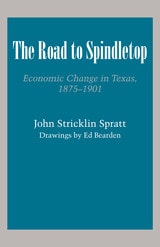
The Road to Spindletop
Economic Change in Texas, 1875–1901By John Stricklin Spratt; drawings by Ed Bearden
University of Texas Press, 1955
This book is an economic history of Texas at the end of the nineteenth century. In 1875, Texas was an agrarian state with limited industry. A generation later, agriculture was heavily commercialized, thousands of miles of railroads carried people and goods around the state, and urban populations increased rapidly. Even before the Spindletop gusher that irrevocably changed the state’s future, Texas had already moved far from its days as a Mexican and American frontier.
The Road to Ticonderoga
The Campaign of 1758 in the Champlain ValleyMichael G. Laramie
Westholme Publishing, 2027
Based on journals, letters, and accounts of the participants on both sides, The Road to Ticonderoga: The Campaign of 1758 in the Champlain Valley by Michael G. Laramie recounts this unexpected tale of victory and defeat on the North American frontier. Here we learn how the unexpected death of a dynamic leader, George Howe, elder brother of Richard and William, nearly crushed “the soul of General Abercrombie’s army,” leading to misinterpreted orders and hesitation on the part of the British. At the same time, the French commander perilously underestimated the ability of his own forces while overestimating his enemy’s before his fateful and unexpected decision to make his stand at Ticonderoga. With lessons and repercussions for future warfare in North America, The Road to Ticonderoga shows how a series of small mistakes can cascade into a catastrophe under weak leadership—or be exploited by a strong one.
The Road to War in Serbia
Trauma and CatharsisNebojša Popov
Central European University Press, 2000
The Yugoslav crisis, with its armed conflict, ethnic cleansing and the reverberating ideas and mindsets, has been going on for more than ten years. The Road to War in Serbia is the first serious assessment to explore the roots of the conflict in the former Yugoslavia. Based on years of research, the authors - all eminent scholars in the field who have lived through these social conflicts - highlight key issues which have to date remained unknown or which have been previously neglected.
The issues dealt with include the institutional frameworks of ethnicity and nationalism; the input of the church, science, literature and sports; specific catalysts of the conflict and the role of the political actors, students, the ruling party and the media.
The Road to War in Serbia will be of great interest to all readers who want to understand why and how the violent option of settling disputes and conflicts on the territory of Yugoslavia is being accepted.
The Road to Wildcat
A Tale of Mountain AlabamaEleanor Risley
University of Alabama Press, 2004
A remarkable chronicle of southern mountain life in the early 20th century
The Road to Wildcat recounts the travels in North Alabama in the mid-1920s of Eleanor Risley (suffering from diabetes), her asthmatic husband, Pierre, their dog, John, and a Chinese wheelbarrow named Sisyphus that held their travel goods. Advised to make the walking tour for improvement of their health, the group left Fairhope in south Alabama and walked hundreds of miles in the southern Appalachians for months, sleeping out under the stars at night, or in a canvas tent or an abandoned building, cooking their fresh-caught foods over campfires, and accepting the generosity and advice of the mountain people they met, some of them moonshiners and outlaws.
During their sojourn across the rural wilderness, they enjoyed fiddlin’ dances in rickety halls, joined Sacred Harp singers, learned about the grapevine telegraph, saw the dreadful effects of inbreeding, and attended “Snake Night” at Posey Holler (a religious revival that included snake handling). Published in segments in the Atlantic Monthly in 1928 and 1929 and then reorganized into book form, the travelogue is a colorful record of the culture, customs, and dialect of the southern mountaineers of that era.
The Road to the Open
Arthur Schnitzler
Northwestern University Press, 1991
The Role of 6G and Beyond on the Road to Net-Zero Carbon
Muhammad Ali Imran
The Institution of Engineering and Technology, 2023
The View From On the Road
The Rhetorical Vision of Jack KerouacOmar Swartz
Southern Illinois University Press, 2000
Through careful analysis of Jack Kerouac’s On the Road, Omar Swartz argues that Kerouac’s influence on American society is largely rhetorical. Kerouac’s significance as a cultural icon can be best understood, Swartz asserts, in terms of traditional rhetorical practices and principles.
To Swartz, Kerouac is a rhetor who symbolically reconstructs his world and offers arguments and encouragements for others to follow. Swartz proposes that On the Road constitutes a “rhetorical vision,” a reality-defining discourse suggesting alternative possibilities for growth and change. Swartz asserts that the reader of Kerouac’s On theRoadbecomes capable of responding to the larger, confusing culture in a strategic manner. Kerouac's rhetorical vision of an alternative social and cultural reality contributes to the identity of localized cultures within the United States.
Till the Dark Angel Comes
Abolitionism and the Road to the Second American RevolutionWilliam S. King
Westholme Publishing, 2016
Establishing himself as a fresh and important voice in the history of African American emancipation,William S. King provides a critical introduction to the lead-up to the Civil War. A skilled and judicious chronicler, King seamlessly weaves multiple and seemingly disparate threads, including early nineteenth-century Revivalism, the emergence of the Republic of Texas, the fugitive slave laws—and even the explosion of a cannon aboard the U.S.S. Princeton in 1844—to explain how the opposition to slavery in America changed from producing speeches and pamphlets to embracing the reality that slavery could be eradicated only through armed conflict. By tracing this transformation through the life of John Brown, King provides an entirely new assessment of this enigmatic figure who was characterized as a “mad man” in the wake of his butchering of proslavery settlers in Kansas and the inept raid on Harpers Ferry, Virginia. King puts these actions in context to explain the paradox of Brown’s legacy. On one hand he was vilified as an unstable threat to American democracy or a fanatical sideshow to the history of the Civil War, while on the other he was an inspiration to the oppressed, a man who garnered the indomitable Harriet Tubman’s commitment to the righteousness of his endeavor.
Elegantly written with a command of period sources, Till the Dark Angel Comes: Abolitionism and the Road to the Second American Revolution is the story of interracial opposition to slavery, the important debates among free blacks as to their future in America, and the arguments and compromises at the highest levels of government. Here we encounter many personalities of the time, some well known, such as Frederick Douglass,William Lloyd Garrison, and John C. Calhoun, and others less so, but no less important—Martin Delany, Henry Highland Garnet, and Elijah Lovejoy.
Transforming Rural Water Governance
The Road from Resource Management to Political Activism in NicaraguaSarah T. Romano
University of Arizona Press, 2019
In Transforming Rural Water Governance Sarah T. Romano explains the bottom-up development and political impact of community-based water and sanitation committees (CAPS) in Nicaragua. Romano traces the evolution of CAPS from rural resource management associations into a national political force through grassroots organizing and strategic alliances.
Resource management and service provision is inherently political: charging residents fees for service, determining rules for household water shutoffs and reconnections, and negotiating access to water sources with local property owners constitute just a few of the highly political endeavors resource management associations like CAPS undertake as part of their day-to-day work in their communities. Yet, for decades in Nicaragua, this local work did not reflect political activism. In the mid-2000s CAPS’ collective push for social change propelled them onto a national stage and into new roles as they demanded recognition from the government.
Romano argues that the transformation of Nicaragua’s CAPS into political actors is a promising example of the pursuit of sustainable and equitable water governance, particularly in Latin America. Transforming Rural Water Governance demonstrates that when activism informs public policy processes, the outcome is more inclusive governance and the potential for greater social and environmental justice.
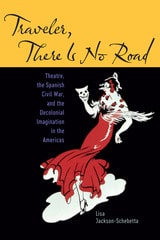
Traveler, There Is No Road
Theatre, the Spanish Civil War, and the Decolonial Imagination in the AmericasLisa Jackson-Schebetta
University of Iowa Press, 2017
This book offers a unique perspective on 1930s theatre and performance, encompassing the theatrical work of the Cuban, Puerto Rican, and Spanish diasporas in the United States, as well as the better-known Anglophone communities. Jackson-Schebetta situates well-known figures, such as Langston Hughes and Clifford Odets, alongside lesser-known ones, such as Erasmo Vando, Franca de Armiño, and Manuel Aparicio. The milicianas, female soldiers of the Spanish Republic, stride on stage alongside the male fighters of the Lincoln Brigade. They and many others used the multiple visions of Spain forged during the civil war to foment decolonial practices across the pasts, presents, and futures of the Americas. Traveler conclusively demonstrates that theatre and performance scholars must position US performances within the Americas writ broadly, and in doing so they must recognize the centrality of the hemisphere’s longest-lived colonial power, Spain.
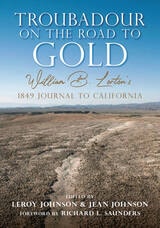
Troubadour on the Road to Gold
William B. Lorton's 1849 Journal to CaliforniaEdited by LeRoy Johnson and Jean Johnson, Foreword by Richard Saunders
University of Utah Press, 2020
Lorton’s work is revealing and entertaining. It captures glimpses of a growing Salt Lake City, the hardships of Death Valley, and the extraordinary and mundane aspects of daily life on the road to gold. With resilience and a droll sense of humor, Lorton shares accounts of life-threatening stampedes, dangerous hailstorms, mysteriously moving rocks, and slithering sidewinders. The inclusion of images, maps, and the editors’ detailed notes make this a volume that will entertain and inform.