Results by title
70 books match the query 'Selected Writings' and 10 start with t
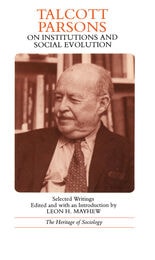
Talcott Parsons on Institutions and Social Evolution
Selected WritingsTalcott Parsons
University of Chicago Press, 1983
In his extensive introduction to this volume, Leon H. Mayhew brings a new focus and clarity to Talcott Parsons's work. Explicating Parsons on his own terms, Mayhew discusses the basic tools of Parsonian analysis and interprets the larger themes of his work. He provides a chronological account of the development of Parsons's thought, his presuppositions, and his position on the ideological spectrum of social thought.
Mayhew then presents twenty of Parsons's essays, touching on each of the major aspects of his work, including "action" theory and the celebrated four-function scheme. Other topics covered include the role of theory in social research, evolutionary universals in society, influence, control, and the mass media.
"Talcott Parsons on Institutions and Social Evolution will become a standard reference for those studying that development of his sociological ideas."—Martin Bulmer, The Times Higher Education Supplement
The Feeling Intellect
Selected WritingsPhilip Rieff
University of Chicago Press, 1989
The Historical Construction of National Consciousness
Selected WritingsJeno Szucs
Central European University Press, 2022
A long essay entitled Three Historical Regions of Europe, appearing first in a samizdat volume in Budapest in 1980, instantly put its author into the forefront of the transnational debate on Central Europe, alongside such intellectual luminaries as Milan Kundera and Czesław Miłosz. The present volume offers English-language readers a rich selection of the depth and breadth of the legacy of Jenő Szűcs (1928–1988).
The selection documents Szűcs’s seminal contribution to many contemporary debates in historical anthropology, nationalism studies, and conceptual history. It contains his key texts on the history of national consciousness and patterns of collective identity, as well as medieval and early modern political thought. The works published here, most of them previously unavailable in English, provide a sophisticated analysis of a wide range of subjects from the myths of origins of Hungarians before Christianization to the political and religious ideology of the Dózsa peasant uprising in 1514, the medieval roots of civil society, or the revival of ethnic nationalism during the communist era. The volume, with an introduction by the editors locating Szűcs in a transnational context, offers a unique insight into the complex and sensitive debate on national identity in post-1945 East Central Europe.
The Modernist as Philosopher
Selected Writings of Marcel HebertC. J. T. Talar
Catholic University of America Press, 2011
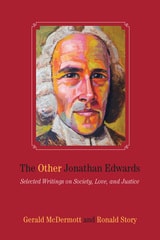
The Other Jonathan Edwards
Selected Writings on Society, Love, and JusticeGerald McDermott
University of Massachusetts Press, 2015
Widely regarded as perhaps America's greatest theologian, Jonathan Edwards still suffers the stereotype of hellfire preacher obsessed with God's wrath. In this anthology, Gerald McDermott and Ronald Story seek to correct that common view by showing that Edwards was also a compassionate, socially conscious minister of the first order.
Through a selection of sermons and primary writings, McDermott and Story reveal an Edwards who preached love toward all humanity regardless of belief or appearance; who demanded private and public charity to the poor; who criticized hard-hearted business dealings as impious and socially destructive; and who condemned envy and status-seeking as anti-Christian and anti-community. This “other” Jonathan Edwards preached about grace and the love of God but also about responsive constitutional government, the iniquities of hypocrisy and corruption, and the nature of wise leadership. He acknowledged the need for national defense but left room for popular revolt from tyranny. He anticipated a millennial age of peace and prosperity and believed that people should live in the world as they would live through grace in heaven.
Jonathan Edwards was, in sum, a worldly as well as spiritual reformer who resisted the materialistic, acquisitive, and individualistic currents of American culture. For these reasons, McDermott and Story think he may have lessons to teach us today.
The Point is to Change the World
Selected Writings of AndaiyeAlissa Andaiye
Pluto Press, 2020
Through essays, letters and journal entries, Andaiye's thinking on the intersections of gender, race, class and power are profoundly articulated, Caribbean histories emerge, and stories from a life lived at the barricades are revealed. We learn about the early years of the Working People's Alliance, the meaning and impact of the murder of Walter Rodney and the fall of the Grenada Revolution. Throughout, we bear witness to Andaiye's acute understanding of politics rooted in communities and the daily lives of so-called ordinary people.
Featuring forewords by Clem Seecharan and Robin DG Kelley, these texts will become vital tools in our own struggles to 'overturn the power relations which are embedded in every unequal facet of our lives'.
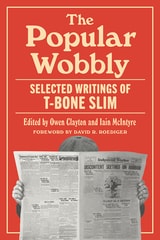
The Popular Wobbly
Selected Writings of T-Bone SlimT-Bone Slim
University of Minnesota Press, 2025
The first critical edition of the writings of the prolific radical workers’ newspaper columnist and musician who rode the rails during the Great Depression
The Popular Wobbly brings together a wide selection of writings by T-Bone Slim, the most popular and talented writer belonging to the Industrial Workers of the World (IWW). Slim wrote humorous, polemical pieces, engaging with topics like labor and class injustice, which were mostly published in IWW publications from 1920 until his death in 1942. Although relatively little is known about Slim, editors Owen Clayton and Iain McIntyre coalesce the latest research on this enigmatic character to create a vivid portrait that adds valuable context for the array of writings assembled here.
Known as “the laureate of the logging camps,” Slim also composed numerous songs that have been performed and recorded by Pete Seeger, Utah Phillips, and Candie Carawan, who in 1960 updated Slim’s song “The Popular Wobbly” with Civil Rights–era lyrics. Slim’s witticisms, sayings, and exhortations (“Wherever you find injustice, the proper form of politeness is attack”; “Only the poor break laws—the rich evade them”) were widely discussed among fellow hobos across the “jungle” campfires that dotted the railways, and some even transcribed his commentary on boxcars that traveled the country. Yet despite Slim’s importance and fame during his lifetime, his work disappeared from public view almost immediately after his death.
The Popular Wobbly is the first critical edition of Slim’s work and also a significant contribution to literature about working-class writers, the radical labor movement, and the history and culture of nomadism and precarity. With this publication, Slim’s rediscovered writings can once again inspire artists and activists to march and agitate for a more just and equitable world.
The Prague School
Selected Writings, 1929-1946Edited by Peter Steiner
University of Texas Press, 1982
The Prague Linguistic Circle came into being on the afternoon of October 6, 1926, when five Czech and Russian linguists gathered to hear a lecture by a German colleague. From this international beginning, the interests of the group grew to first encompass language in all its functional heterogeneity and then finally all of culture, which the Circle conceived of as a structure of sign systems. Semiotics was thus the overarching discipline for the Prague School, serving to organize all phenomena shared and exchanged by a cultural community.
In recent years increasing attention has been paid to the importance of the Prague School, but writing about it has frequently been marred by misconceptions. The central aim of this volume is to correct those misconceptions and to present the diversity of interests within the Prague School—literary criticism, linguistics, theory of theater, folklore, and philosophy. These essays by Bogatyrëv, Jakobson, Karcevskij, Mukařovský, Rieger, Vodička, and Honzl are here translated into English for the first time. Some have a special historical value in illuminating critical stages of structuralist thinking; others reveal the timeliness of the School's contributions for the theoretical conflicts of our day. Each essay is accompanied by an informative introductory note, and the whole is followed by the editor's "Postscript," tracing the roots of structuralist aesthetics.
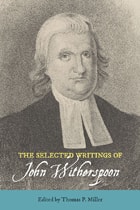
The Selected Writings of John Witherspoon
Edited by Thomas P. Miller
Southern Illinois University Press, 1990
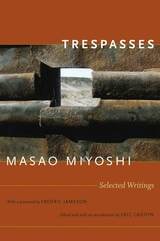
Trespasses
Selected WritingsMasao Miyoshi
Duke University Press, 2010
This volume brings together eleven selections of Miyoshi’s previously published writing, a major new essay, a critical introduction to his life and work, and an interview in which Miyoshi reflects on the trajectory of his thought and the institutional history of modern Japan studies. In the new essay, “Literary Elaborations,” he provides a masterful overview of the nature of the contemporary university, closing with a call for a global environmental protection studies that would radically reconfigure academic disciplines and merge the hard sciences with the humanities and the social sciences. In the other, chronologically arranged selections, Miyoshi addresses cross-culture relations between Japan and the United States, English literary studies in Japan, and Japan studies in the U.S., as well as the organization of urban space and the integrity of art and architecture in aggressively marketed-oriented environments. Trespasses is an invaluable introduction to the work of a fearless cultural critic.