56 books match the query 'Sermons' and 14 start with t
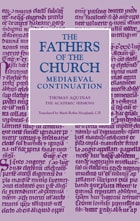
cover of The Academic Sermons (The Fathers of the Church, Mediaeval Continuation, Volume 11)

The Academic Sermons (The Fathers of the Church, Mediaeval Continuation, Volume 11)

Thomas Aquinas

Catholic University of America Press, 2010
No description available
[more]
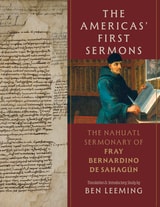
cover of The Americas' First Sermons: The Nahuatl Sermonary of Fray Bernardino de Sahagún

The Americas' First Sermons

The Nahuatl Sermonary of Fray Bernardino de Sahagún

Translation and Introduction study by Ben Leeming

University of Utah Press, 2025

The first English publication of the earliest surviving Christian sermons from the Americas

The Americas’ First Sermons presents the first English translation and critical study of the complete set of sermons composed by Franciscan friar Bernardino de Sahagún and his Nahua students at the Imperial College of Santa Cruz in Tlatelolco, Mexico in 1540. The volume represents a crucial moment in the cultural exchange between European and Indigenous civilizations in sixteenth-century colonial Mexico.

With the collaboration of Mario Alberto Sánchez Aguilera, this edition offers unprecedented access to the collaboration between European friars and Nahua scholars in translating Christian concepts into Native languages. It captures Sahagún’s evolving methods across three phases (1530s–1560s) through his extensive annotations, bridging the divide between his ethnographic and doctrinal works. Unique in its analysis of both text and manuscript features—such as rare maguey paper—it highlights Indigenous intellectual contributions at the Colegio de Santa Cruz. This translation provides essential insights into early colonial religious negotiations and makes previously inaccessible material available to scholars across multiple disciplines.
[more]
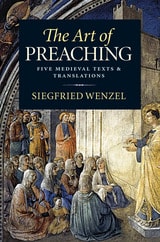
cover of The Art of Preaching

The Art of Preaching

Siegfried Wenzel

Catholic University of America Press, 2013
Based on his wide-ranging knowledge of late-medieval Latin sermons from England as well as his editorial experience with medieval Latin texts, Siegfried Wenzel offers critical editions of five instruction manuals on the "art of preaching" dating from 1230 to the fifteenth century. Four of the texts are edited and translated for the first time; the fifth is re-edited from all extant manuscripts. Each of the five sermons is accompanied by a facing-page translation into English. The book aims to stimulate interest and new research in a field that still awaits closer analysis of the relationships among existing treatises and of their historical development.
[more]
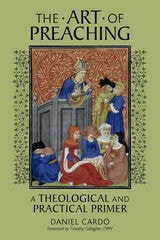
cover of The Art of Preaching: A Theological and Practical Primer

The Art of Preaching

A Theological and Practical Primer

Daniel Cardo

Catholic University of America Press, 2021
The growing awareness of the importance of preaching is a sign of our times. In the past decades, conscious that a renewal of preaching is essential for a renewed evangelization, many seminaries have implemented homiletic courses. However, there is still a real limitation of good and systematic resources in order to learn the theological depth and practical elements of the art of preaching. The Art of Preaching: A Theological and Practical Primer aims to fill that gap. It explores the theological understanding of the homily, lessons from classical and contemporary rhetoric, the relevance of preaching for the life of the Church, highlighting recent teachings of the Magisterium, and it presents the incarnation as the foundation for preaching, understood as an essential aspect of the priestly life and mission. This primer also offers a simple and effective method for the preparation and delivery of homilies, illustrating this by the example of brilliant preachers and exploring the idea of preaching as locus theologicus, i.e., the privileged place for the exercise of theology today. It is in deepening in the value and importance of preaching that theology can be renewed as a living and essential part of the daily life of priests. Seeing the homily not as a burden but as an occasion to fulfill the priestly identity will offer the opportunity to embrace the preparation for preaching as a key for unity among the many tasks and demands of pastoral life. In the homily prayer, study, and work come together. The Art of Preaching will also provide a selection of homilies from the great preachers of the Church, organized chronologically, with brief introductions and commentaries that highlight what those homilies teach us for our preaching today. Only learning from the best preachers can we hope to preach effectively in our times.
[more]
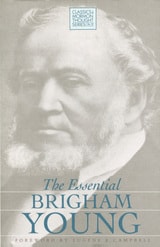
cover of The Essential Brigham Young

The Essential Brigham Young

Eugene E. Campbell

Signature Books, 1992

 After converting to Mormonism in 1832, Brigham Young (1801-77) quickly rose to prominence and was called to the Quorum of Twelve Apostles within three years. He personally directed the highly successful 1839 proselyting mission to Great Britain, and he was appointed president of the Twelve Apostles the following year. In 1846-47 he oversaw the epic colonization of the Intermountain West.

Self-educated and preoccupied with the day-to-day business of his widespread empire, Young rarely found time to read. But he delivered hundreds of lively, extemporaneous sermons which blended common sense with theological speculation. Such homespun treatises carried an immediacy that was absent from the philosophically-oriented studies of his ecclesiastical colleague Orson Pratt, though, at the same time, Young’s speeches could be unfocused and contradictory.

Several of the more controversial teachings that Young promulgated—Adam-as-God, divine omniscience, and blood atonement—have sparked considerable debate since they were first uttered more than one hundred years ago. “Will you love your brothers and sisters likewise,” he once asked, “when they have committed a sin that cannot be atoned for without the shedding of their blood? Will you love that man or woman well enough to shed their blood?”

Other favorite topics were the “personality of God,” “election and reprobation,” and “the resurrection.” His sermons usually begin in a chatty way: “I remarked last Sunday that I had not felt much like preaching,” or “When I contemplate the subject of salvation, and rise before a congregation to speak upon that all-important matter, it has been but a few times in my life that I could see a beginning point to it, or a stopping place.” Readers will find themselves drawn into the rhythm of Young’s rhetoric in the same way as his original hearers were.
[more]
cover of The Homilies of Saint Jerome, Volume 1 (1–59 on the Psalms)

The Homilies of Saint Jerome, Volume 1 (1–59 on the Psalms)

Saint Jerome

Catholic University of America Press, 1965
This volume contains fifty-nine homilies preached by St. Jerome on selected Psalms.
[more]
cover of The Homilies of Saint Jerome, Volume 2

The Homilies of Saint Jerome, Volume 2

Saint Jerome

Catholic University of America Press, 1966
This volume of the Homilies of Saint Jerome contains fifteen homilies on Saint Mark's Gospel, Homilies 75-84.
[more]
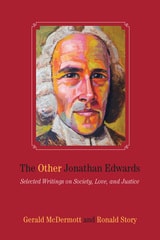
cover of The Other Jonathan Edwards: Selected Writings on Society, Love, and Justice

The Other Jonathan Edwards

Selected Writings on Society, Love, and Justice

Gerald McDermott

University of Massachusetts Press, 2015

Widely regarded as perhaps America's greatest theologian, Jonathan Edwards still suffers the stereotype of hellfire preacher obsessed with God's wrath. In this anthology, Gerald McDermott and Ronald Story seek to correct that common view by showing that Edwards was also a compassionate, socially conscious minister of the first order. 

Through a selection of sermons and primary writings, McDermott and Story reveal an Edwards who preached love toward all humanity regardless of belief or appearance; who demanded private and public charity to the poor; who criticized hard-hearted business dealings as impious and socially destructive; and who condemned envy and status-seeking as anti-Christian and anti-community. This “other” Jonathan Edwards preached about grace and the love of God but also about responsive constitutional government, the iniquities of hypocrisy and corruption, and the nature of wise leadership. He acknowledged the need for national defense but left room for popular revolt from tyranny. He anticipated a millennial age of peace and prosperity and believed that people should live in the world as they would live through grace in heaven. 

Jonathan Edwards was, in sum, a worldly as well as spiritual reformer who resisted the materialistic, acquisitive, and individualistic currents of American culture. For these reasons, McDermott and Story think he may have lessons to teach us today.
[more]
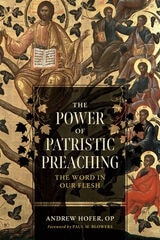
cover of The Power of Patristic Preaching: The Word in Our Flesh

The Power of Patristic Preaching

The Word in Our Flesh

Andrew Hofer, OP

Catholic University of America Press, 2023
The Word made flesh is manifested in the lives of those dedicated to his proclamation. The Power of Patristic Preaching: The Word in Our Flesh presents seven early preachers who show, by life and speech, the divine Word’s power at work in weak human life. The book is inspired by this question preached by Origen, “For what does it profit if I should say that Jesus has come in that flesh alone which he received from Mary and I should not show also that he has come in this flesh of mine?” In seven chapters, The Power of Patristic Preaching studies the exemplars of Origen for holiness, Ephrem for the humility of repentance, Gregory of Nazianzus for purification and faith, John Chrysostom for the hope of salvation, Augustine for love, Leo the Great for love of the poor and the weak, and Gregory the Great for accepting our own weakness.  With an emphasis on the incarnation, deification through the virtues, and proclamation, The Power of Patristic Preaching serves as a resource for those dedicated to the ministry of the Word (clerical, religious, and lay), and as a text for students of early Christian theology and practices. A Catholic work for a broad ecumenical audience, the book gives a cry from the heart in a suffering Church traveling through a world that is passing away.
[more]
cover of Tractates on the Gospel of John 112–24; Tractates on the First Epistle of John

Tractates on the Gospel of John 112–24; Tractates on the First Epistle of John

Saint Augustine

Catholic University of America Press, 1988
In this volume, which concludes John W. Rettig's translation of St. Augustine's Tractates on the Gospel of John, Augustine applies his keen insight and powers of rhetoric to the sacred text, drawing the audience into an intimate contemplation of Jesus through the course of his Passion, Death, and Resurrection.
[more]
cover of Tractates on the Gospel of John 11–27

Tractates on the Gospel of John 11–27

Saint Augustine

Catholic University of America Press, 1988
No description available
[more]
cover of Tractates on the Gospel of John 1–10

Tractates on the Gospel of John 1–10

Saint Augustine

Catholic University of America Press, 1988
No description available
[more]
cover of Tractates on the Gospel of John 28–54

Tractates on the Gospel of John 28–54

Saint Augustine

Catholic University of America Press, 1988
No description available
[more]
cover of Tractates on the Gospel of John 55–111

Tractates on the Gospel of John 55–111

Saint Augustine

Catholic University of America Press, 1988

No description available
[more]