254 books match the query 'Sex' and 41 start with t

cover of Taboo Subjects: Race, Sex, and Psychoanalysis

Taboo Subjects

Race, Sex, and Psychoanalysis

Gwen Bergner

University of Minnesota Press, 2005

In American literature, a traumatic scene of racial and sexual awakening - frequently involving photographs, mirrors, or acts of witnessing - often precipitates a character's "discovery" of racial identity. Similarly, in the annals of psychoanalysis, notions of self and sexual identity often arise from visual trauma such as the mirror stage and primal scene. Noting this parallel between specular births of racial and sexual subjectivity, Gwen Bergner uses a comparative analysis of psychoanalytic theory and American literature to develop a theory of racialization - the process through which individuals assume an identity as black or white. Examining the primal scenes of double consciousness in works by Frederick Douglass, William Faulkner, and Toni Morrison, among others, alongside the formative visual traumas of psychoanalytic theory of Lacan and Freud, Taboo Subjects reveals how literature disrupts psychoanalysis's conventional models of race and gender identification, forcing a reconfiguration of many foundational psychoanalytic texts. And from psychoanalysis Bergner derives a critical vocabulary for theorizing racialization as it intersects with sex and gender, for both black and white Americans.
[more]
cover of Techniques of Pleasure: BDSM and the Circuits of Sexuality

Techniques of Pleasure

BDSM and the Circuits of Sexuality

Margot Weiss

Duke University Press, 2012

Techniques of Pleasure is a vivid portrayal of the San Francisco Bay Area’s pansexual BDSM (SM) community. Margot Weiss conducted ethnographic research at dungeon play parties and at workshops on bondage, role play, and flogging, and she interviewed more than sixty SM practitioners. She describes a scene devoted to a form of erotic play organized around technique, rules and regulations, consumerism, and self-mastery. Challenging the notion that SM is inherently transgressive, Weiss links the development of commodity-oriented sexual communities and the expanding market for sex toys to the eroticization of gendered, racialized, and national inequalities. She analyzes the politics of BDSM’s spectacular performances, including those that dramatize heterosexual male dominance, slave auctions, and US imperialism, and contends that the SM scene is not a “safe space” separate from real-world inequality. It depends, like all sexual desire, on social hierarchies. Based on this analysis, Weiss theorizes late-capitalist sexuality as a circuit—one connecting the promise of new emancipatory pleasures to the reproduction of raced and gendered social norms.
[more]
cover of Temporarily Yours: Intimacy, Authenticity, and the Commerce of Sex

Temporarily Yours

Intimacy, Authenticity, and the Commerce of Sex

Elizabeth Bernstein

University of Chicago Press, 2007

Generations of social thinkers have assumed that access to legitimate paid employment and a decline in the ‘double standard’ would eliminate the reasons behind women’s participation in prostitution. Yet in both the developing world and in postindustrial cities of the West, sexual commerce has continued to flourish, diversifying along technological, spatial, and social lines. In this deeply engaging and theoretically provocative study, Elizabeth Bernstein examines the social features that undergird the expansion and diversification of commercialized sex, demonstrating the ways that postindustrial economic and cultural formations have spawned rapid and unforeseen changes in the forms, meanings, and spatial organization of sexual labor.

Drawing upon dynamic and innovative research with sex workers, their clients, and state actors, Bernstein argues that in cities such as San Francisco, Stockholm, and Amstersdam, the nature of what is purchased in commercial sexual encounters is also new. Rather than the expedient exchange of cash for sexual relations, what sex workers are increasingly paid to offer their clients is an erotic experience premised upon the performance of authentic interpersonal connection. As such, contemporary sex markets are emblematic of a cultural moment in which the boundaries between intimacy and commerce—and between public life and private—have been radically redrawn. Not simply a compelling exploration of the changing landscape of sex-work, Temporarily Yours ultimately lays bare the intimate intersections of political economy, desire, and culture.

[more]
cover of Testing for Athlete Citizenship: Regulating Doping and Sex in Sport

Testing for Athlete Citizenship

Regulating Doping and Sex in Sport

Henne, Kathryn E

Rutgers University Press, 2015
Incidents of doping in sports are common in news headlines, despite regulatory efforts. How did doping become a crisis? What does a doping violation actually entail? Who gets punished for breaking the rules of fair play? In Testing for Athlete Citizenship, Kathryn E. Henne, a former competitive athlete and an expert in the law and science of anti-doping regulations, examines the development of rules aimed at controlling performance enhancement in international sports. 
 
As international and celebrated figures, athletes are powerful symbols, yet few spectators realize that a global regulatory network is in place in an attempt to ensure ideals of fair play. The athletes caught and punished for doping are not always the ones using performance-enhancing drugs to cheat. In the case of female athletes, violations of fair play can stem from their inherent biological traits. Combining historical and ethnographic approaches, Testing for Athlete Citizenship offers a compelling account of the origins and expansion of anti-doping regulation and gender-verification rules. 
 
Drawing on research conducted in Australasia, Europe, and North America, Henne provides a detailed account of how race, gender, class, and postcolonial formations of power shape these ideas and regulatory practices. Testing for Athlete Citizenship makes a convincing case to rethink the power of regulation in sports and how it separates athletes as a distinct class of citizens subject to a unique set of rules because of their physical attributes and abilities. 
 
 
[more]
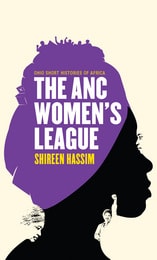
cover of The ANC Women’s League: Sex, Gender and Politics

The ANC Women’s League

Sex, Gender and Politics

Shireen Hassim

Ohio University Press, 2015

First formed in the early twentieth century, the ANC Women’s League has grown into a leading organization in the women’s movement in South Africa. The league has been at the forefront of the nation’s century-long transition from an authoritarian state to a democracy that espouses gender equality as a core constitutional value. It has, indeed, always regarded itself as the women’s movement, frequently asserting its primacy as a vanguard organization and as the only legitimate voice of the women of South Africa. But, as this deeply insightful book shows, the history of the league is a more complicated affair—it was neither the only women’s organization in the political field nor an easy ally for South African feminism.
[more]
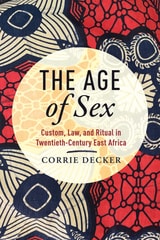
cover of The Age of Sex: Custom, Law, and Ritual in Twentieth-Century East Africa

The Age of Sex

Custom, Law, and Ritual in Twentieth-Century East Africa

Corrie Decker

University of Wisconsin Press, 2025

As in much of the world, societies in precolonial East Africa—what is now Kenya, Tanzania, and Uganda—used rites of passage to chart an individual’s social and developmental progress toward adulthood. Under European colonialism, from the 1890s to the 1960s, colonial judicial systems and the emerging genre of ethnography converged to subject African people to standardized definitions of childhood and adulthood. The coexistence of rites of passage and chronological age regulations generated confusion well into the postcolonial era, and the question of when childhood ends sparked extensive debates about gender, race, and development. Corrie Decker argues that ultimately these debates came down to “the age of sex.”

In The Age of Sex, Decker demonstrates how maturation became defined as the hypothetical moment when a girl becomes a woman capable of engaging in heterosexual activity and a boy becomes a man imbued with the right and responsibility to have heterosexual intercourse. Colonial ethnographic studies reduced complex precolonial rites of passage to “puberty rites” fixated on these sexual transformations. The resulting stereotypes influenced, in turn, how colonial and postcolonial court officials decided age-of-consent and other sex crime cases. Court rituals thus legally transformed girls into women by ruling on their sexual maturity and boys into men by sentencing them to corporal punishment, marking their acceptance of heterosexual responsibilities.

[more]
cover of The Bedtrick: Tales of Sex and Masquerade

The Bedtrick

Tales of Sex and Masquerade

Wendy Doniger

University of Chicago Press, 2000

"Somehow I woke up one day and found myself in bed with a stranger." Meant literally or figuratively, this statement describes one of the best-known plots in world mythology and popular storytelling. In a tour that runs from Shakespeare to Hollywood and from Abraham Lincoln to Casanova, the erudite and irrepressible Wendy Doniger shows us the variety, danger, and allure of the "bedtrick," or what it means to wake up with a stranger.

The Bedtrick brings together hundreds of stories from all over the world, from the earliest recorded Hindu and Hebrew texts to the latest item in the Weekly World News, to show the hilariously convoluted sexual scrapes that people manage to get themselves into and out of. Here you will find wives who accidentally commit adultery with their own husbands. You will read Lincoln's truly terrible poem about a bedtrick. You will learn that in Hong Kong the film The Crying Game was retitled Oh No! My Girlfriend Has a Penis. And that President Clinton was not the first man to be identified by an idiosyncratic organ.

At the bottom of these wonderful stories, ancient myths, and historical anecdotes lie the dynamics of sex and gender, power and identity. Why can't people tell the difference in the dark? Can love always tell the difference between one lover and another? And what kind of truth does sex tell? Funny, sexy, and engaging, The Bedtrick is a masterful work of energetic storytelling and dazzling scholarship. Give it to your spouse and your lover.
[more]
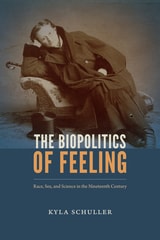
cover of The Biopolitics of Feeling: Race, Sex, and Science in the Nineteenth Century

The Biopolitics of Feeling

Race, Sex, and Science in the Nineteenth Century

Kyla Schuller

Duke University Press, 2018

In The Biopolitics of Feeling Kyla Schuller unearths the forgotten, multiethnic sciences of impressibility—the capacity to be transformed by one's environment and experiences—to uncover how biopower developed in the United States. Schuller challenges prevalent interpretations of biopower and literary cultures to reveal how biopower emerged within the discourses and practices of sentimentalism. Through analyses of evolutionary theories, gynecological sciences, abolitionist poetry and other literary texts, feminist tracts, child welfare reforms, and black uplift movements, Schuller excavates a vast apparatus that regulated the capacity of sensory and emotional feeling in an attempt to shape the evolution of the national population. Her historical and theoretical work exposes the overlooked role of sex difference in population management and the optimization of life, illuminating how models of binary sex function as one of the key mechanisms of racializing power. Schuller thereby overturns long-accepted frameworks of the nature of race and sex difference, offers key corrective insights to modern debates surrounding the equation of racism with determinism and the liberatory potential of ideas about the plasticity of the body, and reframes contemporary notions of sentiment, affect, sexuality, evolution, and heredity.
[more]
cover of The Chinese Diaspora on American Screens: Race, Sex, and Cinema

The Chinese Diaspora on American Screens

Race, Sex, and Cinema

Gina Marchetti

Temple University Press, 2012

The Chinese Diaspora on American Screens looks at the way in which issues of race and sexuality have become central concerns in cinema generated by and about Chinese communities in America after the mid-1990s. This companion volume to Marchetti's From Tian'anmen to Times Square looks specifically at the Chinese diaspora in relation to ethnic, racial, gender, and sexual identity as depicted in the cinema.

Examining films from the United States and Canada, as well as transnational co-productions, The Chinese Diaspora on American Screens includes analyses of films such as The Wedding Banquet and Double Happiness in addition to interviews with celebrated filmmakers such as Wayne Wang.

Marchetti also reflects on how Chinese identity is presented in a multitude of media forms, including commercial cinema, documentaries, experimental films, and hybrid digital media to offer a textured look at representations of the Chinese diasporic experience after Tian'anmen.
[more]
cover of The Color of Sex: Whiteness, Heterosexuality, and the Fictions of White Supremacy

The Color of Sex

Whiteness, Heterosexuality, and the Fictions of White Supremacy

Mason Stokes

Duke University Press, 2001

In The Color of Sex Mason Stokes offers new ways of thinking about whiteness by exploring its surprisingly ambivalent partnership with heterosexuality. Stokes examines a wide range of white-supremacist American texts written and produced between 1852 and 1915—literary romances, dime novels, religious and scientific tracts, film—and exposes whiteness as a tangled network of racial and sexual desire. Stokes locates these white-supremacist texts amid the anti-racist efforts of African American writers and activists, deepening our understanding of both American and African American literary and cultural history.
The Color of Sex reveals what happens when race and sexuality meet, when white desire encounters its own ambivalence. As Stokes argues, whiteness and heterosexuality exist in anxious relation to one another. Mutually invested in “the normal,” they support each other in their desperate insistence on the cultural logic of exclusion. At the same time, however, they threaten one another in their attempt to create and sustain a white future, since reproducing whiteness necessarily involves the risk of contamination
Charting the curious movements of this “white heterosexuality,” The Color of Sex inaugurates a new moment in our ongoing attempt to understand the frenzied interplay of race and sexuality in America. As such, it will appeal to scholars interested in race theory, sexuality studies, and American history, culture, and literature.
[more]
cover of The Cultural Turn in Late Ancient Studies: Gender, Asceticism, and Historiography

The Cultural Turn in Late Ancient Studies

Gender, Asceticism, and Historiography

Dale B. Martin and Patricia Cox Miller, eds.

Duke University Press, 2005

The essays in this provocative collection exemplify the innovations that have characterized the relatively new field of late ancient studies. Focused on civilizations clustered mainly around the Mediterranean and covering the period between roughly 100 and 700 CE, scholars in this field have brought history and cultural studies to bear on theology and religious studies. They have adopted the methods of the social sciences and humanities—particularly those of sociology, cultural anthropology, and literary criticism. By emphasizing cultural and social history and considerations of gender and sexuality, scholars of late antiquity have revealed the late ancient world as far more varied than had previously been imagined.

The contributors investigate three key concerns of late ancient studies: gender, asceticism, and historiography. They consider Macrina’s scar, Mary’s voice, and the harlot’s body as well as Augustine, Jovinian, Gregory of Nazianzus, Julian, and Ephrem the Syrian. Whether examining how animal bodies figured as a means for understanding human passion and sexuality in the monastic communities of Egypt and Palestine or meditating on the almost modern epistemological crisis faced by Theodoret in attempting to overcome the barriers between the self and the wider world, these essays highlight emerging theoretical and critical developments in the field.

Contributors. Daniel Boyarin, David Brakke, Virginia Burrus, Averil Cameron, Susanna Elm, James E. Goehring, Susan Ashbrook Harvey, David G. Hunter, Blake Leyerle, Dale B. Martin, Patricia Cox Miller, Philip Rousseau, Teresa M. Shaw, Maureen A. Tilley, Dennis E. Trout, Mark Vessey

[more]
cover of The Culture of Sensibility: Sex and Society in Eighteenth-Century Britain

The Culture of Sensibility

Sex and Society in Eighteenth-Century Britain

G. J. Barker-Benfield

University of Chicago Press, 1992
G. J. Barker-Benfield documents the emergence of the culture of sensibility that transformed British society of the eighteenth century. His account focuses on the rise of new moral and spiritual values and the struggle to redefine the group identities of men and women. Drawing on the full spectrum of eighteenth-century thought from Adam Smith to John Locke, from the Earl of Shaftesberry to Dr. George Cheyne, and especially Mary Wollstonecraft, Barker-Benfield offers an innovative and compelling way to understand how Britain entered the modern age.
[more]
cover of The Deconstruction of Sex

The Deconstruction of Sex

Jean-Luc Nancy and Irving Goh

Duke University Press, 2021

In The Deconstruction of Sex, Jean-Luc Nancy and Irving Goh discuss how a deconstructive approach to sex helps us negotiate discourses about sex and foster a better understanding of how sex complicates our everyday existence in the age of #MeToo. Throughout their conversation, Nancy and Goh engage with topics ranging from relation, penetration, and subjection to touch, erotics, and jouissance. They show how despite its entrenchment in social norms and centrality to our being-in-the-world, sex lacks a clearly defined essence. At the same time, they point to the potentiality of literature to inscribe the senses of sex. In so doing, Nancy and Goh prompt us to reconsider our relations with ourselves and others through sex in more sensitive, respectful, and humble ways without bracketing the troubling aspects of sex.
[more]
cover of The Empty Cradle of Democracy: Sex, Abortion, and Nationalism in Modern Greece

The Empty Cradle of Democracy

Sex, Abortion, and Nationalism in Modern Greece

Alexandra Halkias

Duke University Press, 2004

During the 1990s, Greece had a very high rate of abortion at the same time that its low birth rate was considered a national crisis. The Empty Cradle of Democracy explores this paradox. Alexandra Halkias shows that despite Greek Orthodox beliefs that abortion is murder, many Greek women view it as “natural” and consider birth control methods invasive. The formal public-sphere view is that women destroy the body of the nation by aborting future citizens. Scrutiny of these conflicting cultural beliefs enables Halkias’s incisive critique of the cornerstones of modern liberal democracy, including the autonomous “individual” subject and a polity external to the private sphere. The Empty Cradle of Democracy examines the complex relationship between nationalism and gender and re-theorizes late modernity and violence by exploring Greek representations of human agency, the fetus, national identity, eroticism, and the divine.

Halkias’s analysis combines telling fragments of contemporary Athenian culture, Greek history, media coverage of abortion and the declining birth rate, and fieldwork in Athens at an obstetrics/gynecology clinic and a family-planning center. Halkias conducted in-depth interviews with one hundred and twenty women who had had two or more abortions and observed more than four hundred gynecological exams at a state family-planning center. She reveals how intimate decisions and the public preoccupation with the low birth rate connect to nationalist ideas of race, religion, freedom, resistance, and the fraught encounter between modernity and tradition. The Empty Cradle of Democracy is a startling examination of how assumptions underlying liberal democracy are betrayed while the nation permeates the body and understandings of gender and sexuality complicate the nation-building projects of late modernity.

[more]
cover of The Fear of Child Sexuality: Young People, Sex, and Agency

The Fear of Child Sexuality

Young People, Sex, and Agency

Steven Angelides

University of Chicago Press, 2019

Continued public outcries over such issues as young models in sexually suggestive ads and intimate relationships between teachers and students speak to one of the most controversial fears of our time: the entanglement of children and sexuality. In this book, Steven Angelides confronts that fear, exploring how emotional vocabularies of anxiety, shame, and even contempt not only dominate discussions of youth sexuality but also allow adults to avoid acknowledging the sexual agency of young people. Introducing case studies and trends from Australia, the United Kingdom, and North America, he challenges assumptions on a variety of topics, including sex education, age-of-consent laws, and sexting. Angelides contends that an unwillingness to recognize children’s sexual agency results not in the protection of young people but in their marginalization.
[more]
cover of The Government of Desire: A Genealogy of the Liberal Subject

The Government of Desire

A Genealogy of the Liberal Subject

Miguel de Beistegui

University of Chicago Press, 2018

Liberalism, Miguel de Beistegui argues in The Government of Desire, is best described as a technique of government directed towards the self, with desire as its central mechanism.  Whether as economic interest, sexual drive, or the basic longing for recognition, desire is accepted as a core component of our modern self-identities, and something we ought to cultivate. But this has not been true in all times and all places. For centuries, as far back as late antiquity and early Christianity, philosophers believed that desire was an impulse that needed to be suppressed in order for the good life, whether personal or collective, ethical or political, to flourish.  Though we now take it for granted, desire as a constitutive dimension of human nature and a positive force required a radical transformation, which coincided with the emergence of liberalism.
 
By critically exploring Foucault’s claim that Western civilization is a civilization of desire, de Beistegui crafts a provocative and original genealogy of this shift in thinking. He shows how the relationship between identity, desire, and government has been harnessed and transformed in the modern world, shaping our relations with others and ourselves, and establishing desire as an essential driving force for the constitution of a new and better social order. But is it? The Government of Desire argues that this is precisely what a contemporary politics of resistance must seek to overcome. By questioning the supposed universality of a politics based on recognition and the economic satisfaction of desire, de Beistegui raises the crucial question of how we can manage to be less governed today, and explores contemporary forms of counter-conduct.

​Drawing on a host of thinkers from philosophy, political theory, and psychoanalysis, and concluding with a call for a sovereign and anarchic form of desire, The Government of Desire is a groundbreaking account of our freedom and unfreedom, of what makes us both governed and ungovernable.
[more]
cover of The Invention of Heterosexuality

The Invention of Heterosexuality

Jonathan Ned Katz

University of Chicago Press, 2007

“Heterosexuality,” assumed to denote a universal sexual and cultural norm, has been largely exempt from critical scrutiny. In this boldly original work, Jonathan Ned Katz challenges the common notion that the distinction between heterosexuality and homosexuality has been a timeless one.  Building on the history of medical terminology, he reveals that as late as 1923, the term “heterosexuality” referred to a "morbid sexual passion," and that its current usage emerged to legitimate men and women having sex for pleasure. Drawing on the works of Sigmund Freud, James Baldwin, Betty Friedan, and Michel Foucault, The Invention of Heterosexuality considers the effects of heterosexuality’s recently forged primacy on both scientific literature and popular culture.

 “Lively and provocative.”—Carol Tavris, New York Times Book Review

 “A valuable primer . . . misses no significant twists in sexual politics.”—Gary Indiana, Village Voice Literary Supplement

 “One of the most important—if not outright subversive—works to emerge from gay and lesbian studies in years.”—Mark Thompson, The Advocate

[more]
cover of The Language of Sex: Five Voices from Northern France around 1200

The Language of Sex

Five Voices from Northern France around 1200

John W. Baldwin

University of Chicago Press, 1994

This study brings together widely divergent discourses to fashion a comprehensive picture of sexual language and attitudes at a particular time and place in the medieval world.

John Baldwin introduces five representative voices from the turn of the twelfth century in northern France: Pierre the Chanter speaks for the theological doctrine of Augustine; the Prose Salernitan Questions, for the medical theories of Galen; Andre the Chaplain, for the Ovidian literature of the schools; Jean Renart, for the contemporary romances; and Jean Bodel, for the emerging voices of the fabliaux. Baldwin juxtaposes their views on a range of essential subjects, including social position, the sexual body, desire and act, and procreation. The result is a fascinating dialogue of how they agreed or disagreed with, ignored, imitated, or responded to each other at a critical moment in the development of European ideas about sexual desire, fulfillment, morality, and gender.

These spokesmen allow us into the discussion of sexuality inside the church and schools of the clergy, in high and popular culture of the leity. This heterogeneous discussion also offers a startling glimpse into the construction of gender specific to this moment, when men and women enjoyed equal status in sexual matters, if nowhere else.

Taken together, these voices extend their reach, encompass their subject, and point to a center where social reality lies. By articulating reality at its varied depths, this study takes its place alongside groundbreaking works by James Brundage, John Boswell, and Leah Otis in extending our understanding of sexuality and sexual behavior in the Middle Ages.

"Superb work. . . . These five kinds of discourse are not often treated together in scholarly writing, let alone compared and contrasted so well."—Edward Collins Vacek, Theological Studies

"[Baldwin] has made the five voices speak to us in a language that is at one and the same time familiar and alien in its resonance and accents. This is a truly exceptional book, interdisciplinary in the real sense of the word, which is surely destined to become a landmark in medieval studies."—Keith Busby, Bryn Mawr Reviews

"[Baldwin's] attempt to 'listen' to these distant voices and translate their language of sex into our own raises challenging methodological questions that will be of great interest to historians and literary scholars alike."—John P. Dalton, Comitatus

[more]
cover of The Law of Love: From Autonomy to Communion

The Law of Love

From Autonomy to Communion

Stephen F. Brett, SSJ

University of Scranton Press, 2010

With an interdisciplinary combination of philosophy, theology, and family law, The Law of Love explores the impact of secular conceptions of autonomy on sexuality and family. Drawing from the thought of Aristotle, Cicero, Augustine, Aquinas, and the modern theologian Servais Pinckaers, Stephen F. Brett argues that the divorce of freedom from virtue has caused cultural relativism, and that a potent and healthy mix of temperance, chastity, and modesty is the antidote. Styled accessibly and quite cleverly with a broader audience in mind, The Law of Love will appeal to intellectuals of all faiths who are interested in facing the ambiguities and problems of contemporary life in a secularized society.

[more]
cover of The Mirror of the Self: Sexuality, Self-Knowledge, and the Gaze in the Early Roman Empire

The Mirror of the Self

Sexuality, Self-Knowledge, and the Gaze in the Early Roman Empire

Shadi Bartsch

University of Chicago Press, 2006

People in the ancient world thought of vision as both an ethical tool and a tactile sense, akin to touch. Gazing upon someone—or oneself—was treated as a path to philosophical self-knowledge, but the question of tactility introduced an erotic element as well.  In The Mirror of the Self, Shadi Bartsch asserts that these links among vision, sexuality, and self-knowledge are key to the classical understanding of the self. 

Weaving together literary theory, philosophy, and social history, Bartsch traces this complex notion of self from Plato’s Greece to Seneca’s Rome. She starts by showing how ancient authors envisioned the mirror as both a tool for ethical self-improvement and, paradoxically, a sign of erotic self-indulgence. Her reading of the Phaedrus, for example, demonstrates that the mirroring gaze in Plato, because of its sexual possibilities, could not be adopted by Roman philosophers and their students. Bartsch goes on to examine the Roman treatment of the ethical and sexual gaze, and she traces how self-knowledge, the philosopher’s body, and the performance of virtue all played a role in shaping the Roman understanding of the nature of selfhood. Culminating in a profoundly original reading of Medea, The Mirror of the Self illustrates how Seneca, in his Stoic quest for self-knowledge, embodies the Roman view, marking a new point in human thought about self-perception.

Bartsch leads readers on a journey that unveils divided selves, moral hypocrisy, and lustful Stoics—and offers fresh insights about seminal works. At once sexy and philosophical, The Mirror of the Self will be required reading for classicists, philosophers, and anthropologists alike.

[more]
cover of The Most Secret Quintessence of Life: Sex, Glands, and Hormones, 1850-1950

The Most Secret Quintessence of Life

Sex, Glands, and Hormones, 1850-1950

Chandak Sengoopta

University of Chicago Press, 2006

Less than a century ago, physicians, scientists, and cultural commentators became fascinated by the endocrine glands and the effects of their secretions on our bodies and minds. Of all the characteristics supposed to be governed by them, the attributes of sex evoked the wildest interest. The gonads, it was revealed, secreted chemicals that not only influenced the biological expressions of sex, but seemed to generate the vitality and energy that made life worth living.
 
Through a series of case studies drawn from Central Europe, the United States, and Britain, The Most Secret Quintessence of Life explores how the notion of sex hormones enabled scientists to remap the human body, encouraging hopes that glandular interventions could cure ills, malfunctions, and even social deviance in ways inconceivable to previous generations. Many of these dreams failed, but their history, Chandak Sengoopta shows, takes us into the very heart of scientific medicine, revealing how even its most arcane concerns are shaped by cultural preoccupations and anxieties.
[more]
cover of The Motion Of Light In Water: Sex And Science Fiction Writing In The East Village

The Motion Of Light In Water

Sex And Science Fiction Writing In The East Village

Samuel R. Delany

University of Minnesota Press, 2004

Winner of the Hugo Award for Non-fiction
The unexpurgated edition of the award-winning autobiography


Born in New York City’s black ghetto Harlem at the start of World War II, Samuel R. Delany married white poet Marilyn Hacker right out of high school. The interracial couple moved into the city’s new bohemian quarter, the Lower East Side, in summer 1961. Through the decade’s opening years, new art, new sexual practices, new music, and new political awareness burgeoned among the crowded streets and cheap railroad apartments. Beautifully, vividly, insightfully, Delany calls up this era of exploration and adventure as he details his development as a black gay writer in an open marriage, with tertiary walk-ons by Bob Dylan, Stokely Carmichael, W. H. Auden, and James Baldwin, and a panoply of brilliantly drawn secondary characters.
[more]
cover of The Night is Young: Sexuality in Mexico in the Time of AIDS

The Night is Young

Sexuality in Mexico in the Time of AIDS

Héctor Carrillo

University of Chicago Press, 2002

The Night Is Young takes us past the stereotypes of macho hombres and dark-eyed señoritas to reveal the complex nature of sexuality in modern-day Mexico. Drawing on field research conducted in Guadalajara, Mexico's second-largest city, Héctor Carrillo shows how modernization, globalization, and other social changes have affected a wide range of hetero- and homosexual practices and identities.

Carrillo finds that young Mexicans today grapple in a variety of ways with two competing tendencies. On the one hand, many seek to challenge traditional ideas and values they find limiting. But they also want to maintain a sense of Mexico's cultural distinctiveness, especially in relation to the United States. For example, while Mexicans are well aware of the dangers of unprotected sex, they may also prize the surrender to sexual passion, even in casual sexual encounters—an attitude which stems from the strong values placed on collective life, spontaneity, and an openness toward intimacy. Because these expectations contrast sharply with messages about individuality, planning, and overt negotiation commonly promoted in global public health efforts, Carrillo argues that they demand a new approach to AIDS prevention education in Mexico.

A Mexican native, Carrillo has written an exceptionally insightful and accessible study of the relations among sexuality, social change, and AIDS prevention in Mexico. Anyone concerned with the changing place of sexuality in a modern and increasingly globalized world will profit greatly from The Night Is Young.

[more]
cover of The Nursing Clio Reader: Histories of Sex, Reproduction, and Justice

The Nursing Clio Reader

Histories of Sex, Reproduction, and Justice

Jacqueline D. The Nursing Clio Editorial Collective

Rutgers University Press, 2025

On June 24, 2022, the Supreme Court’s Dobbs v. Jackson Women’s Health Organization decision overturned Roe v. Wade, stripping federal protection for abortion rights and placing control in the hands of individual states. This monumental shift in policy underscores the need for deeper historical perspectives on reproductive rights.
 
The Nursing Clio Reader answers that call, bringing together essays that examine reproductive health through historical research and personal experience. Featuring both new and classic pieces from the Nursing Clio blog, leading historians of reproductive health provide insights that connect past struggles with today’s ongoing battles over bodies, reproductive rights, and health care. This collection offers intimate, urgent scholarship that speaks to the present moment.
 
A powerful resource for classrooms and individual readers alike, The Nursing Clio Reader invites reflection on how the past informs current debates, urging us to engage deeply with the history of reproductive justice in a time of unprecedented change, underscoring that indeed "the personal is historical." 

 
[more]
cover of The Passion Book: A Tibetan Guide to Love and Sex

The Passion Book

A Tibetan Guide to Love and Sex

Gendun Chopel

University of Chicago Press, 2018

The PassionBook is the most famous work of erotica in the vast literature of Tibetan Buddhism, written by the legendary scholar and poet Gendun Chopel (1903-1951). Soon after arriving in India in 1934, he discovered the Kama Sutra. Realizing that this genre of the erotic was unknown in Tibet, he set out to correct the situation. His sources were two: classical Sanskrit works and his own experiences with his lovers. Completed in 1939, his “treatise on passion” circulated in manuscript form in Tibet, scandalizing and arousing its readers.
 
Gendun Chopel here condemns the hypocrisy of both society and church, portraying sexual pleasure as a force of nature and a human right for all. On page after page, we find the exuberance of someone discovering the joys of sex, made all the more intense because they had been forbidden to him for so long: he had taken the monastic vow of celibacy in his youth and had only recently renounced it. He describes in ecstatic and graphic detail the wonders he discovered. In these poems, written in beautiful Tibetan verse, we hear a voice with tints of irony, self-deprecating wit, and a love of women not merely as sources of male pleasure but as full partners in the play of passion.

[more]
cover of The Place of the Hidden Moon: Erotic Mysticism in the Vaisnava-Sahajiya Cult of Bengal

The Place of the Hidden Moon

Erotic Mysticism in the Vaisnava-Sahajiya Cult of Bengal

Edward C. Dimock Jr.

University of Chicago Press, 1989

The Vaisnava-sahajiya cult that arose in Bengal in the sixteenth century was an intensely emotional attempt to reconcile the sensual and the ascetic. Exploring the history and doctrine of this cult, Edward C. Dimock, Jr., examines the works of numerous poets who are the source of knowledge about this sect. Dimock examines the life of the saint Caitanya, the mad Baul singers, the doctrines of Tantrism, the origins of the figure of Radha, and the worship of Krishna. His study will appeal to students of the history of religion as well as of Indian culture. This edition includes a new Foreword by Wendy Doniger.

"This is a magnificent book—painstakingly researched and gracefully written. . . . Professor Dimock's book is one of the most rewarding and stimulating studies to appear in recent years."—G. Richard Weldon, Journal of Asian Studies

[more]
cover of The Queen of America Goes to Washington City: Essays on Sex and Citizenship

The Queen of America Goes to Washington City

Essays on Sex and Citizenship

Lauren Berlant

Duke University Press, 1997

In The Queen of America Goes to Washington City, Lauren Berlant focuses on the need to revitalize public life and political agency in the United States. Delivering a devastating critique of contemporary discourses of American citizenship, she addresses the triumph of the idea of private life over that of public life borne in the right-wing agenda of the Reagan revolution. By beaming light onto the idealized images and narratives about sex and citizenship that now dominate the U.S. public sphere, Berlant argues that the political public sphere has become an intimate public sphere. She asks why the contemporary ideal of citizenship is measured by personal and private acts and values rather than civic acts, and the ideal citizen has become one who, paradoxically, cannot yet act as a citizen—epitomized by the American child and the American fetus.
As Berlant traces the guiding images of U.S. citizenship through the process of privatization, she discusses the ideas of intimacy that have come to define national culture. From the fantasy of the American dream to the lessons of Forrest Gump, Lisa Simpson to Queer Nation, the reactionary culture of imperilled privilege to the testimony of Anita Hill, Berlant charts the landscape of American politics and culture. She examines the consequences of a shrinking and privatized concept of citizenship on increasing class, racial, sexual, and gender animosity and explores the contradictions of a conservative politics that maintains the sacredness of privacy, the virtue of the free market, and the immorality of state overregulation—except when it comes to issues of intimacy.
Drawing on literature, the law, and popular media, The Queen of America Goes to Washington City is a stunning and major statement about the nation and its citizens in an age of mass mediation. As it opens a critical space for new theory of agency, its narratives and gallery of images will challenge readers to rethink what it means to be American and to seek salvation in its promise.

[more]
cover of The Reinvention of Obscenity: Sex, Lies, and Tabloids in Early Modern France

The Reinvention of Obscenity

Sex, Lies, and Tabloids in Early Modern France

Joan DeJean

University of Chicago Press, 2002

The concept of obscenity is an ancient one. But as Joan DeJean suggests, its modern form, the same version that today's politicians decry and savvy artists exploit, was invented in seventeenth-century France.

The Reinvention of Obscenity casts a fresh light on the mythical link between sexual impropriety and things French. Exploring the complicity between censorship, print culture, and obscenity, DeJean argues that mass market printing and the first modern censorial machinery came into being at the very moment that obscenity was being reinvented—that is, transformed from a minor literary phenomenon into a threat to society. DeJean's principal case in this study is the career of Moliére, who cannily exploited the new link between indecency and female genitalia to found his career as a print author; the enormous scandal which followed his play L'école des femmes made him the first modern writer to have his sex life dissected in the press.

Keenly alert to parallels with the currency of obscenity in contemporary America, The Reinvention of Obscenity will concern not only scholars of French history, but anyone interested in the intertwined histories of sex, publishing, and censorship.
[more]
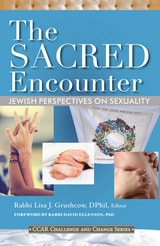
cover of The Sacred Encounter: Jewish Perspectives on Sexuality

The Sacred Encounter

Jewish Perspectives on Sexuality

Rabbi Lisa Grushcow, Dphil

Central Conference of American Rabbis, 2014

This wide-ranging anthology takes a close look at the breadth of human sexuality from a Jewish perspective. The essays begin with a look at biblical and rabbinic views on sexuality and then proceed to explorations of sexuality at different moments in the life cycle, sexuality and the marital model, diverse expressions of sexuality, examples of sexuality education, the nexus of sexuality and theology, and the challenges of contemporary sexual ethics. The Sacred Encounter is a thought-provoking and important Jewish resource. Perfect for personal study or for high school or adult classes.

[more]
cover of The Security Archipelago: Human-Security States, Sexuality Politics, and the End of Neoliberalism

The Security Archipelago

Human-Security States, Sexuality Politics, and the End of Neoliberalism

Paul Amar

Duke University Press, 2013

In The Security Archipelago, Paul Amar provides an alternative historical and theoretical framing of the refashioning of free-market states and the rise of humanitarian security regimes in the Global South by examining the pivotal, trendsetting cases of Brazil and Egypt. Addressing gaps in the study of neoliberalism and biopolitics, Amar describes how coercive security operations and cultural rescue campaigns confronting waves of resistance have appropriated progressive, antimarket discourses around morality, sexuality, and labor. The products of these struggles—including powerful new police practices, religious politics, sexuality identifications, and gender normativities—have traveled across an archipelago, a metaphorical island chain of what the global security industry calls "hot spots." Homing in on Cairo and Rio de Janeiro, Amar reveals the innovative resistances and unexpected alliances that have coalesced in new polities emerging from the Arab Spring and South America's Pink Tide. These have generated a shared modern governance model that he terms the "human-security state."
[more]
cover of The Sex Thieves: The Anthropology of a Rumor

The Sex Thieves

The Anthropology of a Rumor

Julien Bonhomme

HAU, 2016

While working in Africa, anthropologist Julien Bonhomme encountered an astonishing phenomenon: people being accused of stealing or shrinking the genitals of strangers on the simple occasion of a handshake on the street. As he soon discovered, these accusations can have dramatic outcomes: the “sex thieves” are often targeted by large crowds and publicly lynched. Moreover, such rumors are an extremely widespread practice, having affected almost half of the African continent since the 1970s. In this book, Bonhomme examines the story of the “penis snatcher,” asking larger questions about how to account for such a phenomenon—unique in its spatial and temporal scale—without falling prey to the cliché of Africa as an exotic other.

Bonhomme argues that the public belief in sex thieves cannot be considered a superstition or form of mass hysteria. Rather, he brings to light multiple factors that explain the rumor’s success and shows how the cultural dynamic can operate on a vast scale. Analyzing the rumor on both transnational and local levels, he demonstrates how it arises from the ambiguities and dangers of anonymity, and thus that it reveals an occult flipside to everyday social interaction. Altogether, this book provides both richly ethnographic and theoretical understandings of urban sociality and the dynamics of human communication in contemporary Africa and beyond.
 
[more]
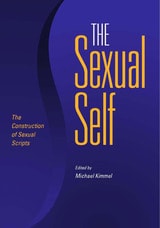
cover of The Sexual Self: The Construction of Sexual Scripts

The Sexual Self

The Construction of Sexual Scripts

Michael Kimmel

Vanderbilt University Press, 2007

In the late 1960s two sociologists, John Gagnon and William Simon, developed the concept of sexual scripts as part of a larger project of treating sexuality like any other social phenomenon. In the end, their vision of social construction turned Kinsey on his head, and their model became the dominant paradigm of social science inquiry into human sexuality, and spurred the development of an entire field of Sexuality Studies. Sexual activity, they argued, was like other social processes, yet one of increasing importance in the construction of the self. Michael Kimmel has gathered together essays from three generations of scholars influenced by this perspective on sexuality. These include many of the foremost social scientists writing and researching sexuality today. The book begins with Kimmel's reflections on the unusual careers of Gagnon and Simon, examines the construction of both sexual identity and sexual behaviors in a variety of settings, and ends with the two of them speaking in their own provocative voices about their perspective in interviews conducted originally for a German journal in 1998.
[more]
cover of The Trouble with Men: Reflections on Sex, Love, Marriage, Porn, and Power

The Trouble with Men

Reflections on Sex, Love, Marriage, Porn, and Power

David Shields

The Ohio State University Press, 2019

David Shields’s The Trouble with Men: Reflections on Sex, Love, Marriage, Porn, and Power is an immersion into the perils, limits, and possibilities of human intimacy. All at once a love letter to his wife, a nervy reckoning with his own fallibility, a meditation on the impact of porn on American culture, and an attempt to understand marriage (one marriage, the idea of marriage, all marriages), The Trouble with Men is exquisitely balanced between the personal and the anthropological, nakedness and restraint. While unashamedly intellectual, it’s also irresistibly readable and extremely moving. Over five increasingly intimate chapters, Shields probes the contours of his own psyche and marriage, marshalling a chorus of other voices that leaven, deepen, and universalize his experience; his goal is nothing less than a deconstruction of eros and conventional masculinity. Masterfully woven throughout is an unmistakable and surprisingly tender cri de coeur to his wife. The risk and vulnerability on display are in the service of radical candor, acerbic wit, real emotion, and profound insight—exactly what we’ve come to expect from Shields, who, in an open invitation to the reader, leaves everything on the page.
[more]
cover of The Wages of Sin: Sex and Disease, Past and Present

The Wages of Sin

Sex and Disease, Past and Present

Peter Lewis Allen

University of Chicago Press, 2000

Near the end of the century, a new and terrifying disease arrives suddenly from a distant continent. Infecting people through sex, it storms from country to country, defying all drugs and medical knowledge. The deadly disease provokes widespread fear and recrimination; medical authorities call the epidemic "the just rewards of unbridled lust"; a religious leader warns that "God has raised up new diseases against debauchery." The time was the 1490s; the place, Europe; the disease, syphilis; and the religious leader was none other than John Calvin.

Throughout history, Western society has often viewed sickness as a punishment for sin. It has failed to prevent and cure diseases—especially diseases tied to sex—that were seen as the retribution of a wrathful God. The Wages of Sin, the remarkable history of these diseases, shows how society's views of particular afflictions often heightened the suffering of the sick and substituted condemnation for care. Peter Allen moves from the medieval diseases of lovesickness and leprosy through syphilis and bubonic plague, described by one writer as "a broom in the hands of the Almighty, with which He sweepeth the most nasty and uncomely corners of the universe." More recently, medical and social responses to masturbation in the eighteenth and nineteenth centuries and AIDS in the twentieth round out Allen's timely and erudite study of the intersection of private morality and public health. The Wages of Sin tells the fascinating story of how ancient views on sex and sin have shaped, and continue to shape, religious life, medical practice, and private habits.

[more]
cover of The War on Sex

The War on Sex

David M. Halperin and Trevor Hoppe, editors

Duke University Press, 2017

The past fifty years are conventionally understood to have witnessed an uninterrupted expansion of sexual rights and liberties in the United States. This state-of-the-art collection tells a different story: while progress has been made in marriage equality, reproductive rights, access to birth control, and other areas, government and civil society are waging a war on stigmatized sex by means of law, surveillance, and social control. The contributors document the history and operation of sex offender registries and the criminalization of HIV, as well as highly punitive measures against sex work that do more to harm women than to combat human trafficking. They reveal that sex crimes are punished more harshly than other crimes, while new legal and administrative regulations drastically restrict who is permitted to have sex. By examining how the ever-intensifying war on sex affects both privileged and marginalized communities, the essays collected here show why sexual liberation is indispensable to social justice and human rights.
 
Contributors. Alexis Agathocleous, Elizabeth Bernstein, J. Wallace Borchert, Mary Anne Case, Owen Daniel-McCarter, Scott De Orio, David M. Halperin, Amber Hollibaugh, Trevor Hoppe, Hans Tao-Ming Huang, Regina Kunzel, Roger N. Lancaster, Judith Levine, Laura Mansnerus, Erica R. Meiners, R. Noll, Melissa Petro, Carol Queen, Penelope Saunders, Sean Strub, Maurice Tomlinson, Gregory Tomso
[more]
cover of The Whitman Revolution: Sex, Poetry, and Politics

The Whitman Revolution

Sex, Poetry, and Politics

Betsy Erkkila

University of Iowa Press, 2020

The Whitman Revolution brings together a rich collection of Betsy Erkkila’s phenomenally influential essays that have been published over the years, along with two powerful new essays. Erkkila offers a moving account of the inseparable mix of the spiritual-sexual-political in Whitman and the absolute centrality of male-male connection to his work and thinking. Her work has been at the forefront of scholarship positing that Whitman’s songs are songs not only of workers and occupations but of sex and the body, homoeroticism, and liberation. What is more, Erkkila’s writing demonstrates that this sexuality and communal impulse is central to Whitman’s revolutionary poetry and his conception of democracy itself—an insight that was all but suppressed during the mid-twentieth century emergence of American literature as a field of study.

Highlights of this collection include Erkkila’s essays on pairings such as Marx and Whitman, Dickinson and Whitman, and Melville and Whitman. Across the volume, she demonstrates an international vision that highlights the place of Leaves of Grass within a global struggle for democracy. The Whitman Revolution is evidence of Erkkila’s remarkable ability to lead critical discussions, and marks an exciting event in Whitman studies.

[more]
cover of Tortilleras Negotiating Intimacy: Love, Friendship, and Sex in Queer Mexico City

Tortilleras Negotiating Intimacy

Love, Friendship, and Sex in Queer Mexico City

Anahi Russo Garrido

Rutgers University Press, 2020

Tortilleras Negotiating Intimacy: Love, Friendship, and Sex in Queer Mexico City is the first ethnography in English to focus primarily on women’s sexual and intimate cultures in Mexico. The book shows the transformation of intimacy in the lives of three generations of women in queer spaces in contemporary Mexico City, as their sexual citizenship changes, including references to same-sex marriage and anti-discrimination laws. The book shows how these individuals reconfigure relationships through marriage, polyamory, friendship, and sex. Tortilleras Negotiating Intimacy suggests that “new” intimate cartographies are emerging in Mexico City, ultimately redefining relationships, gender, and mexicanidad. Building on ethnographic data collected over the past decade, including forty-five in-depth interviews with women between the ages of twenty-two and sixty-five participating in LGBT spaces, Tortilleras Negotiating Intimacy shows how lesbian women (mainly cis, but some trans) negotiate friendship, same-sex marriage, polyamory, and sexual practices, reinventing love, eroticism, friendship, and ultimately the social organization of Latin American societies.
[more]
cover of Touching Encounters: Sex, Work, and Male-for-Male Internet Escorting

Touching Encounters

Sex, Work, and Male-for-Male Internet Escorting

Kevin Walby

University of Chicago Press, 2012

Often depicted as deviant or pathological by public health researchers, psychoanalysts, and sexologists, male-with-male sex and sex work is, in fact, an increasingly mainstream pursuit. Based on a qualitative investigation of the practices involved in male-with-male—or m4m—Internet escorting, Touching Encounters is the first book to explicitly address how masculinity and sexuality shape male commercial sex in this era of Internet communications.
 
By looking closely at the sex and work of male escorts, Kevin Walby tries to reconcile the two extremes of m4m sex—the stereotypical idea of a quick cash transaction and the tendency toward friendship and mutuality. In doing so, Walby draws on the work of Foucault to make visible the play of power in these physical and commercial relations between men. At once a revelation to the sociology of work and a much-needed critical engagement with queer theory, Touching Encounters responds to calls from across the social sciences to connect Foucault with sociologies of sex, sexuality, and intimacy. Walby does this and more, retying this sexual practice back to society at large.
[more]
cover of Transcending Gender Ideology: A Philosophy of Sexual Difference

Transcending Gender Ideology

A Philosophy of Sexual Difference

Antonio Malo

Catholic University of America Press, 2020

Human sexuality is a very important subject, especially in a cultural context such as ours, in which social and work transformations offer behavioral models that are characterized by a remarkable sexual indeterminacy. In Transcending Gender Ideology, Antonio Malo tries to rethink sexuality with equilibrium and intellectual rigor, using a philosophical approach, since sexuality does not only affect biological aspects or social conditioning, but above all the same essence of the relationship between man and woman. Malo’s reflections begin with the historical evolution of the concept of sexuality: the naturalistic conception, which sees the difference between man and woman as something biological and absolute, and the postmodern conception, which criticizes it by judging human sexuality as a socio-cultural construction or gender. According to Malo, the limitation of the gender approach is to deny the relationship of human sexuality to the body and to the differences between man and woman. In fact, by rejecting these aspects, they end up sustaining a limitless creativity of freedom, which transforms the body into something that is used at will, and relationships as something fluid. Faced with these extremes, Malo proposes a vision of sexuality as a personal condition or sexed condition, received at the time of birth, but which develops, grows and matures through family models, experiences and relationships. Even if based on an original sexual difference, sexed condition covers many other aspects: physical, psychological, social and cultural, as well as behavioral patterns and, above all, the personal integration of sexuality through the gift of oneself in marriage or in celibacy.
[more]
cover of Transformed in Christ

Transformed in Christ

John S. Grabowski

Catholic University of America Press, 2017
[more]
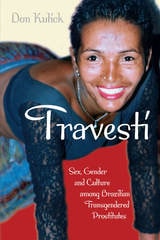
cover of Travesti: Sex, Gender, and Culture among Brazilian Transgendered Prostitutes

Travesti

Sex, Gender, and Culture among Brazilian Transgendered Prostitutes

Don Kulick

University of Chicago Press, 1998

In this dramatic and compelling narrative, anthropologist Don Kulick follows the lives of a group of transgendered prostitutes (called travestis in Portuguese) in the Brazilian city Salvador. Travestis are males who, often beginning at ages as young as ten, adopt female names, clothing styles, hairstyles, and linguistic pronouns. More dramatically, they ingest massive doses of female hormones and inject up to twenty liters of industrial silicone into their bodies to create breasts, wide hips, and large thighs and buttocks. Despite such irreversible physiological changes, virtually no travesti identifies herself as a woman. Moreover, travestis regard any male who does so as mentally disturbed.

Kulick analyzes the various ways travestis modify their bodies, explores the motivations that lead them to choose this particular gendered identity, and examines the complex relationships that they maintain with one another, their boyfriends, and their families. Kulick also looks at how travestis earn their living through prostitution and discusses the reasons prostitution, for most travestis, is a positive and affirmative experience.

Arguing that transgenderism never occurs in a "natural" or arbitrary form, Kulick shows how it is created in specific social contexts and assumes specific social forms. Furthermore, Kulick suggests that travestis—far from deviating from normative gendered expectations—may in fact distill and perfect the messages that give meaning to gender throughout Brazilian society and possibly throughout much of Latin America.

Through Kulick's engaging voice and sharp analysis, this elegantly rendered account is not only a landmark study in its discipline but also a fascinating read for anyone interested in sexuality and gender.
[more]