Results by title
59 books match the query 'Sex customs' and 7 start with t
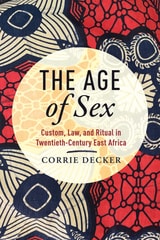
The Age of Sex
Custom, Law, and Ritual in Twentieth-Century East AfricaCorrie Decker
University of Wisconsin Press, 2025
In The Age of Sex, Decker demonstrates how maturation became defined as the hypothetical moment when a girl becomes a woman capable of engaging in heterosexual activity and a boy becomes a man imbued with the right and responsibility to have heterosexual intercourse. Colonial ethnographic studies reduced complex precolonial rites of passage to “puberty rites” fixated on these sexual transformations. The resulting stereotypes influenced, in turn, how colonial and postcolonial court officials decided age-of-consent and other sex crime cases. Court rituals thus legally transformed girls into women by ruling on their sexual maturity and boys into men by sentencing them to corporal punishment, marking their acceptance of heterosexual responsibilities.
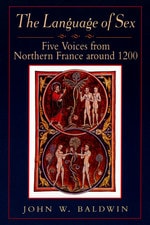
The Language of Sex
Five Voices from Northern France around 1200John W. Baldwin
University of Chicago Press, 1994
John Baldwin introduces five representative voices from the turn of the twelfth century in northern France: Pierre the Chanter speaks for the theological doctrine of Augustine; the Prose Salernitan Questions, for the medical theories of Galen; Andre the Chaplain, for the Ovidian literature of the schools; Jean Renart, for the contemporary romances; and Jean Bodel, for the emerging voices of the fabliaux. Baldwin juxtaposes their views on a range of essential subjects, including social position, the sexual body, desire and act, and procreation. The result is a fascinating dialogue of how they agreed or disagreed with, ignored, imitated, or responded to each other at a critical moment in the development of European ideas about sexual desire, fulfillment, morality, and gender.
These spokesmen allow us into the discussion of sexuality inside the church and schools of the clergy, in high and popular culture of the leity. This heterogeneous discussion also offers a startling glimpse into the construction of gender specific to this moment, when men and women enjoyed equal status in sexual matters, if nowhere else.
Taken together, these voices extend their reach, encompass their subject, and point to a center where social reality lies. By articulating reality at its varied depths, this study takes its place alongside groundbreaking works by James Brundage, John Boswell, and Leah Otis in extending our understanding of sexuality and sexual behavior in the Middle Ages.
"Superb work. . . . These five kinds of discourse are not often treated together in scholarly writing, let alone compared and contrasted so well."—Edward Collins Vacek, Theological Studies
"[Baldwin] has made the five voices speak to us in a language that is at one and the same time familiar and alien in its resonance and accents. This is a truly exceptional book, interdisciplinary in the real sense of the word, which is surely destined to become a landmark in medieval studies."—Keith Busby, Bryn Mawr Reviews
"[Baldwin's] attempt to 'listen' to these distant voices and translate their language of sex into our own raises challenging methodological questions that will be of great interest to historians and literary scholars alike."—John P. Dalton, Comitatus
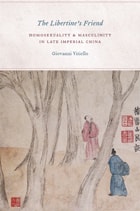
The Libertine's Friend
Homosexuality and Masculinity in Late Imperial ChinaGiovanni Vitiello
University of Chicago Press, 2011
Delving into three hundred years of Chinese literature, from the mid-sixteenth century to the mid-nineteenth, The Libertine’s Friend uncovers the complex and fascinating history of male homosexual and homosocial relations in the late imperial era. Drawing particularly on overlooked works of pornographic fiction, Giovanni Vitiello offers a frank exploration of the importance of same-sex love and eroticism to the evolution of masculinity in China.
Vitiello’s story unfolds chronologically, beginning with the earliest sources on homoeroticism in pre-imperial China and concluding with a look at developments in the twentieth century. Along the way, he identifies a number of recurring characters—for example, the libertine scholar, the chivalric hero, and the lustful monk—and sheds light on a set of key issues, including the social and legal boundaries that regulated sex between men, the rise of male prostitution, and the aesthetics of male beauty. Drawing on this trove of material, Vitiello presents a historical outline of changing notions of male homosexuality in China, revealing the integral part that same-sex desire has played in its culture.
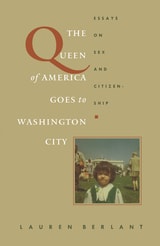
The Queen of America Goes to Washington City
Essays on Sex and CitizenshipLauren Berlant
Duke University Press, 1997
As Berlant traces the guiding images of U.S. citizenship through the process of privatization, she discusses the ideas of intimacy that have come to define national culture. From the fantasy of the American dream to the lessons of Forrest Gump, Lisa Simpson to Queer Nation, the reactionary culture of imperilled privilege to the testimony of Anita Hill, Berlant charts the landscape of American politics and culture. She examines the consequences of a shrinking and privatized concept of citizenship on increasing class, racial, sexual, and gender animosity and explores the contradictions of a conservative politics that maintains the sacredness of privacy, the virtue of the free market, and the immorality of state overregulation—except when it comes to issues of intimacy.
Drawing on literature, the law, and popular media, The Queen of America Goes to Washington City is a stunning and major statement about the nation and its citizens in an age of mass mediation. As it opens a critical space for new theory of agency, its narratives and gallery of images will challenge readers to rethink what it means to be American and to seek salvation in its promise.
The Sexual Organization of the City
Edited by Edward O. Laumann, Stephen Ellingson, Jenna Mahay, Anthony Paik, and Y
University of Chicago Press, 2004
But in The Sexual Organization of the City, Edward Laumann and company argue that this idea is a myth. Drawing on extensive surveys and interviews with Chicago adults, they show that the city is—to the contrary—a place where sexual choices and options are constrained. From Wicker Park and Boys Town to the South Side and Pilsen, they observe that sexual behavior and partnering are significantly limited by such factors as which neighborhood you live in, your ethnicity, what your sexual preference might be, or the circle of friends to which you belong. In other words, the social and institutional networks that city dwellers occupy potentially limit their sexual options by making different types of sexual activities, relationships, or meeting places less accessible.
To explain this idea of sex in the city, the editors of this work develop a theory of sexual marketplaces—the places where people look for sexual partners. They then use this theory to consider a variety of questions about sexuality: Why do sexual partnerships rarely cross racial and ethnic lines, even in neighborhoods where relatively few same-ethnicity partners are available? Why do gay men and lesbians have few public meeting spots in some neighborhoods, but a wide variety in others? Why are African Americans less likely to marry than whites? Does having a lot of friends make you less likely to get a sexually transmitted disease? And why do public health campaigns promoting safe sex seem to change the behaviors of some, but not others?
Considering vital questions such as these, and shedding new light on the city of Chicago, this work will profoundly recast our ideas about human sexual behavior.
The Sleep of Reason
Erotic Experience and Sexual Ethics in Ancient Greece and RomeEdited by Martha C. Nussbaum and Juha Sihvola
University of Chicago Press, 2002
The Sleep of Reason brings together an international group of philosophers, philologists, literary critics, and historians to consider two questions normally kept separate: how is erotic experience understood in classical texts of various kinds, and what ethical judgments and philosophical arguments are made about sex? From same-sex desire to conjugal love, and from Plato and Aristotle to the Roman Stoic Musonius Rufus, the contributors demonstrate the complexity and diversity of classical sexuality. They also show that the ethics of eros, in both Greece and Rome, shared a number of commonalities: a focus not only on self-mastery, but also on reciprocity; a concern among men not just for penetration and display of their power, but also for being gentle and kind, and for being loved for themselves; and that women and even younger men felt not only gratitude and acceptance, but also joy and sexual desire.
Contributors:
* Eva Cantarella
* Kenneth Dover
* Chris Faraone
* Simon Goldhill
* Stephen Halliwell
* David M. Halperin
* J. Samuel Houser
* Maarit Kaimio
* David Konstan
* David Leitao
* Martha C. Nussbaum
* A. W. Price
* Juha Sihvola
The Social Organization of Sexuality
Sexual Practices in the United StatesEdward O. Laumann, John H. Gagnon, Robert T. Michael, and Stuart Michaels
University of Chicago Press, 1994
"The most comprehensive U.S. sex survey ever." —USA Today
"The findings from this survey, the first in decades to provide detailed insights about the sexual behavior of a representative sample of Americans, will have a profound impact on how policy makers tackle a number of pressing health problems." —Alison Bass, The Boston Globe
"A fat, sophisticated, and sperm-freezingly serious volume. . . . This book is not in the business of giving us a good time. It is in the business of asking three thousand four hundred and thirty-two other people whether they had a good time, and exactly what they did to make it so good." —Anthony Lane, The New Yorker
New York Times Book Review Notable Book of the Year