Results by title
105 books match the query 'Social Work' and 6 start with t

Teen Mothers--Citizens or Dependents?
Ruth Horowitz
University of Chicago Press, 1994
"Rich vignettes reveal the complexities of teenage mothers' lives, particularly the disjuncture between classroom and street identities, 'inside' and 'outside.' . . . Original and illuminating as well as timely."—Sharon Thompson, Women's Review of Books
"Horowitz offers insights that should be considered in the debate over welfare reform. . . . Teen Mothers . . . places Horowitz's results in the context of major theories about the role of welfare in the U.S. and offers a microlevel critique of the implicit assumptions and probable consequences of each theory's approach to welfare reform."—Booklist

The Battered Child
Edited by Mary Edna Helfer, Ruth S. Kempe, and Richard D. Krugman
University of Chicago Press, 1999
The new edition of this classic text continues the legacy. While updating and significantly adding to previous editions, the fifth edition retains the multidisciplinary and comprehensive approach that initially set the work apart. This new edition contains chapters from professionals in such diverse fields as pediatrics, psychiatry, legal studies, and social work that reflect the past decade's extraordinary advances in research and techniques. Twenty of the book's 30 chapters are entirely new, while the remaining material has been extensively revised.
Part I provides a historical overview of child abuse and neglect as well as background material on the cultural, psychiatric, social, economic, and legal contexts of child maltreatment. Part II discusses the processes of assessing cases of physical, emotional, and sexual abuse and neglect from the unique perspectives of all the professionals involved, including teachers, pediatricians, and social workers. Part III describes intervention and treatment, focusing on legal issues, investigative procedures, and therapeutic processes, while Part IV addresses prevention and policy issues.
Previous editions of The Battered Child have earned the labels of "a classic" and a "Bible." With its up-to-date information, unequaled scope, and contributions from experts on every aspect of child abuse, the fifth edition of this cornerstone text is even more essential to the field than its predecessors.
"Comprehensive and up-to-date."—David Cottrell, British Journal of Psychiatry
"A valuable contribution to the field of abuse and neglect"—Prasanna Nair, Journal of the American Medical Association

The Future of Youth Violence Prevention
A Mixtape for Practice, Policy, and ResearchPaul Boxer
Rutgers University Press, 2025

The Radical Bookstore
Counterspace for Social MovementsKimberley Kinder
University of Minnesota Press, 2021
Examines how radical bookstores and similar spaces serve as launching pads for social movements
How does social change happen? It requires an identified problem, an impassioned and committed group, a catalyst, and a plan. In this deeply researched consideration of seventy-seven stores and establishments, Kimberley Kinder argues that activists also need autonomous space for organizing, and that these spaces are made, not found. She explores the remarkably enduring presence of radical bookstores in America and how they provide infrastructure for organizing—gathering places, retail offerings that draw new people into what she calls “counterspaces.”
Kinder focuses on brick-and-mortar venues where owners approach their businesses primarily as social movement tools. These may be bookstores, infoshops, libraries, knowledge cafes, community centers, publishing collectives, thrift stores, or art installations. They are run by activist-entrepreneurs who create centers for organizing and selling books to pay the rent. These spaces allow radical and contentious ideas to be explored and percolate through to actual social movements, and serve as crucibles for activists to challenge capitalism, imperialism, white privilege, patriarchy, and homophobia. They also exist within a central paradox: participating in the marketplace creates tensions, contradictions, and shortfalls. Activist retail does not end capitalism; collective ownership does not enable a retreat from civic requirements like zoning; and donations, no matter how generous, do not offset the enormous power of corporations and governments.
In this timely and relevant book, Kinder presents a necessary, novel, and apt analysis of the role these retail spaces play in radical organizing, one that demonstrates how such durable hubs manage to persist, often for decades, between the spikes of public protest.
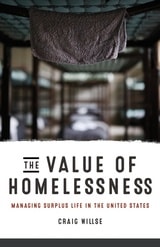
The Value of Homelessness
Managing Surplus Life in the United StatesCraig Willse
University of Minnesota Press, 2015
It is all too easy to assume that social service programs respond to homelessness, seeking to prevent and understand it. The Value of Homelessness, however, argues that homelessness today is an effect of social services and sciences, which shape not only what counts as such but what will?or ultimately won’t?be done about it.
Through a history of U.S. housing insecurity from the 1930s to the present, Craig Willse traces the emergence and consolidation of a homeless services industry. How to most efficiently allocate resources to control ongoing insecurity has become the goal, he shows, rather than how to eradicate the social, economic, and political bases of housing needs. Drawing on his own years of work in homeless advocacy and activist settings, as well as interviews conducted with program managers, counselors, and staff at homeless services organizations in New York, Los Angeles, San Francisco, and Seattle, Willse provides the first analysis of how housing insecurity becomes organized as a governable social problem.
An unprecedented and powerful historical account of the development of contemporary ideas about homelessness and how to manage homelessness, The Value of Homelessness offers new ways for students and scholars of social work, urban inequality, racial capitalism, and political theory to comprehend the central role of homelessness in governance and economy today.
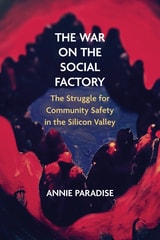
The War on the Social Factory
The Struggle for Community Safety in the Silicon ValleyAnnie Paradise
Northwestern University Press, 2024
A collective ethnography of grassroots mobilizations for community safety across the Silicon Valley
This is a narrative of struggle and solidarity and a collective toolkit for grassroots opposition to militarization, policing, and ongoing conditions of war in the current conjuncture of racial patriarchal capitalism. Grassroots researcher Annie Paradise presents here a collective ethnography of the mothers and community matriarchs whose children have been murdered by police across the San Francisco Bay Area as they develop and practice autonomous, creative forms of resistance.
The War on the Social Factory: The Struggle for Community Safety in the Silicon Valley maps local families’ struggles to reclaim their households and their communities—to create a social infrastructure of care, justice, and safety outside state- and market-determined modes of “security.” Practices such as sustained vigil, testimony, and the production and circulation of insurgent knowledges are shown here to be part of interconnected justice efforts to demilitarize and decarcerate communities in the face of the multiple forms of violence enacted under late racial patriarchal capitalism. Paradise examines the expanding carceral processes of enclosure, criminalization, dispossession, expropriation, and disposability that mark the neoliberal "security” regime across the Silicon Valley and offers counter-counterinsurgent strategies and practices of co-generative, dynamic resistance.