Results by title
139 books match the query 'Social archaeology' and 26 start with t
Ten Thousand Years of Inequality
The Archaeology of Wealth DifferencesEdited by Timothy A. Kohler and Michael E. Smith
University of Arizona Press, 2018
Ten Thousand Years of Inequality addresses these and other questions by presenting the first set of consistent quantitative measurements of ancient wealth inequality. The authors are archaeologists who have adapted the Gini index, a statistical measure of wealth distribution often used by economists to measure contemporary inequality, and applied it to house-size distributions over time and around the world. Clear descriptions of methods and assumptions serve as a model for other archaeologists and historians who want to document past patterns of wealth disparity.
The chapters cover a variety of ancient cases, including early hunter-gatherers, farmer villages, and agrarian states and empires. The final chapter synthesizes and compares the results. Among the new and notable outcomes, the authors report a systematic difference between higher levels of inequality in ancient Old World societies and lower levels in their New World counterparts.
For the first time, archaeology allows humanity’s deep past to provide an account of the early manifestations of wealth inequality around the world.
Contributors
Nicholas Ames
Alleen Betzenhauser
Amy Bogaard
Samuel Bowles
Meredith S. Chesson
Abhijit Dandekar
Timothy J. Dennehy
Robert D. Drennan
Laura J. Ellyson
Deniz Enverova
Ronald K. Faulseit
Gary M. Feinman
Mattia Fochesato
Thomas A. Foor
Vishwas D. Gogte
Timothy A. Kohler
Ian Kuijt
Chapurukha M. Kusimba
Mary-Margaret Murphy
Linda M. Nicholas
Rahul C. Oka
Matthew Pailes
Christian E. Peterson
Anna Marie Prentiss
Michael E. Smith
Elizabeth C. Stone
Amy Styring
Jade Whitlam
Tenahaha and the Wari State
A View of the Middle Horizon from the Cotahuasi ValleyEdited by Justin Jennings and Willy Yépez Álvarez
University of Alabama Press, 2015
Tenahaha and the Wari State contains a series of essays that challenge current beliefs about the Wari state and suggest a reassessment of this pivotal era in Andean history. In this collection, a picture emerges of Wari power projected across the region’s rugged and formidable topography less as a conquering empire than as a source of ideas, styles, and material culture voluntarily adopted by neighboring peoples.
Much of the previous fieldwork on Wari history took place in the Wari heartland and in Wari strongholds, not areas where Wari power and influence were equivocal. In Tenahaha and the Wari State, editors Justin Jennings and Willy Yépez Álvarez set out to test whether current theories of the Wari state as a cohesive empire were accurate or simply reflective of the bias inherent in studying Wari culture in its most concentrated centers. The essays in this collection examine instead life in the Cotahuasi Valley, an area into which Wari influence expanded during the Middle Horizon period.
Drawing on ten years of exhaustive field work both at the ceremonial site of Tenahaha and in the surrounding valley, Jennings and Yépez Álvarez posit that Cotahuasinos at Tenahaha had little contact with the Wari state. Their excavations and survey in the area tell the story of a region in flux rather than of a people conquered by Wari. In a time of uncertainty, they adopted Wari ideas and culture as ways to cope with change.
Teotihuacan and Early Classic Mesoamerica
Multiscalar Perspectives on Power, Identity, and Interregional RelationsClaudia García-Des Lauriers
University Press of Colorado, 2021
The volume offers a multiscalar view of power and identity, showing that the spread of Teotihuacan-related material culture may have resulted from direct and indirect state administration, colonization, emulation by local groups, economic transactions, single-event elite interactions, and various kinds of social and political alliances. The contributors explore questions concerning who interacted with whom; what kinds of materials and ideas were exchanged; what role interregional interactions played in the creation, transformation, and contestation of power and identity within the city and among local polities; and how interactions on different scales were articulated. The answers to these questions reveal an Early Classic Mesoamerican world engaged in complex economic exchanges, multidirectional movements of goods and ideas, and a range of material patterns that require local, regional, and macroregional contextualization.
Focusing on the intersecting themes of identity and power, Teotihuacan and Early Classic Mesoamerica makes a strong contribution to the understanding of the role of this important metropolis in the Early Classic history of the region. The volume will be of interest to scholars and graduate students of Mesoamerican archaeology, the archaeology of interaction, and the archaeology of identity.
Contributors: Sarah C. Clayton, Fiorella Fenoglio Limón, Agapi Filini, Julie Gazzola, Sergio Gómez-Chávez, Haley Holt Mehta, Carmen Pérez, Patricia Plunket, Juan Carlos Saint Charles Zetina, Yoko Sugiura, Gabriela Uruñuela, Gustavo Jaimes Vences
The Archaeology of Environmental Change
Socionatural Legacies of Degradation and ResilienceEdited by Christopher T. Fisher, J. Brett Hill, and Gary M. Feinman
University of Arizona Press, 2009
The Archaeology of Environmental Change shows that the challenges facing humanity today, in terms of causing and reacting to environmental change, can be better approached through an attempt to understand how societies in the past dealt with similar circumstances. The contributors draw on archaeological research in multiple regions—North America, Mesoamerica, Europe, the Near East, and Africa—from time periods spanning the Holocene, and from environments ranging from tropical forest to desert.
The Archaeology of Events
Cultural Change and Continuity in the Pre-Columbian SoutheastZackary I. Gilmore and Jason M. O'Donoughue
University of Alabama Press, 2015
Across the social sciences, gradualist evolutionary models of historical dynamics are giving way to explanations focused on the punctuated and contingent “events” through which history is actually experienced. The Archaeology of Events is the first book-length work that systematically applies this new eventful approach to major developments in the pre-Columbian Southeast.
Traditional accounts of pre-Columbian societies often portray them as “cold” and unchanging for centuries or millennia. Events-based analyses have opened up archaeological discourse to the more nuanced and flexible idea of context-specific, rapidly transpiring, and broadly consequential historical “events” as catalysts of cultural change.
The Archaeology of Events, edited by Zackary I. Gilmore and Jason M. O’Donoughue, considers a variety of perspectives on the nature and scale of events and their role in historical change. These perspectives are applied to a broad range of archeological contexts stretching across the Southeast and spanning more than 7,000 years of the region’s pre-Columbian history. New data suggest that several of this region’s most pivotal historical developments, such as the founding of Cahokia, the transformation of Moundville from urban center to vacated necropolis, and the construction of Poverty Point’s Mound A, were not protracted incremental processes, but rather watershed moments that significantly altered the long-term trajectories of indigenous Southeastern societies.
In addition to exceptional occurrences that impacted entire communities or peoples, southeastern archaeologists are increasingly recognizing the historical importance of localized, everyday events, such as building a house, crafting a pot, or depositing shell. The essays collected by Gilmore and O’Donoughue show that small-scale events can make significant contributions to the unfolding of broad, regional-scale historical processes and to the reproduction or transformation of social structures.
The Archaeology of Events is the first volume to explore the archaeological record of events in the Southeastern United States, the methodologies that archaeologists bring to bear on this kind of research, and considerations of the event as an important theoretical concept.
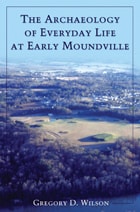
The Archaeology of Everyday Life at Early Moundville
Gregory D. Wilson
University of Alabama Press, 2007
Complex Mississippian polities were neither developed nor sustained in a vacuum. A broad range of small-scale social groups played a variety of roles in the emergence of regionally organized political hierarchies that governed large-scale ceremonial centers. Recent research has revealed the extent to which interactions among corporately organized clans led to the development, success, and collapse of Moundville. These insights into Moundville’s social complexity are based primarily on the study of monumental architecture and mortuary ceremonialism. Less is known about how everyday domestic practices produced and were produced by broader networks of power and inequality in the region.
Wilson’s research addresses this gap in our understanding by analyzing and interpreting large-scale architectural and ceramic data sets from domestic contexts. This study has revealed that the early Mississippian Moundville community consisted of numerous spatially discrete multi-household groups, similar to ethnohistorically described kin groups from the southeastern United States. Hosting feasts, dances, and other ceremonial events were important strategies by which elite groups created social debts and legitimized their positions of authority. Non-elite groups, on the other hand, maintained considerable economic and ritual autonomy through diversified production activities, risk sharing, and household ceremonialism. Organizational changes in Moundville’s residential occupation highlight the different ways kin groups defined and redefined their corporate status and identities over the long term.
The Archaeology of Institutional Life
Edited by April M. Beisaw and James G. Gibb
University of Alabama Press, 2008
Institutions pervade social life. They express community goals and values by defining the limits of socially acceptable behavior. Institutions are often vested with the resources, authority, and power to enforce the orthodoxy of their time. But institutions are also arenas in which both orthodoxies and authority can be contested. Between power and opposition lies the individual experience of the institutionalized. Whether in a boarding school, hospital, prison, almshouse, commune, or asylum, their experiences can reflect the positive impact of an institution or its greatest failings. This interplay of orthodoxy, authority, opposition, and individual experience are all expressed in the materiality of institutions and are eminently subject to archaeological investigation.
A few archaeological and historical publications, in widely scattered venues, have examined individual institutional sites. Each work focused on the development of a specific establishment within its narrowly defined historical context; e.g., a fort and its role in a particular war, a schoolhouse viewed in terms of the educational history of its region, an asylum or prison seen as an expression of the prevailing attitudes toward the mentally ill and sociopaths. In contrast, this volume brings together twelve contributors whose research on a broad range of social institutions taken in tandem now illuminates the experience of these institutions. Rather than a culmination of research on institutions, it is a landmark work that will instigate vigorous and wide-ranging discussions on institutions in Western life, and the power of material culture to both enforce and negate cultural norms.
The Archaeology of Kinship
Advancing Interpretation and Contributions to TheoryBradley E. Ensor
University of Arizona Press, 2013
The Archaeology of Kinship supports Ensor’s objectives: to demonstrate the relevance of kinship to major archaeological questions, to describe archaeological methods for kinship analysis independent of ethnological interpretation, to illustrate the use of those techniques with a case study, and to provide specific examples of how diachronic analyses address broader theory. As Ensor shows, archaeological diachronic analyses of kinship are independently possible, necessary, and capable of providing new insights into past cultures and broader anthropological theory. Although it is an old subject in anthropology, The Archaeology of Kinship can offer new and exciting frontiers for inquiry.
Kinship research in general—and prehistoric kinship in particular—is rapidly reemerging as a topical subject in anthropology. This book is a timely archaeological contribution to that growing literature otherwise dominated by ethnology.
The Archaeology of Meaningful Places
Brenda J Bowser
University of Utah Press, 2009
Diverse spatial and temporal contexts in two culture areas--Mesoamerica and the Greater Southwest--serve as backdrops for nine chapters in which fourteen contributors show how place is an ideal starting point to begin unraveling the human past. Several authors further address the enduring significance of places of the past for contemporary peoples. Among the many strengths of this volume is the careful way in which powerful concepts, diverse lines of thought, and empirical models are integrated to reveal the multiple facets of meaningful places, and to illustrate ways in which places may be approached archaeologically, theoretically, and culturally. Ultimately, the book’s contributors champion the notion that place is a valid and useful analytical unit for describing, reconstructing, interpreting, and explaining the form, structure, and temporality of the meanings humans ascribe to their environment.
The Archaeology of Slavery
A Comparative Approach to Captivity and CoercionEdited by Lydia Wilson Marshall
Southern Illinois University Press, 2014
Plantation sites, especially those in the southeastern United States, have long dominated the archaeological study of slavery. These antebellum estates, however, are not representative of the range of geographic locations and time periods in which slavery has occurred. As archaeologists have begun to investigate slavery in more diverse settings, the need for a broader interpretive framework is now clear.
The Archaeology of Slavery: A Comparative Approach to Captivity and Coercion, edited by Lydia Wilson Marshall, develops an interregional and cross-temporal framework for the interpretation of slavery. Contributors consider how to define slavery, identify it in the archaeological record, and study it as a diachronic process from enslavement to emancipation and beyond.
Essays cover the potential material representations of slavery, slave owners’ strategies of coercion and enslaved people’s methods of resisting this coercion, and the legacies of slavery as confronted by formerly enslaved people and their descendants. Among the peoples, sites, and periods examined are a late nineteenth-century Chinese laborer population in Carlin, Nevada; a castle slave habitation at San Domingo and a more elite trading center at nearby Juffure in the Gambia; two eighteenth-century plantations in Dominica; Benin’s Hueda Kingdom in the seventeenth and eighteenth centuries; plantations in Zanzibar; and three fugitive slave sites on Mauritius—an underground lava tunnel, a mountain, and a karst cave.
This essay collection seeks to analyze slavery as a process organized by larger economic and social forces with effects that can be both durable and wide-ranging. It presents a comparative approach that significantly enriches our understanding of slavery.
The Cherokees of Tuckaleechee Cove
Jon Marcoux
University of Michigan Press, 2012
The Fremont Culture
A Study in Culture Dynamics on the Northern Anasazi Frontier, including the Report of the Claflin-Emerson Expedition of the Peabody MuseumJames H Gunnerson
University of Utah Press, 2009
Early expedition surveys and excavations conducted by Noel Morss would lead to a definition of the Fremont culture; later research would augment existing data on the Fremont by adding entirely new traits, disclosing new variations in architecture and basketry, and providing new information on the distribution of previously known traits.
In The Fremont Culture: A Study in Culture Dynamics on the Northern Anasazi Frontier, archaeologist James H. Gunnerson provides the results of his 1950s survey and excavation in the Utah area. He presents a functional synthesis of the Fremont culture and discusses the dynamics of its growth and decline.
Gunnerson’s report also uses the original field notes, maps, plans, photographs, sketches, and unpublished preliminary reports of the Claflin-Emerson expedition. Together, the reports of Morss and Gunnerson offer the most important and complete overview of the expedition available. They are fitting tributes to the men of that expedition, scientists who recognized the importance of an ancient people who once wrested a meager living from the rugged canyon country of the Green and Colorado Rivers.
The Marana Community in the Hohokam World
Suzanne K. Fish
University of Arizona Press, 1992
The Menial Art of Cooking
Archaeological Studies of Cooking and Food PreparationSarah R. Graff
University Press of Colorado, 2012
This book examines techniques and technologies of food preparation, the spaces where food was cooked, the relationship between cooking and changes in suprahousehold economies, the religious and symbolic aspects of cooking, the relationship between cooking and social identity, and how examining foodways provides insight into social relations of production, distribution, and consumption. Contributors use a wide variety of evidence-including archaeological data; archival research; analysis of ceramics, fauna, botany, glass artifacts, stone tools, murals, and painted ceramics; ethnographic analogy; and the distribution of artifacts across space-to identify signs of cooking and food processing left by ancient cooks.
The Menial Art of Cooking is the first archaeological volume focused on cooking and food preparation in prehistoric and historic settings around the world and will interest archaeologists, social anthropologists, sociologists, and other scholars studying cooking and food preparation or subsistence.
The Neighborhood as a Social and Spatial Unit in Mesoamerican Cities
Edited by M. Charlotte Arnauld, Linda R. Manzanilla, and Michael E. Smith
University of Arizona Press, 2012
The contributions gathered here provide fieldwork data to document the existence of sociopolitically distinct neighborhoods within ancient Mesoamerican settlements, building upon recent advances in multi-scale archaeological studies of these communities. Chapters illustrate the cultural variation across Mesoamerica, including data and interpretations on several different cities with a thematic focus on regional contrasts. This topic is relatively new and complex, and this book is a strong contribution for three interwoven reasons. First, the long history of research on the “Teotihuacan barrios” is scrutinized and withstands the test of new evidence and comparison with other Mesoamerican cities. Second, Maya studies of dense settlement patterns are now mature enough to provide substantial case studies. Third, theoretical investigation of ancient urbanization all over the world is now more complex and open than it was before, giving relevance to Mesoamerican perspectives on ancient and modern societies in time and space.
This volume will be of interest not only to scholars and student specialists of the Mesoamerican past but also to social scientists and urbanists looking to contrast ancient cultures worldwide.
The Philistines and Other Sea Peoples in Text and Archaeology
Ann E. Killebrew
SBL Press, 2013
The Protohistoric Pueblo World, A.D. 1275-1600
Edited by E. Charles Adams and Andrew I. Duff
University of Arizona Press, 2004
The Social Experience of Childhood in Ancient Mesoamerica
Traci Ardren
University Press of Colorado, 2015
Contributors examine material evidence, historical records, and iconography, productively criticizing the claim that children are invisible in the archaeological record and elucidating an ancient childhood comprising multiple and complex identities. They explore the methodological and theoretical difficulties created when investigating childhood - a category defined by each culture - in the archaeological record.
Sure to appeal widely to New World and Old World archaeologists and anthropologists, The Social Experience of Childhood in Ancient Mesoamerica opens up new avenues of research into the lives of this previously overlooked yet remarkably large population.
Contributors include Traci Ardren, Ximena Chávez Balderas, Billie Follensbee, Byron Hamann, Scott R. Hutson, Rosemary A. Joyce, Stacie M. King, Jeanne Lopiparo, Patricia McAnany, Geoffrey G. McCafferty, Sharisse D. McCafferty, Juan Alberto Román Berrelleza, Rebecca Storey, Rissa M. Trachman, Fred Valdez Jr.
The Swift Creek Gift
Vessel Exchange on the Atlantic CoastNeill J. Wallis
University of Alabama Press, 2011
A unique dataset for studying past social interactions comes from Swift Creek Complicated Stamped pottery that linked sites throughout much of the Eastern Woodlands but that was primarily distributed over the lower Southeast. Although connections have been demonstrated, their significance has remained enigmatic. How and why were apparently utilitarian vessels, or the wooden tools used to make them, distributed widely across the landscape?
This book assesses Woodland Period interactions using technofunctional, mineralogical, and chemical data derived from Swift Creek Complicated Stamped sherds whose provenience is fully documented from both mortuary mounds and village middens along the Atlantic coast. Together, these data demonstrate formal and functional differences between mortuary and village assemblages along with the nearly exclusive occurrence of foreign-made cooking pots in mortuary contexts. The Swift Creek Gift provides insight into the unique workings of gift exchanges to transform seemingly mundane materials like cooking pots into powerful tools of commemoration, affiliation, and ownership.
The Teotihuacan Trinity
The Sociopolitical Structure of an Ancient Mesoamerican CityBy Annabeth Headrick
University of Texas Press, 2007
Northeast of modern-day Mexico City stand the remnants of one of the world's largest preindustrial cities, Teotihuacan. Monumental in scale, Teotihuacan is organized along a three-mile-long thoroughfare, the Avenue of the Dead, that leads up to the massive Pyramid of the Moon. Lining the avenue are numerous plazas and temples, which indicate that the city once housed a large population that engaged in complex rituals and ceremonies. Although scholars have studied Teotihuacan for over a century, the precise nature of its religious and political life has remained unclear, in part because no one has yet deciphered the glyphs that may explain much about the city's organization and belief systems.
In this groundbreaking book, Annabeth Headrick analyzes Teotihuacan's art and architecture, in the light of archaeological data and Mesoamerican ethnography, to propose a new model for the city's social and political organization. Challenging the view that Teotihuacan was a peaceful city in which disparate groups united in an ideology of solidarity, Headrick instead identifies three social groups that competed for political power—rulers, kin-based groups led by influential lineage heads, and military orders that each had their own animal insignia. Her findings provide the most complete evidence to date that Teotihuacan had powerful rulers who allied with the military to maintain their authority in the face of challenges by the lineage heads. Headrick's analysis also underscores the importance of warfare in Teotihuacan society and clarifies significant aspects of its ritual life, including shamanism and an annual tree-raising ceremony that commemorated the Mesoamerican creation story.
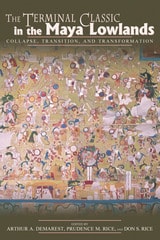
The Terminal Classic in the Maya Lowlands
Collapse, Transition, and TransformationArthur A. Demarest
University Press of Colorado, 2004
Featuring an impressive roster of scholars, The Terminal Classic presents the most recent data and interpretations pertaining to this perplexing period of cultural transformation in the Maya lowlands. Although the research reveals clear interregional patterns, the contributors resist a single overarching explanation. Rather, this volume's diverse and nuanced interpretations provide a new, more properly grounded beginning for continued debate on the nature of lowland Terminal Classic Maya civilization.
Theoretical Approaches to the Archaeology of Ancient Greece
Manipulating Material CultureLisa C. Nevett, Editor
University of Michigan Press, 2017
An introductory section exploring the emergence and growth of theoretical approaches is followed by examinations of the potential insights these approaches provide. The authors probe some of the meanings attached to ancient objects, townscapes, and cemeteries, for those who created, and used, or inhabited them.
The range of contexts stretches from the early Greek communities during the eighth and seventh centuries BCE, through Athens between the eighth and fifth centuries BCE, and on into present day Turkey and the Levant during the third and second centuries BCE. The authors examine a range of practices, from the creation of individual items such as ceramic vessels and figurines, through to the construction of civic buildings, monuments, and cemeteries. At the same time they interrogate a range of spheres, from craft production, through civic and religious practices, to funerary ritual.
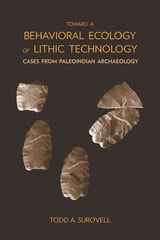
Toward a Behavioral Ecology of Lithic Technology
Cases from Paleoindian ArchaeologyTodd A. Surovell
University of Arizona Press, 2009
Because the fundamental processes of making, using, and discarding stone tools are, at root, exercises in problem solving, Todd Surovell asks what conditions favor certain technological solutions. Whether asking if a biface should be made thick or thin or if a flake should be saved or discarded, Surovell seeks answers that extend beyond a case-by-case analysis. One avenue for addressing these questions theoretically is formal mathematical modeling.
Here Surovell constructs a series of models designed to link environmental variability to human decision making as it pertains to lithic technology. To test the models, Surovell uses data from the analysis of more than 40,000 artifacts from five Rocky Mountain and Northern Plains Folsom and Goshen complex archaeological sites dating to the Younger Dryas stadial (ca. 12,600-11,500 years BP). The primary result is the production of powerful new analytical tools useful to the interpretation of archaeological assemblages.
Surovell's goal is to promote modeling and explore the general issues governing technological decisions. In this light, his models can be applied to any context in which stone tools are made and used.
Tracing the Relational
The Archaeology of Worlds, Spirits, and TemporalitiesMeghan E. Buchanan and B. Jacob Skousen
University of Utah Press, 2015
Transformation by Fire
The Archaeology of Cremation in Cultural ContextEdited by Ian Kuijt, Colin P. Quinn, and Gabriel Cooney
University of Arizona Press, 2014
Editors Ian Kuijt, Colin P. Quinn, and Gabriel Cooney’s volume examines cremation by documenting the material signatures of cremation events and processes, as well as its transformative impact on social relations and concepts of the body. Indeed, examining why and how people chose to cremate their dead serves as an important means of understanding how people in the past dealt with death, the body, and the social world.
The contributors develop new perspectives on cremation as important mortuary practices and social transformations. Varying attitudes and beliefs on cremation and other forms of burial within the same cultural paradigm help us understand what constitutes the body and what occurs during its fiery transformation. In addition, they explore issues and interpretive perspectives in the archaeological study of cremation within and between different cultural contexts.
The global and comparative perspectives on cremation render the book a unique contribution to the literature of anthropological and mortuary archaeology.
Transforming the Dead
Culturally Modified Bone in the Prehistoric MidwestEve A. Hargrave
University of Alabama Press, 2015
Revealing how the dead continued to shape the spiritual and social worlds of prehistoric North America.
Transforming the Dead is a collection of essays that examines culturally modified human bones and their roles as “cultural and ritual objects” among prehistoric Eastern Woodland cultures. Previous scholarship has explored the role of human body parts in Native American cultures as trophies of war and revered ancestors. This collection discusses new evidence that human elements were also important components of daily and ritual activities across the Eastern Woodlands. The contributors to this volume discuss each case study within the unique regional and temporal contexts of the material, rather than seeking universal answers to how these objects were used.
Most research addressing modified human bone has focused on cut marks and trauma associated with warfare, trophy taking, and burial practices. The editors and contributors of Transforming the Dead document the varied and often overlooked ways that human bone was intentionally modified through drilling, incising, cutting, and polishing for utilitarian, ornamental, spiritual, or ritual use. Examples include bracelets and gorgets to be worn, as well as musical rasps, pipe stems, masks, and protective talismans. The form and function of these objects are not unusual; their construction from the remains of “another” sets them apart.
Through a flexible but systematic analysis of the archaeological record, the contributors bring into focus how the careful selection, modification, and retention of particular bones or body parts of an individual after death offer insights into concepts of personhood, the body, life, and death among the prehistoric Native Americans in the Midwest.