Results by title
50 books match the query 'Social control' and 10 start with t

The Betrayal of Dissent
Beyond Orwell, Hitchens and the New American CenturyScott Lucas
Pluto Press, 2004
political writer, and the standard-bearer of honesty and decency for the honourable 'Left'. In this controversial polemic, Scott Lucas argues that the exaltation of Orwell, far from upholding dissent against the State, has sought to quash such opposition. Indeed, Orwell has become the icon of those who, in the pose of the contrarian, try to silence public opposition to US and U K foreign policy in the 'War on Terror'.
Lucas's lively and readable critique of public intellectuals including Christopher Hitchens, Michael Walzer, David Aaronovitch, and Johann Hari – who have all invoked Orwellian honesty and decency to shut down dissent – will appeal to anyone disillusioned with the wars in Afghanistan and Iraq.
Lucas contends that these leading journalists and commentators have used Orwell to justify their own political transition from radicals to upholders of the establishment. All of them play influential roles in supporting the UK and US governments' charge that opponents of war -- and those who question the motives behind American foreign policy and its implementation -- should be condemned as 'appeasers of mass murder'.
This controversial book shows how Orwell has been used since 9/11 to justify, in the guise of independent thought, the suppression of dissent. We must rescue ourselves from Orwell and from those who take on his guise so, as Lucas puts it, our ‘silencing is… vital to a "manufacture of consent" for the wars which are supposedly being fought in our name and for our good’.
The Fabrication of Social Order
A Critical Theory of Police PowerMark Neocleous
Pluto Press, 2000
After an initial exploration of the original relationship between police, state power and the question of order, Neocleous focuses on the ways in which eighteenth century liberalism refined and narrowed the concept of the police, a process which masked the power of capital and broader issues of social control. In doing so he challenges the way liberalism came to define policing solely in terms of the question of crime and the rule of law. This liberal definition created a limited and fundamentally misleading understanding of policing which remains in use today.
In contrast, Neocleous argues for an expanded concept of police, adequate to the expansive set of institutions through which policing takes place. These institutions are concerned not just with the maintenance or reproduction of order, but with its fabrication, especially the fabrication of a social order based on wage labour. This project, he argues, should be understood as the project of social security. Grasping this point allows a fuller understanding of the ways in which the state polices and secures civil society, and how order is fabricated through law and administration.
The Global Police State
William I Robinson
Pluto Press, 2020
"Karl Marx aspired to a world in which our animal needs would be satisfied and our human needs could be addressed. It is a realistic possibility now, as William Robinson outlines—or the alternative that is taking shape before our eyes: a 'global police state' controlled by narrowly concentrated capital with 'surplus humanity' left to survive somehow on its own. The choice is in our hands."
—Noam Chomsky, author of Who Rules the World?
As the world becomes ever more unequal, people become ever more “disposable.” Today, governments systematically exclude sections of their populations from society through heavy-handed policing. But it doesn't always go to plan.
William I. Robinson exposes the nature and dynamics of this out-of-control system, arguing for the urgency of creating a movement capable of overthrowing it. The global police state uses a variety of ingenious methods of control, including mass incarceration, police violence, US-led wars, the persecution of immigrants and refugees, and the repression of environmental activists.
He writes in his Introduction, “I offer a ‘big picture” of the emerging global police state in a short book that is eminently readable. The pages to follow may startle many readers and make them angry. I trust the work will serve as a warning of the dystopic future that is upon us. More importantly, by exposing the nature and dynamic of this out-of-control system, I hope it will contribute to the struggles to bring about an alternative future based on human freedom and liberation.”
Movements have emerged to combat the increasing militarization, surveillance and social cleansing; however, many of them appeal to a moral sense of social justice rather than addressing its root: global capitalism.
Using shocking data which reveals how far capitalism has become a system of repression, Robinson argues that the emerging megacities of the world are becoming the battlegrounds where the excluded and the oppressed face off against the global police state.
The Intensification of Surveillance
Crime, Terrorism and Warfare in the Information AgeEdited by Kirstie Ball and Frank Webster
Pluto Press, 2003
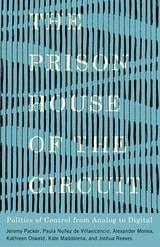
The Prison House of the Circuit
Politics of Control from Analog to DigitalJeremy Packer
University of Minnesota Press, 2023
Has society ceded its self-governance to technogovernance?
The Prison House of the Circuit presents a history of digital media using circuits and circuitry to understand how power operates in the contemporary era. Through the conceptual vocabulary of the circuit, it offers a provocative model for thinking about governance and media.
The authors, writing as a collective, provide a model for collective research and a genealogical framework that interrogates the rise of digital society through the lens of Foucault’s ideas of governance, circulation, and power. The book includes five in-depth case studies investigating the transition from analog media to electronic and digital forms: military telegraphy and human–machine incorporation, the establishment of national electronic biopolitical governance in World War I, media as the means of extending spatial and temporal policing, automobility as the mechanism uniting mobility and media, and visual augmentation from Middle Ages spectacles to digital heads-up displays. The Prison House of the Circuit ultimately demonstrates how contemporary media came to create frictionless circulation to maximize control, efficacy, and state power.
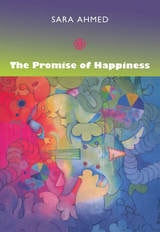
The Promise of Happiness
Sara Ahmed
Duke University Press, 2010
Ahmed draws on the intellectual history of happiness, from classical accounts of ethics as the good life, through seventeenth-century writings on affect and the passions, eighteenth-century debates on virtue and education, and nineteenth-century utilitarianism. She engages with feminist, antiracist, and queer critics who have shown how happiness is used to justify social oppression, and how challenging oppression causes unhappiness. Reading novels and films including Mrs. Dalloway, The Well of Loneliness, Bend It Like Beckham, and Children of Men, Ahmed considers the plight of the figures who challenge and are challenged by the attribution of happiness to particular objects or social ideals: the feminist killjoy, the unhappy queer, the angry black woman, and the melancholic migrant. Through her readings she raises critical questions about the moral order imposed by the injunction to be happy.

The Roots of Rough Justice
Origins of American LynchingMichael J. Pfeifer
University of Illinois Press, 2014
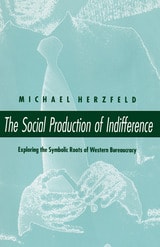
The Social Production of Indifference
Michael Herzfeld
University of Chicago Press, 1993
"Herzfeld's book is extremely ambitious and will be of interest to any anthropologist concerned with the study of bureaucracy, organizational and institutional control, symbols and their power, and social conflict. . . . Thoughtful and challenging."—Helen B. Schwartzman, American Ethnologist
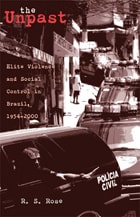
The Unpast
Elite Violence and Social Control in Brazil, 1954–2000R. S. Rose
Ohio University Press, 2005
Portuguese and Brazilian slave-traders shipped at least four million slaves to Brazil—in contrast to the five hundred thousand slaves that English vessels brought to the Americas. Controlling the vast number of slaves in Brazil became of primary importance. The Unpast: Elite Violence and Social Control in Brazil, 1954–2000 documents the ways in which the brutal methods used on plantations led directly to the phenomenon of Brazilian death squads.
The Unpast examines how and why, after the abolition of slavery, elites in Brazil imported new methods of killing, torturing, or disfiguring dissidents and the poor to maintain dominance. Bringing a critical-historical analysis to events following the 1954 suicide of President Getúlio Vargas, R. S. Rose takes the reader along a fifty-year path that helped to shape a nation’s morals. He covers the misunderstood presidency of João Goulart; the overthrow of his government by a U.S.-assisted military; the appalling dictatorship that followed; the efforts to rid the countryside of troublemakers; and the ongoing attempt to cleanse the urban environment of the needy, an endeavor that produced 32,675 victims in just two Brazilian states between 1954 and 2000.
The largest and most comprehensive documentation of suspected death-squad victims ever undertaken, The Unpast is an exposé of practices and attitudes toward the poor in Latin America’s largest country.

Trust in the Law
Encouraging Public Cooperation with the Police and CourtsTom R. Tyler
Russell Sage Foundation, 2002