Results by title
59 books match the query 'Southwestern States' and 16 start with t

Texas on the Table
People, Places, and Recipes Celebrating the Flavors of the Lone Star StateBy Terry Thompson-Anderson, Photos by Sandy Wilson
University of Texas Press, 2014
With a bounty of locally grown meats and produce, artisanal cheeses, and a flourishing wine culture, it’s a luscious time to be cooking in Texas. From restaurant chefs to home cooks, Texans are going to local dairies, orchards, farmers’ markets, ranches, vineyards, and seafood sellers to buy the very freshest ingredients, whether we’re cooking traditional favorites or the latest haute cuisine. We’ve discovered that Texas terroir—our rich variety of climates and soils, as well as our diverse ethnic cultures—creates a unique “taste of place” that gives Texas food a flavor all its own.
Written by one of Texas’s leading cookbook authors, Terry Thompson-Anderson, Texas on the Table presents 150 new and classic recipes, along with stories of the people—farmers, ranchers, shrimpers, cheesemakers, winemakers, and chefs—who inspired so many of them and who are changing the taste of Texas food. The recipes span the full range from finger foods and first courses to soups and breads, salads, seafood, chicken, meat (including wild game), sides and vegetarian dishes, and sweets. Some of the recipes come from the state’s most renowned chefs, and all are user-friendly for home cooks. Finally, the authors and winemakers tell which recipes they turn to when opening their favorite wines.
This delicious compilation of recipes and stories of the people behind them, illustrated with Sandy Wilson’s beautiful photographs, makes Texas on the Table the must-have cookbook for everyone who relishes the flavors of the Lone Star State.
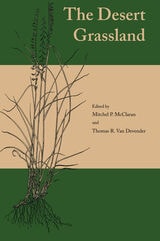
The Desert Grassland
Edited by Mitchel P. McClaran and Thomas R. Van Devender
University of Arizona Press, 1995
Leading experts in geography, biology, botany, zoology, and geoscience present new research on the desert grassland and review a vast amount of earlier work. They reveal that present-day grasses once grew in the ice-age forests that existed in these areas before the climate dried and the trees vanished and how the intensity and frequency of fire can influence the plant and animal species of the grassland. They also document how the influence of humans—from Amerindians to contemporary ranchers, public land managers, and real estate developers—has changed the relative abundance of woody and herbaceous species and how the introduction of new plants and domesticated animals to the area has also affected biodiversity. The book concludes with a review of the attempts, both failed and successful, to reestablish plants in desert grasslands affected by overgrazing, drought, and farm abandonment.
Meticulously researched and copiously illustrated, The Desert Grassland is a major contribution to ecological literature. For advanced lay readers as well as students and scholars of history, geography, and ecology, it will be a standard reference work for years to come.
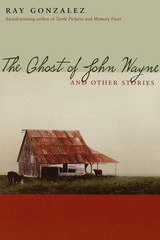
The Ghost of John Wayne
and Other StoriesRay Gonzalez
University of Arizona Press, 2001
The vast Texas borderland is a place divided, a land of legends and lies, sanctification and sinfulness, history and amnesia, haunted by the ghosts of the oppressed and the forgotten, who still stir beneath the parched fields and shimmering blacktops. It is a realm filled with scorpion eaters and mescal drinkers, cowboys and Indians, Anglos and Chicanos, spirit horses and beat-up pickups, brujos and putas, aching passion and seething rage, apparitions of the Virgin and bodies in the Rio Grande.
In his first collection of short fiction, award-winning poet, editor, and anthologist Ray Gonzalez powerfully evokes both the mystery and the reality of the El Paso border country where he came to manhood.
Here, in a riverbed filled with junked cars and old bones, a young boy is given a dark vision of a fiery future. Under the stones of the Alamo, amid the gift shops and tour buses, the wraiths of fallen soldiers cry out to be remembered. By an ancient burial site at the bottom of a hidden canyon, two lovers come face to face with their own dreams and fears.
In these stories, Ray Gonzalez is a literary alchemist, blending contemporary culture with ancient tradition to give a new voice to the peoples of the border.
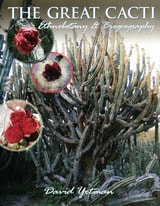
The Great Cacti
Ethnobotany and BiogeographyDavid Yetman
University of Arizona Press, 2007
Yetman has been fascinated by columnar cacti for most of his life and now brings years of study and reflection to a wide-ranging and handsomely illustrated book. Drawing on his close association with the Guarijíos, Mayos, and Seris of Mexico—peoples for whom such cacti have been indispensable to survival—he offers surprising evidence of the importance of these plants in human cultures. The Great Cacti reviews the more than one hundred species of columnar cacti, with detailed discussions of some 75 that have been the most beneficial to humans or are most spectacular. Focusing particularly on northwestern Mexico and the southwestern United States, Yetman examines the role of each species in human society, describing how cacti have provided food, shelter, medicine, even religiously significant hallucinogens.
Taking readers to the exotic sites where these cacti are found—from sea-level deserts to frigid Andean heights—Yetman shows that the great cacti have facilitated the development of native culture in hostile environments, yielding their products with no tending necessary. Enhanced by over 300 superb color photos, The Great Cacti is both a personal and scientific overview of sahuesos, soberbios, and other towering flora that flourish where few other plants grow—and that foster human life in otherwise impossible places.
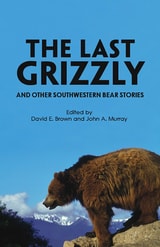
The Last Grizzly and Other Southwestern Bear Stories
Edited by David E. Brown and John A. Murray
University of Arizona Press, 1988
The Mexican American Orquesta
Music, Culture, and the Dialectic of ConflictBy Manuel Peña
University of Texas Press, 1999
The Mexican American orquesta is neither a Mexican nor an American music. Relying on both the Mexican orquesta and the American dance band for repertorial and stylistic cues, it forges a synthesis of the two. The ensemble emerges historically as a powerful artistic vehicle for the expression of what Manuel Peña calls the "dialectic of conflict." Grounded in ethnic and class conflict, this dialectic compels the orquesta and its upwardly mobile advocates to waver between acculturation and ethnic resistance. The musical result: a complex mesh of cultural elements—Mexican and American, working- and middle-class, traditional and contemporary.
In this book, Manuel Peña traces the evolution of the orquesta in the Southwest from its beginnings in the nineteenth century through its pinnacle in the 1970s and its decline since the 1980s. Drawing on fifteen years of field research, he embeds the development of the orquesta within a historical-materialist matrix to achieve the optimal balance between description and interpretation. Rich in ethnographic detail and boldly analytical, his book is the first in-depth study of this important but neglected field of artistic culture.
The Railroad and the Pueblo Indians
The Impact of the Atchison, Topeka and Santa Fe on the Pueblos of the Rio Grande, 1880-1930Richard H. Frost
University of Utah Press, 2015
The Pueblo communities responded variously, though mostly conservatively to sustain their traditional communities. This book spotlights two very different responses. Santo Domingo's reaction was hostile, but Laguna chose accommodation. These reactions reveal previously overlooked aspects of these pueblos’ histories that provide compelling reasons behind their varying responses. The book also analyzes the self-contradictory nature of Pueblo constitutional law from 1876 to 1913 and describes conflicted Bureau of Indian Affairs treatment of the Pueblos in the late nineteenth and early twentieth centuries. Each in turn had fateful consequences.

The Reel Thrilling Events of Bank Robber Henry Starr
From Gentleman Bandit to Movie Star and Back AgainMark Archuleta
University of North Texas Press, 2025
The Ribbon of Green
Change in Riparian Vegetation in the Southwestern United StatesRobert H. Webb, Stanley A. Leake, and Raymond M. Turner
University of Arizona Press, 2007
The Southwest in American Literature and Art
The Rise of a Desert AestheticDavid W. Teague
University of Arizona Press, 1997
By focusing on cultures that lived in the Southwest and by analyzing ways in which they described the land, David Teague persuasively argues against the destructive approach that Americans currently take to the region. Included are Native American legends and Spanish and Hispanic literature. However, the bulk of the study concentrates on Anglo American views of the Southwest, which have been generally at odds with the ecology of the deserts.
Ranging from oral traditions of the Navajo, Zuñi, and Hopi Indians to travel journals, fiction, and visual art, Teague examines the work of nearly thirty writers, artists, and explorers, including Alvar Núñez Cabeza de Vaca, Mary Austin, John Wesley Powell, and Frederic Remington. As he traces ideas about the desert over time, the author shows how American literature and art have come to represent the Southwest as a landscape to be sustained rather than transformed.
Bound to gain a prominent place in ecological criticism and in literature of the Southwest, this book offers important insights for scholars and students of literature, environmental studies, history, anthropology, and Native American studies. Its originality and vigor will also appeal to general readers with an interest in the landscape—and the future—of the American Southwest.

The Struggle for Water
Politics, Rationality, and Identity in the American SouthwestWendy Nelson Espeland
University of Chicago Press, 1998
In the 1970s, the three groups most intimately involved in the Orme Dam—younger Bureau of Reclamation employees committed to "rational choice" decision making, older Bureau engineers committed to the dam, and the Yavapai community—all found themselves and their values transformed by their struggles. Wendy Nelson Espeland lays bare the relations between interests and identities that emerged during the conflict, creating a contemporary tale of power and colonization, bureaucracies and democratic practice, that asks the crucial question of what it means to be "rational."
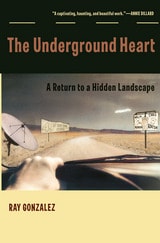
The Underground Heart
A Return to a Hidden LandscapeRay Gonzalez
University of Arizona Press, 2002
As Gonzalez drives the highways of New Mexico and west Texas, he shows us a border culture rejuvenated by tourist and trade dollars, one that will surprise readers for whom the border means only illegal immigration, NAFTA, and the drug trade. Played out against a soundtrack of the Allman Brothers and The Doors, The Underground Heart takes readers on a trip through a seemingly barren landscape that teems with life and stories. Gonzalez witnesses Minnesotans experiencing culture shock while attending a college football game in El Paso; he finds a proliferation of Pancho Villa death masks housed at different museums; he revisits Carlsbad Caverns, discovering unsuspected beauty beneath the desert's desolation; and he takes us shopping at El Mercado—where tourists can buy everything from black velvet paintings of Elvis (or Jesus, or JFK) to Mexican flag underwear.
From "nuclear tourism" in New Mexico to "heritage tourism" in the restored missions of San Antonio, Gonzalez goes behind the slogans of The Land of Enchantment and The Lone Star State to uncover a totally different Southwest. Here are tourist centers that give a distorted view of southwestern life to outsiders, who leave their dollars in museum gift shops and go home weighed down with pounds of Indian jewelry around their necks. Here border history is the story of one culture overlaid on another, re-forming itself into a whole new civilization on the banks of the Rio Grande.
The Underground Heart is a book brimming with subtle ironies and insights both quiet and complex—one which recognizes that sometimes one must go away and grow older to finally recognize home as a life-giving, spiritually sustaining place. As Gonzalez rediscovers the land of his past, he comes to understand the hyper, bilingual atmosphere of its future. And in the Southwest he describes, readers may catch a glimpse of their own hidden landscapes of home.
Tony Hillerman's Navajoland
Hideouts, Haunts, and Havens in the Joe Leaphorn and Jim Chee MysteriesLaurance D. Linford
University of Utah Press, 2005
Tony Hillerman's Navajoland
Hideouts, Haunts, and Havens in the Joe Leaphorn and Jim Chee MysteriesLaurance D. Linford
University of Utah Press, 2011
Tony Hillerman is beloved for his novels of intrigue in the American Southwest. In Tony Hillerman’s Navajoland, Laurance Linford takes readers on a journey through the Four Corners region to the haunts of Hillerman’s characters. Offered in encyclopedic form, each entry gives the common name of a particular location, the Navajo name and history, and a description of the location’s significance in various Hillerman novels. An understanding of the Navajo names and their relations to the landscape will lend a new dimension to the characters and events Tony Hillerman created.
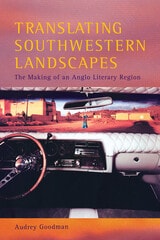
Translating Southwestern Landscapes
The Making of an Anglo Literary RegionAudrey Goodman
University of Arizona Press, 2002
Whether as tourist's paradise, countercultural destination, or site of native resistance, the American Southwest has functioned as an Anglo cultural fantasy for more than a century. In Translating Southwestern Landscapes, Audrey Goodman excavates this fantasy to show how the Southwest emerged as a symbolic space from 1880 through the early decades of the twentieth century.
Drawing on sources as diverse as regional magazines and modernist novels, Pueblo portraits and New York exhibits, Goodman has crafted a wide-ranging history that explores the invention, translation, and representation of the Southwest. Its principal players include amateur ethnographer Charles Lummis, who conflated the critical work of cultural translation; pulp novelist Zane Grey, whose bestselling novels defined the social meanings of the modern West; fashionable translator Mary Austin, whose "re-expressions" of Indian song are contrasted with recent examples of ethnopoetics; and modernist author Willa Cather, who demonstrated an immaterial feeling for landscape from the Nebraska Plains to Acoma Pueblo.
Goodman shows how these writers—as well as photographers such as Paul Strand, Ansel Adams, and Alex Harris—exhibit different phases of the struggle between an Anglo calling to document Native and Hispanic difference and America's larger drive toward imperial mastery. In critiquing photographic representations of the Southwest, she argues that commercial interests and eastern prejudices boiled down the experimental images of the late nineteenth century to a few visual myths: the persistence of wilderness, the innocence of early portraiture, and the purity of empty space.
An ambitious synthesis of criticism and anthropology, art history and geopolitical theory, Translating Southwestern Landscapes names the defining contradictions of America's most recently invented cultural space. It shows us that the Southwest of these early visitors is the only Southwest most of us have ever known.
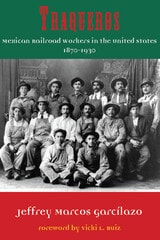
Traqueros
Mexican Railroad Workers in the United States, 1870-1930Jeffrey Marcos Garcilazo
University of North Texas Press, 2012