Results by title
70 books match the query 'Spanish' and 15 start with t

Television Drama in Spain and Latin America
Genre and Format TranslationPaul Julian Smith
University of London Press, 2018
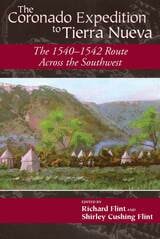
The Coronado Expedition to Tierra Nueva
The 1540-1542 Route across the SouthwestRichard Flint
University Press of Colorado, 1997
In search of where the expedition went and what peoples it encountered, this volume explores the fertile valleys of Sonora, the basins and ranges of southern Arizona, the Zuni pueblos and the Rio Grande Valley of New Mexico, and the Llano Estacado of the Texas panhandle.
The twenty-one contributors to the volume have pursued some of the most significant lines of research in the field in the last fifty years; their techniques range from documentary analysis and recording traditional stories to detailed examination of the landscape and excavation of campsites and Indian towns. With more confidence than ever before, researchers are closing in on the route of the conquistadors.
The Grammatical Structures of English and Spanish
Robert P. Stockwell, J. Donald Bowen, and John W. Martin
University of Chicago Press, 1965
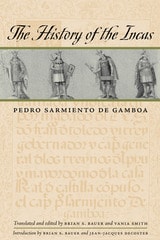
The History of the Incas
By Pedro Sarmiento de Gamboa
University of Texas Press, 2007
The History of the Incas may be the best description of Inca life and mythology to survive Spanish colonization of Peru. Pedro Sarmiento de Gamboa, a well-educated sea captain and cosmographer of the viceroyalty, wrote the document in Cuzco, the capital of the Inca Empire, just forty years after the arrival of the first Spaniards. The royal sponsorship of the work guaranteed Sarmiento direct access to the highest Spanish officials in Cuzco. It allowed him to summon influential Incas, especially those who had witnessed the fall of the Empire. Sarmiento also traveled widely and interviewed numerous local lords (curacas), as well as surviving members of the royal Inca families. Once completed, in an unprecedented effort to establish the authenticity of the work, Sarmiento's manuscript was read, chapter by chapter, to forty-two indigenous authorities for commentary and correction.
The scholars behind this new edition (the first to be published in English since 1907) went to similarly great lengths in pursuit of accuracy. Translators Brian Bauer and Vania Smith used an early transcript and, in some instances, the original document to create the text. Bauer and Jean-Jacques Decoster's introduction lays bare the biases Sarmiento incorporated into his writing. It also theorizes what sources, in addition to his extensive interviews, Sarmiento relied upon to produce his history. Finally, more than sixty new illustrations enliven this historically invaluable document of life in the ancient Andes.
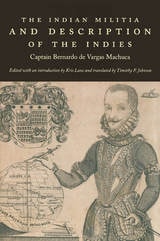
The Indian Militia and Description of the Indies
Captain Bernardo de Vargas Machuca, Edited with an introduction by Kris Lane
Duke University Press, 2008
Containing advice on curing rattlesnake bites with amethysts and making saltpeter for gunpowder from concentrated human urine, The Indian Militia is a manual in four parts, the first of which outlines the ideal qualities of the militia commander. Addressing the organization and outfitting of conquest expeditions, Book Two includes extended discussions of arms and medicine. Book Three covers the proper behavior of soldiers, providing advice on marching through peaceful and bellicose territories, crossing rivers, bivouacking in foul weather, and carrying out night raids and ambushes. Book Four deals with peacemaking, town-founding, and the proper treatment of conquered peoples. Appended to these four sections is a brief geographical description of all of Spanish America, with special emphasis on the indigenous peoples of New Granada (roughly modern-day Colombia), followed by a short guide to the southern coasts and heavens. This first English-language edition of The Indian Militia includes an extensive introduction, a posthumous report on Vargas Machuca’s military service, and a selection from his unpublished attack on the writings of Fray Bartolomé de Las Casas.
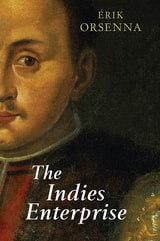
The Indies Enterprise
Erik Orsenna
Haus Publishing, 2011
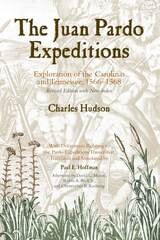
The Juan Pardo Expeditions
Exploration of the Carolinas and Tennessee, 1566-1568Charles Hudson. Afterword by David G. Moore, Robin A. Beck Jr., and Christopher B. Rodning
University of Alabama Press, 2005
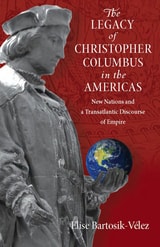
The Legacy of Christopher Columbus in the Americas
New Nations and a Transatlantic Discourse of EmpireElise Bartosik-Velez
Vanderbilt University Press, 2014
Bartosik-Velez seeks to explain the meaning of Christopher Columbus throughout the so-called New World, first in the British American colonies and the United States, as well as in Spanish America, during the eighteenth and nineteenth centuries. She argues that, during the pre- and post-revolutionary periods, New World societies commonly imagined themselves as legitimate and powerful independent political entities by comparing themselves to the classical empires of Greece and Rome. Columbus, who had been construed as a figure of empire for centuries, fit perfectly into that framework. By adopting him as a national symbol, New World nationalists appeal to Old World notions of empire.
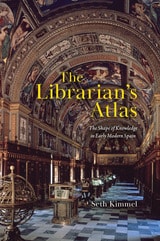
The Librarian's Atlas
The Shape of Knowledge in Early Modern SpainSeth Kimmel
University of Chicago Press, 2024
A history of early modern libraries and the imperial desire for total knowledge—now in paperback.
Medieval scholars imagined the library as a microcosm of the world, but as novel early modern ways of managing information facilitated empire in both the New and Old Worlds, the world became a projection of the library. In The Librarian’s Atlas, Seth Kimmel offers a sweeping material history of how the desire to catalog books coincided in the sixteenth and seventeenth centuries with the aspiration to control territory. Through a careful study of library culture in Spain and Morocco—close readings of catalogs, marginalia, indexes, commentaries, and maps—Kimmel reveals how the booklover’s dream of a comprehensive and well-organized library shaped an expanded sense of the world itself.
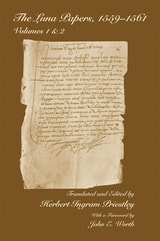
The Luna Papers, 1559–1561
Volumes 1 & 2Translated and edited by Herbert Ingram Priestley, foreword by John E. Worth
University of Alabama Press, 2010
Marks the celebration by the modern city of Pensacola, Florida, of the 450th anniversary of Luna’s fateful colony
The 1559–1561 expedition of Don Tristán de Luna y Arellano to Florida was at the time of Spain’s most ambitious attempt yet to establish a colonial presence in southeastern North America. In June of 159, eleven ships carrying some five hundred soldiers and one thousand additional colonists, including not just Spaniards but also many of Aztec and African descent, sailed north from Veracruz, Mexico, on their way to the bay known then as Ochuse, and later as Pensacola. Finally arriving in mid-August, the colonists quickly sent word of their arrival back to Mexico and unloaded their supplies over the next five weeks, leaving vital food stores onboard the vessels until suitable warehouses could be constructed in the new settlement. When an unexpected hurricane struck on the night of September 19, 1559, however, seven of ten remaining vessels in Luna’s fleet were destroyed, and the expedition was instantaneously converted from a colonial venture to a mission in need of rescue.
Though ultimately doomed to failure by the hurricane that devastated their fleet and food stores, the Luna expedition nonetheless served as an immediate prelude to the successful establishment of a permanent colonial presence at St. Augustine on Florida’s Atlantic coast in 1565, and prefaced the eventual establishment after 1698 of three successive Spanish presidios at the same Pensacola Bay where Luna’s attempt had been made more than a century before.
The Magellan Fallacy
Globalization and the Emergence of Asian and African Literature in SpanishAdam Lifshey
University of Michigan Press, 2012
The Magellan Fallacy argues that literature in Spanish from Asia and Africa, though virtually unknown, reimagines the supposed centers and peripheries of the modern world in fundamental ways. Through archival research and comparative readings, The Magellan Fallacy rethinks mainstream mappings of diverse cultures while advocating the creation of a new field of scholarship: global literature in Spanish. As the first attempt to analyze Asian and African literature in Spanish together, and doing so while ranging over all continents, The Magellan Fallacy crosses geopolitical and cultural borders without end. The implications of the book, therefore, extend far beyond the lands formerly ruled by the Spanish empire. The Magellan Fallacy shows that all theories of globalization, including those focused on the Americas and Europe, must be able to account for the varied significances of hispanophone Asia and Africa as well.
The Search for Mabila
The Decisive Battle between Hernando de Soto and Chief TascalusaEdited by Vernon James Knight Jr.
University of Alabama Press, 2009
The University of Chicago Spanish Dictionary, Fifth Edition, Spanish-English, English-Spanish
Universidad de Chicago Diccionario Español-Inglés, Inglés-EspañolEdited by David A. Pharies
University of Chicago Press, 2002
With thousands of added entries, the Dictionary builds on the features that have made it the leader in its field for more than fifty years: authority, scope, clarity, and conciseness. And with this edition, the Dictionary brilliantly captures the current core vocabularies of two rapidly changing—and increasingly connected—languages and cultures.
Entirely bilingual, the fifth edition focuses on two contemporary international languages—American English and a basic, worldwide Spanish that draws from both Latin American and Iberian sources.
Designed for a wide range of users, including travelers, businesspeople, students, teachers, and professionals, the new Dictionary is the essential first resource for speakers of both languages—from beginners to those at all other stages. Up to date, just comprehensive enough, and extraordinarily clear and easy to use, the new edition of The University of Chicago Spanish Dictionary stands alone. No other dictionary offers so many users so much help—or so much value.
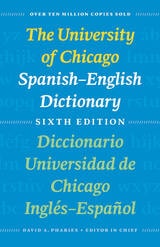
The University of Chicago Spanish-English Dictionary, Sixth Edition
Diccionario Universidad de Chicago Inglés-Español, Sexta EdiciónDavid A. Pharies, Editor in Chief
University of Chicago Press, 2012
A concise, authoritative, up-to-date guide to Spanish and English
The University of Chicago Spanish–English Dictionary has long set the standard for concise bilingual dictionaries. Portable yet remarkably thorough, the dictionary enables users to find the precise equivalents of the words and phrases they seek.
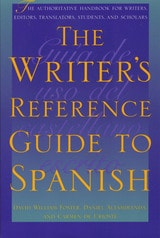
The Writer's Reference Guide to Spanish
By David William Foster, Daniel Altamiranda, and Carmen de Urioste
University of Texas Press, 2000
Writers and editors of Spanish have long needed an authoritative guide to written language usage, similar to The MLA Style Manual and The Chicago Manual of Style. And here it is! This reference guide provides comprehensive information on how the Spanish language is copyedited for publication.
The book covers these major areas:
- Language basics: capitalization, word division, spelling, and punctuation.
- Language conventions: abbreviations, professional and personal titles, names of organizations, and nationalities.
- Bibliographic format, particularly how Spanish differs from English.
- Spanish language forms of classical authors' names.
- Literary and grammatical terminology.
- Linguistic terminology.
- Biblical names and allusions.
- A dictionary of grammatical doubts, including usage, grammatical constructions of particular words and phrases, verbal irregularities, and gender variations.