Results by title
52 books match the query 'Structure' and 16 start with t
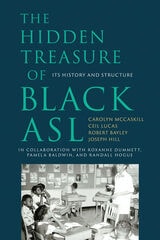
The Hidden Treasure of Black ASL
Its History and StructureCarolyn McCaskill
Gallaudet University Press, 2020
Black ASL has long been recognized as a distinct variety of American Sign Language based on abundant anecdotal evidence. The Hidden Treasure of Black ASL, originally published in 2011, presents the first sociohistorical and linguistic study of this language variety. Based on the findings of the Black ASL Project, which undertook this unprecedented research, Hidden Treasure documents the stories and language of the African American Deaf community. With links to online supplemental video content that includes interviews with Black ASL users (formerly on DVD), this volume is a groundbreaking scholarly contribution and a powerful affirmation for Black Deaf people.
This paperback edition includes an updated foreword by Glenn B. Anderson, a new preface that reflects on the impact of this research, and an expanded list of references and resources on Black ASL.
The supplemental video content is available online at the Gallaudet University Press YouTube Channel. Under Playlists, click “The Hidden Treasure of Black ASL: Companion Video to the Book.” The original Black ASL Project research videos are also available.
Featured in the film Signing Black in America: The Story of Black ASL, produced by The Language and Life Project at North Carolina State University (Dr. Walt Wolfram, Executive Producer). Look for it on PBS.

The Population of the South
Structure and Change in Social Demographic ContextEdited by Dudley L. Poston, Jr., and Robert H. Weller
University of Texas Press, 1981
The expression “the New South” was introduced by Henry Grady, editor of the Atlanta Constitution, to a New York audience in 1886; every generation of writers since has used the term. The southern population, unique in its socioeconomic and cultural characteristics, has always been a topic of major interest with U.S. demographers.
The articles in this book, the majority of which were originally presented at the Southern Regional Demographic Group meeting in 1976, deal with fertility, mortality, migration, and the factors that influence these components. A number of the contributors trace patterns of demographic change in the South showing convergence with the rest of the United States. Questions are raised about whether the convergence represents a permanent trend—possibly due to increased communication—or whether further divergence may be expected in the future.
The contributors include Dudley L. Poston, Jr., William J. Serow, Robert H. Weller, Ronald R. Rindfuss, Harry M. Rosenberg, Drusilla Burnham, David F. Sly, Omer R. Galle, Robert N. Stern, Joachim Singelmann, Susan E. Clarke, and George C. Myers.

The Structure and Evolution of Recent U.S. Trade Policy
Edited by Robert E. Baldwin and Anne O. Krueger
University of Chicago Press, 1985
The contributors chart the history of U.S. trade policy since World War II, analyze industry-specific trade barriers, and discuss the effects of tariff preferences and export-promoting policies such as export credits and domestic international sales corporations (DISCs). The final section of essays examines the worldwide impact of import policies, pointing out subtleties in industry-specific policies and providing insight into the levels of protection in developing countries. The contributors blend state-of-the-art economics with language that is accessible to the business community, economists, and policymakers. Commentaries accompany each paper.
The Structure and Sentiment
Rodney Needham
University of Chicago Press, 1984
"A theoretical and methodological essay of first importance. As such, the book should be of interest to all social scientists interested in the development of specific and general theory in social anthropology."—Southwestern Social Science Quarterly

The Structure of Complex Predicates in Urdu
Miriam Butt
CSLI, 1995
This book takes a detailed look at two differing complex predicates in the South Asian language Urdu. The Urdu permissive in particular brings into focus the problem of the syntax-semantics mismatch. An examination of the syntactic properties of this complex predicate shows that it is formed by the combination of two semantic heads, but that this combination is not mirrored in the syntax in terms of any kind of syntactic or lexical incorporation.

The Structure of English
Studies in Form and Function for Language TeachingJeanette S. DeCarrico
University of Michigan Press, 2000
With an emphasis on discourse function throughout, students are never expected to rely on lists of unrelated, constructed example sentences. Rather, when major points of grammar are presented, the structures are illustrated with rich, "real world" contexts excerpted from literature (mostly American), including novels, short stories, poems, essays, and drama. Exercises in the companion workbook are likewise based on naturally occurring stretches of discourse.

The Structure of Leaves of Grass
By Thomas Edward Crawley
University of Texas Press, 1970
Modern critics and contemporary readers familiar with the field of Whitman criticism may find surprising an analysis of the structure of Leaves of Grass that concerns itself with Whitman as the poet-prophet and the identification of Whitman (or of his persona in the poem) with Christ. Early twentieth-century criticism has tended to exalt the early Whitman at the expense of the later one and to regard as poetically inferior the image of the national and democratically prophetic Whitman as expressed in the later editions.
Thomas Edward Crawley, in full knowledge of the contemporary currents of Whitman criticism, chooses to revert to this older view, through which he sheds new light on Whitman’s artistic achievement.
The basic premise of this study is that Walt Whitman’s Leaves of Grass is a unified work, lyrical, yet epic in quality, design, and spirit. Crawley’s purpose is to demonstrate the basis of this unity: its origin and operation and the nature of its realization. He demonstrates that an aesthetically maturing Whitman, in this work, was finally able to harmoniously bring together his individual and social subject matter.
Crawley defines the unifying spirit of Leaves of Grass in terms of Whitman’s concept of the poet-prophet and the poet-reader relationship. This concept is conveyed primarily through the development of the Christ- symbol, the dominant image in the poem. Through a careful analysis of Whitman’s handling of the simultaneous development of the poet-prophet and the nation, his masterful fusion of the personal element and the national element, an understanding of the complex structure of Leaves of Grass emerges.
Crawley presents an analysis of Whitman’s final and carefully arrived at grouping of the lyrics in the 1881 edition according to a definite, distinguishable pattern—a pattern revealed in Whitman’s use of allusions, in his transitional poems and passages, and, most important, in his thematic handling of imagery. The cumulative effect of these devices is emphasized.
The organic development of Leaves of Grass, made possible by Whitman’s faith in and careful adherence to his concept of the organic theory of art, is substantiated. Crawley concludes his analysis with a detailed examination of the growth of Leaves of Grass as reflected in the various editions leading up to the 1881 volume, the last to be revised and published by Whitman.

The Structure of Policy Change
Derek A. Epp
University of Chicago Press, 2018
Derek A. Epp argues that some agencies can indeed do that and that instability is at least partially a function of poor institutional design. While it is inherently more challenging to maintain stability around complex problems like immigration or climate change, the deliberative process itself can affect the degree of stability around an issue. Epp looks at whether agencies follow a deliberative model for decision making, in which policies are developed by means of debate among a small group of policymakers, or a collective model, in which the opinions of many people are aggregated, as with the stock market. He argues that, in many instances, the collective model produces more informed and stable policy outcomes that can be adapted more readily to new information and changing public priorities.

The Structure of Scientific Articles
Applications to Citation Indexing and SummarizationSimone Teufel
CSLI, 2010

The Structure of Scientific Revolutions
Thomas S. Kuhn
University of Chicago Press, 1996

The Structure of Scientific Revolutions
50th Anniversary EditionThomas S. Kuhn
University of Chicago Press, 2012
A good book may have the power to change the way we see the world, but a great book actually becomes part of our daily consciousness, pervading our thinking to the point that we take it for granted, and we forget how provocative and challenging its ideas once were—and still are. The Structure of Scientific Revolutions is that kind of book. When it was first published in 1962, it was a landmark event in the history and philosophy of science. Fifty years later, it still has many lessons to teach.
With The Structure of Scientific Revolutions, Kuhn challenged long-standing linear notions of scientific progress, arguing that transformative ideas don’t arise from the day-to-day, gradual process of experimentation and data accumulation but that the revolutions in science, those breakthrough moments that disrupt accepted thinking and offer unanticipated ideas, occur outside of “normal science,” as he called it. Though Kuhn was writing when physics ruled the sciences, his ideas on how scientific revolutions bring order to the anomalies that amass over time in research experiments are still instructive in our biotech age.
This new edition of Kuhn’s essential work in the history of science includes an insightful introduction by Ian Hacking, which clarifies terms popularized by Kuhn, including paradigm and incommensurability, and applies Kuhn’s ideas to the science of today. Usefully keyed to the separate sections of the book, Hacking’s introduction provides important background information as well as a contemporary context. Newly designed, with an expanded index, this edition will be eagerly welcomed by the next generation of readers seeking to understand the history of our perspectives on science.

The Structure of Scientific Theories
Edited by Frederick Suppe
University of Illinois Press, 1977
The Structure of Wages
An International ComparisonEdited by Edward P. Lazear and Kathryn L. Shaw
University of Chicago Press, 2009
A distinguished team of contributors reveal how a rising wage variance rewards star employees at a higher rate than ever before, how talent becomes concentrated in a few firms over time, and how outside market conditions affect wages in the twenty-first century. From a comparative perspective that examines wage and income differences within and between countries such as Denmark, Italy, and the Netherlands, this volume will be required reading for economists and those working in industrial organization.

The Structure of World History
From Modes of Production to Modes of ExchangeKojin Karatani
Duke University Press, 2014

Total Communication
Structure and StrategyLionel Evans
Gallaudet University Press, 1982

Typology and Structure of Roman Historical Reliefs
Mario Torelli
University of Michigan Press, 1992