Results by title
82 books match the query 'Taxation' and 32 start with t
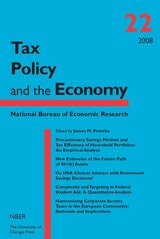
Tax Policy and the Economy, Volume 22
Edited by James M. Poterba
University of Chicago Press Journals, 2008
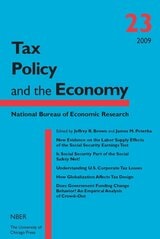
Tax Policy and the Economy, Volume 23
Edited by James M. Poterba
University of Chicago Press Journals, 2009
Tax Policy and the Economy publishes current academic research findings on taxation and government spending that have both immediate bearing on policy debates and longer-term interest. The articles in Volume 23 address a range of topics, including Social Security, understanding corporate tax losses, the influence of globalization on the design of a tax system, and the question of whether federal provision of goods and services crowds out their provision by lower levels of government or the private sector.
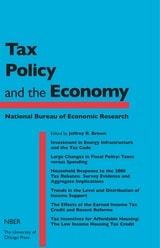
Tax Policy and the Economy, Volume 27
Edited by Jeffrey R. Brown
University of Chicago Press Journals, 2013
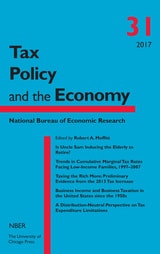
Tax Policy and the Economy, Volume 31
Edited by Robert A. Moffitt
University of Chicago Press Journals, 2017
Tax Policy and the Economy, Volume 33
Edited by Robert A. Moffitt
University of Chicago Press Journals, 2019
Tax Policy and the Economy, Volume 34
Edited by Robert A. Moffitt
University of Chicago Press Journals, 2020
Tax Policy and the Economy, Volume 35
Edited by Robert A. Moffitt
University of Chicago Press Journals, 2021
Tax Policy and the Economy, Volume 36
Edited by Robert A. Moffitt
University of Chicago Press Journals, 2022
Natasha Sarin, Lawrence Summers, Owen Zidar, and Eric Zwick study how investors respond to taxes on capital gains, whether their incentives to invest are affected by those taxes, and whether that responsiveness has changed over time. Ethan Rouen, Suresh Nallareddy, and Juan Carlos Suárez Serrato revisit the question of whether cuts to corporate taxes increase income inequality, bringing new data and new statistical techniques to generate fresh findings. Alan Auerbach and William Gale investigate whether the advantages and disadvantages of different types of taxation are affected when interest rates stay low for long periods, as has been the case in the U.S. for many years. Nora Gordon and Sarah Reber study the distributional impact of emergency subsidies to schools made by the federal government during the recent COVID pandemic and whether those subsidies were sufficient to cover the increased school costs induced by the pandemic. Jacob Goldin, Elaine Maag, and Katherine Michelmore investigate the fiscal cost of an expansion of the U.S. child tax credit, which has been discussed extensively in policy circles recently. They take into account not only the direct expenditure on the allowance but how cost is affected by the existence of work incentives and by possible beneficial effects on childrens’ adult earnings.
Tax Policy and the Economy, Volume 37
Edited by Robert A. Moffitt
University of Chicago Press Journals, 2023
Tax Policy and the Economy publishes current academic research on taxation and government spending with both immediate bearing on policy debates and longer-term interest.
This volume of Tax Policy and the Economy presents new research on important issues concerning US taxation and transfers. First, Edward L. Glaeser, Caitlin S. Gorback, and James M. Poterba examine the distribution of burdens associated with taxes on transportation. Replacing the gasoline tax with a vehicle-miles-traveled (VMT) tax would increase the burden on higher-income households, who drive more fuel-efficient cars and are more likely to own electric vehicles. User charges for airports, subways, and commuter rail are progressive, while the burden of bus fees is larger for lower-income households than for their higher-income counterparts. Next, Katarzyna Bilicka, Michael Devereux, and Irem Güçeri investigate tax shifting by multinational companies (MNCs) and the implications of a potential Global Minimum Tax (GMT). They find that MNCs shift intellectual property to tax havens, and that a large share of patenting activity takes place in tax havens where little or no R&D occurs. Tax havens are particularly important for MNCs with large subsidiary networks; such firms would likely be subject to a GMT. Mark Duggan, Audrey Guo, and Andrew C. Johnston study the role of experience rating in the Unemployment Insurance (UI) system and find that the current structure stabilizes the labor market because it penalizes firms with high rates of UI-eligible layoffs. In the fourth paper, David Altig, Laurence J. Kotlikoff, and Victor Yifan Ye calculate how retiring at different ages will affect Social Security benefit amounts, taking into account taxation and other benefits. They find that virtually all individuals aged 45 to 62 should wait until age 65 or later to maximize their Social Security benefits. Indeed, 90 percent would benefit from waiting until age 70, but only 10 percent do so. Finally, Jonathan Meer and Joshua Witter examine the potential impact of the Earned Income Tax Credit on the labor force decisions of childless adults who are eligible for a small credit after they reach age 25. Comparing labor force attachment changes just before and after this age suggests that the EITC has little impact on the labor force participation of this group.
Tax Policy and the Economy, Volume 38
Edited by Robert A. Moffitt
University of Chicago Press Journals, 2024
Tax Policy and the Economy publishes current academic research on taxation and government spending with both immediate bearing on policy debates and longer-term interest.
This volume presents new research on taxation and public expenditure programs, with particular focus on how they affect economic behavior. John Guyton, Kara Leibel, Dayanand Manoli, Ankur Patel, Mark Payne, and Brenda Schafer study the disallowance of Earned Income Tax Credit (EITC) benefits as a result of IRS audits, and find that in post-audit years, audited taxpayers are less likely than similar non-audited taxpayers to claim EITC benefits. Janet Holtzblatt, Swati Joshi, Nora Cahill, and William Gale provide new empirical evidence on racial differences in the income tax penalty, or bonus, associated with a couple being married. Haichao Fan, Yu Liu, Nancy Qian, and Jaya Wen evaluate how computerizing value-added tax transactions in China affected the tax revenue collected from large manufacturing firms. Niels Johannesen, Daniel Reck, Max Risch, Joel Slemrod, John Guyton, and Patrick Langetieg study data on the ownership of foreign bank accounts and other financial accounts as reported on income tax returns. They find that many of these accounts are in tax havens, and they discuss the impact of the Foreign Account Tax Compliance Act on tax compliance and government revenue. Louis Kaplow integrates charitable giving into an optimal income tax framework, and shows that the externalities associated with such giving are key to determining its optimal tax treatment. Finally, Roger Gordon compares caps or quantity targets on emissions with carbon taxes and points out that which one dominates can be situation-specific and depend on a number of features of the economy.
Tax Policy and the Economy, Volume 39
Edited by Robert A. Moffitt
University of Chicago Press Journals, 2025
Tax Policy and the Economy publishes current academic research on taxation and government spending with both immediate bearing on policy debates and longer-term interest. This volume highlights new insights on taxation, transfer programs, and related issues. First, analyzing the itemized medical deduction in the US federal income tax, Gopi Shah Goda, Ithai Lurie, Priyanka Parikh, and Chelsea Swete find that this provision disproportionately benefits higher-income taxpayers, particularly after the passage of the 2017 Tax Cuts and Jobs Act. They also consider alternative structures, such as a tax credit, that could make the distribution of the tax benefits for those with high medical outlays more equal. Next, Danny Yagan analyzes factors influencing the US federal budget deficit and the debt-to-GDP ratio. He describes the "growth dividend," the impact of GDP growth on the debt ratio, and warns about the potential costs of high debt-to-GDP ratios, especially when interest rates rise. In the third paper, Theresa Gullo, Benjamin Page, David Weiner, and Heidi Williams synthesize the economic evidence on the economic and budgetary effects of R&D investment and examine how this evidence could be incorporated into the standard projections generated by various federal agencies. Fourth, Rosanne Altshuler, Lysle Boller, and Juan Carlos Suárez Serrato investigate profit shifting by US multinational corporations and evaluate the importance of aggregation errors in reported foreign earnings and on estimates of profit shifting elasticities based on these data. Finally, David Neumark and Zeyu Li find no employment effect of California’s Earned Income Tax Credit on less-skilled single mothers, in contrast with the effects of federal and other states' programs. They suggest that structural differences and interactions with minimum wage laws explain this result.
Tax Policy and the Economy, Volume 40
Edited by Damon Jones and Robert A. Moffitt
University of Chicago Press Journals, 2026
Timely and authoritative research on the latest issues in tax policy.
Tax Policy and the Economy publishes current academic research on taxation and government spending with both immediate bearing on policy debates and longer-term interest.
This volume presents new research on taxation, transfer programs, and related issues. Karen Dynan and Douglas Elmendorf examine the potential impact of automatic fiscal stabilizers on fiscal policy and economic activity. They find that a stabilizer providing direct payments could have produced faster unemployment decline after the Great Recession without raising inflation and much lower inflation after COVID-19 at the cost of a slower unemployment reduction. Alan J. Auerbach and William Gale review federal budget history and project the US debt-to-GDP ratio over the next 30 years, arguing that high projected debt could constrain future policy actions. They also explore possible fiscal consolidation policies. Beatrice Ferrario and Stefanie Stantcheva survey Americans’ views of health care and insurance, finding broad agreement regarding costs, access, and efficiency but partisan gaps in policy preferences stemming from fundamentally different views of government scope rather than contrasting efficiency or fairness beliefs. Jonathan S. Hartley, Kevin A. Hassett, and Joshua D. Rauh analyze the corporate investment response to the Tax Cut and Jobs Act of 2017, finding a larger response than a number of earlier studies of investment sensitivity would have suggested. Joel Slemrod reviews historical taxation based on racial, religious, and gender identity and examines how tax policies that are not conditioned on any of these attributes can nevertheless differentially impact families as a result of systemic differences in their economic circumstances. Finally, Marianne Bitler, Jason Cook, Chloe N. East, Sonya R. Porter, and Laura Tiehen analyze geographic proximity effects on Supplemental Nutrition Assistance Program (SNAP) participation, finding that when a SNAP office opens, participation increases by about 20%. When an office closes, they find that participation drops by about 8% in the next two years.
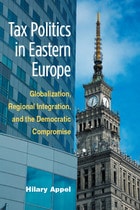
Tax Politics in Eastern Europe
Globalization, Regional Integration, and the Democratic CompromiseHilary Appel
University of Michigan Press, 2011
“This is the first book to systematically examine the variation in policies of Eastern European countries. There is a theoretical contribution to understandings of variation in tax policies, but just as impressive is the in-depth empirical analysis and in particular the data from interviews with key players in the process.”
—Yoshiko Herrera, University of Wisconsin-Madison
Post-Communist tax reform, like institutional reform in other areas of the post-Communist transition, holds tremendous material consequences for different groups in society. Consequently, one would expect the allocation of resources and the distribution of the financial burden of that allocation to be highly sensitive to domestic politics. Indeed the political stakes should be especially high since post-Communist tax reform requires not merely a simple adjustment at the margin, but the fundamental reallocation of the responsibility for government revenue. In Eastern Europe, however, important areas of tax policy do not reflect traditional domestic variables (e.g., interest groups and partisanship) so much as the international imperatives associated with regional and global economic integration.
In Tax Politics in Eastern Europe, Hilary Appel analyzes the domestic and international factors that drive tax policy. She begins with a review of the greatest challenges in the initial creation of the capitalist tax systems in former Communist states and then turns to the evolution of specific forms of taxation in order to gauge the relative impact of domestic politics on tax policy. Appel concludes that, although some tax areas, such as personal income taxes, remain politicized, most other taxes, such as corporate income taxes and all forms of consumption taxes, have been less subject to domestic political pressures because of powerful constraints resulting from regional and global economic integration.

Tax Reform in Developing Countries
Malcolm Gillis, ed.
Duke University Press, 1989
Other conclusions include the apparently mutually reinforcing nature of tax simplification and tax rate reduction, and the role of indirect tax reforms (such as the value-added tax) in successful reform undertakings.
Taxation in the Global Economy
Edited by Assaf Razin and Joel Slemrod
University of Chicago Press, 1990
Assaf Razin and Joel Slemrod gathered experts from two traditionally distinct specialties, taxation and international economics, to lay the groundwork for understanding these issues, which will require the attention of scholars and policymakers for years to come.
Contributors describe the basic provisions of the U.S. tax code with respect to international transactions, highlighting the changes contained in the U.S. Tax Reform Act of 1986; explore the ways that tax systems influence the decisions of multinationals; examine the effect of taxation on trade patterns and capital flows; and discuss the implications of the opening world economy for the design of optimal international tax policy. The papers will prove valuable not only to scholars and students, but to government economists and international tax lawyers as well.
Taxes and Capital Formation
Edited by Martin Feldstein
University of Chicago Press, 1987
By addressing some of the most critical policy issues of the day with a minimum of economic jargon, Taxes and Capital Formation makes the results of Bureau research available to a wide audience of policy officials and staff as well as to members of the business community. The volume should also prove useful for courses in public policy, business, and law. In keeping with Bureau tradition, the papers do not contain policy recommendations; instead, they promote a better understanding of how the economy works and the effects of specific policies on particular aspects of the economy.

Taxing Blackness
Free Afromexican Tribute in Bourbon New SpainNorah L. A. Gharala
University of Alabama Press, 2019
A definitive analysis of the most successful tribute system in the Americas as applied to Afromexicans
During the eighteenth century, hundreds of thousands of free descendants of Africans in Mexico faced a highly specific obligation to the Spanish crown, a tax based on their genealogy and status. This royal tribute symbolized imperial loyalties and social hierarchies. As the number of free people of color soared, this tax became a reliable source of revenue for the crown as well as a signal that colonial officials and ordinary people referenced to define and debate the nature of blackness.
Taxing Blackness: Free Afromexican Tribute in Bourbon New Spain examines the experiences of Afromexicans and this tribute to explore the meanings of race, political loyalty, and legal privileges within the Spanish colonial regime. Norah L. A. Gharala focuses on both the mechanisms officials used to define the status of free people of African descent and the responses of free Afromexicans to these categories and strategies. This study spans the eighteenth century and focuses on a single institution to offer readers a closer look at the place of Afromexican individuals in Bourbon New Spain, which was the most profitable and populous colony of the Spanish Atlantic.
As taxable subjects, many Afromexicans were deeply connected to the colonial regime and ongoing debates about how taxpayers should be defined, whether in terms of reputation or physical appearance. Gharala shows the profound ambivalence, and often hostility, that free people of African descent faced as they navigated a regime that simultaneously labeled them sources of tax revenue and dangerous vagabonds. Some free Afromexicans paid tribute to affirm their belonging and community ties. Others contested what they saw as a shameful imposition that could harm their families for generations. The microhistory includes numerous anecdotes from specific cases and people, bringing their history alive, resulting in a wealth of rural and urban, gender, and family insight.
Taxing Multinational Corporations
Edited by Martin Feldstein, James R. Hines Jr., and R. Glenn Hubbard
University of Chicago Press, 1995
In ten succinct chapters, the book documents the channels through which tax policy in the United States and abroad affects plant and equipment investments, spending on research and development, the cost of debt and equity finance, and dividend repatriations by United States subsidiaries. It also discusses the impact of U.S. firms' outbound foreign investment on domestic and foreign economies. Especially useful to nonspecialists is an appendix that summarizes current United States rules for taxing international income.
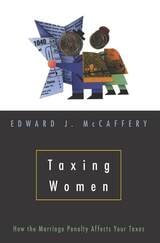
Taxing Women
Edward J. McCaffery
University of Chicago Press, 1997
"Taxing Women is a must-have primer for any woman who wants to understand how our current tax system affects her family's economic condition. In plain English, McCaffery explains how the tax code stacks the deck against women and why it's in women's economic interest to lead the next great tax rebellion."—Patricia Schroeder
"McCaffery is an expert on the interplay between taxes and social policy. . . . Devastating in his analysis. . . . Intriguing."—Harris Collingwood, Working Women
"A wake-up call regarding the inequalities of an archaic system that actually penalizes women for working."—Publishers Weekly
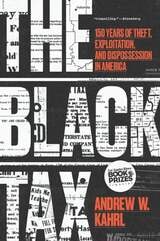
The Black Tax
150 Years of Theft, Exploitation, and Dispossession in AmericaAndrew W. Kahrl
University of Chicago Press, 2024
American taxation is unfair, and it is most unfair to the very people who critically need its support. Not only do taxpayers with fewer resources—less wealth, power, and land—pay more than the well-off, but they are forced to fight for their rights within an unjust system that undermines any attempts to improve their position or economic standing. In The Black Tax, Andrew W. Kahrl reveals the shocking history and ruinous consequences of inequitable and predatory tax laws in this country—above all, widespread and devastating racial dispossession.
Throughout the twentieth century, African Americans acquired substantial amounts of property nationwide. But racist practices, obscure processes, and outright theft diminished their holdings and their power. Of these, Kahrl shows, few were more powerful, or more quietly destructive, than property taxes. He examines all the structural features and hidden traps within America’s tax system that have forced Black Americans to pay more for less and stripped them of their land and investments, and he reveals the staggering cost. The story of America’s now enormous concentration of wealth at the top—and the equally enormous absence of wealth among most Black households—has its roots here.
Kahrl exposes the painful history of these practices, from Reconstruction up to the present, and tells, for the first time, the story of Black Americans’ experiences as taxpayers and their fight for a more fair and equitable system for raising and spending the public’s money. This is a history that deepens our understanding of the disadvantages and persistent inequalities that African American households continue to face and reveals hidden engines of economic inequality in America. Detailing the hows and whys of America’s profoundly unequal tax system, The Black Tax equips readers with the knowledge needed to combat inequality and injustice today.
The Effects of Taxation on Capital Accumulation
Edited by Martin Feldstein
University of Chicago Press, 1987
The Effects of Taxation on Multinational Corporations
Edited by Martin Feldstein, James R. Hines Jr., and R. Glenn Hubbard
University of Chicago Press, 1995
In an attempt to quantify the effect of tax policy on international investment choices, this volume presents in-depth analyses of the interaction of international tax rules and the investment decisions of multinational enterprises. Ten papers assess the role played by multinational firms and their investment in the U.S. economy and the design of international tax rules for multinational investment; analyze channels through which international tax rules affect the costs of international business activities; and examine ways in which international tax rules affect financing decisions of multinational firms. As a group, the papers demonstrate that international tax rules have significant effects on firms' investment and other financing decisions.

The Free List
Property Without TaxesAlfred Balk
Russell Sage Foundation, 1971
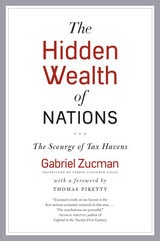
The Hidden Wealth of Nations
The Scourge of Tax HavensGabriel Zucman
University of Chicago Press, 2015
In The Hidden Wealth of Nations, Zucman offers an inventive and sophisticated approach to quantifying how big the problem is, how tax havens work and are organized, and how we can begin to approach a solution. His research reveals that tax havens are a quickly growing danger to the world economy. In the past five years, the amount of wealth in tax havens has increased over 25%—there has never been as much money held offshore as there is today. This hidden wealth accounts for at least $7.6 trillion, equivalent to 8% of the global financial assets of households. Fighting the notion that any attempts to vanquish tax havens are futile, since some countries will always offer more advantageous tax rates than others, as well the counter-argument that since the financial crisis tax havens have disappeared, Zucman shows how both sides are actually very wrong. In The Hidden Wealth of Nations he offers an ambitious agenda for reform, focused on ways in which countries can change the incentives of tax havens. Only by first understanding the enormity of the secret wealth can we begin to estimate the kind of actions that would force tax havens to give up their practices.
Zucman’s work has quickly become the gold standard for quantifying the amount of the world’s assets held in havens. In this concise book, he lays out in approachable language how the international banking system works and the dangerous extent to which the large-scale evasion of taxes is undermining the global market as a whole. If we are to find a way to solve the problem of increasing inequality, The Hidden Wealth of Nations is essential reading.

The Minnesota Department of Taxation
An Administrative HistoryLloyd Short
University of Minnesota Press, 1955
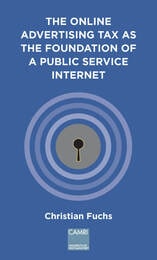
The Online Advertising Tax as the Foundation of a Public Service Internet
a CAMRI extended policy reportChristian Fuchs
University of Westminster Press, 2018
Online advertising will soon form the largest share of global advertisement revenues. Google and Facebook netted profits of US $29 billion in 2016. While these two giants control more than 66% of all online advertising revenues complex legal company structures have minimised their tax liabilities. This extended policy report considers where they should be taxed and where the value of their activities is actually created. It argues that tax paid by those platforms should be levied in the country where platform users are located when they click on or view an advertisement. Furthermore, the report examines the practical steps needed to ensure transparent accounting of taxed transactions in order to avoid long term negative effects for media and democracy.
Considering counter-arguments the author makes the case for an online advertising tax alongside a public service Internet strategy that could support other viable platforms and counter the dangers of duopoly or oligopoly and the high risks of financial bubbles in a world where advertising is the Internet's dominant business model.
The Political Economy of Tax Reform
Edited by Takatoshi Ito and Anne O. Krueger
University of Chicago Press, 1992
Experts from Taiwan, Korea, the Philippines, Japan, and Thailand, as well as the United States, Canada, and Israel examine the major tax programs of the 1980s and their domestic and international economic effects. The analyses reveal similarities between the United States and countries in East Asia in political constraints on policy making, and taken together they show how growing interdependence interacts with domestic economic and political concerns to affect issues as politically vital as tax reform. Economists, policymakers, and members of the business community will benefit from these studies.

The Politics of Fiscal Privilege in Provence, 1530s-1830s
Rafe Blaufarb
Catholic University of America Press, 2012
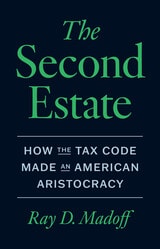
The Second Estate
How the Tax Code Made an American AristocracyRay D. Madoff
University of Chicago Press, 2025
Named by The New Yorker as one of the Best Books of 2025 and featured on the Armchair Expert podcast with Dax Shepherd.
A revelatory book that lifts the curtain on America’s most consequential public deception: how the rich get richer using tools the government gave them.
Amid conflicting narratives about the drivers of wealth and inequality in the United States, one constant hovers in the background: the US tax code. No political force has been more consequential—or more utterly opaque—than the 7,000-page document that details who pays what in American society and government. Most of us have a sense that it’s an unfair system. But does anyone know exactly how it’s unfair?
Legal scholar Ray D. Madoff knows. In The Second Estate, she offers an unprecedented look behind the scenes of America’s byzantine system of taxation, laying bare not only its capacity to consolidate wealth but also the mechanisms by which it has created two fundamentally separate American societies: the working Americans who pay and the ultra-rich who benefit.
This is not a story of offshore accounts or secret tax havens. In The Second Estate, Madoff shows that the US system itself has, over time, been stripped and reconstituted such that it now offers a series of secret paths, hidden in plain sight, for wealthy people in the know to avoid taxation altogether. Through the strategic avoidance of traditional income, leveraging of investments and debt, and exploitation of rules designed to promote charitable giving, America’s wealthy do more than just pay less than their share; they remove themselves from the tax system entirely. Wealth becomes its own sovereign state, and the living is surprisingly—and maddeningly—cheap.
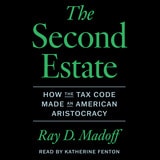
The Second Estate
How the Tax Code Made an American AristocracyRay D. Madoff
University of Chicago Press, 2025
Named by The New Yorker as one of the Best Books of 2025 and featured on the Armchair Expert podcast with Dax Shepherd.
A revelatory book that lifts the curtain on America’s most consequential public deception: how the rich get richer using tools the government gave them.
Amid conflicting narratives about the drivers of wealth and inequality in the United States, one constant hovers in the background: the US tax code. No political force has been more consequential—or more utterly opaque—than the 7,000-page document that details who pays what in American society and government. Most of us have a sense that it’s an unfair system. But does anyone know exactly how it’s unfair?
Legal scholar Ray D. Madoff knows. In The Second Estate, she offers an unprecedented look behind the scenes of America’s byzantine system of taxation, laying bare not only its capacity to consolidate wealth but also the mechanisms by which it has created two fundamentally separate American societies: the working Americans who pay and the ultra-rich who benefit.
This is not a story of offshore accounts or secret tax havens. In The Second Estate, Madoff shows that the US system itself has, over time, been stripped and reconstituted such that it now offers a series of secret paths, hidden in plain sight, for wealthy people in the know to avoid taxation altogether. Through the strategic avoidance of traditional income, leveraging of investments and debt, and exploitation of rules designed to promote charitable giving, America’s wealthy do more than just pay less than their share; they remove themselves from the tax system entirely. Wealth becomes its own sovereign state, and the living is surprisingly—and maddeningly—cheap.
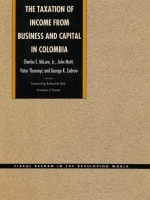
The Taxation of Income from Business and Capital in Colombia
Charles E. McLure, Jr., John Mutti, Victor Thuronyi, and George R. Zodrow
Duke University Press, 1990
“[The book’s] most important contribution, however, is undoubtedly with respect to consumption taxes. No one, anywhere, has thought through with such care just how the so-called ‘simplified alternative tax’ (essentially a direct personal consumption tax combined with a cash-flow corporate tax) might work in the real world. Since such taxes are increasingly being considered—if not adopted—all over the world, in developing and developed countries alike, for this reason alone this book should be high on the reading list of all those concerned with the design and implementation of efficient and equitable direct tax systems.”—From the Foreword by Richard M. Bird
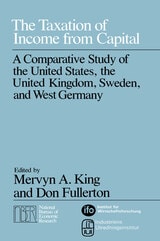
The Taxation of Income from Capital
A Comparative Study of the United States, the United Kingdom, Sweden and West GermanyMervyn A. King and Don Fullerton
University of Chicago Press, 1984