Results by title
333 books match the query 'Television' and 83 start with t
TV Family Values
Gender, Domestic Labor, and 1980s SitcomsAlice Leppert
Rutgers University Press, 2019
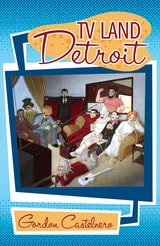
TV Land--Detroit
Gordon Castelnero
University of Michigan Press, 2006
Long before cable, prepackaged syndication, infomercials, do-it-yourselfers, and reality shows cluttered the television dial, there was a brand of entertainment that has today nearly vanished from the airwaves: local TV. And with its colorful and quirky cast of characters, Detroit TV arguably offered some of the best of the best of local programming anywhere in the nation-a smorgasbord of exuberant, one-of-a-kind television shows.
Based on actual interviews with the people who made Detroit TV, Gordon Castelnero's TV Land-Detroit awakens the emotional attachment and nostalgia our community has for these shows, bringing the beloved characters and memorable programs back to life.
From the glamorous Rita Bell to the insanity of the Ghoul, the zany Jingles in Boofland to the opinionated and often confrontational Lou Gordon and the gruff-voiced and somnolent George Pierrot, Castelnero reacquaints us with the talent and behind-the-scenes people, of the creative spirit in Detroit, and the intimacy they shared with the community both on and off the air.
Gordon Castelnero was a producer at WNIC radio for four years. He produced the acclaimed documentaries for WDIV and WTVS, Michigan, It Started Here! Michigan and the American Dream, and Titanic: The Final Chapter. He currently lives in Livonia, Michigan, and works at Technicolor in DVD and game media distribution. He can be contacted by e-mail at tvlanddetroit@yahoo.com

TV Museum
Contemporary Art and the Age of TelevisionMaeve Connolly
Intellect Books, 2014
Lavishly illustrated and with in-depth discussion of over fifty canonical and contemporary artworks, TV Museum offers a new approach to the analysis of television’s place within contemporary art and culture.
TV Snapshots
An Archive of Everyday LifeLynn Spigel
Duke University Press, 2022
TV Socialism
Anikó Imre
Duke University Press, 2016
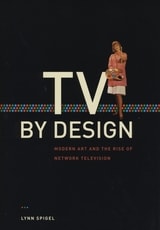
TV by Design
Modern Art and the Rise of Network TelevisionLynn Spigel
University of Chicago Press, 2008
Whereas most histories of television focus on the way older forms of entertainment were recycled for the new medium, Lynn Spigel shows how TV was instrumental in introducing the public to the latest trends in art and design. Abstract expressionism, pop art, art cinema, modern architecture, and cutting-edge graphic design were all mined for staging techniques, scenic designs, and an ever-growing number of commercials. As a result, TV helped fuel the public craze for trendy modern products, such as tailfin cars and boomerang coffee tables, that was vital to the burgeoning postwar economy. And along with influencing the look of television, many artists—including Eero Saarinen, Ben Shahn, Saul Bass, William Golden, and Richard Avedon—also participated in its creation as the networks put them to work designing everything from their corporate headquarters to their company cufflinks.
Tabloid Culture
Trash Taste, Popular Power, and the Transformation of American TelevisionKevin Glynn
Duke University Press, 2000
Glynn begins by situating these media shifts within the context of Reaganism, which gave rise to distinctive ideological currents in society and led the socially and economically disenfranchised to access new forms of information via the exploding television industry. He then tackles specific daytime talk shows and tabloid newscasts such as Jerry Springer and A Current Affair, reality-TV programs such as Cops and America’s Most Wanted, and two different supermarket tabloids’ coverage of the O.J. Simpson case. Tabloid Culture is the first book to treat these diverse yet related media forms and events in tandem. Rejecting the elitist dismissal of sensationalist media, Glynn instead traces the cultural currents and countercurrents running through their forms and products. Locating both reactionary and oppositional meanings in these texts, he demonstrates how these particular media genres draw on and contribute to important cultural struggles over the meanings of race, sexuality, gender, class, “normality,” “truth,” and “reality.” The study ends by discussing how the growing use of the Internet provides an entirely new realm in which such material can circulate, distort, inform, and flourish.
This innovative and provocative study of contemporary mainstream media culture in the United States will be valuable to those interested in both print and television media, the cultural-political influence of the Reagan era, and American culture in general.
Talking #browntv
Latinas and Latinos on the ScreenFrederick Luis Aldama and William Anthony Nericcio
The Ohio State University Press, 2019
From the subversive critiques embedded in well-loved children’s characters like Speedy Gonzalez to the perpetuation of racial stereotypes in modern-era pornography, from Eva Longoria as ethnic mannequin to J-Lo flipping the sexy Latina music video on its head in “I Luh Ya Papi,” and with more than 150 full-color images, Aldama and Nericcio seek to expose the underlying causes as to why Latina/os constitute only 2 percent of mainstream cultural production when they’re the majority minority in the US. In a moment when anti-Mexican and anti-immigrant rhetoric oozes from TV sets and medias platform, Talking #browntv emerges as a bold antidote, an eloquent rejoinder, and a thoughtful meditation on Latina/os on the American screen and in America today.
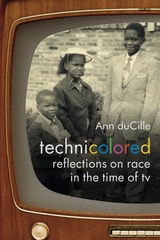
Technicolored
Reflections on Race in the Time of TVAnn duCille
Duke University Press, 2018
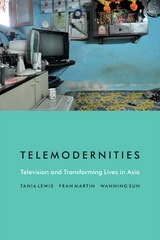
Telemodernities
Television and Transforming Lives in AsiaTania Lewis, Fran Martin, and Wanning Sun
Duke University Press, 2016
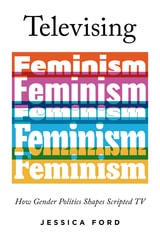
Televising Feminism
How Gender Politics Shapes Scripted TVJessica Ford
University of Illinois Press, 2026
Jessica Ford examines popular media’s tendency to apply the feminist label to all women-centric TV. Focusing on the post-Sex and the City era that began in 2005, Ford explores how women-centric scripted TV absorbed the feminisms of its past. It now televises these feminisms in divergent, diffuse, and distinct ways that find expression as a sensibility rather than a cogent politic, genre, or category. Ford’s analysis examines shows identified as feminist alongside programs that negotiate ideas, offer critiques, generate feelings and sentiments, and deploy aesthetics in both low-key and visible political ways.
Innovative and insightful, Televising Feminism looks at the construction and expression of the many feminisms at work on American scripted television.
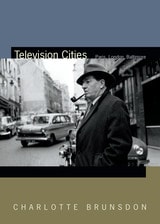
Television Cities
Paris, London, BaltimoreCharlotte Brunsdon
Duke University Press, 2018

Television Drama in Spain and Latin America
Genre and Format TranslationPaul Julian Smith
University of London Press, 2018
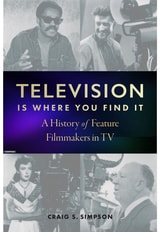
Television Is Where You Find It
A History of Feature Filmmakers in TVCraig S. Simpson
Rutgers University Press, 0
Television Is Where You Find It is a revelatory journey into the overlooked world of feature filmmakers who brought their cinematic vision to the small screen between 1955 and 1990—long before directing for television became trendy in the age of “Prestige TV.” With ten compelling case studies—from legends like Alfred Hitchcock, David Lynch, and Orson Welles to trailblazers like Ida Lupino, Melvin Van Peebles, and Martin Scorsese—author Craig S. Simpson uncovers how these directors reshaped the language of television with style and imagination.
Far from simply dabbling in a “lesser” medium, these filmmakers pushed the boundaries of what TV could do, crafting bold, innovative work that challenges the old notion that television belongs solely to writers and producers. In this fresh, critical study, Television Is Where You Find It makes a case for rediscovering and reevaluating a rich chapter of television history—one in which cinematic artistry quietly flourished, often hidden in plain sight.
Television Rewired
The Rise of the Auteur SeriesBy Martha P. Nochimson
University of Texas Press, 2019
In 1990, American television experienced a seismic shift when Twin Peaks premiered, eschewing formulaic plots and clear lines between heroes and villains. This game-changing series inspired a generation of show creators to experiment artistically, transforming the small screen in ways that endure to this day.
Focusing on six shows (Twin Peaks, with a critical analysis of both the original series and the 2017 return; The Wire; Treme; The Sopranos; Mad Men; and Girls), Television Rewired explores what made these programs so extraordinary. As their writers and producers fought against canned plots and moral simplicity, they participated in the evolution of the exhilarating new auteur television while underscoring the fact that art and entertainment don't have to be mutually exclusive. Nochimson also makes provocative distinctions between true auteur television and shows that were inspired by the freedom of the auteur series but nonetheless remained entrenched within the parameters of formula. Providing opportunities for vigorous discussion, Television Rewired will stimulate debates about which of the new television series since 1990 constitute “art” and which are tweaked “business-driven storytelling.”
Television Talk
A History of the TV Talk ShowBy Bernard M. Timberg
University of Texas Press, 2002
A CHOICE Outstanding Academic Book
Flip through the channels at any hour of the day or night, and a television talk show is almost certainly on. Whether it offers late-night entertainment with David Letterman, share-your-pain empathy with Oprah Winfrey, trash talk with Jerry Springer, or intellectual give-and-take with Bill Moyers, the talk show is one of television's most popular and enduring formats, with a history as old as the medium itself.
Bernard Timberg here offers a comprehensive history of the first fifty years of television talk, replete with memorable moments from a wide range of classic talk shows, as well as many of today's most popular programs. Dividing the history into five eras, he shows how the evolution of the television talk show is connected to both broad patterns in American culture and the economic, regulatory, technological, and social history of the broadcasting industry. Robert Erler's "A Guide to Television Talk" complements the text with an extensive "who's who" listing of important people and programs in the history of television talk.
Television after TV
Essays on a Medium in TransitionLynn Spigel and Jan Olsson, eds.
Duke University Press, 2004
With historical, critical, and speculative essays by some of the leading television and media scholars, Television after TV examines both commercial and public service traditions and evaluates their dual (and some say merging) fates in our global, digital culture of convergence. The essays explore a broad range of topics, including contemporary programming and advertising strategies, the use of television and the Internet among diasporic and minority populations, the innovations of new technologies like TiVo, the rise of program forms from reality tv to lifestyle programs, television’s changing role in public places and at home, the Internet’s use as a means of social activism, and television’s role in education and the arts. In dialogue with previous media theorists and historians, the contributors collectively rethink the goals of media scholarship, pointing toward new ways of accounting for television’s past, present, and future.
Contributors. William Boddy, Charlotte Brunsdon, John T. Caldwell, Michael Curtin, Julie D’Acci, Anna Everett, Jostein Gripsrud, John Hartley, Anna McCarthy, David Morley, Jan Olsson, Priscilla Peña Ovalle, Lisa Parks, Jeffrey Sconce, Lynn Spigel, William Uricchio
Television and Criticism
Edited by Solange Davin and Rhona Jackson
Intellect Books, 2008
Television and the Afghan Culture Wars
Brought to You by Foreigners, Warlords, and ActivistsWazhmah Osman
University of Illinois Press, 2020
Fieldwork from across Afghanistan allowed Osman to record the voices of many Afghan media producers and people. Afghans offer their own seldom-heard views on the country's cultural progress and belief systems, their understandings of themselves, and the role of international interventions. Osman analyzes the impact of transnational media and foreign funding while keeping the focus on local cultural contestations, productions, and social movements. As a result, she redirects the global dialogue about Afghanistan to Afghans and challenges top-down narratives of humanitarian development.
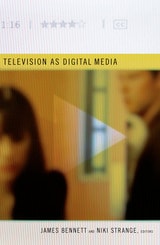
Television as Digital Media
James Bennett and Niki Strange, eds.
Duke University Press, 2011
Introducing the collection, James Bennett explains how television as digital media is a non-site-specific, hybrid cultural and technological form that spreads across platforms such as mobile phones, games consoles, iPods, and online video services, including YouTube, Hulu and the BBC’s iPlayer. Television as digital media threatens to upset assumptions about television as a mass medium that has helped define the social collective experience, the organization of everyday life, and forms of sociality. As often as we are promised the convenience of the television experience “anytime, anywhere,” we are invited to participate in communities, share television moments, and watch events live. The essays in this collection demonstrate the historical, production, aesthetic, and audience changes and continuities that underpin the emerging meaning of television as digital media.
Contributors. James Bennett, William Boddy, Jean Burgess, John Caldwell, Daniel Chamberlain, Max Dawson, Jason Jacobs, Karen Lury, Roberta Pearson, Jeanette Steemers, Niki Strange, Julian Thomas, Graeme Turner
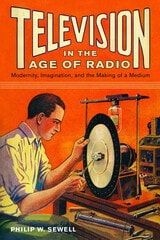
Television in the Age of Radio
Modernity, Imagination, and the Making of a MediumSewell, Philip W
Rutgers University Press, 2014
Television existed for a long time before it became commonplace in American homes. Even as cars, jazz, film, and radio heralded the modern age, television haunted the modern imagination. During the 1920s and 1930s, U.S. television was a topic of conversation and speculation. Was it technically feasible? Could it be commercially viable? What would it look like? How might it serve the public interest? And what was its place in the modern future? These questions were not just asked by the American public, but also posed by the people intimately involved in television’s creation. Their answers may have been self-serving, but they were also statements of aspiration. Idealistic imaginations of the medium and its impact on social relations became a de facto plan for moving beyond film and radio into a new era.
In Television in the Age of Radio, Philip W. Sewell offers a unique account of how television came to be—not just from technical innovations or institutional struggles, but from cultural concerns that were central to the rise of industrial modernity. This book provides sustained investigations of the values of early television amateurs and enthusiasts, the fervors and worries about competing technologies, and the ambitions for programming that together helped mold the medium.
Sewell presents a major revision of the history of television, telling us about the nature of new media and how hopes for the future pull together diverse perspectives that shape technologies, industries, and audiences.

Television, History, and American Culture
Feminist Critical EssaysMary Beth Haralovich and Lauren Rabinovitz, eds.
Duke University Press, 1999
The essays collected here focus on women in front of, behind, and on the TV screen, as producers, viewers, and characters. Using feminist and historical criticism, the contributors investigate how television has shaped our understanding of gender, power, race, ethnicity, and sexuality from the 1950s to the present. The topics range from the role that women broadcasters played in radio and early television to the attempts of Desilu Productions to present acceptable images of Hispanic identity, from the impact of TV talk shows on public discourse and the politics of offering viewers positive images of fat women to the negotiation of civil rights, feminism, and abortion rights on news programs and shows such as I Spy and Peyton Place.
Innovative and accessible, this book will appeal to those interested in women’s studies, American studies, and popular culture and the critical study of television.
Contributors. Julie D’Acci, Mary Desjardins, Jane Feuer, Mary Beth Haralovich, Michele Hilmes, Moya Luckett, Lauren Rabinovitz, Jane M. Shattuc, Mark Williams
Television, Japan, and Globalization
Mitsuhiro Yoshimoto, Eva Tsai, and JungBong Choi, Editors
University of Michigan Press, 2010
Television, Nation, and Culture in Indonesia
Ris Sea#104Philip Kitley
Ohio University Press, 2000

Television, Tabloids, and Tears
Fassbinder and Popular CultureJane Shattuc
University of Minnesota Press, 1995
Television, Tabloids, and Tears was first published in 1995. Minnesota Archive Editions uses digital technology to make long-unavailable books once again accessible, and are published unaltered from the original University of Minnesota Press editions.
"I am Biberkopf," Rainer Werner Fassbinder declared, aligning himself with the protagonist of his widely seen television adaptation of Berlin Alexanderplatz. The statement provoked an unprecedented national debate about what constituted an acceptable German artist and who has the power to determine art. More than any recent German director, Fassbinder embodied this debate, and Jane Shattuc shows us how much this can tell us, not just about the man and his work, but also about the state of "culture" in Germany.
It is fascinating in itself that Fassbinder, a highly controversial public figure, was chosen to direct Berlin Alexanderplatz, Germany's longest, costliest, and most widely viewed television drama. Shattuc exposes the dichotomy of institutional support for this project versus the scandalous controversial reputation of Fassbinder as a gay man who flaunted his sexuality and involvement with drugs.
Fassbinder built his reputation on two separate images of the director-the faithful adapter and the underground star; with Berlin Alexanderplatz these two identities came together explosively. Tracing the two artistic paths that led Fassbinder to this moment, Shattuc offers us a look at cultural class divisions in Germany. Her account of Fassbinder's history as an Autor reveals both the triumph and the failure of bourgeois cultural domination in postwar West Germany.
Television, a memoir
Karen Brennan
Four Way Books, 2022
Television, a memoir is a hybrid collection of autobiographical pieces, tragi-comic in spirit, that depict a woman’s life evolving through time and culture in fragmentary glimpses. Indeterminate in genre, Television is a fluid text that sometimes reads as poetry, sometimes as prose, while exploring classism, ableism, and feminism in a world defined by the advent of new media and, for the author, a privilege that often felt suffocating. Working structurally and thematically, television creates conceptual mileposts in the memoir, with certain programs and cultural references corresponding to specific eras in the author’s past, but it also gestures at an existential modality — the experience of a televisual life, the performative arrangements of nuclear families and neighborhoods, the periodic events and dramas of an adolescence watched from outside oneself.

Television
An international history of the formative yearsR.W. Burns
The Institution of Engineering and Technology, 1998
Televisuality
Style, Crisis, and Authority in American TelevisionJohn T Caldwell
Rutgers University Press, 2020
That's the Way It Is
A History of Television News in AmericaCharles L. Ponce de Leon
University of Chicago Press, 2015
The critics may be right. But, as Charles L. Ponce de Leon explains in That’s the Way It Is, TV news has always walked a fine line between hard news and fluff. The familiar story of decline fails to acknowledge real changes in the media and Americans’ news-consuming habits, while also harking back to a golden age that, on closer examination, is revealed to be not so golden after all. Ponce de Leon traces the entire history of televised news, from the household names of the late 1940s and early ’50s, like Eric Sevareid, Edward R. Murrow, and Walter Cronkite, through the rise of cable, the political power of Fox News, and the satirical punch of Colbert and Stewart. He shows us an industry forever in transition, where newsmagazines and celebrity profiles vie with political news and serious investigations. The need for ratings success—and the lighter, human interest stories that can help bring it—Ponce de Leon makes clear, has always sat uneasily alongside a real desire to report hard news.
Highlighting the contradictions and paradoxes at the heart of TV news, and telling a story rich in familiar figures and fascinating anecdotes, That’s the Way It Is will be the definitive account of how television has showed us our history as it happens.
The American Historical Imaginary
Contested Narratives of the PastCaroline Guthrie
Rutgers University Press, 2023
The Apartment Complex
Urban Living and Global Screen CulturesPamela Robertson Wojcik
Duke University Press, 2018
Contributors. Steven Cohan, Michael DeAngelis, Veronica Fitzpatrick, Annamarie Jagose, Paula J. Massood, Joe McElhaney, Merrill Schleier, Lee Wallace, Pamela Robertson Wojcik
The Apartment Plot
Urban Living in American Film and Popular Culture, 1945 to 1975Pamela Robertson Wojcik
Duke University Press, 2010
The Big Story
The Oral History of Philadelphia TV NewsDavid Grzybowski
Temple University Press, 2025
“We were the only station that stayed on the air continuously. We even pre-empted the CBS evening news.”—Larry Kane, anchor at WCAU, about covering the MOVE bombing
“The highs of working during the pandemic were keeping people informed of this deadly virus and what they had to do to take care of themselves and each other.”—Ukee Washington, KYW anchor, on the pandemic
The Big Story is David Grzybowski’s engrossing oral history of Philadelphia TV news from the perspective of reporters, photographers, producers, and news directors. Covering all the big stories from the late 1970s through the present, this fast-paced running commentary reflects on the uncertainty of the Three Mile Island disaster, the thrill of the Live Aid concert, the “Storm of the Century” (that wasn’t), and the championship victories of the Phillies and the Eagles, among other notable events, local, national, and global.
The Big Story features more than 200 interviews, including anecdotes from seasoned Philadelphia anchors Jim Gardner, Larry Kane, Lisa Thomas-Laury, Mike Jerrick, Vai Sikahema, Tamala Edwards, Pat Ciarrocchi, and Cecily Tynan, among others, about their experience on and off the job. Decision makers reflect on how to cover hot news stories such as Pennsylvania State Treasure R. Budd Dwyer’s on-air suicide. (“It was a big bloody horrifying mess,” according to Chris Wagner, WPVI anchor.)
Grzybowski highlights the Mummers, the launch of Good Day Philadelphia, off-the-air scandals, and how the Action News style secured a loyal following with Philadelphians while the Eyewitness News format competed hard to gain ratings. But the Big Story is how The Big Story provides compelling stories about Philadelphia’s news breakers and newsmakers.
The Byronic Hero in Film, Fiction, and Television
Atara Stein
Southern Illinois University Press, 2004
The Byronic Hero in Film, Fiction, and Television bridges nineteenth- and twentieth-century studies in pursuit of an ambitious, antisocial, arrogant, and aggressively individualistic mode of hero from his inception in Byron’s Manfred, Childe Harold, and Cain, through his incarnations as the protagonists of Westerns, action films, space odysseys, vampire novels, neo-Gothic comics, and sci-fi television. Such a hero exhibits supernatural abilities, adherence to a personal moral code, ineptitude at human interaction (muddled even further by self-absorbed egotism), and an ingrained defiance of oppressive authority. He is typically an outlaw, most certainly an outcast or outsider, and more often than not, he is a he. Given his superhuman status, this hero offers no potential for sympathetic identification from his audience. At best, he provides an outlet for vicarious expressions of power and independence. While audiences may not seek to emulate the Byronic hero, Stein notes that he desires to emulate them; recent texts plot to “rehumanize” the hero or to voice through him approbation and admiration of ordinary human values and experiences.
Tracing the influence of Lord Byron’s Manfred as outcast hero on a pantheon of his contemporary progenies—including characters from Pale Rider, Unforgiven, The Terminator, Alien, The Crow, Sandman, Star Trek: The Next Generation,and Angel—Atara Stein tempers her academic acumen with the insights of a devoted aficionado in this first comprehensive study of the Romantic hero type and his modern kindred.
Atara Stein was a professor of English at California State University, Fullerton. Her articles on the development of the Byronic hero have appeared in Popular Culture Review, Romantic Circles Praxis Series, Genders, and Philological Quarterly.
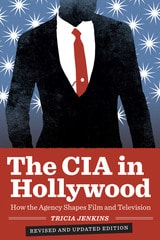
The CIA in Hollywood
How the Agency Shapes Film and TelevisionBy Tricia Jenkins
University of Texas Press, 2016
What’s your impression of the CIA? A bumbling agency that can’t protect its own spies? A rogue organization prone to covert operations and assassinations? Or a dedicated public service that advances the interests of the United States? Astute TV and movie viewers may have noticed that the CIA’s image in popular media has spanned this entire range, with a decided shift to more positive portrayals in recent years. But what very few people know is that the Central Intelligence Agency has been actively engaged in shaping the content of film and television, especially since it established an entertainment industry liaison program in the mid-1990s.
The CIA in Hollywood offers the first full-scale investigation of the relationship between the Agency and the film and television industries. Tricia Jenkins draws on numerous interviews with the CIA’s public affairs staff, operations officers, and historians, as well as with Hollywood technical consultants, producers, and screenwriters who have worked with the Agency, to uncover the nature of the CIA’s role in Hollywood. In particular, she delves into the Agency’s and its officers’ involvement in the production of The Agency, In the Company of Spies, Alias, The Recruit, The Sum of All Fears, Enemy of the State, Syriana, The Good Shepherd, and more. Her research reveals the significant influence that the CIA now wields in Hollywood and raises important and troubling questions about the ethics and legality of a government agency using popular media to manipulate its public image.

The Castaways
How Producers Lost Their Independence and Conjured Up the Outsider SitcomLarry Durst
Rutgers University Press, 2027
In the early 1960s a new style of situation comedy took over primetime as Bewitched, Gilligan’s Island, Gomer Pyle, U.S.M.C., I Dream of Jeannie, My Favorite Martian, and other “Outsider Sitcoms” featuring alien characters disrupting their TV environments shot to the top of the ratings. Departing from a critical approach that understands these series as reflections of the decade’s many social disruptions, The Castaways reveals the programs as emotional responses by their creators to a more personal upheaval: their loss of influence in the broadcast industry. As network executives turned increasingly to audience research, independent producers felt the ability that had been most crucial to their success in broadcasting was being devalued: gut creative intuition. Drawing on memoirs, show treatments, and other original documents, The Castaways uncovers how leading characters on the programs served as emotional proxies for their creators’ fears of industry irrelevance as they were cast out from the corporate halls of power where their series’—and personal—fates were decided.
The Comedy Studies Reader
Edited by Nick Marx and Matt Sienkiewicz
University of Texas Press, 2018
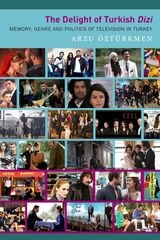
The Delight of Turkish Dizi
Memory, Genre and Politics of Television in TurkeyArzu Öztürkmen
Seagull Books, 2021
Standing at the crossroads of folklore, media, and performance studies, Arzu Öztürkmen explores the rise of the dizi genre in Turkey since the 1970s, when national television broadcasting began in the country. The Delight of Turkish Dizi approaches this unique genre—not quite soap opera or telenovela—as an art form that developed with the collective creative input of writers, producers, directors, actors, editors, musicians, and, lately, international distributors. Öztürkmen shows how dizi-making is a marathon run by sprinters, where production and broadcasting processes have been tightly interwoven, offering a mode of communication and consumption that is distinct to the Turkish television industry. The research consists of oral history with key figures in dizi production and ethnographic surveys of film sets, international content markets, and award ceremonies. This first-ever monograph on Turkish dizi will be a valuable addition to the field of performance and media studies while delighting the general reader as well.
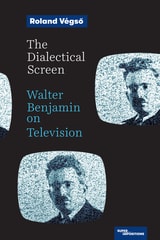
The Dialectical Screen
Walter Benjamin on TelevisionRoland Végso
Northwestern University Press, 2027
Exploring the meanings of media technologies through Walter Benjamin’s thought
Walter Benjamin’s prime years as a cultural critic coincided with the rise of televised broadcasting in Europe and North America, a unique period of rapid expansion in a new technological medium. So why would such a subtle and sensitive critic of media, known for his cultural criticism across genres, seem to have ignored or even missed the entire phenomenon of television? This book reveals how television, as a concept and a metaphor, in fact structures Benjamin’s philosophy.
Through a careful reading of Benjamin’s work across various media—literature, photography, cinema, radio, and television—Roland Végső reconstructs a powerful vision of media technologies as not merely tools of communication but as forces that shape how we imagine and construct the world as a conceptual totality. The Dialectical Screen provides a timely and provocative framework for understanding how media continue to shape our political, cultural, and existential horizons, recasting Benjamin's understanding of historical materialism in fundamentally tele-visual terms as a theoretical orientation that makes visible the perishing of the world itself.
The Expanding Vista
American Television in the Kennedy YearsMary Ann Watson
Duke University Press, 1994
The Femme Fatale
Julie Grossman
Rutgers University Press, 2020
This book offers readers a concise look at over a century of femmes fatales on both the silver screen and the TV screen. Starting with ethnically exoticized silent film vamps like Theda Bara and Pola Negri, it examines classic film noir femmes fatales like Barbara Stanwyck in Double Indemnity, as well as postmodern revisions of the archetype in films like Basic Instinct and Memento. Finally, it explores how contemporary film and television creators like Fleabag and Killing Eve’s Phoebe Waller-Bridge have appropriated the femme fatale in sympathetic and surprising ways.
Analyzing not only the films themselves, but also studio press kits and reviews, The Femme Fatale considers how discourses about the pleasures and dangers of female performance are projected onto the figure of the femme fatale. Ultimately, it is a celebration of how “bad girl” roles have provided some of Hollywood’s most talented actresses opportunities to fully express their on-screen charisma.
The Golden Age of Chicago Children's Television
Ted Okuda and Jack Mulqueen
Southern Illinois University Press, 2004
The Golden Girls
Tales from the LanaiTaylor Cole Miller
Rutgers University Press, 2025
The Great Television Race
A History of the American Television Industry, 1925-1941Joseph H. Udelson
University of Alabama Press, 1989
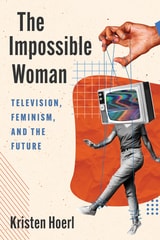
The Impossible Woman
Television, Feminism, and the FutureKristen Hoerl
Rutgers University Press, 2026
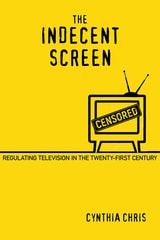
The Indecent Screen
Regulating Television in the Twenty-First CenturyChris, Cynthia
Rutgers University Press, 2019
The Meaning of Commercial Television
The Texas-Stanford Seminar, 1966Edited by Stanley T. Donner
University of Texas Press, 1967
Commercial television deserves praise for its many achievements, but since its earliest days, almost everyone has agreed that it is also open to many criticisms. The Texas-Stanford Seminars, made possible by a grant from TV Guide magazine, were intended "to help bring about the general improvement of television," and to provide "a place and a climate for significant discussion." The vigorous and enthusiastic participation in the seminars by executives from the three major networks, from a number of group stations and independent producers, and from advertising agencies and some of the larger advertisers demonstrated the desire of the industry itself to recognize its own faults and to understand the complaints of its critics.
The Meaning of Commercial Television collects the speeches presented at the second of these seminars, in April 1966. Contributors include Harry S. Ashmore, George Schaefer, August Priemer, Leonard S. Matthews, Thomas Moore, David M. Potter, Paul Goodman, Marshall McLuhan, and John R. Silber. Also in the book are summaries of the discussions which followed each of the speeches, and an examination of the overall impact of the meeting and the conclusions which might be drawn from it. Some of the topics discussed are "numbers" rating method of evaluating television programs; the position in the television industry of the independent producer, of the advertiser, and of the television network, and television itself with respect to its history, social perspective, and other aspects of American life to which it is related.
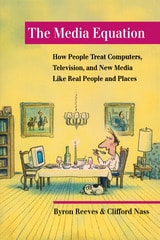
The Media Equation
How People Treat Computers, Television, and New Media Like Real People and PlacesByron Reeves and Clifford Nass
CSLI, 2003
The Media Swirl
Politics, Audiovisuality, and AestheticsCarol Vernallis
Duke University Press, 2023
The Money Shot
Trash, Class, and the Making of TV Talk ShowsLaura Grindstaff
University of Chicago Press, 2002
From "classy" shows like Oprah to "trashy" shows like Jerry Springer, the key to a talk show's success is what Laura Grindstaff calls the money shot—moments when guests lose control and express joy, sorrow, rage, or remorse on camera. In this new work, Grindstaff takes us behind the scenes of daytime television talk shows, a genre focused on "real" stories told by "ordinary" people. Drawing on extensive interviews with producers and guests, her own attendance of dozens of live tapings around the country, and more than a year's experience working on two nationally televised shows, Grindstaff shows us how producers elicit dramatic performances from guests, why guests agree to participate, and the supporting roles played by studio audiences and experts.
Grindstaff traces the career of the money shot, examining how producers make stars and experts out of ordinary people, in the process reproducing old forms of cultural hierarchy and class inequality even while seeming to challenge them. She argues that the daytime talk show does give voice to people normally excluded from the media spotlight, but it lets them speak only in certain ways and under certain rules and conditions. Working to understand the genre from the inside rather than pass judgment on it from the outside, Grindstaff asks not just what talk shows can tell us about mass media, but also what they reveal about American culture more generally.