Results by title
64 books match the query 'Text' and 19 start with t
TEXT
Transactions of the Society for Textual Scholarship, Volume 7D. C. Greetham and W. Speed Hill, Editors
University of Michigan Press, 1994
Tango Lessons
Movement, Sound, Image, and Text in Contemporary PracticeMarilyn G. Miller, ed.
Duke University Press, 2014
Contributors. Esteban Buch, Oscar Conde, Antonio Gómez, Morgan James Luker, Carolyn Merritt, Marilyn G. Miller, Fernando Rosenberg, Alejandro Susti
Teaching through the Archives
Text, Collaboration, and ActivismEdited by Tarez Samra Graban and Wendy Hayden
Southern Illinois University Press, 2022
Disruptive pedagogies for archival research
In a cultural moment when institutional repositories carry valuable secrets to the present and past, this collection argues for the critical, intellectual, and social value of archival instruction. Graban and Hayden and 37 other contributors examine how undergraduate and graduate courses in rhetoric, history, community literacy, and professional writing can successfully engage students in archival research in its many forms, and successfully model mutually beneficial relationships between archivists, instructors, and community organizations.
Combining new and established voices from related fields, each of the book’s three sections includes a range of form-disrupting pedagogies. Section I focuses on how approaching the archive primarily as text fosters habits of mind essential for creating and using archives, for critiquing or inventing knowledge-making practices, and for being good stewards of private and public collections. Section II argues for conducting archival projects as collaboration through experiential learning and for developing a preservationist consciousness through disciplined research. Section III details praxis for revealing, critiquing, and intervening in historic racial omissions and gaps in the archives in which we all work.
Ultimately, contributors explore archives as sites of activism while also raising important questions that persist in rhetoric and composition scholarship, such as how to decolonize research methodologies, how to conduct teaching and research that promote social justice, and how to shift archival consciousness toward more engaged notions of democracy. This collection highlights innovative classroom and curricular course models for teaching with and through the archives in rhetoric and composition and beyond.

Text and Culture
The Politics of InterpretationDaniel Cottom
University of Minnesota Press, 1989
Text and Culture was first published in 1989. Minnesota Archive Editions uses digital technology to make long-unavailable books once again accessible, and are published unaltered from the original University of Minnesota Press editions.
In Text & Culture, Daniel Cottom examines the political aspects of contemporary disciplines of interpretation. He pleads against limiting the act of reading by disqualifying some readings as "wrong" or unscholarly, and he argues for the necessity of multiple readings, claiming that a closed-off text glosses over differences that are political in nature. He proceeds, then, from the notion of text to culture. Just as the reading of the text is conditioned by irreducible political differences, so is the reading of culture. Finally, to illustrate and further develop his arguments, Cottom presents an extensive analysis of Great Expectations.
Cottom's materials range from academic jokes to King Lear, and the writers he discusses range from Kant to Derrida, from Freud to Basil Bernstein, from Ludwig Wittgenstein and Bronislaw Malinowski to Erving Goffman, Clifford Geertz, and Stanley Fish. This study is especially concerned with the way "culture" and related terms, such as "context" and "norm," are part of a larger discourse in the contemporary humanities and social sciences - a discourse in which their effect is to repress recognition of important historical differences, conflicts, and possibilities. At the same time that he shows how difficult it is to get "beyond culture," he tries to indicate how interpretation may be turned into a more socially responsible practice.
Daniel Cottom is associate professor of English at the University of Florida. He is the author of Social Figures: George Eliot, Social History, and Literary Representation (Minnesota, 1987) and The Civilized Imagination: A Study of Ann Radcliffe, Jane Austen, and Sir Walter Scott.
Text and Data Mining Literacy for Librarians
Whitney Kramer
Assoc of College & Research Libraries, 2025
Text and Data Mining Literacy for Librarians collects ways that academic libraries are supporting TDM literacy through services, workflows, and professional development. In five parts, it offers a variety of perspectives, insights, and experiences that can help you address the challenges of supporting TDM research, fit it into your existing reference and instruction work, and conduct your own.
- Essentials of Text and Data Mining (TDM) Literacy
- Data Literacy, Licensing, and Management Challenges with TDM
- TDM Research in Action: Practical Applications and Case Studies
- Generating Insights from Library Reference Data
- Proprietary TDM Software: Examples and Implementations
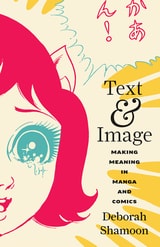
Text and Image
Making Meaning in Manga and ComicsDeborah Shamoon
University of Minnesota Press, 2026
How manga and comics reshape storytelling across cultures
Text and Image is a groundbreaking exploration of how Japanese manga and comics from the United States and United Kingdom craft meaning through the combination of words and pictures. Current scholarship often isolates manga in niche genre studies or prioritizes anime instead; in response, Deborah Shamoon proposes a unified framework for understanding paneled visual storytelling across cultures. She reframes comics not as kids’ stuff but as a sophisticated narrative art with its own grammar, rhythm, and visual poetics.
Drawing on narratology, art history, film studies, and media theory, Text and Image examines a vast array of material, from four-panel comic strips to different manga genres, including shōjo (girls’ romance comics), shōnen (teen action), seinen (adult drama), and gekiga (mature realism). Through close visual analysis, Shamoon demonstrates how creators use panel layout, pacing, and the choreography of text and image to shape emotional impact and narrative momentum. She reveals the shared techniques that link works as disparate as Fun Home and Spider-Man while also showing where cultural conventions diverge. Beyond the traditional print realm, Shamoon discusses digital platforms, such as webtoons and vertically scrolling comics, to show how new technologies merge manga’s cinematic sensibility with global innovation.
Making a bold case for a more expansive, inclusive theory of visual narrative that bridges long-standing divides between manga studies and Anglophone comics scholarship, Text and Image is an indispensable guide to understanding how contemporary stories work and why they resonate across borders.
Retail e-book files for this title are screen-reader friendly with images accompanied by short alt text and/or extended descriptions.
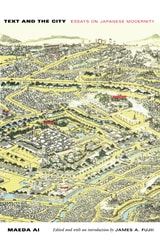
Text and the City
Essays on Japanese ModernityMaeda Ai
Duke University Press, 2004
Maeda remapped the study of modern Japanese literature and culture in the 1970s and 1980s, helping to generate widespread interest in studying mass culture on the one hand and marginalized sectors of modern Japanese society on the other. These essays reveal the broad range of Maeda’s cultural criticism. Among the topics considered are Tokyo; utopias; prisons; visual media technologies including panoramas and film; the popular culture of the Edo, Meiji, and contemporary periods; maps; women’s magazines; and women writers. Integrally related to these discussions are Maeda’s readings of works of Japanese literature including Matsubara Iwagoro’s In Darkest Tokyo, Nagai Kafu’s The Fox, Higuchi Ichiyo’s Growing Up, Kawabata Yasunari’s The Crimson Gang of Asakusa, and Narushima Ryuhoku’s short story “Useless Man.” Illuminating the infinitely rich phenomena of modernity, these essays are full of innovative, unexpected connections between cultural productions and urban life, between the text and the city.
Text as Ride
Electronic Literature and New Media ArtJanez Strehovec
West Virginia University Press, 2016
Text, Image, and Otherness in Children's Bibles
What is in the Picture.Caroline Vander Stichele
SBL Press, 2012

Text
The Genealogy of an Antidisciplinary ObjectJohn Mowitt
Duke University Press, 1992
Beginning with the Tel Quel group in France in the sixties and seventies, Mowitt's study details how a certain interdisciplinary crisis prompted academics to rethink the conditions of cultural interpretation. Concentrating on three disciplinary projects—literary analysis, film studies, and musicology—Mowitt shows how textuality's emergence called into question not merely the relations among these disciplines, but also the cultural logic of disciplinary reason as such.
At once an effort to define "the text" and to explore and extend the theory of textuality, this book illustrates why the notion of interdisciplinary research has recently acquired such urgency. At the same time, by emphasizing the genealogical dimension of the textual object, Mowitt raises the issues of its "antidisciplinary" character, and by extension its immediate pertinence for the current debates over multiculturalism and Eurocentrism.
The Lancelot-Grail Cycle
Text and TransformationsEdited by William W. Kibler
University of Texas Press, 1994
Composed in Old French between about 1220 and 1240, the Lancelot-Grail Cycle is a group of five prose romances centered on the love affair between Lancelot and Guenevere. It consists of an immense central core, the Lancelot Proper, introduced by The History of the Holy Grail and The Story of Merlin and concluded by The Quest for the Holy Grail and The Death of Arthur.
This volume brings together thirteen essays by noted scholars from the first symposium ever devoted exclusively to the Lancelot-Grail Cycle. Exploring the cycle's evolution across the literatures of medieval France, Italy, Spain, Catalonia, and England, the authors take a variety of approaches that highlight a broad range of cultural, social, historical, and political concerns and offer a comparative and interdisciplinary vision of this great romance.
The Margins of the Text
D. C. Greetham, Editor
University of Michigan Press, 1997
The Margins of the Text is the first attempt to collect a body of essays concerned with specific aspects of the marginal as they relate to text. The volume is divided into two sections. The first part assembles essays concerned with the margins of textual discourse and explores the function of discourses not previously recognized as significant to scholarly editing, such as those of class, race, gender, and sexual orientation. The second section attends to the textual margins in the bibliographical sense--the margins of the book, in which there has been so much recent interest. The two parts of the collection are clearly interrelated, since both study the effects of margins as a form of cultural discourse.
As a whole, the collection spans several periods (medieval, Renaissance, eighteenth-century to modern), several disciplines (drama, literature, art history, politics, and philosophy), and offers a wide-ranging consideration of a single topic as it is manifested in various genres, formats, and media. The contributors are among the most respected textual/critical theorists in their fields.
The Margins of the Text will become a standard reference in the field, and will be read profitably by culture critics and social historians as well as textual critics and editors.
D. C. Greetham is Professor of English and Medieval Studies, City University of New York Graduate School.

The Mirror in the Text
Lucien Dällenbach
University of Chicago Press, 1989
In this classic study, Lucien Dällenbach provides the first systematic analysis of this device and its literary and artistic applications from Van Eyck and Velasquez to Gide, Beckett and the French nouveau roman.
Alongside this wealth of examples, Dällenbach constructs his theoretical argument with elegance and clarity, assuming no previous knowledge of arcane and specialized theory, but guiding the reader helpfully through the maze of literary criticism. The result is a new conceptual field, a new grammar of the mise en abyme, and an examination of its function within the work of art and literature.
The highly original study has been acclaimed as one of the most important works of contemporary literary theory. It will be of interest to all students of English and European literature, as well as to students of the visual arts.
The Road to Serfdom
Text and Documents--The Definitive EditionF. A. Hayek
University of Chicago Press, 2007
First published by the University of Chicago Press on September 18, 1944, The Road to Serfdom garnered immediate, widespread attention. The first printing of 2,000 copies was exhausted instantly, and within six months more than 30,000 books were sold. In April 1945, Reader’s Digest published a condensed version of the book, and soon thereafter the Book-of-the-Month Club distributed this edition to more than 600,000 readers. A perennial best seller, the book has sold 400,000 copies in the United States alone and has been translated into more than twenty languages, along the way becoming one of the most important and influential books of the century.
With this new edition, The Road to Serfdom takes its place in the series The Collected Works of F. A. Hayek. The volume includes a foreword by series editor and leading Hayek scholar Bruce Caldwell explaining the book's origins and publishing history and assessing common misinterpretations of Hayek's thought. Caldwell has also standardized and corrected Hayek's references and added helpful new explanatory notes. Supplemented with an appendix of related materials ranging from prepublication reports on the initial manuscript to forewords to earlier editions by John Chamberlain, Milton Friedman, and Hayek himself, this new edition of The Road to Serfdom will be the definitive version of Hayek's enduring masterwork.
The Spectacle of History
Speech, Text, and Memory at the Iran-Contra HearingsMichael Lynch and David Bogen, eds.
Duke University Press, 1996
Lynch and Bogen detail the practices through which the historical agents at the center of the hearings composed, confirmed, used, erased, and denied the historical record. They show how partisan skirmishes over the disclosure of records and testimony led to a divided and irresolute outcome, an outcome further facilitated by the “applied deconstruction” deployed by North and his allies. The Spectacle of History immerses the reader in a crowded field of texts, utterances, visual displays, and media commentaries, but, more than a case study, it develops unique insight into problems at the heart of society and social theory—lying and credibility, the production of civic spectacle, the relationship between testimony and history, the uses of memory, and the interplay between speech and writing.
Drawing on themes from sociology, literary theory, and ethnomethodology and challenging prevailing concepts held by contemporary communication and cultural studies, Lynch and Bogen extract valuable theoretical lessons from this specific and troubling historical episode.
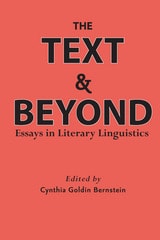
The Text and Beyond
Essays in Literary LinguisticsCynthia Bernstein
University of Alabama Press, 1997
A groundbreaking collection that bridges linguistics and literature, offering powerful tools to uncover how language shapes meaning, identity, and power in literary texts.
The Text and Beyond: Essays in Literary Linguistics, edited by Cynthia Bernstein, presents a groundbreaking collection of essays that demonstrate how linguistic tools can enrich literary analysis. The volume brings together scholars who explore the intersections of language, literature, and culture—examining how syntax, discourse, gender, power, and regional dialects shape meaning in texts. From Tennessee Williams to Harry Crews, from Dickens to immigrant literature, the essays offer models for integrating linguistic theory with literary interpretation. This book is essential for scholars of stylistics, discourse analysis, and anyone interested in the evolving relationship between language and literature.
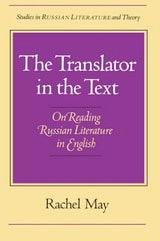
The Translator in the Text
On Reading Russian Literature in EnglishRachel May
Northwestern University Press, 1994
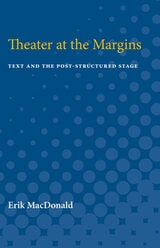
Theater at the Margins
Text and the Post-Structured StageErik MacDonald
University of Michigan Press, 1993
Troubadours, Trumpeters, Troubled Makers
Lyricism, Nationalism, and Hybridity in China and Its OthersGregory B. Lee
Duke University Press, 1996
Lee’s broad definition of lyric includes the work of poets, amateur versifiers, and all manner of popular songwriters, and his inclusive sense of nation refers to all Chinese communities regardless of geographic location. Whether examining the globalized consumption of satellite-broadcast pop music or the heroic efforts of little-known poets on the margins of the Chinese diaspora, he finds a questioning and contesting of both the Orientalist construction of a mythic monolithic China invented by the West and the Chinese obsession with ideas of authenticity and purity of nationhood. Lee explores the lyrical transgression of these ideological boundaries in China, in the Chinese communities of America and Britain, and in other marginalized communities, before using the examples of Hong Kong and other non-nationalistic sites to discuss the creative possibilities of hybrid cultures and societies.