Results by title
89 books match the query 'Transgender Studies' and 23 start with t
TSQ
Transgender Studies Quarterly (5:1)Paisley Currah and Susan Stryker, special issue editors
Duke University Press, 0
TSQ
Transgender Studies Quarterly (6:1)Paisley Currah and Susan Stryker, special issue editors
Duke University Press, 0
The Issue of Blackness
Susan Stryker and Paisley Currah, special issue editors
Duke University Press, 0
The Juggler
RachildeHawthorne, Melanie C
Rutgers University Press, 1990
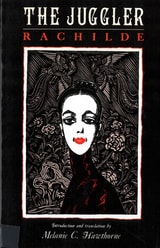
The Juggler (La Jongleuse) is a "decadent" novel that was first published in 1900. Its author, Marguerite Vallette-Eymery (1860-1953), who used the pseudonym Rachilde, was a prolific novelist (over sixty works of fiction), playwright, literary critic and reviewer, and a forceful presence in French literary society of her time.
The protagonist of the novel, Eliante Donalger, is in some sense an exaggerated double for her creator--bizarre in appearance, clothing, and interests. Instinctively grasping a medical and psychological truth that the turn-of-the-century scientific world was only beginning to understand, Eliante maintains that there is nothing "natural" about human sexual expression. She claims to be in love with an inanimate (though anthropomorphic and sexually ambiguous) object, a Greek amphora, and the novel traces the rivalry between this faithful partner and an ardent human suitor, a young medical student. It is only through juggling, both literally and metaphorically, that Eliante is able to use her seductive power to maintain desire. The surprise ending challenges the limits of such power in a controversial and surprising twist.
Although Rachilde's work has been neglected in the past, the women's movement and feminist criticism have stimulated renewed interest in her fiction. The Juggler is a major rediscovery.

The Music Diva Spectacle
Camp, Female Performers and Queer Audiences in the Arena Tour ShowConstantine Chatzipapatheodoridis
Intellect Books, 2021
In this original new work, Constantine Chatzipapatheodoridis pulls back the curtain on the production of camp as a queer praxis that constantly feeds the diva-queer culture relationship. By examining the iconography and theatrics of the diva tour show, the author presents a performance studies reading of camp and the culture-sharing process of production and audience reception. Detailed case studies take a close look at popular contemporary performers like Madonna, Kylie Minogue, Beyoncé, and Lady Gaga, and a final section analyzes audience drag in the arena space. Chatzipapatheodoridis also investigates the relationship between camp theory as an academic subject and the figure of the diva as an expression of camp.
A rich and insightful revival of the question of camp in contemporary queer performance, The Music Diva Spectacle seeks to establish how camp is appropriated by the diva and explores how this affects—and is in turn appropriated by—the audience.
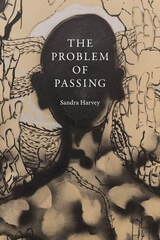
The Problem of Passing
Sandra Harvey
Duke University Press, 2026

The Problem of the Negro as a Problem for Gender
Marquis Bey
University of Minnesota Press, 2020
A complex articulation of the ways blackness and nonnormative gender intersect—and a deeper understanding of how subjectivities are formed
A deep meditation on and expansion of the figure of the Negro and insurrectionary effects of the “X” as theorized by Nahum Chandler, The Problem of the Negro as a Problem for Gender thinks through the problematizing effects of blackness as, too, a problematizing of gender. Through the paraontological, the between, and the figure of the “X” (with its explicit contemporary link to nonbinary and trans genders) Marquis Bey presents a meditation on black feminism and gender nonnormativity. Chandler’s text serves as both an argumentative tool for rendering the “radical alternative” in and as blackness as well as demonstrating the necessarily trans/gendered valences of that radical alternative.
Forerunners is a thought-in-process series of breakthrough digital works. Written between fresh ideas and finished books, Forerunners draws on scholarly work initiated in notable blogs, social media, conference plenaries, journal articles, and the synergy of academic exchange. This is gray literature publishing: where intense thinking, change, and speculation take place in scholarship.

The Single Life
Unpatriarchal Manhoods in English Renaissance LiteratureJordan Windholz
University of Alabama Press, 2025
Exploring the Varied Roles of Bachelors during the Renaissance
What if the Renaissance bachelor wasn’t just a social outlier but a literary lens through which early modern masculinity reveals its cracks? In The Single Life: Unpatriarchal Manhoods in English Renaissance Literature, Jordan Windholz examines the overlooked and often subversive roles played by never-married men in shaping gender, sexuality, and social order.
Windholz challenges conventional views on gender and sexuality, identifying five archetypes of bachelorhood that complicate our understanding of patriarchal success: the chaste youth, the journeyman bachelor, the true gallant, the incel scholar, and the unmarried eunuch. These figures don’t conform to ideals of marriage, legacy, or economic productivity, but they also weren’t merely left behind. Instead, they served to define what early modern society valued by embodying what it resisted. Windholz shows how Renaissance texts constructed, contained, and occasionally celebrated these “unpatriarchal manhoods.”
By examining the intersections of sexuality, labor, gentility, emotion, and gender, the book provides a nuanced understanding of how single men both upheld and resisted patriarchal norms. Each chapter offers a detailed analysis of literary texts, blending historical and literary analysis with feminist and queer theory. The first study of its kind, Windholz’s work is essential reading for anyone interested in Renaissance literature, gender studies, or those looking to understand the margins of masculinity and the meanings of singledom—then and now.
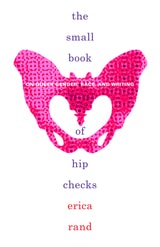
The Small Book of Hip Checks
On Queer Gender, Race, and WritingErica Rand
Duke University Press, 2021
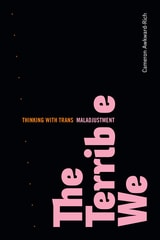
The Terrible We
Thinking with Trans MaladjustmentCameron Awkward-Rich
Duke University Press, 2022
Duke University Press Scholars of Color First Book Award recipient
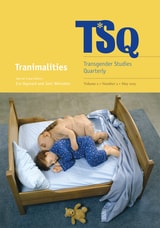
Tranimalities
Eva S. Hayward and Jami Weinstein, special issue editors
Duke University Press, 0

Trans Care
Hil Malatino
University of Minnesota Press, 2020
A radical and necessary rethinking of trans care
What does it mean for trans people to show up for one another, to care deeply for one another? How have failures of care shaped trans lives? What care practices have trans subjects and communities cultivated in the wake of widespread transphobia and systemic forms of trans exclusion?
Trans Care is a critical intervention in how care labor and care ethics have been thought, arguing that dominant modes of conceiving and critiquing the politics and distribution of care entrench normative and cis-centric familial structures and gendered arrangements. A serious consideration of trans survival and flourishing requires a radical rethinking of how care operates.
Forerunners is a thought-in-process series of breakthrough digital works. Written between fresh ideas and finished books, Forerunners draws on scholarly work initiated in notable blogs, social media, conference plenaries, journal articles, and the synergy of academic exchange. This is gray literature publishing: where intense thinking, change, and speculation take place in scholarship.
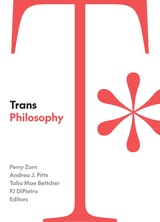
Trans Philosophy
Perry Zurn
University of Minnesota Press, 2024
Establishing trans philosophy as a unique field of inquiry, offering tools for our quest toward a more just and equitable world
Trans Philosophy defines this burgeoning and polymorphous discipline as philosophical work that is accountable to and illuminative of cross-cultural and global trans experiences, histories, and cultural productions. Across language and politics, feminism and phenomenology, and decolonial theory, it addresses trans worldmaking in all its beauty and mundanity.
Critically, the editors center the contributions of trans and gender-nonconforming philosophers from around the globe. Showcasing work from a range of emerging and established voices, Trans Philosophy addresses discrimination, embodiment, identity, language, and law, utilizing diverse philosophical methods to attend to significant intersections between trans experience and class, disability, race, nationality, and sexuality.
At a time when trans-exclusionary views are gaining traction in politics as well as philosophy, this volume urgently redraws the contours of trans discourse, centering the wisdom already generated in trans and other gender-disruptive communities.
Contributors: Megan Burke, Sonoma State U; Robin Dembroff, Yale U; Marie Draz, San Diego State U; Che Gossett, U of Pennsylvania; Ryan Gustafsson, U of Melbourne; Stephanie Kapusta, Dalhousie U; Tamsin Kimoto, Washington U, St. Louis; Hil Malatino, Pennsylvania State U and Rock Ethics Institute; Amy Marvin, Lafayette U; Marlene Wayar.
Retail e-book files for this title are screen-reader friendly.

Trans Pornography
Sophie Pezzutto and Lynn Comella, special issue editors
Duke University Press, 2020
Contributors
Skylar Adams, Carolyn Bronstein, Lynn Comella, Korra Del Rio, Sly Fawkes, Aster Gilbert, RL Goldberg, Laura Horak, Valentina Mia, Geoffrey H. Nicholson, Sophie Pezzutto, Matt Richardson, Whitney Strub, Rae Threat
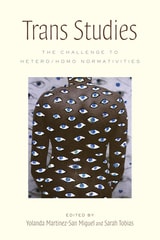
Trans Studies
The Challenge to Hetero/Homo NormativitiesMartínez-San Miguel, Yolanda
Rutgers University Press, 2016
From Caitlyn Jenner to Laverne Cox, transgender people have rapidly gained public visibility, contesting many basic assumptions about what gender and embodiment mean. The vibrant discipline of Trans Studies explores such challenges in depth, building on the insights of queer and feminist theory to raise provocative questions about the relationships among gender, sexuality, and accepted social norms.
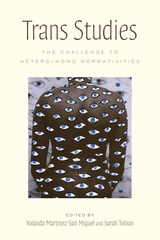
Trans Studies
The Challenge to Hetero/Homo NormativitiesMartínez-San Miguel, Yolanda
Rutgers University Press, 2016
From Caitlyn Jenner to Laverne Cox, transgender people have rapidly gained public visibility, contesting many basic assumptions about what gender and embodiment mean. The vibrant discipline of Trans Studies explores such challenges in depth, building on the insights of queer and feminist theory to raise provocative questions about the relationships among gender, sexuality, and accepted social norms.
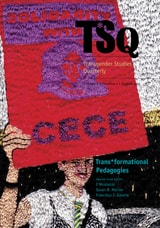
Trans*formational Pedagogies
Z. Nicolazzo, Susan B. Marine, and Francisco J. Galarte, special issue editors
Duke University Press, 0
Trans- Political Economy
Dan Irving and Vek Lewis, special issue editors
Duke University Press, 0
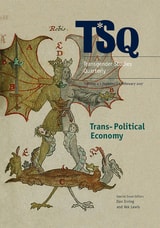
This issue of TSQ: Transgender Studies Quarterly, “Trans-Political Economy,” edited by Dan Irving and Vek Lewis, addresses how capitalism differentially and unequally affects trans and sex/gender-diverse people across the globe. “We all, from our different social and political locations, become implicated in those architectures through our everyday interactions with a variety of coordinated and contradictory institutions and rationalities that order our lives across different local and global geopolitical spaces and scales,” write Lewis and Irving. The editors of and contributors to this issue reveal how the narrowly constructed objects of trans studies and political economy (such as gender, labor, class, and economy) have been complicit in the necropolitical devaluation of trans lives and existing strategies crafted for trans survival. Topics include trans visibility and commodity culture; trans credit reporting; the growing population of T-girls, trans women truckers; trans street-based sex workers; the system of sex/gender identification for trans asylum seekers in South Africa; and waria affective labor in Indonesia. There is also a roundtable deconstructing trans* political economy.
The Arts & Culture section of this issue features a review of season 7 of RuPaul's Drag Race in relation to certain political-economic elements of the drag industry as well as an in-depth look at the representation of transgender lives on film, specifically in Dallas Buyers Club.
Trans-in-Asia, Asia-in-Trans
Howard Chiang, Todd A. Henry, and Helen Hok-Sze Leung, special issue editors
Duke University Press, 0
Transformismo
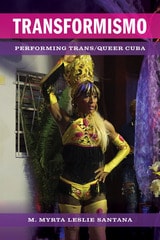
Performing Trans/Queer CubaM. Myrta Leslie Santana
University of Michigan Press, 2025
Transgender Cinema
Rebecca Bell-Metereau
Rutgers University Press, 2019
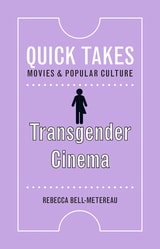
Transgender Cinema gives readers the big picture of how trans people have been depicted on screen. Beginning with a history of trans tropes in classic Hollywood cinema, from comic drag scenes in Chaplin’s The Masquerader to Garbo’s androgynous Queen Christina, and from psycho killer queers to The Rocky Horror Picture Show’s outrageous queen, it examines a plethora of trans portrayals that subsequently emerged from varied media outlets, including documentary films, television serials, and world cinema. Along the way, it analyzes milestones in trans representation, like The Crying Game, Boys Don’t Cry, Hedwig and the Angry Inch,and A Fantastic Woman.
As it traces the evolution of trans people onscreen, Transgender Cinema also considers the ongoing controversies sparked by these movies and series both within LGBTQ communities and beyond. Ultimately it reveals how film and television have shaped not only how the general public sees trans people, but also how trans people see themselves.
Selected Filmography:
Adventures of Priscilla, Queen of the Desert, All about My Mother, Anak, Austin Unbound, Becoming Chaz, The Blossoming of Maximo Oliveros, Boy I Am, Boy Meets Girl, Boys Don’t Cry, The Brandon Teena Story, A Busy Day, Call Me Malcolm, Carlotta, Change over Time, The Crying Game, Dallas Buyers Club, The Danish Gir, The Devil Is a Woman, Drunktown’s Finest, Facing Mirrors, A Fantastic Woman, 52 Tuesdays, Flesh, Girl Inside, A Girl like Me: The Gwen Araujo Story, Hedwig and the Angry Inch, I Was a Male War Bride,Kate Bornstein Is a Queer and Pleasant Danger, Kumu Hina, La Cage aux Folles, Ma Vie en Rose (My Life in Pink) The Masquerader, Myra Breckinridge, Orlando, Paris Is Burning, Playing with Gender, Psycho, Queen Christina, The Rocky Horror Picture Show, The Saga of Anatahan, She’s a Boy I Knew, Silence of the Lambs, Some Like It Hot, Southern Comfort, Still Black: A Portrait of Black Transmen, Stonewall, The Tenant, Three Generations. Tomboy, Tootsie, Transamerica, Transparent, Trash, Whatever Suits You, A Woman.
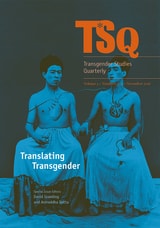
Translating Transgender
David Gramling and Aniruddha Dutta, special issue editors
Duke University Press, 0

Transounding
Listening for Black Queer Lusophone DiasporasDaniel da Silva
Duke University Press, 2027