Results by title
62 books match the query 'Twain, Mark' and 12 start with t
Telling Twain
A book of short stories by Mark TwainSteve Daut
Parkhurst Brothers, Inc., 2019
The Ghosts of Mark Twain
A Study of Manhood, Race, and the Gothic ImaginationAnn M Ryan
University of Missouri Press, 2025
Ann M. Ryan maps Twain’s resistance to ideals of white masculinity and his occasional capitulation to them. While Twain reflects upon the history of White men—including the intimate memory of his father’s failures and abuses—he also imagines a future in which Black men will gain an authentic voice and agency. Preferring the messy humanity of Mark Twain, Ryan calls into question the “St. Mark” school of criticism, which glosses—among other themes—Twain’s uneasy relation to Black culture. In unpublished works and excised material, Twain conjures memories and specters of Black men that are far from comforting. No longer “friends and allies” like fictive Ol’ Uncle Dan’l; these Black ghosts will settle for revenge if they can’t get justice.
Some of the works considered in The Ghosts of Mark Twain are not widely known: “Which Was It?,” “The United States of Lyncherdom,” No. 44: The Mysterious Stranger, and the Morgan manuscript of Pudd’nhead Wilson. Written into the record of these fragments is Twain’s desire to be a different kind of White man, just as their incomplete nature demonstrates how often he stumbled in that effort. When Jim describes the White and Black spirits hovering over Pap Finn, Twain reveals his own conflicted position in America’s racial history. And as Jim declares to Huck, “A body can’t tell yit which one gwyne to fetch him at de las.’”
The Jester and the Sages
Mark Twain in Conversation with Nietzsche, Freud, and MarxForrest G. Robinson, Gabriel Noah Brahm, Jr., and Catherine Carlstroem
University of Missouri Press, 2011
During their lifetimes, Twain, Nietzsche, Freud, and Marx witnessed massive upheavals in Western constructions of religion, morality, history, political economy, and human nature. The foundations of reality had been shaken, and one did not need to be a philosopher—nor did one even need to read philosophy—to weigh in on what this all might mean. Drawing on a wide range of primary and secondary materials, the authors show that Twain was well attuned to debates of the time. Unlike his Continental contemporaries, however, he was not as systematic in developing his views.
Brahm and Robinson’s chapter on Nietzsche and Twain reveals their subjects’ common defiance of the moral and religious truisms of their time. Both desired freedom, resented the constraints of Christian civilization, and saw punishing guilt as the disease of modern man. Pervasive moral evasion and bland conformity were the principal end result, they believed.
In addition to a continuing focus on guilt, Robinson discovers in his chapter on Freud and Twain that the two men shared a lifelong fascination with the mysteries of the human mind. From the formative influence of childhood and repression, to dreams and the unconscious, the mind could free people or keep them in perpetual chains. The realm of the unconscious was of special interest to both men as it pertained to the creation of art.
In the final chapter, Carlstroem and Robinson explain that, despite significant differences in their views of human nature, history, and progress, Twain and Marx were both profoundly disturbed by economic and social injustice in the world. Of particular concern was the gulf that industrial capitalism opened between the privileged elite property owners and the vast class of property-less workers. Moralists impatient with conventional morality, Twain and Marx wanted to free ordinary people from the illusions that enslaved them.
Twain did not know the work's of Nietzsche, Freud, and Marx well, yet many of his thoughts cross those of his philosophical contemporaries. By focusing on the deeper aspects of Twain’s intellectual makeup, Robinson, Brahm, and Carlstroem supplement the traditional appreciation of the forces that drove Twain’s creativity and the dynamics of his humor.
The Life of Mark Twain
The Early Years, 1835-1871Gary Scharnhorst
University of Missouri Press, 2018
With dozens of Mark Twain biographies available, what is left unsaid? On average, a hundred Clemens letters and a couple of Clemens interviews surface every year. Scharnhorst has located documents relevant to Clemens’s life in Missouri, along the Mississippi River, and in the West, including some which have been presumed lost. Over three volumes, Scharnhorst elucidates the life of arguably the greatest American writer and reveals the alchemy of his gifted imagination.
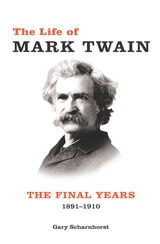
The Life of Mark Twain
The Final Years, 1891–1910Gary Scharnhorst
University of Missouri Press, 2022
In the final volume of his three-volume biography, Gary Scharnhorst chronicles the life of Samuel Langhorne Clemens from his family’s extended trip to Europe in 1891 to his death in 1910 at age 74. During these years Clemens grapples with bankruptcy, returns to the lecture circuit, and endures the loss of two daughters and his wife. It is also during this time that he writes some of his darkest, most critical works; among these include Pudd’nhead Wilson; Personal Recollections of Joan of Arc; Tom Sawyer Abroad; Tom Sawyer, Detective; Following the Equator; No. 44, the Mysterious Stranger; and portions of his Autobiography.
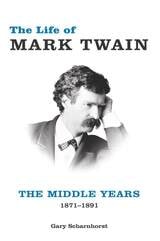
The Life of Mark Twain
The Middle Years, 1871–1891Gary Scharnhorst
University of Missouri Press, 2019
The second volume of Gary Scharnhorst’s three-volume biography chronicles the life of Samuel Langhorne Clemens between his move with his family from Buffalo to Elmira (and then Hartford) in spring 1871 and their departure from Hartford for Europe in mid-1891.
During this time he wrote and published some of his best-known works, including Roughing It, The Gilded Age, The Adventures of Tom Sawyer, A Tramp Abroad, The Prince and the Pauper, Life on the Mississippi,Adventures of Huckleberry Finn, and A Connecticut Yankee in King Arthur’s Court.
Significant events include his trips to England (1872–73) and Bermuda (1877); the controversy over his Whittier Birthday Speech in December 1877; his 1878–79 Wanderjahr on the continent; his 1882 tour of the Mississippi valley; his 1884–85 reading tour with George Washington Cable; his relationships with his publishers (Elisha Bliss, James R. Osgood, Andrew Chatto, and Charles L. Webster); the death of his son, Langdon, and the births and childhoods of his daughters Susy, Clara, and Jean; as well as the several lawsuits and personal feuds in which he was involved. During these years, too, Clemens expressed his views on racial and gender equality and turned to political mugwumpery; supported the presidential campaigns of Grover Cleveland; advocated for labor rights, international copyright, and revolution in Russia; founded his own publishing firm; and befriended former president Ulysses S. Grant, supervising the publication of Grant’s Memoirs.
The Life of Mark Twain is the first multi-volume biography of Samuel Clemens to appear in more than a century and has already been hailed as the definitive Twain biography.
The Mythologizing of Mark Twain
Sara Davis
University of Alabama Press, 1984
How Samuel Clemens became Mark Twain—and Mark Twain became a myth.
The Mythologizing of Mark Twain explores the enduring fascination with one of America's most celebrated literary figures and examines how Samuel Langhorne Clemens became the cultural icon known around the world as Mark Twain. Bringing together a distinguished group of scholars, this thought-provoking collection investigates Twain not simply as an author, but as a powerful symbol whose life, works, and public persona have become inseparable from larger ideas about American identity, humor, democracy, individualism, and national character.
Readers and critics have long recognized Twain's literary genius, yet explaining the origins and significance of that genius remains an ongoing challenge. The essays in this volume address that challenge by exploring the many ways Twain has been interpreted, celebrated, debated, and transformed into a mythic figure. They examine how his writings helped define an American literary tradition while simultaneously contributing to the creation of a broader cultural mythology that continues to shape public perceptions of the United States and its history.
Rather than seeking a single interpretation of Twain, the contributors employ a range of critical approaches to illuminate the complexity of both the man and the legend. Their analyses reveal how the boundaries between Samuel Clemens, Mark Twain, and the popular image of "America's author" have often blurred, generating new layers of meaning for successive generations of readers and scholars.
The Mythologizing of Mark Twain is an essential resource for students and scholars of American literature, cultural history, and literary criticism. By examining the evolution of Twain's reputation and influence, the collection offers a deeper understanding of how literary figures become cultural myths and why Mark Twain remains one of the most enduring voices in the American imagination.
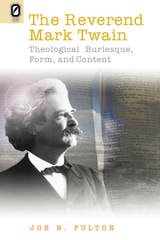
The REVEREND MARK TWAIN
THEOLOGICAL BURLESQUE, FORM, AND CONTENTJoe B. Fulton
The Ohio State University Press, 2006
Twain adopted such religious personae to burlesque the religious literary genres associated with those vocations. He wrote catechisms, prophecies, psalms, and creeds, all in the theological tradition, but with a comic twist. Twain even wrote a burlesque life of Christ that has the son of God sporting blue jeans and cowboy boots. With his distinctive comic genius, Twain entered the religious dialogue of his time, employing the genres of belief as his vehicle for criticizing church and society.
Twain’s burlesques of religious form and content reveal a writer fully engaged with the religious ferment of his day. Works like The Innocents Abroad, Adventures of Huckleberry Finn, Personal Recollections of Joan of Arc, Roughing It, and What Is Man? are the productions of a writer skilled at adopting and adapting established literary and religious forms for his own purposes. Twain is sometimes viewed as a haphazard writer, but in The Reverend Mark Twain, Fulton demonstrates how carefully Twain studied established literary and theological genres to entertain—and criticize—his society.
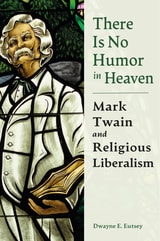
There is No Humor in Heaven
Mark Twain and Religious LiberalismDwayne E. Eutsey
University of Missouri Press, 2025
In There is No Humor in Heaven, Dwayne Eutsey challenges the persistent view of Twain as a hostile critic of religion by placing him within the prevailing liberal religious ethos of his time. From Hannibal to the western frontier and from Hartford to the wider world, Eutsey contends Twain’s vocation as a humorist was rooted in his frustrated youthful ambition to become a preacher of the Gospel. Throughout his life, his friendships with several influential liberal ministers, each of them espousing various forms of the era’s diverse progressive theology, informed not only Twain’s evolving religious worldview but his lecture performances and literary output.
There is No Humor in Heaven traces unconventional theological influences on Twain ranging from African-American spirituality, Freemasonry, and frontier Unitarianism to devout Liberal Christianity, radical Free Religion, and esoteric Hinduism. Drawing from Twain’s writings, documents, personal notes, and more, There is No Humor in Heaven offers readers a radical re-examination of the spiritually creative vitality of a controversial literary giant.
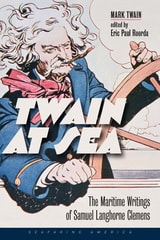
Twain at Sea
The Maritime Writings of Samuel Langhorne ClemensMark Twain
University Press of New England, 2018

Twain in His Own Time
A Biographical Chronicle of His Life, Drawn from Recollections, Interviews, and Memoirs by Family, Friends, and AssociatesGary Scharnhorst
University of Iowa Press, 2010
Never one to suffer fools gladly, especially if they wore crinolines, Mark Twain lost as many friends as he made, and he targeted them all indiscriminately. The first major American writer born west of the Mississippi River, he enjoys a reputation unrivaled in American literary history, and from the beginning of his career he tried to control that reputation by fiercely protecting his public persona. Not a debunking account of Twain’s life but refreshingly immune from his relentless image making, Gary Scharnhorst’s Twain in His Own Time offers an anecdotal version of Twain’s life over which the master spin-doctor had virtually no control.
The ninety-four recollections gathered in Twain in His Own Time form an unsanitized, collaborative biography designed to provide a multitude of perspectives on the iconic author. Opening with an interview with his mother that has never been reprinted, it includes memoirs by his daughters and by men who knew him when he was roughing it in Nevada and California, an interview with the pilot who taught him to navigate the Mississippi River, reminiscences from his illustrators E. M. Kemble and Dan Beard and two of his so-called adolescent angelfish, contributions from politicians and from such literary figures as Dan De Quille and George Bernard Shaw, and one of the most damning assessments of his character—by the author Frank Harris—ever published.
Each entry is introduced by a brief explanation of its historical and cultural context; explanatory notes provide further information about people and places; and Scharnhorst’s introduction and chronology of Twain’s eventful life are comprehensive and detailed. Dozens of lively primary sources published incrementally over more than eighty years, most recorded after his death, illustrate the complexities of this flamboyant, outspoken personality in a way that no single biographer could.

Twain, Alcott, and the Birth of the Adolescent Reform Novel
Roberta S. Trites
University of Iowa Press, 2007