Results by title
57 books match the query 'Understanding' and 3 start with t

The Business Francis Means
Understanding the Pope's Message on the EconomyMartin Schlag
Catholic University of America Press, 2017
Pope Francis, generally speaking, has thus far chosen to concentrate his papacy on social justice issues, as opposed to doctrinal or liturgical issues. This has led to Francis being hailed as a hero to many on the left, while it has made some conservative supporters of St. John Paul II and Pope Emeritus Benedict XVI disappointed and uncomfortable, even as they love and appreciate his person and gestures of mercy and compassion. Some find his teachings difficult to embrace, especially those concerning business and the economy. Pope Francis has spoken of building bridges as part of what it is to be Christian, but aspects of his message seem to be just constructing walls between the Holy Father and groups of the faithful.
The Business Francis Means aims to break through these walls, showing that Pope Francis has something to say to all Christians. His message, taken as a whole, keeps us from dividing the “seamless garment” of Christ: he reminds the conservatives of the problems of inequality and poverty, and the liberals that social justice is not enough – the Church is the bride of Christ, not a social institution or an NGO.
Monsignor Martin Schlag summarizes and explains the message of Pope Francis on business and the economy in this compact volume. The Business Francis Means will be of great interest to the Catholic layperson, especially one involved in political or economic life.
[more]
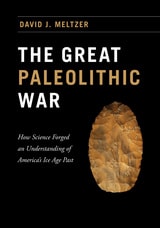
The Great Paleolithic War
How Science Forged an Understanding of America's Ice Age PastDavid J. Meltzer
University of Chicago Press, 2015
Following the discovery in Europe in the late 1850s that humanity had roots predating known history and reaching deep into the Pleistocene era, scientists wondered whether North American prehistory might be just as ancient. And why not? The geological strata seemed exactly analogous between America and Europe, which would lead one to believe that North American humanity ought to be as old as the European variety. This idea set off an eager race for evidence of the people who might have occupied North America during the Ice Age—a long, and, as it turned out, bitter and controversial search.
In The Great Paleolithic War, David J. Meltzer tells the story of a scientific quest that set off one of the longest-running feuds in the history of American anthropology, one so vicious at times that anthropologists were deliberately frightened away from investigating potential sites. Through his book, we come to understand how and why this controversy developed and stubbornly persisted for as long as it did; and how, in the process, it revolutionized American archaeology.
In The Great Paleolithic War, David J. Meltzer tells the story of a scientific quest that set off one of the longest-running feuds in the history of American anthropology, one so vicious at times that anthropologists were deliberately frightened away from investigating potential sites. Through his book, we come to understand how and why this controversy developed and stubbornly persisted for as long as it did; and how, in the process, it revolutionized American archaeology.
[more]
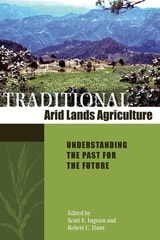
Traditional Arid Lands Agriculture
Understanding the Past for the FutureEdited by Scott E. Ingram and Robert C. Hunt
University of Arizona Press, 2015
Traditional Arid Lands Agriculture is the first of its kind. Each chapter considers four questions: what we don’t know about specific aspects of traditional agriculture, why we need to know more, how we can know more, and what research questions can be pursued to know more. What is known is presented to provide context for what is unknown.
Traditional agriculture, nonindustrial plant cultivation for human use, is practiced worldwide by millions of smallholder farmers in arid lands. Advancing an understanding of traditional agriculture can improve its practice and contribute to understanding the past. Traditional agriculture has been practiced in the U.S. Southwest and northwest Mexico for at least four thousand years and intensely studied for at least one hundred years. What is not known or well-understood about traditional arid lands agriculture in this region has broad application for research, policy, and agricultural practices in arid lands worldwide.
The authors represent the disciplines of archaeology, anthropology, agronomy, art, botany, geomorphology, paleoclimatology, and pedology. This multidisciplinary book will engage students, practitioners, scholars, and any interested in understanding and advancing traditional agriculture.
[more]