Results by title
65 books match the query 'Virginia' and 13 start with t
The Bioarchaeology of Virginia Burial Mounds
Debra L. Gold
University of Alabama Press, 2004
Uncovering the stories of Virginia's ancient peoples through the science of bioarchaeology.
By the 14th century more than a dozen accretional burial mounds—reaching heights of 12 to 15 feet—marked the floodplains of interior Virginia. Today, none of these mounds built by the nearly forgotten Monacan Indians remain on the landscape, having been removed over the centuries by a variety of natural and cultural causes. This study uses what remains of the mounds—excavated from the 1890s to the 1980s— to gain a new understanding of the Monacans and to gauge their importance in the realm of the late prehistoric period in the Eastern Woodlands.
Based on osteological examinations of dozens of complete skeletons and thousands of isolated bones and bone fragments, this work constructs information on Monacan demography, diet, health, and mortuary ritual in the 10th through the 15th centuries. The results show an overall pattern of stability and local autonomy among the Late Woodland village societies of interior Virginia in which a mixture of maize farming and the collection of wild food resources were successful for more than 600 years.
This book—uniting biological and cultural aspects of the data for a holistic understanding of everyday life in the period—will be of interest to ethnohistorians, osteologists, bioarchaeologists, and anyone studying Late Woodland, Mississippian, and contact periods, as well as middle range societies, in the Eastern Woodlands.
The Civil War Memoirs of a Virginia Cavalryman
Lt. Robert T. Hubard Jr., Edited by Thomas P. Nanzig
University of Alabama Press, 2007
Robert Hubard was an enlisted man and officer of the 3rd Virginia Cavalry in the Army of Northern Virginia (CSA) from 1861 through 1865. He wrote his memoir during an extended convalescence spent at his father’s Virginia plantation after being wounded at the battle of Five Forks on April 1, 1865. Hubard served under such Confederate luminaries as Jeb Stuart, Fitz Lee, Wade Hampton, and Thomas L. Rosser. He and his unit fought at the battles of Antietam, on the Chambersburg Raid, in the Shenandoah Valley, at Fredericksburg, Kelly’s Ford, Chancellorsville, Gettysburg, Bristoe Station, and down into Virginia from the Wilderness to nearly the end of the war at Five Forks.
Hubard was like many of his class and station a son of privilege and may have felt that his service was an act of noblesse oblige. Unlike many of his contemporaries, however, he was a keen observer and a writer of unusual grace, clarity, humor, and intelligence. The editor has fleshed out his memoir by judicious use of Hubard’s own wartime letters, which not only fill in gaps but permit the reader to see developments in the writer’s thinking after the passage of time. Because he was a participant in events of high drama and endured the quotidian life of a soldier, Hubard’s memoir should be of value to both scholars and avocational readers.
The Confederate Negro
Virginia's Craftsmen and Military Laborers, 1861-1865James H. Brewer
University of Alabama Press, 2007
A superb work in the social history of American industry
A Gettysburg College "Top 200 Civil War Books" selection
Mayflower Award Winner for 1970

The Deer in the Mirror
Cary Holladay
The Ohio State University Press, 2013

The Fate of War
Fredericksburg, 1862Duane Schultz
Westholme Publishing, 2011
An Exploration of the Human Experience in One of the Civil War’s Most Important and Devastating Battles
The Union assault on the critical Confederate stronghold of Fredericksburg, Virginia, along the Rappahannock River in December 1862 was one of the most significant and storied battles of the Civil War. It was fought in order to secure confidence in the North for Lincoln’s administration after 18 months of Confederate victories, Union setbacks, and directionless Northern leadership. The result was a complete and stunning Confederate victory and one of the bloodiest losses for the Union Army. Federal General Ambrose E. Burnside and his Army of the Potomac planned to overrun Fredericksburg and move on to Richmond, the Confederate capital. The opposing general, Robert E. Lee, and his Army of Northern Virginia prepared Fredericksburg’s defense. Thousands of Union troops were able to successfully cross the Rappahannock River despite withering small arms fire and proceeded to brutally sack the city, terrorizing its remaining civilian inhabitants while the Confederates fell back to a line of heights to the west. Burnside soon ordered his generals to attack with the intention of flanking the Confederate defenders. Unable to dislodge or go around the enemy, Burnside was forced to withdraw without a victory after suffering appalling casualties.
In The Fate of War: Fredericksburg, 1862, historian and professional psychologist Duane Schultz uses this key moment in Civil War history to address how soldiers and civilians react to the stress of war. Rather than a traditional military history—and there are a number of excellent accounts of troop movements and strategy at Fredericksburg—The Fate of War explores the human element in battle; the motivations, passions, and emotions of the people who fought on both sides. Using letters, diaries, and memoirs, including those of Clara Barton and Walt Whitman, Schultz reveals what individuals can force themselves to do in the name of duty, patriotism, and dedication to a cause, or the ultimate fear of letting down their friends. Schultz’s account, grounded in careful research, is a record of the triumph and failure, courage and cowardice, compassion and cruelty of the people—the ordinary and high-ranking, soldier and civilian, men and women—who came together one terrible day.

The Invasion of Virginia, 1781
Michael Cecere
Westholme Publishing, 2017
The American War for Independence was fought in nearly every colony, but some colonies witnessed far more conflict than others. In the first half of the war, the bulk of military operations were concentrated in Massachusetts, New York, New Jersey, and Pennsylvania. A shift in British strategy southward after the Battle of Monmouth in 1778 triggered numerous military engagements in 1779 and 1780 in Georgia and the Carolinas.Surprisingly, Virginia, the largest of the original thirteen colonies, saw relatively little fighting for the first six years of the Revolutionary War. This changed in 1781 when British and American forces converged on Virginia. The war’s arrival did not result from one particular decision or event, but rather, a series of incidents and battles beginning in the fall of 1780 at Kings Mountain, South Carolina.
Benedict Arnold’s sudden appearance in Virginia in early 1781 with 1,600 seasoned British troops and his successful raid up the James River to Richmond and subsequent occupation of Portsmouth, demonstrated Virginia’s vulnerability to attack and the possibility that the colonies could be divided and subdued piecemeal, a strategy Britain had attempted to deploy several times earlier in the war. British General Henry Clinton’s decision to reinforce Arnold in Virginia expanded Britain’s hold on the colony while events in North Carolina, including the battle of Guilford Court House, led British General Charles Cornwallis to conclude that defeating the Patriots in Virginia was the key to ending the war. As a result, Cornwallis marched his army north in May 1781 to assume command of what was now a very powerful British force of over 7,000 troops. The war had returned to Virginia with a vengeance, and how it did so and what happened as a result is the focus of The Invasion of Virginia 1781.
The Monacan Indian Nation of Virginia
The Drums of LifeRosemary Clark Whitlock, with foreword by J. Anthony Paredes and introduction by Thomas J. Blumer
University of Alabama Press, 2008
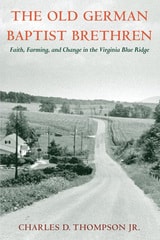
The Old German Baptist Brethren
Faith, Farming, and Change in the Virginia Blue RidgeCharles D. Thompson Jr.
University of Illinois Press, 2006
Charles D. Thompson Jr.'s The Old German Baptist Brethren combines oral history with ethnography and archival research--as well as his own family ties to the Franklin County community--to tell the story of the Brethren's faith on the cusp of impending change. The book traces the transformation of their operations from frontier subsistence farms to cash-based enterprises, connecting this with the wider confluence of agriculture and faith in colonial America. Using extensive interviews, Thompson looks behind the scenes at how individuals interpret their own futures in farming, their hope for their faith, and how the failure of religiously motivated agriculture figures in the larger story of the American farmer.
The Perils and Prospects of Southern Black Leadership
Gordon Blaine Hancock, 1884–1970Raymond Gavins
Duke University Press, 1993
The Quick-Change Artist
StoriesCary Holladay
Ohio University Press, 2006
In these stories of magic and memory, clustered around a resort hotel in a small Virginia community, Cary Holladay takes the reader on an excursion through the changes wrought by time on the community and its visitors. From the quiet of a rural forest to the rhythms of rock and roll, The Quick-Change Artist is at once whimsical and hard-edged, dizzying in its matter-of-fact delivery of the fantastic.
Romance, a sense of place and belonging, and the supernatural—especially in the lives of children coming of age—offer windows into worlds beyond the ordinary throughout The Quick-Change Artist. In the title story, a young chambermaid is in love with a foreign magician who performs at the hotel where she works. In “Heaven,” set during the 1918 flu epidemic, a struggling mother and son rely on the support of their fortune-telling plow horse. The narrator of “Jane’s Hat” recalls a childhood enlivened by an unusual school principal and a friend who starts finding beauty everywhere.
Horses and the people who love them, wanderers and those who feed them, creatures that disappear and those who search for them: these are stories with a constant heart.

The Spirit of Colonial Williamsburg
Ghosts and Interpreting the Recreated PastAlena Pirok
University of Massachusetts Press, 2022
On any given night, hundreds of guests walk the darkened streets of Colonial Williamsburg looking for ghosts. Since the early 2000s, both the museum and private companies have facilitated these hunts, offering year-round ghost tours. Critics have called these excursions a cash grab, but in truth, ghosts and hauntings have long been at the center of the Colonial Williamsburg project.
The Spirit of Colonial Williamsburg examines how the long-dead past comes alive at this living-history museum. In the early twentieth century, local stories about the ghosts of former residents—among them Revolutionary War soldiers and nurses, tavern owners and prominent attorneys, and enslaved African Americans—helped to turn Williamsburg into a desirable site for historical restoration. But, for much of the twentieth century, the museum tried diligently to avoid any discussion of ghosts, considering them frivolous and lowbrow. Alena Pirok explores why historic sites have begun to embrace their spectral residents in recent decades, arguing that through them, patrons experience an emotional connection to place and a palpable understanding of the past through its people.

The Spirits of Bad Men Made Perfect
The Life and Diary of Confederate Artillerist William Ellis JonesConstance Hall Jones
Southern Illinois University Press, 2020
In 1865 Jones returned to his prewar printing trade in Richmond, and his lasting reputation stems from his namesake publishing company’s role in the creation and dissemination of much of the Lost Cause ideology. Unlike the pro-Confederate books and pamphlets Jones published—primary among them the Southern Historical Society Papers—his diary shows the mindset of an unenthusiastic soldier. In a model of contextualization, Constance Hall Jones shows how her ancestor came to embrace an uncritical veneration of the army’s leadership and to promulgate a mythology created by veterans and their descendants who refused to face the amorality of their cause.
Jones brackets the soldier’s diary with rich, biographical detail, profiling his friends and relatives and providing insight into his childhood and post-war years. In doing so, she offers one of the first serious investigations into the experience of a Welsh immigrant family loyal to the Confederacy and makes a significant contribution to our understanding of Civil War–era Richmond and the nineteenth-century publishing industry. Invitingly written, The Spirits of Bad Men Made Perfect is an engaging life-and-times story that will appeal to historians and general readers alike.
Threads
Gender, Labor, and Power in the Global Apparel IndustryJane L. Collins
University of Chicago Press, 2003
To dispel these misunderstandings, Jane L. Collins visited two very different apparel firms and their factories in the United States and Mexico. Moving from corporate headquarters to factory floors, her study traces the diverse ties that link First and Third World workers and managers, producers and consumers. Collins examines how the transnational economics of the apparel industry allow firms to relocate or subcontract their work anywhere in the world, making it much harder for garment workers in the United States or any other country to demand fair pay and humane working conditions.
Putting a human face on globalization, Threads shows not only how international trade affects local communities but also how workers can organize in this new environment to more effectively demand better treatment from their distant corporate employers.