Results by title
51 books match the query 'Voegelin, Eric' and 9 start with t
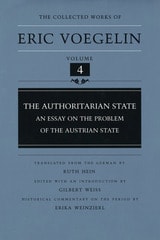
The Authoritarian State (CW4)
An Essay on the Problem of the Austrian StateEric Voegelin, Edited & Intro by Gilbert Weiss, Translated by Ruth Hein, & Historical Commentary by Erika Weinzierl
University of Missouri Press, 1999
Published in Vienna in 1936, The Authoritarian State by Eric Voegelin has remained virtually unknown to the public until now. Sales of the German edition were halted following the Nazi invasion of Austria in 1938, and the entire printing was later destroyed by wartime bombing. In this volume, Voegelin offers a critical examination of the most prominent European theories of state and constitutional law of the period while providing a political and historical analysis of the Austrian situation. He discusses the dismissal of Parliament in 1933, the civil war, the murder of Federal Chancellor Dollfuss, the adoption of the "Authoritarian Constitution" of 1934, and the predicament of being sandwiched between Hitler and Mussolini.
A radical critique of Hans Kelsen's pure theory of law lies at the heart of this work, marking Voegelin's definitive departure from Neo-Kantian epistemology. For the first time, Voegelin elaborates on the important distinction between theoretical concepts and political symbols as a basis for explaining the nontheoretical and speculative character of ideologies, both left and right. He shows that total and authoritarian are symbols of ideological self-interpretation that have no theoretical value, a distinction basic to his later work in The New Science of Politics.
Available for the first time in English, The Authoritarian State is a valuable addition to the Voegelin canon and to the field of intellectual history in general.
The Drama of Humanity and Other Miscellaneous Papers, 1939-1985 (CW33)
Eric Voegelin, Edited & Intro by William Petropulos & Gilbert Weiss
University of Missouri Press, 2004
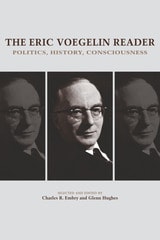
The Eric Voegelin Reader
Politics, History, ConsciousnessCharles R. Embry
University of Missouri Press, 2023
Drawing from the University of Missouri Press’s thirty-four-volume edition of The Collected Works of Eric Voegelin (1990-2009), Charles Embry and Glenn Hughes have assembled a selection of representative works of Voegelin, satisfying a longstanding need for a single volume that can serve as a general introduction to Voegelin’s philosophy. The collection includes writings that demonstrate the range and creativity of Voegelin’s thought as it developed from 1956 until his death in 1985 in his search for the history of order in human society.
The Reader begins with excerpts from Autobiographical Reflections (1973), which include an orienting mixture of biographical information, philosophical motivations, and the scope of Voegelin’s project. It reflects key periods of Voegelin’s philosophical development, pivoting on his flight from the Gestapo.
The next section focuses on Voegelin’s understanding of the contemporary need to re-ground political science in a non-positivistic, post-Weberian outlook and method. It begins with Voegelin’s historical survey of science and scientism, followed by his explanation of what political science now requires in his introduction to The New Science of Politics. Also included are two essays that exemplify the practice of this “new science.” Voegelin started his academic career as a political scientist, and these early essays indicate his wide philosophical vision.
Voegelin recognized that a fully responsible “new science of politics” would require the development of a philosophy of history. This led to the writing of his magnum opus, the five-volume Order and History (1956–1985). This section of the Reader includes his introductions to volumes 1, 2 and 4 and his most essential accounts of the theoretical requirements and historical scope of a philosophy of history adequate to present-day scholarship and historical discoveries.
In the course of his career, Voegelin came to understand that political science, political philosophy, and philosophy of history must have as their theoretical nucleus a sound philosophical anthropology based on an accurate philosophy of human consciousness. The next set of writings consists of one late lecture and four late essays that exemplify how Voegelin recovers the wisdom of classical philosophy and the Western religious tradition while criticizing modern misrepresentations of consciousness. The result is Voegelin’s contemporary accounts of the nature of reason, the challenge of truly rational discussion, and the search for divine origins and the life of the human spirit.
During his philosophical journey, Voegelin addressed the historical situatedness of human existence, explicating the historicity of human consciousness in a manner that gave full due to the challenges of acknowledging both human immersion in the story of history and the ability of consciousness to arrive at philosophically valid truths about existence that are transhistorical. The essays in this final section present the culmination of his philosophical meditation on history, consciousness, and reality.

The History of the Race Idea (CW3)
From Ray to CarusEric Voegelin, Edited & Intro by by Klaus Vondung, & Translated by Ruth Hein
University of Missouri Press, 0
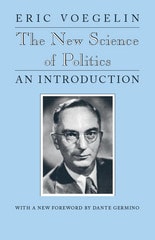
The New Science of Politics
An IntroductionEric Voegelin
University of Chicago Press, 1987
What Eric Voegelin attempts in The New Science of Politics is nothing less ambitious than a complete theory of humanity, society, and history. To build his theory, Voegelin draws on a breathtaking range of subjects from throughout history, including the Mongol Orders of Submission, the Behistun Inscription, and a controversy over an alter to the goddess Victoria in the Roman Forum. Addressing the access to truth afforded by myth, revelation, and philosophy, Voegelin then carefully contrasts each with gnosticism. The resulting book is a heady exploration of the development of European politics through the Western tradition and the ongoing importance of the inner quest for transcendent reality. =
The New Science of Politics
An IntroductionEric Voegelin
University of Chicago Press, 1987
"Thirty-five years ago few could have predicted that The New Science of Politics would be a best-seller by political theory standards. Compressed within the Draconian economy of the six Walgreen lectures is a complete theory of man, society, and history, presented at the most profound and intellectual level. . . . Voegelin's [work] stands out in bold relief from much of what has passed under the name of political science in recent decades. . . . The New Science is aptly titled, for Voegelin makes clear at the outset that a 'return to the specific content' of premodern political theory is out of the question. . . . The subtitle of the book, An Introduction, clearly indicates that The New Science of Politics is an invitation to join the search for the recovery of our full humanity."—From the new Foreword by Dante Germino
"This book must be considered one of the most enlightening essays on the character of European politics that has appeared in half a century. . . . This is a book powerful and vivid enough to make agreement or disagreement with even its main thesis relatively unimportant."—Times Literary Supplement
"Voegelin . . . is one of the most distinguished interpreters to Americans of the non-liberal streams of European thought. . . . He brings a remarkable breadth of knowledge, and a historical imagination that ranges frequently into brilliant insights and generalizations."—Francis G. Wilson, American Political Science Review
"This book is beautifully constructed . . . his erudition constantly brings a startling illumination."—Martin Wright, International Affairs
"A ledestar to thinking men who seek a restoration of political science on the classic and Christian basis . . . a significant accomplishment in the retheorization of our age."—Anthony Harrigan, Christian Century
The Philosopher and the Storyteller
Eric Voegelin and Twentieth-Century LiteratureCharles R. Embry
University of Missouri Press, 2018
Throughout his philosophical career, Eric Voegelin had much to say about literature in both his published work and his private letters. Many of his most trenchant comments regarding the analysis of literature appear in his correspondence with critic Robert Heilman, and, through his familiarity with that exchange, Charles Embry has gained extraordinary insight into Voegelin’s literary views.
The Philosopher and the Storyteller is the first book-length study of the literary dimensions of Voegelin’s philosophy—and the first to use his philosophy to read specific novels. Bringing to bear a thorough familiarity with both Voegelin and great literature, Embry shows that novels—like myths, philosophy, and religious texts—participate in the human search for the truth of existence, and that reading literature within a Voegelinian framework exposes the existential and philosophical dimensions of those works.
Embry focuses on two key elements of Voegelin’s philosophy as important for reading literature: metaxy, the in-between of human consciousness, and metalepsis, human participation in the community of being. He shows how Voegelin’s philosophy in general is rooted in literary-symbolic interpretation and, therefore, provides a foundation for the interpretation of literature. And finally he explores Voegelin’s insistence that the soundness of literary criticism lies in the consciousness of the reader.
Embry then offers Voegelinian readings that vividly illustrate the principles of this approach. First he considers Graham Swift’s Waterland as an example of the human search for meaning in the modern world, then he explores the deformation and recovery of reality in Heimito von Doderer’s long and complex novel The Demons, and finally he examines how Flannery O’Connor’s The Violent Bear It Away mythically expresses the flux of divine presence in what Voegelin calls the Time of the Tale.
The Philosopher and the Storyteller unites fiction and philosophy in the common quest to understand our nature, our world, and our cosmos. A groundbreaking exploration of the connection between Voegelin and twentieth-century literature, this book opens a new window on the philosopher’s thought and will motivate readers to study other novels in light of this approach.
Theory of Governance and Other Miscellaneous Papers, 1921-1938 (CW32)
Eric Voegelin, Edited & Intro by William Petropulos & Gilbert Weiss, & Translated by William Petropulos, Jodi Cockerill, M. J. Hanak, Ingrid Heldt, Elisabeth von Lochner, & Sue Bollans
University of Missouri Press, 2004
This first of two volumes of Voegelin's miscellaneous papers brings together crucial writings, published for the first time, from the early, formative period of this scholar's thought. The book begins with Voegelin's dissertation on sociological method, completed under the direction of Othmar Spann and Hans Kelsen at the University of Vienna in 1922. It reveals an intimate knowledge of the writings of Georg Simmel and a skillful use of insights gained from Edmund Husserl's Logical Investigations and Ideas.
The dissertation, and other smaller pieces written at this time, addresses problems that remained of great importance to Voegelin throughout his life: the relation of insight to language, the structure of the human being, and the human's spiritual center. They disclose both Voegelin's theoretical reference points during these early years, including the thought of Henri Bergson, Othmar Spann, Georg Simmel, and Edmund Husserl, as well the young scholar's remarkably independent approach to theoretical problems.
Moreover, this volume includes a work that is fundamental to an understanding of Voegelin's theoretical development: his extended study on the "theory of governance," written between 1930 and 1932. It follows the issues that confront political society to their roots in the soul and in the soul's relationship to the ground of being.
The Theory of Governance and Other Miscellaneous Papers presents a meditative-exegetic study of texts from Augustine, Descartes, and Husserl, early examples of the meditations that became central to Voegelin's later work. Other essays included in this volume such as "Theory of Law" and "Political Theory as Human Science" develop these theoretical insights and refine Voegelin's methodological tools. This volume will be of interest to all scholars of the work of Eric Voegelin and of the refoundation of political philosophy in the twentieth century in general.
Transcendence and History
The Search for Ultimacy from Ancient Societies to PostmodernityGlenn Hughes
University of Missouri Press, 2020