Results by title
81 books match the query 'Volume 3' and 25 start with t

Tactical Missiles - From Concepts to Components
Warheads, Volume 3P.K. Sinha
The Institution of Engineering and Technology, 2026

Taking Stock of the Profession & Teaching the Faerie Queen, Volume 3
Jennifer L. Holberg and Marcy Taylor, eds.
Duke University Press, 0

The Bard in the Borderlands
An Anthology of Shakespeare Appropriations en La Frontera, Volume 3Edited by Katherine Gillen, Adrianna M. Santos, and Kathryn Vomero Santos
Arizona Center for Medieval and Renaissance Studies, 2026
The third volume in the anthology, featuring a wide range of plays that reimagine Shakespeare works from Borderlands perspectives.
For several decades, Chicanx and Indigenous theatermakers have been repurposing Shakespeare’s plays to reflect the histories and lived realities of the US–Mexico Borderlands and to create space to tell stories of and for La Frontera. Celebrating this rich tradition, The Bard in the Borderlands: An Anthology of Shakespeare Appropriations en La Frontera brings a wide range of Borderlands Shakespeare plays together for the first time in a multi-volume open-access scholarly edition. This anthology celebrates the dynamic, multilingual reworking of canon and place that defines Borderlands Shakespeare, and it situates these geographically and temporally diverse plays within the robust study of Shakespeare’s global afterlives.
The plays featured in this volume diverge drastically from Shakespeare, bringing elements of Hamlet, Henry IV, Part 1, Macbeth, and The Tempest into a range of subcultures that challenge dominant structures of power. In so doing, they remix and revise intersecting histories and traditions to heal colonial wounds and to call forth new worlds for fronterizos.
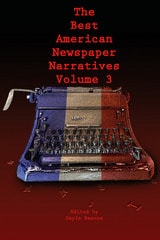
The Best American Newspaper Narratives, Volume 3
Gayle Reaves
University of North Texas Press, 2016

The Collected Essays and Criticism, Volume 3
Affirmations and Refusals, 1950-1956Clement Greenberg
University of Chicago Press, 1995
With the inclusion of critical exchanges between Greenberg and F. R. Leavis, Fairfield Porter, Thomas B. Hess, Herbert Read, Max Kozloff, and Robert Goldwater, these volumes are essential sources in the ongoing debate over modern art. For each volume, John O'Brian has furnished an introduction, a selected bibliography, and a brief summary of events that places the criticism in its artistic and historical context.
The Collected Letters of Thomas and Jane Welsh Carlyle
1824–25, Volume 3Charles Richard Sanders
Duke University Press, 0

The Complete Greek Tragedies, Volume 3
EuripidesEdited by David Grene and Richmond Lattimore
University of Chicago Press, 1992
For the Centennial Edition two of the original translations have been replaced. In the original publication David Grene translated only one of the three Theban plays, Oedipus the King. Now he has added his own translations of the remaining two, Oedipus at Colonus and Antigone, thus bringing a new unity of tone and style to this group. Grene has also revised his earlier translation of Prometheus Bound and rendered some of the former prose sections in verse. These new translations replace the originals included in the paperback volumes Sophocles I (which contains all three Theban plays), Aeschylus II, Greek Tragedies, Volume I, and Greek Tragedies, Volume III, all of which are now being published in second editions.
All other volumes contain the translations of the tragedies of Aeschylus, Sophocles, and Euripides for the most part from the original versions first published in the 1940s and 1950s. These translations have been the choice of generations of teachers and students, selling in the past forty years over three million copies.
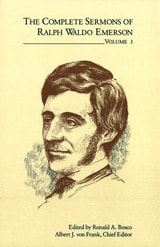
The Complete Sermons of Ralph Waldo Emerson, Volume 3
Ralph Waldo Emerson; Edited by Ronald A. Bosco; Chief Editor, Albert J. von Frank
University of Missouri Press, 1991
The forty-five sermons collected in Volume 3 were composed and first delivered between October 1830 and November 1831. During that time Emerson's first wife, Ellen Tucker Emerson, died of tuberculosis, a loss that deeply affected Emerson.
Transcribed and edited from manuscripts in Harvard's University's Houghton Library, the sermons are presented in a clear text approximating as nearly as possible the original version delivered to Emerson's congregation. As well as the detailed chronology, explanatory footnotes, and textual endnotes found in previous volumes, this one contains a comprehensive index.

The Complete Writings and Selected Correspondence of John Dickinson
Volume 3Jane E. Calvert
University of Delaware Press, 2024

The Correspondence of Michael Faraday
1841-1848, Volume 3Frank A.J.L. James
The Institution of Engineering and Technology, 1996
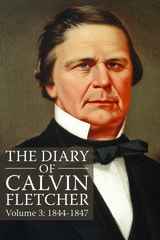
The Diary of Calvin Fletcher, Volume 3
1844-1847Gayle Thornbrough
Indiana Historical Society Press, 1974

The Mahabharata, Volume 3
Book 4: The Book of the Virata; Book 5: The Book of the EffortEdited by J. A. B. van Buitenen
University of Chicago Press, 1978
The Medici Codex of 1518, Volume 3
Facsimile EditionEdited by Edward E. Lowinsky
University of Chicago Press, 1968
It is invaluable for transmitting the excellent readings of the repertory of the French Royal Chapel and a number of political motets of great musical and historical interest that reflect events at the French court and are unique to this collection.
Edward E. Lowinsky presents this anthology as part of a series containing critical editions of major sources of fifteenth- and sixteenth-century music in their entirety.
The Nature of Love, Volume 3
The Modern WorldIrving Singer
University of Chicago Press, 1987
"Irving Singer . . . has developed a method of historical analysis flexible enough to deal with all kinds of love, from Greek homosexual love in Plato, to the philia and agape of the New Testament, to the courtly love of medieval romance, to the Romantics, for whom love was magic. . . . [This] final volume brings us to the present. In 'The Modern World,' Singer offers readings of Freud, Proust, and Sartre, among others. He shows how their work was formed in reaction to the 19th-century ideal of 'merging' of the identities of lover and beloved. More often than not, the great modern writers portray love as impossible, as a field of failure and regret. . . . This masterpiece of critical thinking is a timely, eloquent, and scrupulous account of what, after all, still makes the world go round."—Thomas D'Evelyn, Christian Science Monitor
"This is the third of a three-volume history of the philosophy of love. It begins with Kierkegaard, Tolstoy, and Nietzsche in the nineteenth century and treats Freud, Proust, Bergson, D. H. Lawrence, G. B. Shaw, Santayana, Sartre, and others in the twentieth. Although the author's approach is primarily historical, he intersperses critical remarks throughout. Most of the major themes which are discussed by philosophers of love make their way into this history, including friendship, sexual love, and the distinction between love that is based on the value of the beloved and love that bestows value on the beloved. Singer devotes a number of pages to his own views on falling in love, being in love, and staying in love. . . . Singer's exposition is lucid and organized; his criticisms are insightful."—Ethics
"In this third volume of historical overview of the development of the Western conception of love, Singer uses writers, philosophers, and psychologists to provide the reader with an overview of love in the late 19th and 20th century. . . . Analyzing authors such as Tolstoy, Proust, D. H. Lawrence, and Shaw and philosophers such as Nietzsche, Kierkegaard, Sartre, and Santayana, as well as Freud, Singer . . . links each contributor's thoughts to the influence of previous writers and also provides some psycho-historical insight into their personal lives that might have been either a source or direct result of their views. In this final volume, Singer proceeds to look at not just the 'great men' influence but also provides a chapter overviewing scientific contributions to our understanding of love. . . . Singer's work is a significant contribution to understanding the social construction of important, abstract social and personal values. By tracing love through different historical periods through a variety of voices, Singer has created a rich history of the struggle between the ideal and the real, between the dreams of what love should provide and the reality of what relationships have been in each historical period. By personalizing the voice through psychohistorical analysis, Singer also provides insight into the shaping of ideas through the intimate struggles of the shapers."—Mark V. Chaffee, Contemporary Psychology
The Origin of Table Manners
Mythologiques, Volume 3Claude Lévi-Strauss
University of Chicago Press, 1990
"An immense anthropological erudition is here wielded by one of the world's finest minds, and the myths themselves have never been taken more seriously. . . . [Lévi-Strauss] raises issues and then resolves them with the suspenseful cunning of a mystery novelist."—John Updike, New Yorker

The Plays of David Garrick, Volume 3
Garrick's Adaptations of Shakespeare, 1744 - 1756Edited by Harry William Pedicord and Fredrick Louis Bergmann
Southern Illinois University Press, 1981
David Garrick’s accomplishments as an actor, manager, and theatrical innovator brought him great fame and fortune, and his ideas influenced not only his own age but succeeding ages as well. Yet as a playwright, a part of the elegant combination of talents that was David Garrick, he has never achieved the critical reputation he richly deserves, in main because of the unavailability of texts and the lack of proper assessment of the historic importance of his plays in the English theatre.
This first complete edition makes available to scholars and students all the plays of Garrick in well edited texts, with commentary and notes.
Contents: Macbeth. A Tragedy, 1744; Romeo and Juliet, 1748; The Fairies. An Opera, 1755; Catherine and Petruchio. A Comedy, 1756; Florizel and Perdita. A Dramatic Pastoral, 1756; The Tempest. An Opera, 1756; and King Lear. A Tragedy, 1756.
The Raj Quartet, Volume 3
The Towers of SilencePaul Scott
University of Chicago Press, 1998
India, 1943: In a regimental hill station, the ladies of Pankot struggle to preserve the genteel façade of British society amid the debris of a vanishing empire and World War II. A retired missionary, Barbara Batchelor, bears witness to the connections between many human dramas; the love between Daphne Manner and Hari Kumar; the desperate grief an old teacher feels for an India she cannot rescue; and the cruelty of Captain Ronald Merrick, Susan Layton's future husband.
The Selected Papers of Edward Shils, Volume 3
The Calling of Sociology and Other Essays on the Pursuit of LearningEdward Shils
University of Chicago Press, 1980

The Skull, Volume 3
Functional and Evolutionary MechanismsEdited by James Hanken and Brian K. Hall
University of Chicago Press, 1993
The Talmud of the Land of Israel, Volume 3
DemaiJacob Neusner, General Editor
University of Chicago Press, 1993
The Topical Notebooks of Ralph Waldo Emerson, Volume 3
Ralph Waldo Emerson; Edited by Glen M. Johnson; Series Editor, Ralph H. Orth
University of Missouri Press, 1994
"Ralph Orth...has been indefatigable in giving us volumes of the highest accuracy and usefulness," said American Renaissance Literary Report. Volume 3 completes the series that brings twelve of Emerson's topical notebooks and four other notebooks into print for the first time. In this final volume, Glen Martin Johnson presents four of the topical notebooks dating from the mid 1840s through the early 1870s, the end of Emerson's productive life. The notebooks include diverse material from which Emerson wrote his lectures, essays, and books.
Each of the four notebooks illustrates some of the many uses Emerson made of these collections of quotations and ideas: OP Gulistan is a compendium of biographical information and anecdotes about dozens of Emerson's acquaintances; S Salvage takes stock of and preserves parts of his earlier writings; ZO was used in preparing the lectures that became "Poetry and Imagination"; and ML was employed for extensive notes on the moral law and religion, and as a resource in preparing lectures and readings during the late 1860s.
The publication of these notebooks renders an invaluable service to the scholarly community and to students of American literature. Collectively, they dipict in great detail the subtle changes that occurred in Emerson's thought from the beginning until the end of his career to give a complete picture of the man and the writer. The younger Emerson, whose writing abounds with enthusiasm, became someone whose darker wisdom about inevitable limitations was expressed in essays such as "Fate" and "Illusions." The notebooks in this volume will allow us to better understand the last three decades of Emerson's career, which have remained less than fully explored.

The Venture of Islam, Volume 3
The Gunpowder Empires and Modern TimesMarshall G. S. Hodgson
University of Chicago Press, 1977
In this concluding volume of The Venture of Islam, Hodgson describes the second flowering of Islam: the Safavi, Timuri, and Ottoman empires. The final part of the volume analyzes the widespread Islamic heritage in today's world.
"This is a nonpareil work, not only because of its command of its subject but also because it demonstrates how, ideally, history should be written."—The New Yorker
The War Diaries of Vladimir Dedijer
Volume 3: From September 11, 1943, to November 7, 1944by Vladimir Dedijer
University of Michigan Press, 1990
Time and Narrative, Volume 3
Paul Ricoeur
University of Chicago Press, 1990
Ricoeur's aim here is to explicate as fully as possible the hypothesis that has governed his inquiry, namely, that the effort of thinking at work in every narrative configuration is completed in a refiguration of temporal experience. To this end, he sets himself the central task of determing how far a poetics of narrative can be said to resolve the "aporias"—the doubtful or problematic elements—of time. Chief among these aporias are the conflicts between the phenomenological sense of time (that experienced or lived by the individual) and the cosmological sense (that described by history and physics) on the one hand and the oneness or unitary nature of time on the other. In conclusion, Ricoeur reflects upon the inscrutability of time itself and attempts to discern the limits of his own examination of narrative discourse.
"As in his previous works, Ricoeur labors as an imcomparable mediator of often estranged philosophical approaches, always in a manner that compromises neither rigor nor creativity."—Mark Kline Taylor, Christian Century
"In the midst of two opposing contemporary options—either to flee into ever more precious readings . . . or to retreat into ever more safe readings . . . —Ricoeur's work offers an alternative option that is critical, wide-ranging, and conducive to new applications."—Mary Gerhart, Journal of Religion

Trade and Employment in Developing Countries, Volume 3
Synthesis and ConclusionsAnne O. Krueger
University of Chicago Press, 1988