Results by title
58 books match the query 'Whitman, Walt' and 9 start with t
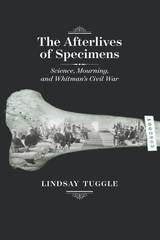
The Afterlives of Specimens
Science, Mourning, and Whitman's Civil WarLindsay Tuggle
University of Iowa Press, 2017
Grounded in archival discoveries, Afterlives traces the origins of nineteenth-century America’s preservation compulsion, illuminating the influences of botanical, medical, spiritualist, and sentimental discourses on Whitman’s work. Tuggle unveils previously unrecognized connections between Whitman and the leading “medical men” of his era, such as the surgeon John H. Brinton, founding curator of the Army Medical Museum, and Silas Weir Mitchell, the neurologist who discovered phantom limb syndrome. Remains from several amputee soldiers whom Whitman nursed in the Washington hospitals became specimens in the Army Medical Museum.
Tuggle is the first scholar to analyze Whitman’s role in medically memorializing the human cadaver and its abandoned parts.
The Ethics of Oneness
Emerson, Whitman, and the Bhagavad GitaJeremy David Engels
University of Chicago Press, 2021
In The Ethics of Oneness, Jeremy David Engels reads the Bhagavad Gita alongside the works of American thinkers Ralph Waldo Emerson and Walt Whitman. Drawing on this rich combination of traditions, Engels presents the notion that individuals are fundamentally interconnected in their shared divinity. In other words, everything is one. If the lessons of oneness are taken to heart, particularly as they were expressed and celebrated by Whitman, and the ethical challenges of oneness considered seriously, Engels thinks it is possible to counter the pervasive and problematic American ideals of hierarchy, exclusion, violence, and domination.
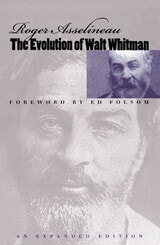
The Evolution of Walt Whitman
Roger Asselineau
University of Iowa Press, 1999
Now, nearly forty years after its original translation into English, Roger Asselineau's complete and magisterial biography of Walt Whitman will remind readers of the complex weave of traditions in Whitman scholarship. It is startling to recognize how much of our current understanding of Whitman was already articulated by Asselineau nearly half a century ago. Throughout its eight hundred pages, The Evolution of Walt Whitman speaks with authority on a vast range of topics that define both Whitman the man and Whitman the mythical personage. Remarkably, most of these discussions remain fresh and relevant, and that is in part because they have been so influential.
In particular, The Evolution of Walt Whitman inaugurated the study of Leaves of Grass as a lifelong work in progress, and it marked the end of the habit of talking about Leaves as if it were a single unified book. Asselineau saw Whitman's poetry “not as a body of static data but as a constantly changing continuum whose evolution must be carefully observed.” Throughout Evolution, Asselineau placed himself in the role of the observer, analyzing Whitman's development with a kind of scientific detachment. But behind this objective persona burned the soul of a risk taker who was willing to rewrite Whitman studies by bravely proposing what was then a controversial biographical source for Whitman's art—his homosexual desires.
The Evolution of Walt Whitman is a reminder that extraordinary works of criticism never exist in and of themselves. In this expanded edition, Roger Asselineau has provided a new essay summarizing his own continuing journey with Whitman. A foreword by Ed Folsom, editor of the Walt Whitman Quarterly, regards Evolution as the genesis of contemporary Whitman studies.
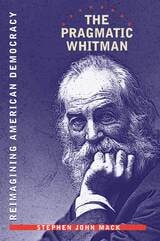
The Pragmatic Whitman
Reimaining American DemocracyStephen John Mack
University of Iowa Press, 2002
In this surprisingly timely book, Stephen Mack examines Whitman’s particular and fascinating brand of patriotism: his far-reaching vision of democracy. For Whitman, loyalty to America was loyalty to democracy. Since the idea that democracy is not just a political process but a social and cultural process as well is associated with American pragmatism, Mack relies on the pragmatic tradition of Emerson, James, Dewey, Mead, and Rorty to demonstrate the ways in which Whitman resides in this tradition.
Mack analyzes Whitman's democratic vision both in its parts and as a whole; he also describes the ways in which Whitman's vision evolved throughout his career. He argues that Whitman initially viewed democratic values such as individual liberty and democratic processes such as collective decision-making as fundamental, organic principles, free and unregulated. But throughout the 1860s and 1870s Whitman came to realize that democracy entailed processes of human agency that are more deliberate and less natural—that human destiny is largely the product of human effort, and a truly humane society can be shaped only by intelligent human efforts to govern the forces that would otherwise govern us.
Mack describes the foundation of Whitman’s democracy as found in the 1855 and 1856 editions of Leaves of Grass, examines the ways in which Whitman’s 1859 sexual crisis and the Civil War transformed his democratic poetics in “Sea-Drift,” “Calamus,” Drum-Taps,and Sequel to Drum-Taps, and explores Whitman’s mature vision in Democratic Vistas, concluding with observations on its moral and political implications today. Throughout, he illuminates Whitman's great achievement—learning that a full appreciation for the complexities of human life meant understanding that liberty can take many different and conflicting forms—and allows us to contemplate the relevance of that achievement at the beginning of the twenty-first century.
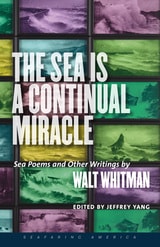
The Sea Is a Continual Miracle
Sea Poems and Other Writings by Walt WhitmanWalt Whitman
University Press of New England, 2017

The Stamp of Class
Reflections on Poetry and Social ClassGary Lenhart
University of Michigan Press, 2005
-Lorenzo Thomas
The Stamp of Class explores the nature of reading poetry in the context of class and its themes and sheds new light on how this important yet little-heralded subject affects the poet's life and work.
While numerous works have taken up the question of race and gender as they relate to literary creation, this is the first book of its kind to probe the interplay between class and American poetry. Author Gary Lenhart considers poetry and class across a wide variety of time periods and poetic trends and reflects on a range of influential poets from the eighteenth to the twenty-first centuries.
The essays in The Stamp of Class deal with the question of class as reflected in the works of Tracie Morris, Tillie Olsen, Melvin Tolson, William Carlos Williams, Walt Whitman, and others. The work is rooted in the author's own experiences as a working-class poet and teacher and is the result of more than a decade of exploration.
Poet and scholar Gary Lenhart is Lecturer in English at Dartmouth College in Hanover, New Hampshire. His most recent books of poetry are Father and Son Night, Light Heart, and One at a Time. His essays and reviews have appeared in numerous magazines and journals, including the American Poetry Review, American Book Review, and Exquisite Corpse.

The Whitman Revolution
Sex, Poetry, and PoliticsBetsy Erkkila
University of Iowa Press, 2020
The Whitman Revolution brings together a rich collection of Betsy Erkkila’s phenomenally influential essays that have been published over the years, along with two powerful new essays. Erkkila offers a moving account of the inseparable mix of the spiritual-sexual-political in Whitman and the absolute centrality of male-male connection to his work and thinking. Her work has been at the forefront of scholarship positing that Whitman’s songs are songs not only of workers and occupations but of sex and the body, homoeroticism, and liberation. What is more, Erkkila’s writing demonstrates that this sexuality and communal impulse is central to Whitman’s revolutionary poetry and his conception of democracy itself—an insight that was all but suppressed during the mid-twentieth century emergence of American literature as a field of study.
Highlights of this collection include Erkkila’s essays on pairings such as Marx and Whitman, Dickinson and Whitman, and Melville and Whitman. Across the volume, she demonstrates an international vision that highlights the place of Leaves of Grass within a global struggle for democracy. The Whitman Revolution is evidence of Erkkila’s remarkable ability to lead critical discussions, and marks an exciting event in Whitman studies.
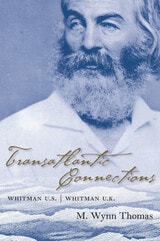
Transatlantic Connections
Whitman U.S., Whitman U.K.Thomas, M. Wynn
University of Iowa Press, 2005
The book’s contrasting sections reflect the two locations studied: the first shows Whitman in his time and place, while the second repositions him within the cultures of England and Wales from the late 19th to the late 20th century. In the opening chapter he is placed against the vivid, outrageous background of the New York of his time; the second finds evidence in his poetry of a critique of the new urban politics of the emerging city boss; the third radically redefines Whitman's relationship to his famous contemporary Longfellow. Other chapters deal with the Civil War poet, exploring the ways in which his poetic responses were in part shaped by his relationship to his soldier brother George, and his use of the meteorological discoveries of his day to fashion metaphors for imaging the different phases of the conflict.
The second section ponders the paradox that this Whitman, who was so much the product of his specific time and limited “local” culture, should come to be accepted as an international visionary. The United Kingdom is taken as offering striking instances of this phenomenon, and his transatlantic admirers are shown to have been engaged in an unconscious process of “translating” Whitman into the terms of their own culturally specific social, political, and sexual preoccupations. Some of the connections explored are those between Whitman and Edward Carpenter, the so-called English Whitman; between Whitman and perhaps his greatest English critic, D. H. Lawrence; and between Whitman and the Welsh poets Ernest Rhys, Amanwy (David Rees Griffiths), Niclas y Glais (T. E. Nicholas), Waldo Williams, Glyn Jones, Dylan Thomas, and R. S. Thomas.
This bold and original study, offering new points of entry into understanding Whitman as the product of his time and place as well as understanding the reception of Whitman in the U.K. as a process of cultural translation, should fascinate scholars of Whitman and students of comparative literature.
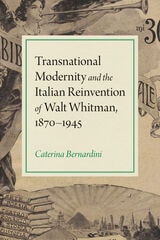
Transnational Modernity and the Italian Reinvention of Walt Whitman, 1870-1945
Caterina Bernardini
University of Iowa Press, 2021
Studying Whitman’s reception from a transnational perspective shows how many countries were simultaneously carving out a new modernity in literature and culture. In this sense, Bernardini not only shows the interconnectedness of various international agents in understanding and contributing to the spread of Whitman’s work, but, more largely, illustrates a constellation of similar pre-modernist and modernist sensibilities. This stands in contrast to the notion of sudden innovation: modernity was not easy to achieve, and it did not imply a complete refusal of tradition. Instead, a continuous and fruitful negotiation between tradition and innovation, not a sudden break with the literary past, is at the very heart of the Italian and transnational reception of Whitman. The book is grounded in archival studies and the examination of primary documents of noteworthy discovery.