Results by title
53 books match the query 'Wildlife' and 15 start with t
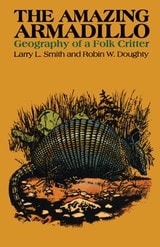
The Amazing Armadillo
Geography of a Folk CritterBy Larry L. Smith and Robin W. Doughty
University of Texas Press, 1984
Perhaps no creature has so fired the imagination of a populace as the armadillo—that most ungainly, awkward, and timid little animal. Its detractors call it a varmint and wish it good speed from the Lone Star State and its other natural territories. But its supporters claim that it is the animal kingdom's representative of all that's truly Texan: tough, pioneering, adaptable, and generous in sharing its habitation with others. What is it that sets this quizzical little creature apart from the rest of the animal kingdom?
Larry L. Smith and Robin W. Doughty ably answer this question in The Amazing Armadillo: Geography of a Folk Critter. This informative book traces the spread of the nine-banded armadillo from its first notice in South Texas late in the 1840s to its current range east to Florida and north to Missouri. The authors look at the armadillo's natural history and habitat as well as the role of humans in promoting its spread, projecting that the animal is increasing in both range and number, continuing its ecological success in areas where habitat and climate are favorable.
The book also contributes to a long-standing research theme in geography—the relationship between humans and wildlife. It explores the armadillo's value to the medical community in current research in Hansen's Disease (leprosy) as well as commercial uses, and abuses, of the armadillo in recent times. Of particular note is the author's engaging look at the armadillo as a symbol of popular culture, the efforts now underway to make it a "totem animal" symbolizing the easy-going lifestyles of some Sunbelt cities, and the spread of the craze for armadilliana to other urban centers.
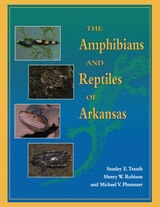
The Amphibians and Reptiles of Arkansas
Stanley E. Trauth
University of Arkansas Press, 2004
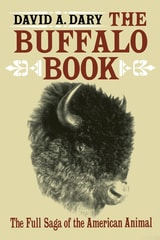
The Buffalo Book
The Full Saga Of The American AnimalDavid A. Dary
Ohio University Press, 1989
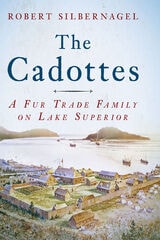
The Cadottes
A Fur Trade Family on Lake SuperiorRobert Silbernagel
Wisconsin Historical Society Press, 2023

The Cadottes
A Fur Trade Family on Lake SuperiorRobert Silbernagel
Wisconsin Historical Society Press, 2026

The Last Panda
George B. Schaller
University of Chicago Press, 1993
"No scientist is better at letting the rest of us in on just how the natural world works; no poet sees the world with greater clarity or writes about it with more grace. . . . Anyone who genuinely cares for wildlife cannot help being grateful to Schaller—both for his efforts to understand the panda and for the candor with which he reports what has gone so badly wrong in the struggle to save it from extinction."—Geoffrey C. Ward, New York Times Book Review
"Schaller's book is a unique mix of natural history and the politics of conservation, and it makes for compelling reading. . . . Having been in giant panda country myself, I found some of the descriptions of the animals and habitats breathtaking. Schaller describes the daily routines and personalities of the giant pandas he studied (as well as their fates thereafter) as though they were his blood relatives. . . . Schaller's brilliant presentation of the complexities of conservation makes his book a milestone for the conservation movement."—Devra G. Kleiman, Washington Post Book World
"George Schaller's most soulful work, written in journal style with many asides about a creature who evolved only two to three million years ago (about the same time as humans). . . . Here, conservation biology confronts an evil that grinds against hope and shatters the planet's diversity. Written with hope."—Whole Earth Catalog
"A nicely crafted blend of wildlife observation and political-cultural analysis. . . . The Last Panda is a sad chronicle of our failure, so far, to stem the decline of the animal that may be the most beloved on the planet."—Donald Dale Jackson, Smithsonian
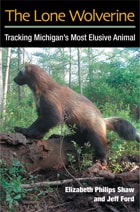
The Lone Wolverine
Tracking Michigan's Most Elusive AnimalElizabeth Philips Shaw and Jeff Ford
University of Michigan Press, 2012
It began in late winter of 2004. Almost 100 years had passed since the last spotting of a wild wolverine in Michigan when coyote hunters caught a glimpse of one of the animals in a frozen farm field in the northern thumb region. For the next six years, Jeff Ford, a local science teacher and amateur naturalist, devoted himself to locating and filming the wolverine that had unexpectedly and inexplicably appeared in the Wolverine State. By the time hikers found the animal dead in early 2010, Ford had taken hundreds of rare live action photos and shot numerous hours of video, with the story of the "Wolverine Guy" attracting national attention through countless newspaper and magazine articles and appearances on Animal Planet and PBS Nature.
This is the tale of Ford's quest as he uncovered answers to mysteries surrounding the animal's territory and movement patterns, while sparking a flurry of controversy surrounding the elusive predator's origin, much of which remains unresolved today. It's an intimate look at research in the raw, from DNA samples stuck on barbed wire to a sophisticated, motion-sensing infrared camera unit strategically placed to observe nocturnal behavior.
The Lone Wolverine brings to vivid life this unforgettable piece of American wildlife lore, using candid interviews, public records, and Ford's own vast storehouse of notes, personal writings, correspondence, and images, offering an extraordinary chronicle of a wild wolverine in its natural habitat, at play and in fierce competition for food and survival. This is a wildlife detective story, recounting years of study and fierce debate as researchers pondered the riddles of Michigan's last wolverine---her origins, habits, and ultimately the cause of her untimely death.
The Vanishing Present
Wisconsin's Changing Lands, Waters, and WildlifeEdited by Donald M. Waller and Thomas P. Rooney
University of Chicago Press, 2008
The Vanishing Present brings together a distinguished set of contributors—including scientists, naturalists, and policy experts—to examine how human pressures on Wisconsin’s changing lands, waters, and wildlife have redefined the state’s ecology. Though they focus on just one state, the authors draw conclusions about changes in temperate habitats that can be applied elsewhere, and offer useful insights into future of the ecology, conservation, and sustainability of Wisconsin and beyond.
A fitting tribute to the home state of Aldo Leopold and John Muir, The Vanishing Present is an accessible and timely case study of a significant ecosystem and its response to environmental change.
The War Against The Beavers
Learning to Be Wild in the North WoodsVerena Andermatt Conley
University of Minnesota Press, 2005

The Well-Connected Animal
Social Networks and the Wondrous Complexity of Animal SocietiesLee Alan Dugatkin
University of Chicago Press, 2024
An engaging exploration of the wondrous social webs that permeate life in animal societies around the world.
It’s all about who you know. Whether vampire bats sharing blood meals for survival, field crickets remembering champion fighters, macaque monkeys forming grooming pacts after a deadly hurricane, or great tit birds learning the best way to steal milk—it pays to be well connected.
In this tour of the animal kingdom, evolutionary biologist Lee Alan Dugatkin reveals a new field of study, uncovering social networks that existed long before the dawn of human social media. He accessibly describes the latest findings from animal behavior, evolution, computer science, psychology, anthropology, genetics, and neurobiology, and incorporates interviews and insights from researchers he finds swimming with manta rays, avoiding pigeon poop, and stopping monkeys from stealing iPads. With Dugatkin as our guide, we investigate social networks in giraffes, elephants, kangaroos, Tasmanian devils, whales, bats, and more. From animal networks in Australia and Asia to Africa, Europe, and the Americas, The Well-Connected Animal is an eye-opening exposé of wild friends, enemies, and everything in between.
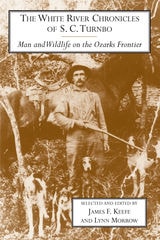
The White River Chronicles of S. C. Turnbo
Man and Wildlife on the Ozarks FrontierJames Keefe
University of Arkansas Press, 1999
This highly readable folklore collection highlights the most representative and evocative tales in the twenty-five hundred pages of backwoods stories collected by Silas Tunbo toward the end of the last century. Turnbo and his informants, antebellum Ozarks natives, believed that the legends of the hunt were, as William Faulkner would write, “the best of all breathing and forever the best of all listening.”
With no apology, the first settlers on the southern frontiers became predators in their own environment. They embraced blood sport and sought its rewards at every turn. The chase promised them a sureness of profit more predictable than land speculation, timbering, or commercial agriculture.
These early opportunists believed that the greatest natural resource along the lush White River drainages in Missouri and Arkansas was large game. Although surrounded by living waters, climax forests, and luxuriant grasses, the tellers of Turnbo’s stories only incidentally made mention of flora. Silas Turnbo and his informants were fascinated by animals and the settlers’ ongoing relationship with them—a relationship often defined by contents for supremacy.
Significantly, Tunbo’s education included only a few years in subscription schools of the 1850s. His writing is direct and in the idiom of hte Ozarks, including spellings that are occasionally whimsical, perfectly befitting these “fireside stories” of the great outdoor drama of the southern frontiers.

The Wildlife of New England
A Viewer's GuideJohn S. Burk
University of New Hampshire Press, 2011
With practical guidance, helpful tips, and informative overviews of each location, The Wildlife of New England invites you to discover more than 80 wildlife-viewing areas around New England.
• Where are you most likely to spot a moose, black bear, or otter in the wild?
• On what hilltop can you see thousands of migrating hawks in a single day?
• Where might you see a basking shark, seal, or sea star?
Experienced nature writer and photographer John S. Burk answers these questions and more in this unique guidebook. Organized by state, each viewing location is discussed in detail, including its natural habitats and their unique features, characteristic species to watch for and when to see them, and recommended trails, auto roads, and driving directions. The Wildlife of New England also offers informative introductions to 60 of the region's iconic animals organized by their natural habitats and shown in stunning photographs, many in color.
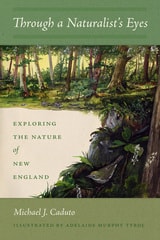
Through a Naturalist's Eyes
Exploring the Nature of New EnglandMichael J. Caduto
University Press of New England, 2016
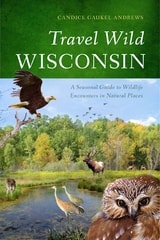
Travel Wild Wisconsin
A Seasonal Guide to Wildlife Encounters in Natural PlacesCandice Gaukel Andrews
University of Wisconsin Press, 2013
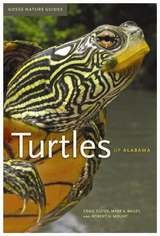
Turtles of Alabama
Craig Guyer, Mark A. Bailey, and Robert H. Mount
University of Alabama Press, 2015
From Riverbeds to Coastlines: The Ultimate Guide to Alabama’s Turtles.
For nearly 200 million years, Earth has been occupied by reptiles—a lineage of terrestrial vertebrates that includes some, like birds, that have invaded the aerial environment, and others, like turtles, that have invaded aquatic environments. With thirty-nine known species, Alabama harbors more turtle species than any other state in the nation, and its Mobile River basin is the center of the world's greatest biodiversity in turtles, surpassing all other river systems around the globe, including the Amazon and the Nile. Turtles of Alabama documents that extraordinary wealth and presents each species in full, describing its physical appearance, habitat and range, behavior, conservation and management, and taxonomy.
In addition to providing sixty-five full-color photographs of juveniles and adults along with forty-two colorfully detailed distribution maps, this volume features an introductory section explaining the physiography, climate, and habitats of the state, and offers illustrated taxonomic keys for all the species considered, including the oceanic behemoths that lay their eggs on Alabama's gulf beaches and the lumbering gopher tortoise that provides safe haven for countless other animals and arthropods in its underground burrows of the Coastal Plain. With fine line drawings to highlight various distinguishing attributes of the animals, this volume is the definitive guide to the state’s fascinating and diverse turtle populations—freshwater, marine, and terrestrial.
Although they are notoriously slow-moving, turtles still survive on Earth because of their remarkable adaptations—an exterior shell for body protection, long lives, high reproductive output, stamina, and a capacity for doing without. Turtles are cold-blooded reptiles that were here long before mammals, and they're still around, continuing to adapt to many different habitats and ecological niches, still interbreeding, evolving, and speciating. Turtles of Alabama is a fitting celebration of that phenomenal variety and strength.