Results by title
53 books match the query 'Women authors, American' and 11 start with t
Templates for Authorship
American Women's Literary Autobiography of the 1930sWindy Counsell Petrie
University of Massachusetts Press, 2021
Windy Counsell Petrie considers twelve autobiographies from a diverse group of writers, ranging from highbrow modernists such as Gertrude Stein and Harriet Monroe to popular fiction writers like Edith Wharton and Edna Ferber, and lesser known figures such as Grace King and Carolyn Wells. Since there were few existing examples of women's literary autobiography, these writers found themselves marketed and interpreted within four cultural templates: the artist, the activist, the professional, and the celebrity. As they wrote their life stories, the women adapted these templates to counter unwanted interpretations and resist the sentimental feminine traditions of previous generations with innovative strategies of deferral, elision, comedy, and collaboration. This accessible study contends that writing autobiography offered each of these writers an opportunity to define and defend her own literary legacy.
The (Other) American Traditions
Nineteenth-Century Women WritersWarren, Joyce W
Rutgers University Press, 1993
The American literary canon has been the subject of debate and change for at least a decade. As women writers and writers of color are being rediscovered and acclaimed, the question of whether they are worthy of inclusion remains open.
The (Other) American Traditions brings together for the first time in one place, essays on individual writers and traditions that begin to ask the harder questions. How do we talk about these writers once we get beyond the historical issues? How is their work related to their male counterparts? How is it similar: how is it different? Are differences related to gender or race or class? How has the selection of books in the literary canon (Melville, Hawthorne, Emerson, and James) led to a definition of the American tradition that was calculated to exclude women? Do we need a new critical vocabulary to discuss these works? Should we stop talking about a tradition and begin to talk about many traditions? How did black American women writers develop strategies for speaking out when they were doubly in jeopardy of being ignored as blacks and as women? The volume offers irrefutable proof that the writers, the critics who work on their texts, all these questions, and the expansion of the canon matter very much indeed.
Contributors: Nina Baym, Deborah Carlin, Joanne Dobson, Josephine Donovan, Judith Fetterley, Frances Smith Foster, Susan K. Harris, Karla F.C. Holloway, Paul Lauter, Diane Lichtenstein, Carla L. Peterson, Carol J. Singley, Jane Tompkins, Joyce W. Warren and Sandra A. Zagarell.
The Color of Democracy in Women's Regional Writing
Jean Carol Griffith
University of Alabama Press, 2009
Exploring how women writers used regional fiction to reimagine democracy, identity, and belonging in America.
American regionalism has become a contested subject in literary studies alongside the ubiquitous triad of race, class, and gender. The Color of Democracy in Women's Regional Writing enters into the heart of an ongoing debate in the field about the significance of regional fiction at the end of the 19th century. Jean Griffith presents the innovative view that regional writing provided Edith Wharton, Ellen Glasgow, and Willa Cather with the means to explore social transformation in a form of fiction already closely associated with women readers and writers.
Griffith provides new readings of texts by these authors; she places them alongside the works of their contemporaries, including William Faulkner and Langston Hughes, to show regionalism's responses to the debate over who was capable of democratic participation and reading regionalism's changing mediations between natives and strangers as reflections of the changing face of democracy.
This insightful work enriches the current debate about whether regionalism critiques hierarchies or participates in nationalist and racist agendas and will be of great interest to those invested in regional writing or the works of these significant authors.
The Selected Letters of Elizabeth Stoddard
Jennifer Putzi
University of Iowa Press, 2012
As scholars of epistolarity have recently argued, letters provide more than just a biographical narrative; they also should be understood as aesthetic performances themselves. The correspondence provides a sense of Stoddard as someone who understood letter writing as a distinct and important literary genre, making this collection particularly well suited for new conceptualizations of the epistolary genre.
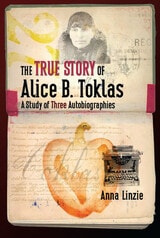
The True Story of Alice B. Toklas
A Study of Three AutobiographiesAnna Linzie
University of Iowa Press, 2006
There Was an Old Woman
Reflections on These Strange, Surprising, Shining YearsAndrea Carlisle
Oregon State University Press, 2023
In these personal essays, Carlisle looks for new ways to bring herself more fully to this time of life, such as daily walks with other women and connecting to the natural world that surrounds her houseboat on an Oregon river at the foot of a forest. She writes about experiences shared with many, if not most, older women: wondering at her body’s transformation, discovering new talents, caregiving, facing loss, tuning in to life patterns and drawing strength through understanding them, letting go (or not) of pieces of the past, and facing other changes large and small. Those curious about, approaching, or living in old age will find wisdom and insight in her unique perspective.
In a voice that rings with clarity, humor, humility, Carlisle shows us that Old Age is not another country where we can expect to find The Old Woman grimly waiting, but is instead an expansion of the borders in the country we’re most familiar with: ourselves.
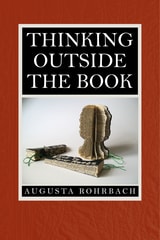
Thinking Outside the Book
Augusta Rohrbach
University of Massachusetts Press, 2014
In Thinking Outside the Book, Augusta Rohrbach works through the increasing convergences between digital humanities and literary studies to explore the meaning and primacy of the book as a literary, material, and cultural artifact. Rohrbach assembles a rather unlikely cohort of nineteenth-century women writers—Jane Johnston Schoolcraft, Sojourner Truth, Hannah Crafts, Augusta Evans, and Mary Chesnut—to consider the publishing culture of their period from the perspective of our current digital age, bringing together scholarly concepts from both print culture and new media studies.
In nineteenth-century America, women from a variety of racial and class affiliations were bombarding the print market with their literary productions, taking advantage of burgeoning rates of literacy and advances in publishing technology. Their work challenged prevailing modes of authorship and continues to do so today. Each chapter of Thinking Outside the Book positions a focal figure as both paradigmatic and problematic within the context of key terms that define the study of the book. In lieu of terms such as literacy, authorship, publication, edition, and editor, Rohrbach develops an alternate typology that includes mediation, memory, history, testimony, and loss. Recognizing that the field spans radio, cinema, television, and the Internet, she draws comparisons to the present day, when Web 2.0 allows writers from varying backgrounds and positions to seek out readers without “gatekeepers” limiting their exposure.
More than a literary history, this book takes up theories of recovery, literacy, authorship, narrative, the book, and new media in connection with race, gender, class, and region.
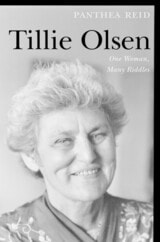
Tillie Olsen
One Woman, Many RiddlesReid, Panthea
Rutgers University Press, 2011
Born in Omaha, Nebraska, Tillie Olsen spent her young adulthood there, in Kansas City, and in Faribault, Minnesota. She relocated to California in 1933 and lived most of her life in San Francisco. From 1962 on, she sojourned frequently in Massachusetts, New Hampshire, Santa Cruz, and Soquel, California. She was a 1920s "hell-cat"; a 1930s revolutionary; an early 1940s crusader for equal pay for equal work and a war-relief patriot; an ex-GI's ideal wife in the later 1940s; a victim of FBI surveillance in the 1950s;a civil rights and antiwar advocate during the 1960s and 1970s; and a life-long orator for universal human rights.
The enigma of Tillie Olsen is intertwined with that of the twentieth century. From the rebellions in Czarist Russia, through the terrors of the Depression and the hopes of the New Deal, to World War II, the Nuremberg Trials, and the United Nations' founding, to the cold war and House Un-American Activities Committee hearings, to later progressive and repressive movements, the story of Olsen's life brings remote events into focus.
In her classic short story "I Stand Here Ironing" and her groundbreaking Tell Me a Riddle, Yonnondido, and Silences, Olsen scripted powerful, moving prose about ordinary people's lives, exposing the pervasive effects of sexism, racism, and classism and elevating motherhood and women's creativity into topics of study. Popularly referred to as "Saint Tillie," Olsen was hailed by many as the mother of modern feminism.
Based on diaries, letters, manuscripts, private documents, resurrected public records, and countless interviews, Reid's artfully crafted biography untangles some of the puzzling knots of the last century's triumphs and failures and speaks truth to legend, correcting fabrications and myths about and also by Tillie Olsen.

Transatlantic Women
Nineteenth-Century American Women Writers and Great BritainBeth L. Lueck
University of New Hampshire Press, 2012
Transcendent Woman
Margaret Fuller’s Art and AchievementDavid M. Robinson
University of Massachusetts Press, 2025
Journalist, editor, critic, translator, and women’s rights advocate, Margaret Fuller was America’s first major female intellectual. Throughout much of the late-19th and 20th centuries, however, critics and scholars largely saw her as a minor figure in the transcendentalist movement with which she is associated, and her work was considered secondary to that of male figures like Emerson and Hawthorne. While her biography—including her marriage to an Italian noble and her dramatic death in a shipwreck—was often the focus, her skill as a writer was generally overlooked, and her intellectual development largely ignored.
In the early 1980s, David M. Robinson was one of the first scholars to publish an article that focused on Fuller’s mind and art. Now Transcendent Woman completes and extends this early work. Outlining the development of her philosophy, which Robinson defines as a “purpose-oriented form of thinking, tailored to the commitment and assets of each individual,” he traces Fuller’s intellectual journey, first in relation to her family and the people around her in New England and later in her travels in the midwestern United States and, more importantly, through Europe and her residency in Italy. He focuses first and foremost on what Fuller was reading (Goethe was key), what she was thinking as revealed in her letters and journals, and what she was writing, including seminal works such as Summer on the Lakes and Woman in the Nineteenth Century as well as lesser-known essays, translations, and short stories. Drawing extensively on primary sources, Robinson charts Fuller’s development and achievement as an original thinker and fearless advocate of democracy.
Traveling Economies
American Women's Travel WritingJennifer Bernhardt Steadman
The Ohio State University Press, 2007