Results by title
52 books match the query 'Women in motion pictures' and 11 start with t

The American Girl Goes to War
Women and National Identity in U.S. Silent FilmLiz Clarke
Rutgers University Press, 2022
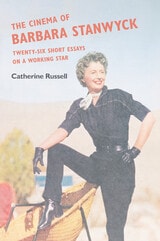
The Cinema of Barbara Stanwyck
Twenty-Six Short Essays on a Working StarCatherine Russell
University of Illinois Press, 2023
Original and rich, The Cinema of Barbara Stanwyck is an essential and entertaining reexamination of an enduring Hollywood star.
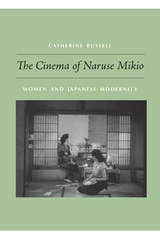
The Cinema of Naruse Mikio
Women and Japanese ModernityCatherine Russell
Duke University Press, 2008
Naruse was a studio-based director, a company man renowned for bringing films in on budget and on time. During his long career, he directed movies in different styles of melodrama while displaying a remarkable continuity of tone. His films were based on a variety of Japanese literary sources and original scripts; almost all of them were set in contemporary Japan. Many were “women’s films.” They had female protagonists, and they depicted women’s passions, disappointments, routines, and living conditions. While neither Naruse or his audiences identified themselves as “feminist,” his films repeatedly foreground, if not challenge, the rigid gender norms of Japanese society. Given the complex historical and critical issues surrounding Naruse’s cinema, a comprehensive study of the director demands an innovative and interdisciplinary approach. Russell draws on the critical reception of Naruse in Japan in addition to the cultural theories of Harry Harootunian, Miriam Hansen, and Walter Benjamin. She shows that Naruse’s movies were key texts of Japanese modernity, both in the ways that they portrayed the changing roles of Japanese women in the public sphere and in their depiction of an urban, industrialized, mass-media-saturated society.
The Dread of Difference
Gender and the Horror FilmEdited by Barry Keith Grant
University of Texas Press, 2015
“The Dread of Difference is a classic. Few film studies texts have been so widely read and so influential. It’s rarely on the shelf at my university library, so continuously does it circulate. Now this new edition expands the already comprehensive coverage of gender in the horror film with new essays on recent developments such as the Hostel series and torture porn. Informative and enlightening, this updated classic is an essential reference for fans and students of horror movies.”—Stephen Prince, editor of The Horror Film and author of Digital Visual Effects in Cinema: The Seduction of Reality
“An impressive array of distinguished scholars . . . gazes deeply into the darkness and then forms a Dionysian chorus reaffirming that sexuality and the monstrous are indeed mated in many horror films.”—Choice
“An extremely useful introduction to recent thinking about gender issues within this genre.”—Film Theory
The Female Complaint
The Unfinished Business of Sentimentality in American CultureLauren Berlant
Duke University Press, 2008
Pairing literary criticism and historical analysis, Berlant explores the territory of this intimate public sphere through close readings of U.S. women’s literary works and their stage and film adaptations. Her interpretation of Uncle Tom’s Cabin and its literary descendants reaches from Harriet Beecher Stowe to Toni Morrison’s Beloved, touching on Shirley Temple, James Baldwin, and The Bridges of Madison County along the way. Berlant illuminates different permutations of the women’s intimate public through her readings of Edna Ferber’s Show Boat; Fannie Hurst’s Imitation of Life; Olive Higgins Prouty’s feminist melodrama Now, Voyager; Dorothy Parker’s poetry, prose, and Academy Award–winning screenplay for A Star Is Born; the Fay Weldon novel and Roseanne Barr film The Life and Loves of a She-Devil; and the queer, avant-garde film Showboat 1988–The Remake. The Female Complaint is a major contribution from a leading Americanist.
The Hypersexuality of Race
Performing Asian/American Women on Screen and SceneCeline Parreñas Shimizu
Duke University Press, 2007
Shimizu combines theoretical and textual analysis and interviews with artists involved in various productions. She complicates understandings of the controversial portrayals of Asian female sexuality in the popular Broadway musical Miss Saigon by drawing on ethnographic research and interviews with some of the actresses in it. She looks at how three Hollywood Asian/American femme fatales—Anna May Wong, Nancy Kwan, and Lucy Liu—negotiate representations of their sexuality; analyzes 1920s and 1930s stag films in which white women perform as sexualized Asian characters; and considers Asian/American women’s performances in films ranging from the stag pornography of the 1940s to the Internet and video porn of the 1990s. She also reflects on two documentaries depicting Southeast Asian prostitutes and sex tourism, The Good Woman of Bangkok and 101 Asian Debutantes. In her examination of films and videos made by Asian/American feminists, Shimizu describes how female characters in their works reject normative definitions of race, gender, and sexuality, thereby expanding our definitions of racialized sexualities in representation.
The New Woman International
Representations in Photography and Film from the 1870s through the 1960sElizabeth Otto and Vanessa Rocco, editors
University of Michigan Press, 2012
"In The New Woman International, editors Elizabeth Otto and Vanessa Rocco have gathered a group of intellectually stimulating and provocative essays that present the emergence, both tentative and triumphant, of this new global icon and her increasingly multicultural image. Written largely by historians of art and film, these essays emphasize visual analysis of the photographic and film media that carried the new woman's influential message."
---Norma Broude, American University
"The New Woman International focuses on the New Woman not simply as an image to be analyzed but also as a producer of images and text. This groundbreaking anthology represents a theoretically sophisticated set of essays that thoroughly examine the phenomenon of the New Woman in previously unexplored ways."
---Sarah E. Chinn, Hunter College, CUNY
Images of flappers, garçonnes, Modern Girls, neue Frauen, and trampky---all embodiments of the dashing New Woman---symbolized an expanded public role for women from the suffragist era through the dawn of 1960s feminism. Chronicling nearly a century of global challenges to gender norms, The New Woman International: Representations in Photography and Film from the 1870s through the 1960s is the first book to examine modern femininity's ongoing relationship with the nineteenth and twentieth centuries' most influential new media: photography and film. This volume examines the ways in which novel ideas about women's roles in society and politics were disseminated through these technological media, and it probes the significance of radical changes in female fashion, appearance, and sexual identity. Additionally, these original essays explore the manner in which New Women artists used photography and film to respond creatively to gendered stereotypes and to reconceive of ways of being a woman in a rapidly modernizing world.
The New Woman International brings together different generations of scholars and curators who are experts in gender, photography, literature, mass media, and film to analyze the New Woman from her inception in the later nineteenth century through her full development in the interwar period, and the expansion of her forms in subsequent decades. Arranged both chronologically and thematically, these essays show how controversial female ideals figured in discourses including those on gender norms, race, technology, sexuality, female agency, science, media representation, modernism, commercial culture, internationalism, colonialism, and transnational modernity. In exploring these topics through images that range from montages to newspapers' halftone prints to film stills, this book investigates the terms of gendered representation as a process in which women were as much agents as allegories. Inaugurating a new chapter in the scholarship of representation and New Womanhood and spanning North America, Western and Eastern Europe, Asia, and the colonial contexts of Africa and the Pacific, this volume reveals the ways in which a feminine ideal circled the globe to be translated into numerous visual languages.
With a foreword from the eminent feminist art historian Linda Nochlin, this collection includes contributions by Jan Bardsley, Matthew Biro, Gianna Carotenuto, Melody Davis, Kristine Harris, Karla Huebner, Kristen Lubben, Maria Makela, Elizabeth Otto, Martha H. Patterson, Vanessa Rocco, Clare I. Rogan, Despina Stratigakos, Brett M. Van Hoesen, Kathleen M. Vernon, and Lisa Jaye Young.
DIGITALCULTUREBOOKS: a collaborative imprint of the University of Michigan Press and the University of Michigan Library
The Unruly Woman
Gender and the Genres of LaughterBy Kathleen Rowe
University of Texas Press, 1995
Unruly women have been making a spectacle of themselves in film and on television from Mae West to Roseanne Arnold. In this groundbreaking work, Kathleen Rowe explores how the unruly woman—often a voluptuous, noisy, joke-making rebel or "woman on top"—uses humor and excess to undermine patriarchal norms and authority.
At the heart of the book are detailed analyses of two highly successful unruly women—the comedian Roseanne Arnold and the Muppet Miss Piggy. Putting these two figures in a deeper cultural perspective, Rowe also examines the evolution of romantic film comedy from the classical Hollywood period to the present, showing how the comedic roles of actresses such as Katharine Hepburn, Barbara Stanwyck, and Marilyn Monroe offered an alternative, empowered image of women that differed sharply from the "suffering heroine" portrayed in classical melodramas.
There She Goes Again
Gender, Power, and Knowledge in Contemporary Film and Television FranchisesAviva Dove-Viebahn
Rutgers University Press, 2024
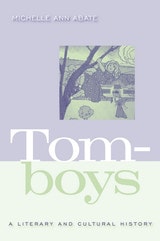
Tomboys
A Literary and Cultural HistoryMichelle Ann Abate
Temple University Press, 2008
Starting with the figure of the bold, boisterous girl in the mid-19th century and ending with the “girl power” movement of the 1990’s, Tomboys is the first full-length critical study of this gender-bending code of female conduct. Michelle Abate uncovers the origins, charts the trajectory, and traces the literary and cultural transformations that the concept of “tomboy” has undergone in the United States.
Abate focuses on literature including Louisa May Alcott's Little Women and Carson McCullers's The Member of the Wedding and films such as Peter Bogdanovich's Paper Moon and Jon Avnet's Fried Green Tomatoes. She also draws onlesser-known texts like E.D.E.N. Southworth's once wildly popular 1859 novel The Hidden Hand, Cold War lesbian pulp fiction, and New Queer Cinema from the 1990s.
Tomboys also explores the gender and sexual dynamics of tomboyism, and offers intriguing discussions of race and ethnicity's role in the construction of the enduring cultural archetype. Abate’s insightful analysis provides useful, thought-provoking connections between different literary works and eras. The result demystifies this cultural phenomenon and challenges readers to consider tomboys in a whole new light.
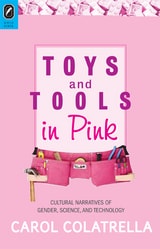
Toys and Tools in Pink
Cultural Narratives of Gender, Science, and TechnologyCarol Colatrella
The Ohio State University Press, 2011