Results by title
1787 books match the query 'Literary Collections' and 471 start with t

Traslados/Translations
Essays on Latin America in Honour of Jason WilsonEdited by Claire Lindsay
University of London Press, 2012

Travel
A Literary HistoryPeter Whitfield
Bodleian Library Publishing, 2011
Taking the form of fact-filled travelogues, stunt-writing spectaculars, or genre-blurring imaginative works, travel writing has never been more popular than it is today. But beyond the self-conscious literary artistry of today’s narratives lies a rich and well-documented history of travel writing, stretching back over several thousand years and incorporating the work of mariners and missionaries, diplomats and dilettantes alike.
Traveling Freely
EssaysRoberto Carlos Garcia
Northwestern University Press, 2025
A poet’s debut essay collection exploring American faults through the eyes of a Dominican American
In Traveling Freely: Essays, Roberto Carlos Garcia explores intersecting topics such as race, identity, American socioeconomic inequality, police violence, our inability to partake in our culture as innocents, and our complicity as Americans in all that’s wrong with the United States from the author’s specific vantage point as a Black Dominican American man. The voice in these essays is both clear and nuanced, and as readers move through the collection, the various themes cohere into a multilayered investigation of institutional racism and the inherent exploitations of capitalism.
In essays that are uniquely straightforward and accessible, Garcia insists that in order to resist state-sanctioned violence against marginalized bodies and populations, we must understand our shared history of oppression—so that we can rise against it effectively and find new paths forward.
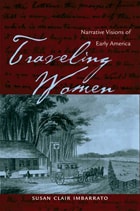
Traveling Women
Narrative Visions of Early AmericaSusan Clair Imbarrato
Ohio University Press, 2006
Susan Clair Imbarrato closely examines women’s accounts of their journeys from 1700 to 1830, including Sarah Kemble Knight’s well-known journal of her trip from Boston to New York in 1704 and many lesser-known accounts, such as Sarah Beavis’s 1779 journal of her travel to Ohio via Kentucky and Susan Edwards Johnson’s account or her 1801–2 journey from Connecticut to North Carolina.
In the women’s keen observations and entertaining wit, readers will find bravado mixed with hesitation, as women set forth on business, to relocate, and for pleasure. These travelers wrote compellingly of crossing rivers and mountains, facing hunger, encountering native Americans, sleeping in taverns, and confronting slavery, expressing themselves in voices that differed in sensibility from male explorers and travelers.
These accounts, as Imbarrato shows, challenge assumptions that such travel was predominately a male enterprise. In addition, Traveling Women provides a more balanced portrait of westward settlement by affirming women’s importance in the settling of early America.
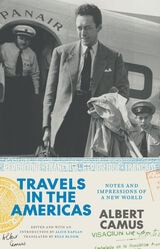
Travels in the Americas
Notes and Impressions of a New WorldAlbert Camus
University of Chicago Press, 2023
In March 1946, the young Albert Camus crossed from Le Havre to New York. Though he was virtually unknown to American audiences at the time, all that was about to change—The Stranger, his first book translated into English, would soon make him a literary star. By 1949, when he set out on a tour of South America, Camus was an international celebrity. Camus’s journals offer an intimate glimpse into his daily life during these eventful years and showcase his thinking at its most personal—a form of observational writing that the French call choses vues (things seen).
Camus’s journals from these travels record his impressions, frustrations, joys, and longings. Here are his unguarded first impressions of his surroundings and his encounters with publishers, critics, and members of the New York intelligentsia. Long unavailable in English, the journals have now been expertly retranslated by Ryan Bloom, with a new introduction by Alice Kaplan. Bloom’s translation captures the informal, sketch-like quality of Camus’s observations—by turns ironic, bitter, cutting, and melancholy—and the quick notes he must have taken after exhausting days of travel and lecturing. Bloom and Kaplan’s notes and annotations allow readers to walk beside the existentialist thinker as he experiences changes in his own life and the world around him, all in his inimitable style.
Tremors
New Fiction by Iranian American WritersAnita Amirrezvani
University of Arkansas Press, 2013
Trial Balance
The Collected Short Stories of William MarchWilliam March
University of Alabama Press, 2011
The Collected Short Stories of William March
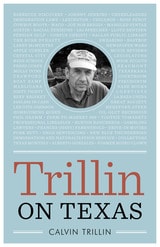
Trillin on Texas
By Calvin Trillin
University of Texas Press, 2011
A remarkably perceptive portrait of the Lone Star State, this collection of pieces from the New Yorker, the Nation, and other publications presents highlights of bestselling author Calvin Trillin’s classic writing on Texas subjects.
"Yes, I do have a Texas connection, but, as we say in the Midwest, where I grew up, not so's you'd know it." So Calvin Trillin introduces this collection of articles and poems about a place that turns up surprisingly often when he's ostensibly writing about something else. Whether reporting on the American scene for the New Yorker, penning comic verse and political commentary for the Nation, or writing his memoirs, Trillin has bumped into Texas again and again. He insists that "this has not been by design . . . there has simply been a lot going on in Texas." Astute readers will note, however, that Trillin's family immigrated to the United States through the port of Galveston, and, after reading this book, many will believe that the Lone Star State has somehow imprinted itself in the family's imagination.
Trillin on Texas gathers some of Trillin's best writing on subjects near to his heart—politics, true crime, food, and rare books, among them—which also have a Texas connection. Indulging his penchant for making "snide and underhanded jokes about respectable public officials," he offers his signature sardonic take on the Bush dynasty and their tendency toward fractured syntax; a faux, but quite believable, LBJ speech; and wry portraits of assorted Texas county judges, small town sheriffs, and Houston immigration lawyers. Trillin takes us on a mouthwatering pilgrimage to the barbecue joint that Texas Monthly proclaimed the best in Texas and describes scouting for books with Larry McMurtry—who rejects all of his "sleepers." He tells the stories of two teenagers who dug up half a million dollars in an ice chest on a South Texas ranch and of rare book dealer Johnny Jenkins, who was found floating in the Colorado River with a bullet wound in the back of his head. And he recounts how redneck movie reviewer "Joe Bob Briggs" fueled a war between Dallas's daily newspapers and pays tribute to two courageous Texas women who spoke truth to power—Molly Ivins and Sissy Farenthold.
Sure to entertain Texans and other folks alike, Trillin on Texas proves once again that Calvin Trillin is one of America's shrewdest observers and wittiest writers.
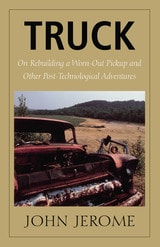
Truck
On Rebuilding a Worn-Out Pickup and Other Post-Technological AdventuresJohn Jerome
University Press of New England, 1996

Truth and Lies in Literature
Essays and ReviewsStephen Vizinczey
University of Chicago Press, 1988
"If a critic's job is to puncture pomposity, deflate over-hyped reputations and ferret out true value, then Vizinczey is master of the art."—Publishers Weekly
"Stephen Vizinczey comes on like a pistol-packing stranger here to root out corruption and remind us of our ideals. He carries the role off with inspired gusto. His boldness and pugnacity are bracing and can be very funny."—Ray Sawhill, Newsweek
"Every piece in the book is good, and many are so good that, after dipping into the middle, I stayed up half of the night, reading with growing amazement and admiration."—Bruce Bebb, Los Angeles Reader
Truth in Nonfiction
EssaysDavid Lazar
University of Iowa Press, 2008
The past and the truth are slippery things, and the art of nonfiction writing requires the writer to shape as well as explore. In personal essays, meditations on the nature of memory, considerations of the genres of memoir, prose poetry, essay, fiction, and film, the contributors to this provocative collection attempt to find answers to the question of what truth in nonfiction means.
Contributors: John D’Agata, Mark Doty, Su Friedrich, Joanna Frueh, Ray González, Vivian Gornick, Barbara Hammer, Kathryn Harrison, Marianne Hirsch, Wayne Koestenbaum, Leonard Kriegel, David Lazar, Alphonso Lingis, Paul Lisicky, Nancy Mairs, Nancy K. Miller, Judith Ortiz Cofer, Phyllis Rose, Oliver Sacks, David Shields, and Leo Spitzer
Tsing
David Albahari
Northwestern University Press, 1997
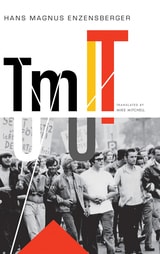
Tumult
Hans Magnus Enzensberger
Seagull Books, 2016
Hans Magnus Enzensberger, widely regarded as Germany’s greatest living poet, was already well known in the 1960s, the tempestuous decade of which Tumult is an autobiographical record. Derived from old papers, notes, jottings, photos, and letters that the poet stumbled upon years later in his attic, the volume is not so much about the man, but rather the many places he visited and people whom he met on his travels through the Soviet Union and Cuba during the 1960s. The book is made up of four long-form pieces written from 1963 to 1970, each episode concluding with a poem and postscript written in 2014. Translated by Mike Mitchell, the book is a lively and deftly written travelogue offering a glimpse into the history of leftist thought. Dedicated to “those who disappeared,” Tumult is a document of that which remains one of humanity’s headiest times.
Turn Out the Lights
Chronicles of Texas during the 80s and 90sBy Gary Cartwright
University of Texas Press, 2000
Whether the subject is Jack Ruby, Willie Nelson, or his own leukemia-stricken son Mark, when it comes to looking at the world through another person's eyes, nobody does it better than Gary Cartwright. For over twenty-five years, readers of Texas Monthly have relied on Cartwright to tell the stories behind the headlines with pull-no-punches honesty and wry humor. His reporting has told us not just what's happened over three decades in Texas, but, more importantly, what we've become as a result.
This book collects seventeen of Cartwright's best Texas Monthly articles from the 1980s and 1990s, along with a new essay, "My Most Unforgettable Year," about the lasting legacy of the Kennedy assassination. He ranges widely in these pieces, from the reasons for his return to Texas after a New Mexican exile to profiles of Kris Kristofferson and Willie Nelson. Along the way, he strolls through San Antonio's historic King William District; attends a Dallas Cowboys old-timers reunion and the Holyfield vs. Foreman fight; visits the front lines of Texas' new range wars; gets inside the heads of murderers, gamblers, and revolutionaries; and debunks Viagra miracles, psychic surgery, and Kennedy conspiracy theories. In Cartwright's words, these pieces all record "the renewal of my Texas-ness, a rediscovery of Texas after returning home."
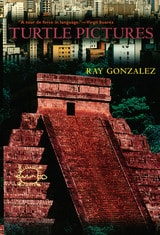
Turtle Pictures
Ray Gonzalez
University of Arizona Press, 2000
Gonzalez has forged a new Chicano manifesto, a cultural memoir that traces both his personal journey and the communal journey that Mexican Americans have traveled throughout this century, across this land. He interweaves lyrical poetry, prose poems, short fiction, and nonfiction commentary into a lush cacophony that traces the evolution of today's politically charged Chicano voices from the deafening silence of their ancestors. Adopting the turtle as a metaphor for the Native American origins of border culture, Gonzalez frames this multitextured individual vision until it becomes a universal portrait of American life: a slow, ancient creature morphing into one of voracious rapidity. In wild and challenging surrealistic images, he hammers out a political statement from language that takes on a special urgency. Walking a fine line between lyricism and polemic, and succeeding where others have stumbled, he calls on Mexican Americans to return to their roots in order to avoid being swept up in American material culture.
Turtle Pictures is a complex body of work by a poet totally in tune with the spirit and nuances of language, imbued with a deep sense of craft and literary tradition. It invites readers to revel in its richness and vitality, to be caught up in its chantlike spirit, to luxuriate in its hauntingly beautiful passages. It is a work to devour, to savor, to return to, for it speaks with all the rhythms of the soul.
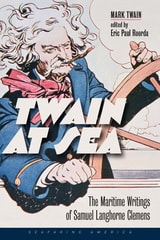
Twain at Sea
The Maritime Writings of Samuel Langhorne ClemensMark Twain
University Press of New England, 2018

Twentieth-Century American Literary Naturalism
An InterpretationDonald Pizer
Southern Illinois University Press, 1982
Scorned by critics since birth, decreed dead by many, naturalism, according to Donald Pizer, is “one of the most persistent and vital strains in American fiction, perhaps the only modern literary form in America that has been both popular and significant.”
To define naturalism and explain its tenacious hold throughout the twentieth century on the American creative imagination, Pizer explores six novels: James T. Farrell’s Studs Lonigan, John Dos Passos’s U.S.A., John Steinbeck’s The Grapes of Wrath, Norman Mailer’s The Naked and the Dead, William Styron’s Lie Down in Darkness, and Saul Bellow’s The Adventures of Augie March.
Pizer’s approach to these novels is empirical; he does not wrench each novel awkwardly until it fits his framework of generalizations and principles; rather, he approaches the novels as fiction and arrives at his definition through his close reading of the works.
Establishing the background of naturalism, Pizer explains that it comes under attack because it is “sordid and sensational in subject matter,” it challenges “man’s faith in his innate moral sense and thus his responsibility for his actions,” and it is so full of “social documentation” that it is often dismissed as little more than a photographic record of a life or an era; thus the “aesthetic validity of the naturalistic novel has often been questioned.”
Pizer posits the 1890s, the 1930s,and the late 1940s as the decades when naturalism flourished in America. He concentrates on literary criticism, not on the philosophy ofnaturalism, to show that literary criticism can make a contribution to a particularly muddled area of literary history—a naturalism that is alive and changing, thus resisting the neat definitions reserved for the dead.
Twenty Square Feet of Skin
Megan Baxter
The Ohio State University Press, 2023
Twenty-one Texas Short Stories
Edited by William Peery
University of Texas Press, 1954
This is a splendid collection of stories about Texas by Texans—stories that appeared in leading magazines in the first half of the twentieth century.
Authors in this volume:
- Dillon Anderson
- Barry Benefield
- Charles Carver
- Margaret Cousins
- Chester T. Crowell
- Eugene Cunningham
- J. Frank Dobie
- Fred Gipson
- William Goyen
- O. Henry
- Sylvan Karchmer
- Harry Kidd, Jr.
- Mary King O’Donnell
- George Pattullo
- George Sessions Perry
- Katherine Anne Porter
- Winifred Sanford
- John W. Thomason, Jr.
- Thomas Thompson
- John Watson
- John W. Wilson
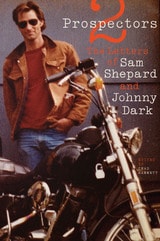
Two Prospectors
The Letters of Sam Shepard and Johnny DarkBy Sam Shepard and Johnny Dark
University of Texas Press, 2013
Sam Shepard was arguably America’s finest working dramatist, as well as an accomplished screenwriter, actor, and director. Winner of a Pulitzer Prize, he wrote more than forty-five plays, including True West, Fool for Love, and Buried Child. Shepard also appeared in more than fifty films, beginning with Terrence Malick’s Days of Heaven, and was nominated for an Academy Award for his performance in The Right Stuff. Despite the publicity his work and life attracted, however, Shepard remained a strongly private man who said many times that he would never write a memoir. But he did write intensively about his inner life and creative work to his former father-in-law and housemate, Johnny Dark, who was Shepard’s closest friend, surrogate brother (they were nearly the same age), and even artistic muse.
Two Prospectors gathers nearly forty years of correspondence and transcribed conversations between Shepard and Dark. In these gripping, sometimes gut-wrenching letters, the men open themselves to each other with amazing honesty. Shepard’s letters give us the deepest look we will ever get into his personal philosophy and creative process, while in Dark’s letters we discover insights into Shepard’s character that only an intimate friend could provide. The writers also reflect on the books and authors that stimulate their thinking, their relationships with women (including Shepard’s anguished decision to leave his wife and son—Dark’s stepdaughter and grandson—for actress Jessica Lange), personal struggles, and accumulating years. Illustrated with Dark’s candid, revealing photographs of Shepard and their mutual family across many years, as well as facsimiles of numerous letters, Two Prospectors is a compelling portrait of a complex friendship that anchored both lives for decades, a friendship also poignantly captured in Treva Wurmfeld’s film, Shepard & Dark.
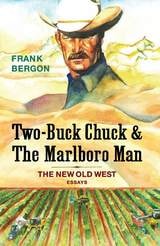
Two-Buck Chuck & The Marlboro Man
The New Old WestFrank Bergon
University of Nevada Press, 2019
Bergon presents a powerful array of rural and small-town Westerners who often see themselves as part of a region and a way of life most Americans aren’t aware of or don’t understand, their voices unheard, their stories untold. In these essays, Westerners from the diverse heritage of the San Joaquin Valley include California’s legendary Fred Franzia, the maker of the world’s best-selling Charles Shaw wines dubbed “Two-Buck Chuck,” and Darrell Winfield, a Dust Bowl migrant and lifelong working cowboy who for more than thirty years reigned as the iconic Marlboro Man. Their voices help us understand the complexities of today’s rural West, where Old West values intersect with New West realities. This is the West (and America today)—a region in conflict with itself.